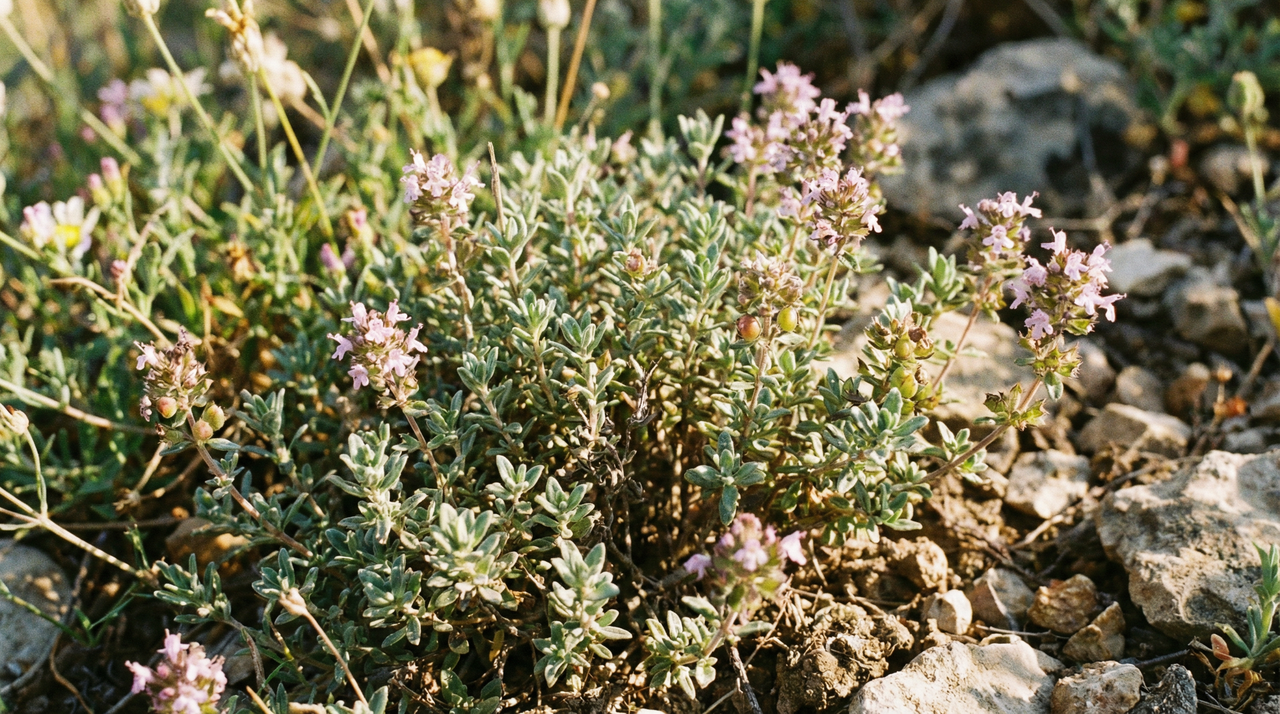
Nobody warned me that thyme would outlive everything else in my first herb bed. The basil collapsed in October, the cilantro bolted in June, the parsley got crown rot, and there was thyme, just sitting there in the corner of a neglected raised bed, flowering away, completely unbothered. I didn't water it that summer. I barely weeded around it. And yet when I finally crouched down and rubbed a stem between my fingers, the oil was so concentrated it stayed on my hands for hours. That's the thing about plants that evolved on rocky Mediterranean hillsides with almost no soil and months of summer drought: they don't need your help. They need your restraint.
What most gardeners get wrong about thyme is treating it like a soft annual that needs coddling. It's actually a woody perennial subshrub, and a fairly ancient one at that, with a chemistry so potent that ancient Egyptians used it in embalming preparations.[1] The same compound responsible for that scent on your fingertips, thymol, is still listed in pharmacopeias today. There's a strange continuity in that. A plant that smells like Sunday dinner was also doing serious preservation work in ancient burial rites. Once you know that, it's hard to look at a grocery store sprig the same way.
Thyme Origin, History, and Botanical Background
Mediterranean Roots and Botanical Characteristics of Thymus vulgaris
Thyme didn't get its reputation as a tough, unfussy herb by accident. Thymus vulgaris evolved on the rocky, sun-blasted calcareous hillsides of the Mediterranean Basin, from southern Europe and North Africa into parts of the Middle East, where it threads through scrublands and dry grasslands anywhere from sea level up to about 1,500 meters elevation.[2][3] Hot, dry summers and mild wet winters shaped everything about this plant: its compact form, its waxy, glandular leaves, its almost theatrical fragrance when you brush against it. That's not culinary charm; that's survival chemistry.
The broader genus echoes this pattern consistently. Thymus zygis and Thymus mastichina are native to the Iberian Peninsula, Thymus praecox spreads across the western and central Mediterranean, Thymus pulegioides ranges as far north as southern Scandinavia, and Thymus serpyllum has naturalized in parts of North America after arriving through cultivation.[4][5] Different latitudes, similar ecological logic: lean soils, excellent drainage, intense light. As a polycarpic perennial, T. vulgaris typically spends its first year building roots and foliage, begins flowering in years one to two, hits full maturity around year three, and can persist for five to fifteen years under good conditions, sometimes longer in cultivation.[6][7]
Visual Characteristics and Identification Features
Once you know thyme, you'll spot it anywhere. The common form stays low, typically 15 to 30 centimeters tall and spreading 20 to 45 centimeters wide, forming dense, semi-woody mats.[8][9] The stems are square in cross-section, a telltale Lamiaceae trait shared with basil, mint, and rosemary; woody at the base, more pliable toward the growing tips. Opposite leaves run only 5 to 15 millimeters long and are covered in fine hairs and glandular trichomes, which is exactly where the aromatic oils concentrate. Crush a stem between your fingers and you'll understand immediately why ancient peoples reached for this plant before chemical antiseptics existed.
Flowers arrive in late spring through summer as small, tubular, bilabiate blooms in pale pink to lavender-purple, clustered densely along the stems.[10] The supporting species show how far the genus stretches within that basic template: creeping forms like T. praecox and T. serpyllum hug the ground at five to fifteen centimeters, while T. mastichina grows into a bushier upright shrub reaching 30 to 60 centimeters.[11] In my experience, plants grown in full, unrelenting sun develop noticeably more compact habits and sharper fragrance than those tucked into even slight shade, a visible expression of the essential-oil chemistry that makes this genus so useful.
Traditional and Cultural Uses Through the Ages
The history of thyme as a human herb reaches back to ancient Egypt around 3000 BCE, where it was used in kyphi, a sacred incense compound.[12][13] The Greeks associated it with courage and Aphrodite, burned it as temple incense, and drew on it medicinally; Hippocrates recommended it for respiratory conditions.[12] Roman soldiers bathed in thyme-infused water before battle to summon bravery, and writers like Pliny the Elder and Dioscorides documented its uses for coughs and purification.[14] When I harvest my own thyme for a kitchen tea or a sore-throat remedy, that thread feels genuinely old.
European folklore layered on its own meanings: thyme warded off nightmares, attracted fairies, and symbolized resilience across cultures that probably never compared notes.[15] Medieval monasteries kept it in physic gardens for respiratory, digestive, and wound-care applications, a tradition continuous with what Dioscorides had written centuries earlier. Supporting species carried parallel roles in their own regions: T. zygis remained prominent in Iberian and Moroccan folk medicine, T. mastichina in Spanish and Portuguese herbal traditions, each used for similar complaints even when the species differed.[16] Roman trade routes eventually carried thyme north into Britain, where it became integral to European cooking, bouquet garni, herbes de Provence, and the flavoring of meats and stews.[17]
Fun Facts and Ecological Insights About Thyme
A few things about thyme tend to surprise people who've only thought of it as a pantry staple. The same glandular trichomes that make the foliage so aromatic also deter deer and rabbits effectively, meaning thyme pulls garden duty as a low-maintenance edible and a natural herbivore barrier at the same time.[18] Some relatives, including T. zygis, show allelopathic effects on neighboring plants and even capacity to resprout after fire, adaptations that make sense when you picture those dry Iberian hillsides where summer fires aren't unusual.[19] I've used creeping thymes like T. praecox between pavers and across rocky slopes where they form dense, pollinator-friendly mats that suppress weeds without ever threatening to escape the garden.[20] None of the commonly cultivated thymes are considered invasive in the United States, which, given how vigorously some groundcovers behave, feels like a genuine gift.
Thyme Varieties and Where to Buy Them
Most Thymus vulgaris cultivars are hardy in USDA zones 5–9, though the zone number is almost the least useful piece of information here.[21][6] What actually determines whether a plant thrives or rots out by February is drainage. I've watched perfectly zone-appropriate thymes die in a wet clay pocket while a neglected cutting in sandy grit sailed through the same winter without complaint.
Popular Cultivars of Common Thyme (Thymus vulgaris)
For the kitchen, the three workhorses are English thyme (broad leaves, classic savory depth), French thyme (finer-leaved, trailing, higher thymol), and Lemon Thyme, sold as 'Citriodorus', whose citrus note is almost shockingly bright in leaves harvested just before flowering.[20][6][22] I reach for it whenever I'm baking or making tea; the difference from plain English thyme is not subtle. If thymol content matters to you for pest deterrence in a guild planting, named cultivars are your best bet because the oils are far more consistent than wild seed.[23]
On the ornamental side, 'Silver Queen' and 'Argenteus' give you that silver-variegated edge plant for borders, while 'Aureus' and 'Thyme Gold' bring golden foliage that lights up a dry slope in winter.[24][20] For super-low ground cover between pavers, 'Kew Fairy' tops out under three inches and 'Elfin' forms a dense mat that handles foot traffic surprisingly well.[24][25]
Creeping and Ornamental Relatives
The T. serpyllum and T. praecox complex is what most people mean when they say "creeping thyme" or "mother of thyme," and you'll often see the same plant sold under both names at the same nursery.[26][27] These stay 2–4 inches tall and are genuinely excellent as a ground cover between stepping stones or as a lawn alternative in dry spots. 'Coccineus' has scarlet flowers that stop people in their tracks, 'Magic Carpet' runs a vivid magenta-pink, and 'Snowdrift' is pure white for a calmer palette. The 'Aureus' selection from this group is cold-hardy to –30°F, which is impressive for a plant that looks this delicate.[28] I grow 'Pink Chintz' alongside my upright English thyme and the creeping form flowers far more prolifically in hot weather, provided it has the sharp drainage it's asking for.
Beyond the common species, T. pulegioides offers a citrus-scented 'Lemon' form and a golden 'Aureus' (one quirk: it greens up in shade) at 6–12 inches tall with lilac flowers pollinators love.[29][30] T. zygis brings a stronger, more pungent punch with higher thymol and carvacrol than common thyme, and T. mastichina delivers a mastic-resinous character from its 1,8-cineole profile that reads almost like a savory marjoram.[31][32] Both are worth seeking out if you want serious aromatic intensity in a xeriscape or guild planting.
Sourcing and Buying Quality Thyme Plants and Seeds
Common thyme is everywhere. Seeds run $3–5 for a packet, starter plugs are $4–8, and 4-inch potted plants sit at $6–12 at most big-box garden centers; organic stock carries a 20–50% premium but is just as easy to find through Burpee, Johnny's, and Monrovia.[33][34] Creeping thyme is nearly as accessible; Seed Savers Exchange and Fedco are good sources if you want biodiversity-focused stock at slightly lower prices.[35] For T. zygis and T. mastichina, you'll need to go online: Richters, Strictly Medicinal Seeds, Mountain Valley Growers, and Horizon Herbs all carry specialty thymes, and they ship phytosanitary-certified plants, which matters when you're importing unusual Mediterranean species.[36]
Early in my gardening life I bought unlabeled nursery thyme that turned out to be a low-thymol ornamental clone. It looked fine and smelled vaguely herbal, but it had no real kick in the kitchen and didn't deter anything in the garden. That experience taught me to always buy named cultivars from reputable herb specialists, or start from cuttings taken from a known plant, since seed propagation reliably produces variable offspring anyway.[37] When you're shopping in person, inspect closely for aphids, spider mites, and any powdery mildew on the foliage before you take a plant home.[38] I skip wild-collected stock entirely; the ecological cost isn't worth it when cultivated plants are this available. The good news is that none of the Thymus species covered here are listed as federal noxious weeds or invasive in the U.S., so you can plant freely and confidently.[39]
Thyme Propagation and Planting (Thymus vulgaris)
Every time I teach a propagation workshop, someone asks whether they should start thyme from seed or cuttings. My honest answer: cuttings, almost always. Stem cuttings are the commercial and home-garden standard for good reason, with success rates running 80 to 95 percent and, crucially, genetic consistency that preserves the exact aroma and essential-oil profile of the parent plant.[40][41][42] Once you've tasted the difference between a plant with confirmed thymol-dominant chemistry and a randomly seeded offspring, you'll understand why commercial growers don't gamble on seed for named cultivars.
Propagation Methods for Thyme
For stem cuttings, take 3 to 4-inch lengths from healthy, non-flowering growth in spring or early summer, softwood from late spring or semi-hardwood from midsummer both work well. Strip the lower leaves, stick them into a gritty sterile medium (a sand-and-perlite blend is my go-to), and keep the environment at 65 to 75°F with moderate humidity. Rooting happens in 2 to 8 weeks.[43][44] Bottom heat and a dilute IBA rooting hormone (1,000 to 3,000 ppm) can push success rates up another 20 to 30 percent, though I skip both for small batches and still get excellent results.
Seed is a legitimate option if you want variety, experimentation, or a large ground-cover planting where genetic variation doesn't matter much. Surface-sow the seeds because they need light to germinate, give them a cold stratification period of a few weeks at around 40°F if you have time, and expect germination in 14 to 28 days at 59 to 68°F.[41][45] The catch is that thyme is largely outcrossing, so seedlings are genetically variable and not true-to-type.[42] I learned to label every single row after mistaking young thyme seedlings for carrot tops for an embarrassing two weeks. The first true leaves look almost identical.
For the mat-forming species like Thymus serpyllum, T. praecox, T. pulegioides, and T. mastichina, layering and division are almost foolproof. Their trailing stems root naturally at the nodes, so tip layering in late spring is almost effortless, and success rates run 70 to 100 percent.[41][46] If you have an established clump, divide it in spring or autumn and you'll have rooted divisions ready to plant within the hour. Tissue culture exists for commercial mass production but has no practical role in the home garden.[47]
Whatever method you choose, drainage in the propagation medium is non-negotiable. I lost an entire flat to damping-off in my first year of starting thyme from seed because I used a standard seed-starting mix that held too much moisture. Since then, I always use a sterile, grit-based medium, keep airflow moving, and watch humidity carefully. Pythium and other fungal pathogens will find wet, poorly aerated conditions before you do.[48][44]
Soil, Site Selection, and Planting Technique
Thyme's native habitat tells you everything you need to know about where to plant it. These are plants of rocky Mediterranean hillsides, limestone-derived soils with excellent drainage and relatively low fertility.[49][21] A sandy or loamy soil with a pH anywhere from 6.0 to 8.0 suits the genus well, with the sweet spot around 6.5 to 7.5. If your soil stays wet for more than a day after rain, thyme will sulk or die. I've amended heavy clay beds with generous grit and never looked back.
Drainage matters more than pH, more than fertility, more than almost any other variable. Heavy, waterlogged soil deprives roots of oxygen and opens the door to Pythium and Fusarium rot in short order.[43] Thyme is also happier in lean conditions; rich soil or excess nitrogen encourages floppy, leggy growth and dilutes the essential oils that make it worth growing in the first place.[8] I've learned not to add compost to thyme beds and the plants are better for it.
Full sun means full sun: 6 to 8 hours minimum for compact growth and peak oil production.[43] Light shade is possible in intense summer heat, but the plants stretch and lose fragrance. Root systems are shallow and fibrous, so even 4 to 6 inches of well-drained soil is enough depth to establish a healthy plant.[50] Raised beds and sloped sites work beautifully; flat clay ground does not.
Spacing and Establishment Timeline
For garden thyme, space plants 6 to 12 inches apart and rows 12 to 18 inches apart; commercial plantings open to 18 to 24 inches between rows for equipment access.[51][52] In containers, one plant per six-inch pot is plenty, or space plants 8 to 10 inches apart in larger planters. If you're planting creeping thyme (T. serpyllum or T. praecox) for a fragrant ground cover between pavers, tighten that spacing to 6 to 8 inches. In my garden, plants spaced at 6 to 8 inches close into a solid, walkable mat within about 18 months. Even then, don't crowd them so tightly that air circulation suffers, especially in humid climates where fungal pressure is real.
Germination and First-Harvest Timeline
Seeds surface-sown and kept at 60 to 75°F typically germinate in 14 to 21 days, sometimes stretching to 30.[53] Seedlings need 8 to 12 weeks before transplanting, and while a light harvest is possible 60 to 90 days after that, a meaningful harvest is realistically a second-season reward as roots establish.[54][55] That 3 to 6-month-plus wait from sowing to first modest picking is the main reason I almost always choose cuttings for named cultivars; cuttings root in 4 to 6 weeks and can yield a useful harvest within the same growing season.[56]
The creeping species track similarly. T. serpyllum and T. praecox germinate in 14 to 21 days from seed with a light harvest possible around 10 to 12 weeks after transplant, while cuttings of T. mastichina and T. pulegioides root in 3 to 6 weeks and hit first harvest within 6 to 12 months.[57][43] Label your seedling rows meticulously; young thyme plants look almost identical to each other and to a few other small-leaved herb seedlings for the first couple of weeks, and losing track of which species is which creates real headaches once it's time to plant out.
Thyme Care Guide: Growing Thymus vulgaris Successfully
Everything useful to know about caring for thyme flows from one fact: this plant evolved on rocky Mediterranean hillsides, in lean soil, under relentless sun, with almost no summer rain. Its compact habit, tiny trichome-covered leaves, and deep root system aren't accidents; they're precisely the traits that let it shrug off drought and still smell incredible.[21][58] Once you internalize that origin story, every specific care recommendation starts to make intuitive sense rather than feeling like a checklist you have to memorize.
Watering Needs and Drought Tolerance
The core rule is simple: let the top inch of soil dry before watering again. In the first year, that usually works out to every seven to ten days; once a plant is established, you can stretch that further.[59][25] Creeping species like Thymus praecox take this even further once settled in, sometimes going two to three months without supplemental water in average conditions.[60] The diagnostic is straightforward: yellowing lower leaves and mushy roots mean you're watering too much; crispy edges and bone-dry soil mean not enough.[61]
I grow several thyme cultivars here in Central Florida, and the humidity is the sneaky variable nobody warns you about. The soil can feel dry on the surface and still be holding more moisture than thyme wants. In my first season I lost a plant to root rot I didn't see coming. Now I stick my finger in an extra inch and wait one more day than I think I need to. Drip irrigation, excellent drainage, and keeping water off the foliage altogether have made all the difference.[62] In containers, check more frequently; soil in pots dries faster, sometimes every few days in a hot spell.[8]
Fertility and Feeding Requirements
Thyme is about as close to a no-feed herb as you'll find. Excess fertility produces floppy, lush stems with noticeably less flavor, because the essential oils that make thyme worth growing concentrate under mild stress, not abundance.[51][63] If you feel you need to do something, a light application of balanced slow-release fertilizer at half strength in early spring is plenty, or just work some aged compost into the planting hole and leave it at that.[64] Soil pH between 6.0 and 8.0 suits it fine, with neutral to slightly alkaline conditions being ideal; watch for interveinal chlorosis in young leaves if your soil runs very alkaline, as iron becomes less available up there.[65]
I learned this the hard way. One spring I worked in a generous amount of rich compost, expecting to reward my thyme. What I got was rangy, soft growth that flopped over itself and smelled like a shadow of what it should. The lean approach isn't just theory; it genuinely produces a better, more aromatic plant.
Sunlight and Heat Tolerance
Thyme wants a minimum of six hours of direct sun and performs best with more.[50] What it struggles with is the combination of intense heat and poor drainage or high humidity, which is a meaningful distinction in climates like mine. When heat, drought stress, and trapped moisture all arrive together, you'll see leaf scorch, bleaching, and wilting that can look like underwatering even when the roots are saturated.[66] I compare it to basil in this regard; both start showing stress at roughly the same heat-and-humidity threshold, and for both, afternoon shade and airflow matter as much as sun totals. A 30 to 50 percent shade cloth during extreme peak heat above 35°C can prevent the worst scorch while keeping the plant productive.[67]
Frost Tolerance and Winter Protection
Common thyme is hardy in USDA zones 5 through 9, tolerating minimum temperatures down to around -20°F, though leaves and flowers are more vulnerable than the root system.[3][68] The real danger in cold climates isn't a hard freeze so much as freeze-thaw cycles in poorly drained soil; water that freezes and expands around roots does far more damage than steady cold ever would. Apply two to four inches of mulch after the ground freezes, use row covers during extreme dips, and skip fall pruning entirely.[25] If you're gardening in zone 4, reach for Thymus serpyllum, T. praecox, or T. pulegioides, all of which extend reliably to -30°F. For warmer climates in zones 7 to 10, T. zygis and T. mastichina are better suited and won't need nearly as much coddling.[43][69] Even in Central Florida where freezes are rare, I still mulch my container thymes lightly and move the pots under cover during cold snaps; a well-drained established plant recovers from brief temperature dips with no fuss at all.
Pruning, Maintenance, and Seasonal Rhythm
In temperate climates thyme follows a reliable arc: vegetative growth picks up in early spring, flowering runs from May through August, and the plant rests semi-dormant through winter.[5] That post-flowering window is your pruning moment. Cut back up to one-third of the current season's growth to encourage bushy regrowth and head off the woodiness that sets in when plants are left to their own devices.[52] The one thing to avoid is cutting into old wood; it rarely regenerates well. Plan to divide or replace plants every three to five years before the center turns too woody to be worth keeping.[8]
The plants I've pruned faithfully after flowering are still compact, fragrant, and productive in their sixth and seventh year. The ones I neglected in earlier beds became sparse, woody mounds by year four. That consistent light cut is genuinely the difference between a thyme planting that earns its space for a decade and one that quietly declines into kindling. Florida's long growing season lets me harvest well into fall, so I time my post-bloom prune to keep new leafy growth coming right through the cooler months when the plant is at its most comfortable.
When and How to Harvest Thyme
Timing a thyme harvest isn't really about the calendar. It's about the plant's chemistry, and the plant will tell you when it's ready if you know what to look for.
Timing and Cues for Peak Flavor and Oil Content
The research is clear: harvest just before or at the very beginning of flowering to catch peak essential-oil concentration, when thymol and carvacrol levels in the dried herb run between 1 and 2.5 percent by weight.[70][71] For common thyme in temperate climates that window falls roughly May through July,[72] but I trust the plant's aroma over any date on my phone. A patch that hits you with an overwhelming wave of fragrance on a June morning is ready, full stop. If it smells faintly pleasant rather than aggressively thyme-like, wait a few more days. Watch for dense, compact foliage clusters, vivid green leaves, and that intense scent; those three signals together are more reliable than a bloom count.[73]
Always harvest in the morning after the dew has dried but before the midday heat drives off the volatile oils.[72][74] I think of it the same way I think about harvesting basil: morning, pre-bloom, dry foliage. The mental model transfers well. For new growers, light leaf picking can start eight to twelve weeks after planting once plants reach six to eight inches tall, but real productive cuts are a second-year reward after the roots have fully settled in.[52] If you grow creeping relatives like T. serpyllum or T. zygis, the same early-flowering rule applies; their exact phenological windows shift a bit,[75] but I treat them as "same principles, slightly different calendar" and let the scent guide me just as it does with the common culinary types.
Harvesting Techniques That Encourage Regrowth
Use sharp, clean scissors or shears and cut stems four to six inches above the woody base, just above a leaf node.[72][52] I never take more than one-third of the plant in a single pass. I've seen what happens when you push that boundary: the plant bounces back slowly, and the regrowth the following season is noticeably less aromatic. It's not worth the shortcut.[54] A clean cut above a node is what cues the plant to push new lateral shoots, and that bushy regrowth is exactly what lets you harvest every two to three weeks through the active growing season on an established plant.[76] Avoid harvesting during prolonged dry heat, after full bloom has passed, or on wet days when fungal pressure is higher.[54] These same cuts double as maintenance pruning, keeping the plant compact and preventing the woody dieback at the center that shortens its productive life.
Expected Yields, Flavor, and Storage
A mature T. vulgaris plant yields roughly half a pound to a full pound of fresh leaves per year, with dense plantings pushing one to two pounds per square foot.[72] My own established plants give me enough to dry a jar or two for the kitchen year while leaving plenty of flower heads for the bees. Midsummer is also when you can harvest the flowers, which are fully usable fresh or dried, lovely scattered over a salad.[77] For drying thyme herbs, hang small bundles or spread stems on a screen in a dark, well-ventilated spot at 68 to 86 °F; once dried, strip the leaves into airtight glass jars kept away from light and heat, and they'll hold their character for up to two years.[78] A properly timed, properly dried batch of thyme is a genuinely different ingredient from the dusty stuff at the back of a grocery shelf, and that difference starts with the morning you pick it.
Thyme Preparation and Uses
Edible Parts and Culinary Applications
The usable parts of Thymus vulgaris are the leaves and flowers; woody stems are too fibrous to eat but I always toss a few whole sprigs into a stock pot and fish them out before serving.[79][80] The same applies to the relatives I grow alongside common thyme: T. serpyllum, T. praecox, T. zygis, T. mastichina, and T. pulegioides all offer aromatic leaves and blossoms that are safe to eat and genuinely useful in the kitchen.[79][81]
In Mediterranean cooking, thyme is the backbone of bouquet garni and herbes de Provence, and it pairs especially well with tomatoes, garlic, eggs, olive oil, and anything fatty that benefits from a slight antiseptic edge.[82] Species breadth matters here more than most herb profiles acknowledge: T. zygis shows up in Spanish paella and hearty stews, T. mastichina turns up in Portuguese cozido, and T. pulegioides appears in Georgian khmeli-suneli.[83][84] I've found that lemon thyme, whether a T. pulegioides cultivar or a citriodorus type, brightens a roast chicken in a way that plain common thyme never quite does; cooking with fresh lemon thyme is worth the extra effort of tracking it down.
One practical warning from years of growing thyme alongside other low creepers: learn your look-alikes. Pennyroyal (Mentha pulegium and Hedeoma pulegioides) contains hepatotoxic pulegone and can resemble creeping thymes at a glance.[85][86] True thyme has a warm, distinctly herbal scent when you crush a leaf; pennyroyal hits sharper and mintier, and Ajuga reptans has essentially no culinary aroma at all. Leaf margins, flower color, and that crush test together make identification straightforward once you've done it a few times.
Flavor, Aroma, and Preparation Methods
Fresh thyme delivers bright, earthy, minty, and subtly lemony notes; drying concentrates those flavors into something more robust, woody, and pungent as thymol levels increase relative to the fresh herb's more volatile top notes.[87][88] Thymol, which can make up around half of the essential oil in T. vulgaris, is the compound responsible for that spicy, slightly antiseptic edge, alongside carvacrol, p-cymene, and γ-terpinene.[89] Different species shift the balance: T. mastichina is dominated by 1,8-cineole, which gives it a eucalyptol-camphor mintiness quite different from common thyme, while carvacrol-forward T. praecox reads peppery and punchy.[90][91]
For drying, I hang bunches upside-down in a shaded, ventilated spot at around 20-30 °C (68-86 °F) for one to two weeks.[92] If you're in a hurry, an oven at 35-40 °C works, but push past 50 °C and you can lose 20-40% of the volatile oils that make the herb worth drying in the first place.[93][94] Plants harvested just as the first flowers open in early summer consistently give me the most fragrant dried thyme for winter cooking; that's not intuition, it's the oil-peak timing the research describes. Store dried herb in airtight glass jars somewhere cool and dark; it holds well for one to three years. Fresh stems keep for one to three weeks in the refrigerator, wrapped loosely with a damp paper towel in a perforated bag.[95]
Medicinal Preparations and Dosages
The medicinal parts are the leaves and flowering tops. A standard thyme tea uses 1-2 teaspoons of dried herb per cup of just-boiled water, steeped for five to ten minutes, up to three cups a day, per EMA and WHO monographs.[96][97] That's an easy threshold to hit on days when you're already cooking with fresh thyme; the line between culinary and therapeutic is genuinely thin here. A tincture runs 1:5 to 1:10 in 40-60% alcohol, with 1-2 ml diluted in water two to three times daily.[98]
Essential oil is where I urge real care. I keep a 1% dilution in jojoba on hand for topical use and never apply it neat; internally, the ESCOP guidance allows 1-2 drops in honey or tea up to three times daily, but that's a ceiling, not a target.[96] Thymol's potency is real, and the research is clear that concentrated forms deserve respect. In my guilds I rotate harvest patches so no single plant gets stripped, taking no more than a fifth of any clump at a time to keep both flavor quality and pollinator habitat intact season after season.[99]
Safety, Storage, and Non-Food Uses
At normal culinary amounts, up to roughly 4-6 grams a day, thyme is considered safe for most adults.[96] Essential oils of wild thyme relatives like T. serpyllum are better reserved for inhalation or external applications rather than internal use without professional guidance. Beyond the kitchen and medicine cabinet, thyme finds occasional use in potpourri, aromatic sachets, and natural moth deterrents; the same bundles I dry for cooking end up tucked between folded linens once they've fully cured.[16] It's a satisfying loop: one plant, one harvest, the pantry and the linen closet both sorted.
Thyme Health Benefits
When I first started growing thyme, I thought of it purely as a kitchen herb. Something to throw in a braise, scatter over roasted potatoes, forget about. It took a deeper look at the research, and a few seasons of watching it do things in the garden I didn't expect, to understand that this small woody plant has a genuinely impressive medicinal track record behind it.
Thymol and Carvacrol: The Compounds Behind Thyme's Medicinal Reputation
The active chemistry that gives thyme most of its therapeutic muscle comes from two phenolic monoterpenes: thymol and carvacrol. Thymol has well-documented antimicrobial properties, showing activity against a range of bacteria and fungi in laboratory settings,[100] and it's the primary active ingredient in several commercial antiseptic products for good reason. Carvacrol, its close structural cousin, has demonstrated antifungal and anti-inflammatory activity in multiple studies.[101] These aren't fringe herbalism claims; they're supported by peer-reviewed research, which is why thyme appears in authoritative herbal monographs like those published by the European Medicines Agency.[102]
Thyme Herbal Tea and Respiratory Benefits
One of the most practical and accessible medicinal uses of thyme is as a tea. A simple thyme herb tea, made by steeping fresh or dried leaves in hot water for 10 minutes, has a long traditional role as a remedy for coughs, bronchitis, and upper respiratory congestion. That use isn't just folklore: thyme's expectorant and antispasmodic actions are recognized in several European pharmacopeial monographs, and clinical studies have found thyme-ivy combination preparations significantly reduced acute bronchitis symptoms compared to placebo.[103][104] I've made thyme herb tea for myself during every winter cold for years, and while I can't run my own clinical trial, I can say it consistently eases that tight, irritated feeling in my chest faster than most things in my cabinet.
Beyond respiratory support, thyme has traditionally been used to support digestion, ease bloating, and as a carminative for gut cramping, which aligns with its antispasmodic properties and its historical role across Mediterranean folk medicine as an after-meal remedy.[102] At culinary amounts, it's considered quite safe for most adults; the caution, as with any herb, comes with concentrated preparations like essential oils, which should never be taken internally without professional guidance.
Emerging research suggests thyme's antioxidant compounds may offer broader protective effects, including anti-inflammatory activity at the cellular level.[101] The benefits of this herb aren't a single-compound story; they reflect the kind of complex phytochemical synergy that whole plants tend to produce, and that isolated supplements rarely replicate. Growing your own thyme and using it fresh or as a simple tea keeps you connected to that whole-plant complexity in the most direct way possible.
Thyme Pests and Diseases
Thyme earns its reputation as a low-maintenance herb partly because it's genuinely tough. That signature scent isn't just for the kitchen; the thymol and carvacrol saturating every leaf are potent antimicrobials that suppress fungal and bacterial pathogens right at the surface of the plant.[105][106] Across the genus, that resistance profile holds: T. serpyllum, T. praecox, T. zygis, T. pulegioides, and T. mastichina all share this aromatic chemical defense, rooted in drought tolerance and dense glandular trichomes.[107][108] Compare it to basil, which collapses at the first sign of humidity; thyme in those same conditions usually just sits there looking unimpressed.
Natural Disease Resistance from Essential Oils
Thymus vulgaris shows high natural resistance to powdery mildew and leaf spot, with its essential oils actively inhibiting pathogens like Botrytis cinerea and Alternaria alternata.[105][109] It even manages moderate resistance to downy mildew and bacterial infections like Pseudomonas syringae. That's a solid defensive profile for a small perennial herb, and it's why healthy, vigorously growing thyme under full sun almost never needs intervention from me.
Common Diseases and Environmental Triggers
The one problem that does take thyme down, reliably, is root rot. I've lost more plants to enthusiastic watering during Central Florida's rainy season than to any insect or fungal pathogen combined. Poor drainage is the trigger; once those roots sit in wet soil for too long, it's over.[110][109][111] I now grow mine in raised beds with gritty, lean soil, and the difference is dramatic. Every species in the genus shares this vulnerability, no matter how aromatic.
When drainage is fine but humidity lingers, powdery mildew occasionally appears as white powdery patches, caused by Oidium or Erysiphe species, typically in shaded spots or crowded plantings where air barely moves.[109][112] Downy mildew is the other yellowing-leaves culprit: look for grayish-white fuzz on leaf undersides in cool, damp conditions.[109] Leaf spot, dark lesions from Alternaria, Septoria, or bacterial pathogens, follows the same pattern and can cause defoliation if foliage stays wet regularly.[109][113] If you're seeing a dying thyme plant or yellowing leaves and the drainage is good, check for these foliar issues before assuming root rot.
Cultivar choice matters, but only at the margins. 'Coccineus' and 'Doone Valley' handle leaf spot and downy mildew a bit better, while variegated and golden forms tend toward more vulnerability due to lower overall vigor.[43] No cultivar, though, compensates for a wet, shady site. Full sun, excellent drainage, and proper spacing (covered in the care guide) do more for thyme plant disease prevention than any variety selection ever will.[114][52]
Common Pests and Natural Deterrents
Thyme's volatile oils, running 20 to 50% thymol with up to 10% carvacrol, make it noticeably more pest-resistant than most of its Lamiaceae relatives.[115][116] I've noticed that young seedlings will attract aphids in their first few weeks, before essential-oil production fully kicks in. Once those plants are established and growing hard in full sun, however, the same insects largely ignore them. Stress changes the equation. Aphids, spider mites, thrips, whiteflies, and the occasional leafminer or flea beetle will target weakened or shade-grown plants, while healthy specimens under optimal conditions shrug most of them off.[117][43] T. serpyllum and T. pulegioides add a layer of physical pubescence that makes them even less appealing to browsers, and both show solid deer and rabbit resistance. Mediterranean ecotypes grown under a little drought stress actually ramp up terpene production, which further deters insects.[118]
Integrated Management and Prevention
After years of growing thyme across multiple species and climates, my IPM toolkit is mostly cultural: full sun, impeccable drainage, spacing plants 6 to 12 inches apart with rows 12 to 18 inches out, deep infrequent watering every 7 to 10 days, and keeping water off the foliage entirely.[52][8] That handles roughly 90% of problems before they start. When aphids do show up, they've usually drifted in from a neighboring plant. I'll introduce ladybugs or lacewings, or hit the affected stems with insecticidal soap, and that's typically the end of it.[119][120] Neem oil is in my shed, but I reach for it rarely. The healthiest thyme patches in my garden are honestly the ones I almost forget to check, because they're so well sited that there's nothing to find.
Thyme in Permaculture Design
If you've spent any time working with Mediterranean herbs in humid climates, you already know that thyme's hardiness rating is almost beside the point. The plant can laugh off a cold snap. What it cannot survive is sitting in wet soil with poor air circulation. That lesson shapes every design decision I make with this genus.
Climate Adaptation and Hardiness Zones
Thymus vulgaris is rated for USDA zones 5 through 9, tolerating minimum temperatures down to around -15 °C to -20 °C before it starts to struggle.[21][121] It grows best between 15 and 25 °C and can push through summer heat up to 35-40 °C as long as the roots stay dry.[54][8] Annual rainfall requirements are modest; 20-30 inches is plenty once the plant is established, and survival is possible on as little as 10-15 inches in very well-drained conditions.[21][25] What the numbers don't tell you is that humidity is the real enemy. All Thymus species prefer humidity below 50% and absolutely require well-drained soil; high moisture around the roots and crown invites fungal disease and rot almost immediately.[54][122]
After losing three plants to root rot in my first Central Florida summer, I stopped planting thyme flat. Now every thyme in my beds sits on a low mound with at least 30% coarse grit worked through the planting zone. Cold is rarely the real killer; wet roots are.
If you're gardening at the cold edge of zone 5 or beyond, the supporting species open things up considerably. Thymus serpyllum, Thymus praecox, and Thymus pulegioides push down to zone 4, while Thymus zygis and Thymus mastichina favor the warmer, drier end of the spectrum in zones 7 through 10.[5][123][124] Warmer, drier zones (6 through 8) that replicate the native Mediterranean climate produce the most potent essential-oil concentration and the most intensely aromatic harvests.[8] In borderline zones, microclimate choices, raised beds, grit-amended soil, and south-facing exposures will do more for your plants than the hardiness zone number ever could.[125]
Ecosystem Functions and Services
The same thymol and carvacrol chemistry that makes thyme valuable in the kitchen and medicine cabinet is the engine behind almost every ecological service the plant delivers. These essential oils give Thymus vulgaris strong antimicrobial and antioxidant activity, and they translate directly into pest repulsion against aphids, spider mites, cabbage worms, and a range of other common garden insects.[126][127] I've noticed this in my own food forest: the low mat of common thyme running beneath my citrus trees has correlated with noticeably less aphid pressure on the brassicas planted nearby. It won't replace attentive scouting, but it shifts the baseline.
As a companion plant, thyme has real, documented value around roses, brassicas, tomatoes, and strawberries, repelling pests while simultaneously drawing in pollinators.[54][128] Broad-leaved thyme (Thymus pulegioides) is particularly well-suited around cabbage and strawberries, and lemon thyme is a useful companion plant option where a lighter aromatic profile is preferred near more delicately flavored crops. The pollinator side of that equation is substantial. Thyme flowers are primarily bee-pollinated, with honeybees, bumblebees, and solitary bees accounting for over 80% of successful pollination events across the genus.[129][130] Flowering runs from late spring through summer, typically June through September for T. vulgaris, producing abundant nectar and pollen across that entire window.[131][132] I've watched bumblebees working Thymus praecox in early summer using buzz pollination, which seems to increase seed set noticeably compared to the honeybee visits alone. It's a good reminder that biodiversity in the pollinator community matters even at the groundcover layer.
Most Thymus species are self-incompatible or partially so, relying on insect cross-pollination for optimal seed set, with protandry pushing the plant further toward outcrossing.[133] That's all the more reason to plant thyme in generous drifts rather than isolated clumps. Beyond pest and pollinator work, thyme in its native Mediterranean habitats actively stabilizes slopes, reduces erosion, and supports grassland biodiversity.[134][135] The mat-forming growth habit across the genus, ranging from 2 to 12 inches tall depending on species, creates a living mulch that conserves soil moisture, suppresses weeds through both physical cover and those allelopathic oils, and shelters beneficial soil organisms.[136][137] Add in the fact that thyme forms arbuscular mycorrhizal associations that improve phosphorus uptake and drought tolerance even in low-fertility soils,[138] and you have a plant earning its keep on several fronts at once. It does not fix nitrogen, so don't expect that from it. As a member of the Lamiaceae, it has no rhizobial relationship. But the other services are real and consistent.
Forest Garden Layer and Guild Roles
Thymus vulgaris sits squarely in the groundcover layer, growing 15 to 30 cm tall with a spread of 30 to 45 cm, forming the dense cushion or mat that fills the 0 to 0.5 m zone in forest gardens, orchards, and agroforestry plantings.[21][139] Its shallow roots and drought tolerance, inherited from dry rocky hillside habitats, mean it competes minimally with the trees and shrubs above it.[8] I treat it much like creeping oregano in my guilds: useful under fruit trees, tucked along the sunny edges of shrub layers, happy in the gaps where bare soil would otherwise invite weeds.
For colder gardens pushing into zone 4 territory, Thymus serpyllum and Thymus praecox step in as lower-growing relatives (5 to 15 cm) that maintain the same mat-forming, pollinator-friendly groundcover role without sacrificing cold hardiness.[82] The allelopathic suppression that makes thyme such a reliable weed fighter does come with one caveat worth knowing from experience. I've learned to keep thyme a few inches back from direct-sown carrot or lettuce seedlings; once the vegetables are established the effect is negligible and the weed suppression is genuinely worth it, but the essential-oil chemistry can inhibit germination and early root development in sensitive seedlings nearby.[140] Plant with intention, leave a little buffer when establishing from seed, and thyme will do what it's always done on Mediterranean hillsides: hold the ground, feed the bees, and keep the pests guessing.
The Herb I Keep Planting Even When I Think I Have Enough
I have thyme tucked into almost every bed I've ever designed, and I still stop to pinch a stem every single time I walk past it. There's something about that scent on your fingers in the middle of an ordinary afternoon that makes the whole garden feel worthwhile. It's not dramatic. It doesn't demand anything. It just keeps showing up, fragrant and unhurried, which is more than I can say for most things I've loved.
Sources 140
- Antimicrobial activity of essential oils from Mediterranean aromatic plants ↩
- Kew Science Plants of the World Online - Thymus vulgaris ↩
- Thymus vulgaris - Wikipedia ↩
- Kew Science Plants of the World Online ↩
- USDA PLANTS Database - Thymus serpyllum ↩
- Royal Horticultural Society - Thyme Growing Guide ↩
- Missouri Botanical Garden - Thymus vulgaris ↩
- Missouri Botanical Garden - Thymus vulgaris ↩
- Flora of North America - Thymus vulgaris ↩
- Royal Horticultural Society - Thymus vulgaris ↩
- Royal Horticultural Society - Thymus pulegioides ↩
- Thyme: A Historical and Cultural Review ↩
- Ancient Egyptian Medicine: The Papyrus Ebers ↩
- Dioscorides: De Materia Medica ↩
- Mythology and Symbolism of Thyme ↩
- Ethnobotany of Thymus Species in the Mediterranean ↩
- Kew Science - Culinary and Cultural Uses of Thyme ↩
- Royal Horticultural Society - Thymus vulgaris ↩
- Role of Thymus zygis in Soil Stabilization ↩
- Missouri Botanical Garden - Thymus praecox ↩
- Thymus vulgaris - Common Thyme ↩
- The Herb Society of America - Thymus vulgaris Varieties ↩
- Disease-Resistant Thyme Varieties - University of California IPM ↩
- RHS Plants: Thymus vulgaris ↩
- Drought-Tolerant Herbs: Thyme ↩
- Thymus serpyllum - Wild Thyme ↩
- Thymus praecox subsp. arcticus ↩
- Cultivars of Thymus serpyllum ↩
- Thymus pulegioides - Wikipedia ↩
- Royal Horticultural Society - Thymus pulegioides ↩
- Agronomic Performance of Thymus zygis Cultivars in Mediterranean Conditions ↩
- Essential Oil Yield and Composition of Selected Thymus mastichina Clones ↩
- Common Thyme Seeds ↩
- Thyme Seeds ↩
- Creeping Thyme (Thymus serpyllum) ↩
- Thymus zygis Seeds ↩
- Propagation of Thymus Species ↩
- How to Choose and Buy Plants ↩
- Federal Noxious Weed List ↩
- Missouri Botanical Garden Plant Finder: Thymus vulgaris ↩
- How to Propagate Thyme ↩
- Thyme Production and Marketing ↩
- How to grow thyme ↩
- Commercial Production of Thyme in Nurseries ↩
- Germination of Thymus vulgaris L. Seeds: Effect of Temperature and Light ↩
- Propagating Creeping Thyme by Layering ↩
- Micropropagation of Thymus Species: A Review ↩
- Thyme: Pests and Diseases ↩
- Missouri Botanical Garden - Thymus vulgaris ↩
- Gardening Know How - Thyme Plant Care ↩
- Herb Gardening: Thyme - University of Maryland Extension ↩
- Thyme Growing Guide - RHS ↩
- Seed Starting Guide for Thyme ↩
- How to Grow and Harvest Thyme ↩
- Thyme Production ↩
- Missouri Botanical Garden Plant Finder - Thymus vulgaris ↩
- Thymus serpyllum - Creeping Thyme ↩
- Royal Horticultural Society - Thymus vulgaris ↩
- Thyme (Thymus vulgaris) Plant Profile ↩
- How to Grow and Care for Creeping Thyme ↩
- Missouri Botanical Garden Plant Finder ↩
- Royal Horticultural Society Plant Care Guide ↩
- Fertilizing Herbs in the Home Garden ↩
- Thyme Growing Guide - Royal Horticultural Society ↩
- Macronutrient Requirements for Mediterranean Herbs ↩
- Symptoms of Heat Stress in Herbs ↩
- Sunscald and Heat Stress in Herbs ↩
- USDA Plant Hardiness Zone Map ↩
- Missouri Botanical Garden - Thymus serpyllum ↩
- Essential Oil Content in Thymus vulgaris: Effect of Harvest Time ↩
- Harvesting and Processing of Thymus vulgaris ↩
- Harvesting Herbs: Thyme ↩
- Herb Harvesting and Preservation ↩
- Harvesting Thyme for Essential Oils ↩
- Phenology and Essential Oil Yield of Thymus mastichina in Portugal ↩
- Common Thyme ↩
- Missouri Botanical Garden - Thymus vulgaris Plant Care ↩
- Harvesting and Storing Herbs - University of Minnesota Extension ↩
- Thyme - Wikipedia ↩
- Thymus vulgaris L. - USDA Plants Database ↩
- Thymus serpyllum - Wild Thyme ↩
- Thymus vulgaris - Missouri Botanical Garden Plant Finder ↩
- Thymus mastichina - Wikipedia ↩
- Thymus pulegioides - Large Thyme ↩
- Mentha pulegium - Pennyroyal Toxicity - NCBI ↩
- Identification of Thyme Species in the Mediterranean ↩
- Royal Horticultural Society - Thymus vulgaris ↩
- Thyme: A Review of Its Phytochemicals, Antioxidant and Antimicrobial Properties ↩
- Wild Thyme (Thymus serpyllum L.): Nutritional Profile and Phytochemical Composition ↩
- Thymus mastichina L. Essential Oil: A Review on Chemical Composition and Bioactivity ↩
- Chemical Composition and Variability of Essential Oils from Wild Populations of Thymus pulegioides L. ↩
- Drying and Preserving Herbs ↩
- Influence of Drying Methods on the Essential Oil Composition of Thymus serpyllum L. ↩
- Effect of Harvest Time and Drying Methods on the Yield and Composition of Thymus pulegioides Essential Oil ↩
- Fresh Herbs: Storage and Use ↩
- EMA Assessment Report: Thymus vulgaris L., herba ↩
- WHO Monographs on Selected Medicinal Plants - Volume 1 ↩
- ESCOP Monograph on Thymi herba ↩
- WHO Monographs on Selected Medicinal Plants - Thyme ↩
- Thymol and carvacrol antimicrobial activity review ↩
- Carvacrol biological activities ↩
- EMA Herbal Monograph: Thymi herba ↩
- Thyme-ivy syrup vs. placebo in bronchitis ↩
- Thyme extract clinical study for respiratory conditions ↩
- Disease Resistance in Aromatic Plants: Thymus vulgaris ↩
- Essential Oils of Thymus zygis: Antifungal Properties ↩
- Thymus serpyllum Botanical Profile ↩
- Mastic Thyme: Essential Oil and Medicinal Uses ↩
- Common Diseases of Thyme and Management Strategies ↩
- Fungal Pathogens of Lamiaceae Herbs ↩
- Diseases of Thyme - Phytophthora and Fungal Pathogens ↩
- Powdery Mildew on Herbs ↩
- Bacterial Leaf Spot on Thyme - Cornell University ↩
- Thymus vulgaris Growing Guide ↩
- Repellent Activity of Thymus vulgaris Essential Oil Against Aphids ↩
- Volatile Compounds in Thymus vulgaris for Thrips Deterrence ↩
- Insect Pests of Herbs: Thyme ↩
- Environmental Factors Influencing Essential Oil Yield and Pest Resistance in Thymus Species ↩
- Thyme—Thymus spp. ↩
- Integrated Pest Management for Herbs ↩
- Thyme (Thymus vulgaris) - RHS Gardening ↩
- Thyme Growing Guide - University of Maryland Extension ↩
- Thymus praecox ↩
- Thymus zygis L. - USDA Plants Database ↩
- Royal Horticultural Society (RHS) - Guide to Thymus ↩
- Biological Control Using Aromatic Plants like Thyme in Horticulture ↩
- Essential Oils from Thymus Species: Composition and Bioactivity ↩
- Companion Planting with Thyme for Pest Control ↩
- Insect Visitors and Pollinators of Common Thyme (Thymus vulgaris L.) ↩
- Pollination Ecology of Thymus vulgaris in Mediterranean Ecosystems ↩
- Thymus vulgaris - RHS Gardening ↩
- Pollination Biology of Thymus Species ↩
- Flower Morphology and Pollinator Interactions in Lamiaceae Family ↩
- Ecological Role of Thyme Species in Mediterranean Grasslands - Journal of Ecology ↩
- Soil Erosion Control by Mediterranean Shrubs Including Thymus Species ↩
- Missouri Botanical Garden Plant Finder: Thymus serpyllum ↩
- Ecosystem Services of Wild Thyme ↩
- Mycorrhizal Associations of Thymus Species in Intercropping Systems ↩
- Royal Horticultural Society - Thymus vulgaris ↩
- Allelopathic Effects of Thymus vulgaris in Agroecosystems ↩