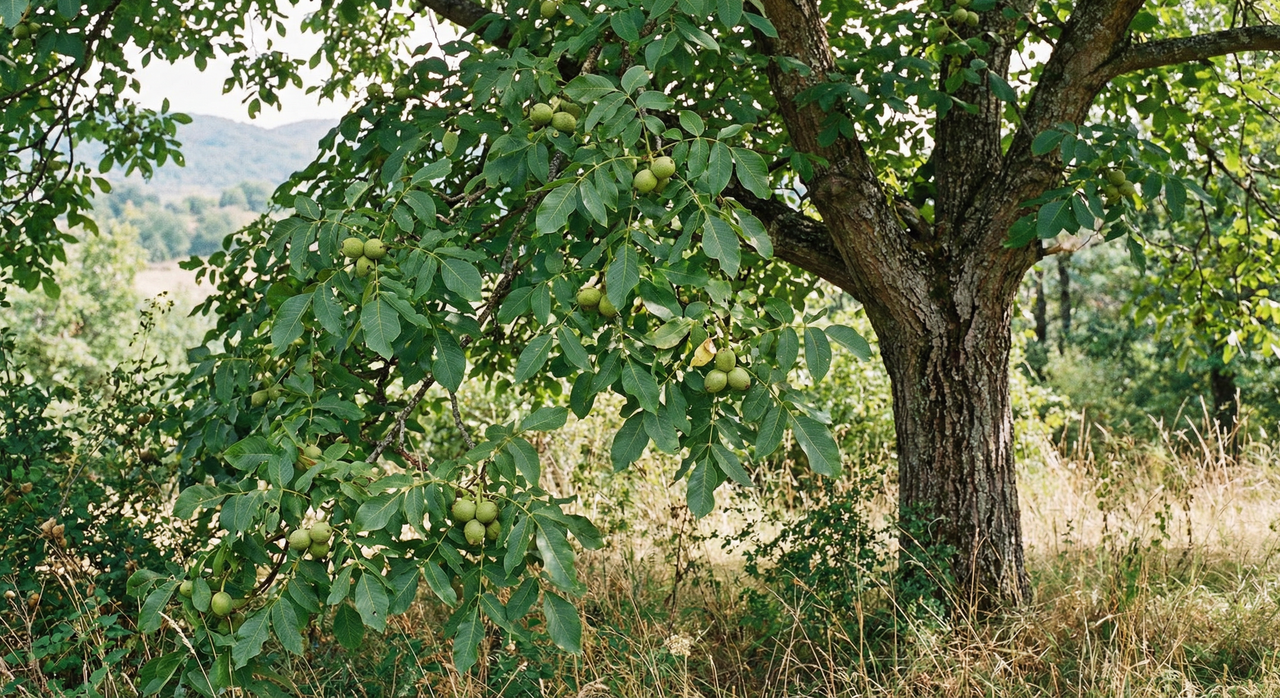
Every permaculture designer I've ever met has an opinion about walnut, and almost none of them are neutral. People either refuse to plant one anywhere near their food forest, convinced it will poison everything within reach, or they've got three growing in their backyard and can't understand what all the fuss is about. I've been in both camps. What shifted me wasn't a book or a research paper; it was watching a stand of pawpaws thrive directly under a black walnut for six consecutive seasons while the tomatoes twenty feet away slowly collapsed. The tree wasn't indiscriminately toxic. It was selective, and that distinction changes everything about how you design around it.
Walnut is genuinely one of the most chemically sophisticated trees you can grow, and that sophistication cuts in every direction at once, shaping soil communities, deterring pests, delivering serious cardiovascular and neuroprotective benefits when you eat the nuts, and simultaneously creating planting challenges that defeat growers who didn't do their homework. It's been doing all of this, in human landscapes, for somewhere around nine thousand years.[1] That's a long time to develop an opinion about a tree. Here's everything I wish someone had handed me before I planted my first one.
Walnut Origin, History, and Botanical Background
Few trees carry as much human history in their grain as the walnut. The genus Juglans has been feeding, healing, dyeing, and sheltering people across three continents for millennia, and the more time I spend working with these trees in food forest design, the more I appreciate just how deeply they're woven into the story of civilization itself.
Native Range and Botanical Characteristics of English Walnut and Its Relatives
English walnut (Juglans regia), the scientific name for the species most people picture when they say "walnut," is native to riparian zones, slopes, and mountain woodlands stretching from the Balkans and Caucasus through Central Asia and the Himalayas into southwest China, at elevations ranging from 100 to 2000 meters.[2][3] Its relatives occupy strikingly different corners of the globe: black walnut (Juglans nigra), whose scientific name translates roughly to "black Jupiter's nut," dominates the rich hardwood forests of eastern North America; the shrubby California walnut (J. californica) clings to dry riparian canyons in southern California; Japanese walnut colonizes temperate East Asian woodlands; and the critically endangered Andean walnut (J. neotropica) survives in montane cloud forests at 1500 to 3000 meters elevation.[4][5]
What unites them is an impressive set of shared traits. All are polycarpic perennials capable of producing nuts annually for 100 to 300 years, though commercial English walnut orchards are typically replaced after 30 to 50 productive years before the trees approach that potential.[2][6] All are wind-pollinated and monoecious, bearing separate male and female flowers on the same tree, but they don't always cooperate with themselves: a phenomenon called dichogamy means pollen is often shed before or after the female flowers are receptive, which can cause irregular yields and makes selecting compatible pollinators genuinely important in orchard design.[2][7] I tell clients who want to plant a single specimen for food that this is the first thing they need to understand about the genus.
English walnut starts bearing nuts at 4 to 8 years; black walnut takes longer, often 4 to 15 years depending on conditions.[2][8] Growth is slow at first, then accelerates to one to two feet per year once the taproot establishes, and that deep taproot is the tree's secret weapon for drought resilience.[9] The Andean walnut is worth a separate mention: classified as Critically Endangered by the IUCN after losing more than 80% of its population to deforestation, logging, and mining, it's a sobering reminder of what the genus stands to lose when conservation isn't prioritized.[10]
Ancient Domestication, Cultural Spread, and Traditional Uses
The domestication story of English walnut begins in ancient Persia, with evidence pointing to intentional cultivation as far back as 7000 BCE and clear archaeological traces in the Caucasus between 3000 and 1400 BCE.[11][12] From Persia it traveled the Silk Road into China during the Han Dynasty, arrived in Greece by the 4th century BCE, and reached the broader Roman world by around 100 BCE, carried by traders who understood that a high-calorie, shelf-stable nut was worth moving across continents.[11][13]
The symbolism that accumulated along the way is striking in its consistency. Across Persian, Greek, Roman, Chinese, and Ayurvedic traditions, the walnut became associated with wisdom, intellect, fertility, strength, and immortality.[14] Persian culture linked the tree with victory and fertility; medieval European traditions used walnut wood for religious artifacts and crosses; Native American traditions associated the black walnut specifically with strength, protection, and purification.[15][16] When you read walnut tree symbolism across these cultures, what comes through isn't coincidence; it's the accumulated respect of people who lived in close relationship with a tree that fed them, sheltered them, and lasted longer than they did.
The ethnobotanical parallels across the genus are equally remarkable. Native American tribes including the Chumash, Tongva, Cherokee, and Iroquois ate processed nuts, extracted brown and black dyes from the husks, and used bark and leaves medicinally for skin conditions, parasites, and toothaches.[17][18] Central Asian, Japanese, and European traditions documented nearly identical non-food uses for dyeing, tanning, and insect repellence, while walnut wood earned a global reputation for durability in furniture, gunstocks, and tools.[19][20] These parallel discoveries across cultures with no contact with each other speak to genuine observed utility rather than borrowed myth.
Fascinating Facts and Ecological Impact of Walnuts
English walnut at maturity is a genuinely impressive tree: typically 9 to 15 meters tall, occasionally reaching 30 meters or more, with a broad rounded crown and alternate pinnately compound leaves bearing 5 to 9 aromatic leaflets.[4][2] Crush a leaflet between your fingers and the scent is unmistakable, a sharp, resinous, almost medicinal smell that I find immediately grounding whenever I'm assessing a site. Bark on mature trees runs light gray to brown becoming deeply furrowed, while black walnut shows darker diamond-patterned ridges and California walnut carries a corky, lenticeled texture.[21][22]
The ecological personality that shapes every design decision involving walnuts is juglone. All species in the genus produce this allelopathic compound in their roots, leaves, and husks, and it inhibits respiration in a wide range of competing plants, effectively creating a sparse "walnut desert" in the understory.[23][24] In my food forest design work, I've learned to treat the juglone zone not as a problem to be solved but as a design parameter that shapes guild selection from the start. The root system extends two to three times the canopy width, so the influence is broader than most people expect.[25] I always tell clients: plant a walnut knowing it will outlive you, and design the landscape around it accordingly.
That long view matters. Black walnut can exceed 45 meters and 300 years; California walnut is a much more modest 6 to 15 meters with strong drought adaptation; Japanese walnut produces the easily cracked heartnut form beloved by foragers.[26][27] Meanwhile, global commercial production of English walnut now exceeds 3 million tons annually, led by China, the United States, and Turkey, none of which are the tree's native range.[28] That gap between a Critically Endangered Andean species and a globally traded commodity crop tells you everything about the divergent fates of trees in this genus, and why both cultivation and conservation deserve serious attention.
Walnut Varieties and Where to Buy Them
The familiar English walnut produces classic nuts 3 to 5 centimeters across wrapped in that thin, light-colored shell most of us picture when we think "walnut."[29][30][31] That elegance didn't happen by accident. Formal breeding in the US began in the 1920s at the University of California, building on ancient Persian domestication and decades of selection pressure toward disease resistance, yield, and nut quality.[32] The result is a genus now offering more than 50 recognized cultivars worldwide, selected for everything from harvest timing to blight tolerance.[33][34]
Notable English Walnut Cultivars
Chandler is the one to know first. Released in 1974 by UC Davis, it dominates commercial orchards for good reason: late-blooming habit that sidesteps late frosts, high and consistent yield, excellent kernel quality, mild flavor, and moderate-to-high resistance to thousand cankers disease.[35][36] I've seen grafted Chandler trees in demonstration plantings come into meaningful production a full two to three years ahead of seedling-grown trees nearby. That gap matters enormously when you're committing to a tree that needs a decade to hit its stride.
Howard is the instructive contrast. It grows faster out of the gate than Chandler and the kernel flavor is genuinely rich, but it carries real susceptibility to bacterial blight and thousand cankers disease, and yields drop noticeably in colder sites.[35] I learned this lesson the hard way with an ungrafted Howard in a borderline-cold microclimate; two seasons of thin kernels later, I switched to a grafted Carpathian-type and the difference in northern-climate reliability was immediate. Other named cultivars worth knowing include Hartley (vigorous, good for processing), Franquette (late harvest, disease resistant), Payne (early maturing), Serr (precocious bearer), and Tulare (high productivity).[33][35]
If you're gardening in Zone 4 or 5, look instead at cold-hardy selections like Broadview (Zone 5), Colby (Zone 4), and Thomas (Zone 5).[37][38] Whatever cultivar you choose, grafting onto a disease-resistant rootstock such as Paradox (Juglans hindsii x J. regia) or RX1 (J. microcarpa x J. nigra) is standard practice, adding vigor and meaningful protection against soil-borne pathogens and nematodes.[39][40] Seedlings are widely available and cheaper, but if you want true-to-type performance from a named cultivar, always buy grafted.[41]
Cultivars Across Other Walnut Species
Black walnut and Japanese heartnut both have rich cultivar traditions of their own. Black walnut selections for nut production include Thomas, Ohio, Mystry, Davidson, Football, Jefferson, and the compact-growing Sparrow, with differences in shell thickness, flavor, disease resistance, and leafing timing.[42][43] Japanese walnut, especially the heartnut variety (Juglans ailantifolia var. cordiformis), has cultivars like Columbia, Drake, Hansen, and Yamagata 1 developed specifically for nut quality and ease of harvest.[44][45] A named heartnut drops cleanly from its shell in a way that makes cracking English walnuts feel fussy by comparison; if harvest efficiency matters to you, that tactile difference is worth experiencing before you commit to a species.
At the other end of the spectrum sit Southern California walnut, Colombian walnut, and butternut. Southern California walnut (Juglans californica) has almost no named cultivars for home use, appearing mainly as rootstock and in native planting work.[40] Colombian walnut (Juglans neotropica) has zero formally registered cultivars; conservation efforts there focus on wild populations and local landraces rather than breeding programs.[46][47] Butternut (Juglans cinerea, sometimes called white walnut) has a handful of canker-resistant experimental selections including Pea, Stonetree, Myers, Hope, and Wentworth, but most are not commercially available and remain research material for the time being.[48][49] Different conservation priorities, different breeding histories; not every walnut species has had a century of California agriculture behind it.
Sourcing Walnut Trees and Seeds
English walnut nursery stock is genuinely easy to find. Reputable suppliers include Burnt Ridge Nursery, One Green World, Raintree Nursery, Stark Bro's, and Trees of Antiquity, among others.[50][51] Bare-root trees run $15 to $30 and are typically available from January through April; 1-gallon potted saplings cost $20 to $50, and specific cultivars like Howard can push $40 to $60.[52][53] Seeds from Sheffield's Seed Company, Seed Savers Exchange, Baker Creek, and Fedco typically cost $3 to $10 per packet of 5 to 25 seeds[54][55], though remember that seed-grown trees won't be true to their parent cultivar. For English walnut in cold climates, look specifically for Carpathian walnut selections, which extend the usable range into USDA Zone 4.[56]
Black walnut is the most widely accessible option for growers in the eastern and midwestern US, available through Prairie Moon Nursery, FastGrowingTrees.com, and most regional native-plant suppliers, with saplings ranging $10 to $30 and larger specimens $50 to $150 or more.[57][58] Japanese walnut and heartnut cultivars require more hunting; Burnt Ridge, One Green World, Oikos Tree Crops, and Badgersett Research are the names I'd check first, with seedlings typically $25 to $75.[59][60] Southern California walnut is a different situation entirely: it's rare in the horticultural market, available mainly through the Theodore Payne Foundation and Las Pilitas Nursery, and carries conservation concern status in parts of California, so treat it accordingly.[61][62]
Before you order anything across state lines, check the current regulatory picture. All walnut species are subject to USDA APHIS import and interstate movement regulations due to the walnut twig beetle and thousand cankers disease, and California imposes additional quarantines on top of federal rules.[63][64][65] I always ask nurseries directly about their TCD screening protocols and request phytosanitary certificates before purchasing, especially from California suppliers. It takes two minutes and could save years of heartbreak.
Walnut Propagation and Planting Guide
Planting a walnut tree is a commitment measured in decades, and the decisions you make before anything goes in the ground will shape what that tree produces for the rest of your life. I've learned to treat propagation and site selection as a single conversation rather than two separate tasks, because a perfectly germinated seedling planted in the wrong spot, or a grafted tree dropped into compacted clay, will underperform for years before you figure out why.
Walnut Seed Morphology, Dormancy, and Storage
The walnut "nut" is actually a drupe, with a fleshy green husk that stains your hands dark brown the moment you handle it (I still forget gloves at least once every fall). That husk ripens to dark brown or nearly black, splits open along its sutures, and releases the woody shell inside, which runs 3-5 cm across with deep ridges enclosing a pale, convoluted kernel that makes up 60-70% of the nut's weight.[66][67] Each seed has a single zygotic embryo, though in some cultivars like 'Chandler' you'll occasionally find two seedlings emerging from one nut, a low-frequency phenomenon called polyembryony.[68]
Before any of that matters, the seed needs to break dormancy. English walnut requires 60-120 days of cold moist stratification at 1-5°C, after which germination rates climb to 70-90% at 20-25°C.[69] The practical approach is to mix cleaned seeds with lightly moistened peat-free compost or perlite, seal them in a labeled bag, and refrigerate them from late autumn through late winter. English walnut behaves as an orthodox seed, meaning you can dry it down to 4-6% moisture and store it in sealed containers at 0-5°C for 2-5 years without significant viability loss.[70] If you're working with black walnut or Southern California walnut, throw that playbook out: both are recalcitrant, meaning they cannot tolerate desiccation and must be kept moist and cool, stored for no longer than 6-24 months before use.[70][71] When in doubt about viability, a tetrazolium soak will stain live embryo tissue red within hours and give you a reliable read before you waste a stratification cycle.[72]
Walnut Propagation Methods from Seeds to Grafting
Here's the catch with seed-grown walnuts: because the species outcrosses heavily and carries high genetic variability, only about 1-5% of seedlings will resemble the parent tree in any meaningful way.[73] If you're growing walnut from seed specifically to produce nuts from a known cultivar, you'll be disappointed. Seed propagation is most valuable for producing rootstock, which is where most growers use it anyway.
For anyone who wants a named cultivar with predictable nut quality, grafting is the answer. Whip-and-tongue, cleft, side veneer, and bark grafting all work well, with chip budding also a reliable option; success rates run 70-90% on vigorous Paradox hybrid rootstock, which is the cross between J. regia and J. hindsii that has become the industry standard for its disease resistance and vigor.[74][75] After practicing whip-and-tongue grafts over several seasons in my own small nursery, I'm now consistently hitting 80% or better takes, and most of that improvement came from timing the work precisely to scion dormancy combined with rootstock that was already pushing actively.
Cuttings are possible but slow and unreliable by comparison. Hardwood cuttings root at only 10-30%, softwood at 20-50% with IBA at 3,000-10,000 ppm and high-humidity mist propagation.[76] Air layering in spring with wounding and auxin application performs better, at 40-80% success, and is worth knowing as a backup technique.[77] Tissue culture achieves 70-90% multiplication rates but is effectively a commercial tool due to the cost, sterile protocols, and persistent phenolic browning problems that make it impractical at the home-nursery scale.[78] Across all methods, the recurring enemies are Phytophthora (especially in poorly drained propagation beds), crown gall, nematodes, and juglone allelopathy in the rhizosphere, which can suppress rooting even in the propagation bench.[79] Starting with disease-free certified stock and ensuring excellent drainage solves most of these problems before they start. One conservation note worth mentioning: wild seed collection of Southern California walnut requires permits given its threatened status,[80] and Japanese walnut shows invasive potential in North America, so check regional guidelines before establishing it.[81]
Soil, Site, and pH Requirements for Walnuts
More walnut plantings fail because of soil than for any other reason, in my observation. The tree wants deep, fertile, well-drained loam with 2-4% organic matter, a granular structure, and bulk density below 1.4 g/cm³.[82] Compaction, waterlogging, and heavy clay without amendment are dealbreakers. Before I site any walnut, I push a long screwdriver or tile probe into the soil and confirm at least 4 feet of friable, uncompacted ground; the taproot will eventually push 10-15 feet in ideal conditions, and anything that impedes that early vertical drive will stunt the tree for decades.[83] On marginal sites, working in 5-10 tons per acre of compost and establishing cover crops for a full season before planting can genuinely shift a mediocre soil into something that sustains a walnut long-term.[70]
Soil pH should sit between 6.0 and 7.5, with the sweet spot at 6.5-7.0.[82] Push above 7.5 and you'll start seeing interveinal yellowing on new leaves as iron becomes unavailable; drop below 6.0 and you risk aluminum and manganese toxicity alongside phosphorus lockout.[84][85] Soil testing before planting is non-negotiable here; lime raises pH and sulfur or chelated iron supplements lower it or address deficiency symptoms once the tree is in the ground. Sun requirements are similarly firm: while young trees show some shade tolerance, that window closes fast as the canopy develops.[4] Southern California walnut can handle partial shade in its native canyon habitat,[86] but for English walnut, an open sunny site is simply the baseline.
Planting Spacing, Technique, and Establishment
English walnut reaches 25-50 feet tall with a canopy spread of 40-60 feet at maturity.[70] Standard orchard spacing runs 20-30 feet between trees and 20-25 feet between rows, putting roughly 100-150 trees per acre; high-density systems with trellising can squeeze down to 12-18 feet, while vigorous rootstocks on fertile soil benefit from the wider end of that range.[70] Black walnut grows taller still, 70-90 feet, and needs 30-40 feet of spacing for nut production, though timber plantings typically start denser and thin over time.[7] I learned to take juglone radius seriously after losing a row of tomatoes and some young apple starts that I'd placed about 45 feet from a black walnut; the affected zone runs 50-80 feet from the trunk, and adequate spacing also improves airflow enough to meaningfully reduce fungal pressure.[87] Train young grafted trees to a central leader with dormant-season pruning to establish structure early, removing crossing or dead wood while keeping cuts conservative since heavy pruning stimulates vegetative regrowth at the expense of nut development.[88]
Timeline to First Nuts and Maturity
Every new grower asks the same question first, and the honest answer is: it depends on how you propagate. Seed-grown English walnut typically takes 5-7 years to produce its first nuts, sometimes stretching to 8.[82] Grafted trees on Paradox rootstock close that gap considerably, often bearing in 4-6 years with commercial-scale harvests by years 5-8.[82] Black walnut takes considerably longer: full production arrives at 15-20 years, peaks somewhere between 30 and 60 years, and productive trees can continue bearing for 50-100 years after that.[89] Japanese walnut seedlings need 8-12 years, though grafted specimens may bear in 3-5, and early-bearing cultivars like 'Thomas' black walnut or 'Kwak' heartnut can shorten timelines across the board.[90][91] These are long-term trees. Grafted English walnut on a good site is a 4-6 year wait for your first real harvest; everything else is a longer game, and that framing should sit at the center of any planting decision you make.
Walnut Tree Care Guide: Growing Juglans regia Successfully
A walnut will tell you exactly what it needs if you learn to read its leaves and timing. That's something I've come to genuinely believe after years of managing these trees through drought years, surprise frosts, and the occasional nutrient mystery. The care fundamentals aren't complicated, but they're unforgiving if you ignore them, and the seasonal rhythm of this tree is really the organizing principle behind every task you'll do.
Sunlight Requirements for Optimal Growth and Nut Production
English walnut is a full-sun tree, full stop. It needs at least 6-8 hours of direct sun daily for good vigor and reliable nut production.[4][92] Young trees can tolerate a bit more shade than mature ones, but I've watched seedlings planted under even light canopy come up pale, spindly, and slow, which trained me early to site walnuts in the most open, exposed spots I have. Mature trees have genuinely low shade tolerance and decline predictably when shaded out, so they rarely work as understory contributors in a food forest design. If you see pale, chlorotic foliage, smaller-than-normal leaves, or early leaf drop on a young walnut, inadequate light is the first thing to rule out.[93] On the other end, extreme heat combined with drought pushes toward leaf scorch with brown, necrotic margins, which can look deceptively similar to nutrient problems or disease.[94]
Water Needs and Irrigation Strategies
Mature English walnuts are thirsty during the growing season, needing 30-60 inches of water annually depending on your climate and crop load, with deep irrigations of 1-2 inches every 7-14 days from April through October.[95][96] Peak demand hits during kernel filling in June through August, and I've seen noticeable kernel shrivel in hot summers when irrigation timing slips even by a week. My most useful habit is checking soil moisture at 12-18 inches with a probe rather than going by the calendar. It's a simple practice that has kept me from both underwatering during critical periods and overwatering young trees into root rot problems I once spent a season trying to reverse.
Once established, Juglans regia can handle 4-6 weeks without severe stress, though wilting, leaf scorch, and premature nut drop show up sooner than that.[82] What it absolutely cannot handle is waterlogged soil, which triggers chlorosis, root rot, and often Phytophthora infection that can kill a tree slowly over several seasons.[97] Water quality matters too; walnuts have low salinity tolerance, and yield loss begins above a soil ECe of around 1.5-2.0 dS/m, so if you're irrigating with marginal water it's worth testing before problems appear.[98]
Feeding and Nutrient Management
Walnuts are heavy feeders with high nitrogen requirements and elevated needs for potassium, zinc, and boron.[99][93] The first unusual deficiency I ever saw on my trees was zinc rosetting: tight, small, puckered leaves clustered at branch tips that I initially thought was some kind of virus. A leaf tissue test cleared that up fast, and annual zinc sprays have kept the issue from returning.[100] In alkaline soils, iron chlorosis is the more typical problem. Guessing fertilizer rates is genuinely risky with walnuts; too little and you get weak growth and poor nut set, too much nitrogen in late summer and you stimulate tender new growth right before frost. Soil and leaf tissue testing every 2-5 years is the highest-return practice any walnut grower can adopt.[93] Apply fertilizer in early spring around the drip line, and favor organic amendments like compost or aged manure, which build long-term soil health and moderate the juglone effects on surrounding plants.[101]
Frost Tolerance and Cold Protection
Juglans regia is hardy in USDA zones 5-9, with mature trees tolerating down to -15°F or -20°F.[102][103] The real vulnerability is in spring. Buds begin taking frost damage at 25-28°F, and open flowers are gone near 30°F, wiping out the season's crop in a single cold night.[104] I lost the nut crop on two young trees in my first years of growing before I understood how critical site selection is. Cold air drains to low spots, so positioning trees on gentle slopes or elevated ground with good air movement is the most reliable protection you can build in. Overhead sprinkling, wind machines, and frost blankets are useful backups, and Paradox hybrid rootstocks improve cold hardiness in marginal zones.[105]
Heat Tolerance and Summer Stress Management
English walnut is rated for AHS Heat Zones 5-9, but once temperatures push above 95°F, photosynthesis slows, pollen viability drops, and kernel development suffers.[70][106] Above 100°F, kernel fill can fail almost entirely.[107] The symptoms overlap with drought stress, which makes sense since the fix for both often overlaps too: consistent deep irrigation, 4-6 inches of organic mulch, and canopy pruning for airflow all help simultaneously. For young trees in hot climates, 40-50% shade cloth during peak summer has made a real difference in my experience, protecting developing bark and reducing transplant shock in the establishment years. Heat-tolerant cultivars like Chandler and Franquette handle warm summers better than many older selections, and California black walnut is naturally adapted to zones 8-10 if you're working in a hot, dry region.[108]
Pruning, Maintenance, and Seasonal Rhythm
Prune walnuts in late winter during full dormancy, before bud break. I do this job in old clothes with gloves because walnut sap stains everything it contacts, and the smell is distinctive enough that I've learned to schedule it deliberately rather than on a whim. Train young trees to a strong central leader with 3-5 well-spaced scaffold branches, remove suckers and water sprouts annually, and keep mature tree canopy removal to 20-25% per session every 3-5 years to avoid stress-induced disease vulnerability.[109][110]
Keep 2-4 inches of organic mulch around the base, pulled 6 inches back from the trunk, to conserve moisture and regulate soil temperature.[82] Protect young trunks from sunscald with white latex paint or wraps, and use windbreaks for the first few years in exposed sites.[4] Then there's the ongoing reality of juglone management to protect sensitive plants within that 50-75 foot radius.[111][112] I've found that certain native grasses and comfrey planted at the outer edge of the drip line do fine; tomatoes and apples do not. Learning which companions thrive in the juglone zone turns what feels like a design constraint into a planted guild you can actually rely on.
Seasonal Care Calendar for Walnut Trees
Juglans regia follows a clear deciduous rhythm requiring 600-1500 chill hours below 45°F to break dormancy properly.[50] Winter is when you prune and plan. Spring brings catkin and leaf emergence along with the frost vulnerability window, so it's the season for monitoring, protecting, and applying fertilizer as growth resumes. Summer centers on irrigation and watching for heat and moisture stress during kernel fill. Autumn is harvest prep and cleanup, removing fallen leaves and hulls that concentrate juglone and harbor disease. The seasonal cycle also dictates every larger decision: feeding timed to spring flush, irrigation ramping up through summer, pruning locked to dormancy.
A well-managed walnut can live 100-300 years, though commercial orchards are typically replaced at 50-100 years.[82][113] The threats that cut that life short, Phytophthora, bacterial blight, poor drainage, chronic drought, all trace back to the same core practices: drainage at planting, regular soil and tissue testing, and consistent seasonal maintenance. Get the first 5-8 years right and a walnut becomes one of the quietest, most self-sufficient trees in the food forest, asking surprisingly little in return for the decades of productivity ahead.
Harvesting Walnuts: Timing, Technique, Yield, and Flavor
There's a particular satisfaction to getting the walnut harvest right, and a particular frustration to getting it wrong. The difference usually comes down to timing and what happens in the 72 hours after the nuts hit the ground.
When to Harvest Walnuts: Maturity Indicators and Regional Timing
English walnut typically runs 120 to 200 days from bloom to harvest-ready, with commercial workhorses like Chandler and Hartley landing in the 140 to 160 day window.[82][114] The cues that actually tell you it's time are the hull shifting from solid green toward yellowish-brown, visible splitting or loosening along the seams, and kernel moisture dropping into the 8 to 12 percent range.[115][116] The water test is the one I trust most: drop nuts into a bucket and check whether they sink. A specific gravity of 1.05 to 1.10 means the kernel has filled out properly.[115] I've run this test against my own eyeballing plenty of times, and the floaters consistently taste more bitter or turn rancid faster in storage. It's worth the extra thirty seconds.
In California, early cultivars like Howard and Tulare are ready by early to mid-September, while Chandler can push into November or even December.[117][118] Pacific Northwest growers typically run one to two weeks behind those California windows due to cooler conditions.[119] Black walnut peaks in October after husks soften and early drops begin, usually following the first frost.[120] Japanese walnut follows a similar September through November arc.[121] My own observation: nuts harvested just as the hulls begin to split, rather than after they've gone fully dark and soft, tend to yield noticeably sweeter kernels. Don't wait for the hull to blacken if you can help it.
Harvesting Methods and Post-Harvest Handling for English Walnuts
Once the cues line up, move quickly and pick a dry day around 50°F if you can.[41] Commercial orchards use mechanical shakers with catch frames; home growers pole-shake smaller branches and gather fallen nuts by hand, which works fine as long as you're not letting them sit on wet ground for days. Hull within three to four days of harvest.[122] That deadline is non-negotiable if you want clean, unstained kernels. The hull-splitting signal here is similar to what I watch for with pecans, but English walnut demands faster follow-up than hickory relatives do. After hulling, dry gently with forced air or natural ventilation, keeping temperatures below 100°F until moisture drops to 8 percent or lower.[123] Then cure at 50 to 60 percent relative humidity below 70°F for two to four weeks to develop flavor.[122] After that, in-shell nuts stored at 32 to 50°F hold quality for 12 to 24 months; shelled kernels run 6 to 12 months.[124] I keep mine in breathable bags at 40°F and have had in-shell nuts taste genuinely fresh at the two-year mark. Black walnut follows a roughly parallel sequence but hulling is messier, drying runs at 95 to 100°F for two to four weeks, and the juglone in the husks will stain everything within reach.[125] Gloves are not optional.
Walnut Flavor Profiles, Texture, and Yield
The kernel is the prize: rich, nutty, mildly sweet with umami depth from glutamic acid and a faint astringency that lingers pleasantly on the finish.[126][127] Raw kernels are crisp and firm; roasting softens the texture and rounds out the oils into something noticeably more buttery.[128] Phenolics like juglone add to the slight bitterness, and that intensity shifts depending on cultivar, soil, climate, and how carefully you handled post-harvest.[129] Sloppy hulling and slow drying show up directly in the bowl. Black walnut dials up these bitter and earthy profiles significantly compared to English walnut.[130] At the other end of the spectrum, Japanese walnut and butternut both lean creamy and mild, noticeably less bitter than English walnut in fresh tastings.[131] Southern California walnut sits at the bitter extreme, with tannin levels that limit its appeal to those willing to do extra processing.[132] Everything a grower does from hull timing through storage either protects or erodes that flavor potential, which is why the post-harvest steps aren't just logistics: they're the whole point.
Walnut Preparation and Uses
Culinary Uses and Preparation of Walnut Kernels
The English walnut kernel is mildly sweet, buttery, and nutty with subtle earthy undertones that shift noticeably by cultivar and ripeness.[133][134] Black walnut is a different animal entirely. I'd compare it to the difference between mild cheddar and an aged gouda: bolder, earthier, with a pronounced bitterness from higher tannin levels that roasting does a real job of mellowing.[135] Southern California walnut falls in similar territory, and its smaller, harder-shelled nuts take more effort to process.[136] Knowing these differences upfront saves a lot of kitchen frustration.
The kernel itself can be eaten fresh or dried,[137] and the nutritional payoff is substantial: around 654 kcal per 100g, 15g of protein, 65g of fat rich in both omega-3 and omega-6 fatty acids, plus vitamin E, magnesium, copper, manganese, and antioxidants.[138][139] To reduce the light bitterness from tannins in the pellicle, soaking or blanching works well; roasting both deepens flavor and extends shelf life.[140][141] For black and California walnuts, leaching in water is the more traditional approach, a technique Native American communities refined over generations.[142]
Culinarily, walnuts reach into almost every corner of the kitchen: salads, baked goods like banana walnut bread, pesto-style sauces, and traditional dishes across Mediterranean and Middle Eastern cuisines.[102] Persian fesenjan stew is one of the oldest expressions of that tradition, and walnut preparations appear across Chinese, Ayurvedic, and ancient Greek food cultures as well.[143][144][145] After years of cracking English walnuts straight from the tree, I've learned the exact moment when the hull slips off cleanly without too much staining (a process best mastered by closely following the post-harvest curing steps detailed earlier) to ensure the shell rattles properly when shaken.[141][146] That rattle is the signal. Wear gloves; juglone stains skin a stubborn brown that lasts for days.
On safety: green hulls, leaves, bark, and roots contain juglone at levels that are toxic if consumed, potentially causing nausea, vomiting, or skin irritation.[147][148] Properly processed kernels are safe; everything else is not food. Tree nut allergies affect roughly 1-2% of the population, and anyone with a known allergy should avoid all Juglans species entirely due to the risk of anaphylaxis.[149][150] If you're on warfarin, the vitamin K content (about 0.8 mcg per nut) adds up faster than people expect and can reduce the drug's effectiveness; I always tell friends to check with their doctor before making walnuts a daily habit.[151]
Medicinal Preparations and Traditional Remedies
Across traditions, the kernel gets most of the attention as food, but the hull and bark are where the medicinal action concentrates. Hulls have long been valued for astringent properties useful in treating skin conditions, while bark tannins make it a traditional wound-healing and digestive aid.[20][152] Native American traditions around black walnut emphasize inner bark and green hulls for antiparasitic and topical applications; similar leaf and bark uses appear in Asian and Andean contexts.[153]
Traditional references suggest adult tincture doses of 1-2 mL three times daily for hulls or bark, leaf decoctions around 2-3 grams steeped in 150 mL of water two to three times daily, and black walnut tincture typically at 0.5-1.5 mL one to three times daily for short periods only.[154] None of this is FDA-standardized; walnut preparations are classified as dietary supplements in the United States, not drugs. I always recommend running any medicinal use past a healthcare provider first, particularly with black walnut preparations where short-term use is specifically advised to limit juglone exposure.
Non-Food Applications and Safety Considerations
Juglone is the thread that runs through every non-food application of the walnut genus. The same allelopathic compound that suppresses competing plants in the garden[155][156] also makes fresh husks a potent natural dye, historically used in Native American basketry and textile work.[157][158] I designate specific harvest buckets for husk processing so that intense brown pigment doesn't migrate anywhere near my vegetable beds; it's a simple habit that prevents a lot of headaches.
Southern California walnut bark decoctions have traditional uses as astringents for diarrhea, wound care, and skin conditions, with additional applications as diuretics and antispasmodics.[159][160] Smoked leaves were used for respiratory complaints, and nut hulls applied for dental pain.[161] These are fascinating ethnobotanical threads, but the practical reminder holds regardless of application: outside the properly processed kernel, all parts of the walnut carry real toxicity risks, and that demands respect whether you're working in the kitchen, the apothecary, or the garden.
Walnut Health Benefits
Walnuts are potent chemistry before they're food. The same compound that kills your tomatoes under a black walnut tree is also driving some of the genus's most compelling therapeutic actions, and understanding that duality is the key to using walnuts wisely, whether you're eating a handful from your harvest or deciding what to plant within 50 feet of one.
Key Phytochemicals in Walnut: Juglone, Polyphenols, and Omega-3 Fatty Acids
Juglone, a naphthoquinone, is the walnut's most distinctive molecule. Concentrations vary dramatically by tissue: roots typically run 1-3 mg/g dry weight, husks 0.5-2 mg/g, and leaves 0.05-0.5 mg/g, while the shelled kernel you eat contains very little, under 0.1 mg/g.[162][163][164] I've watched this chemistry play out in real time in design projects: mint and black currants establish beautifully near walnuts, but tomatoes go sideways within a season, a living demonstration of juglone's cellular respiration disruption in sensitive species.[165]
Layered on top of juglone is a rich phenolic matrix: flavonoids including quercetin, myricetin, and kaempferol; phenolic acids like gallic, ellagic, and ferulic; and ellagitannins concentrated heavily in the papery pellicle at over 20 mg/g dry weight.[166][167] That inner skin most people peel off is actually doing a lot of the antioxidant heavy lifting. The kernel's fat profile adds another dimension: roughly 50-60% linoleic acid and about 8.8 g of alpha-linolenic acid (ALA, an omega-3) per 100g, alongside gamma-tocopherol and phytosterols like beta-sitosterol.[168][138] Growing conditions shift these balances, too; trees under drought stress have been shown to produce 15-30% higher antioxidant activity in their tissues, which tracks with my observation that nuts from drier years tend to taste more assertive.[169]
Medicinal Actions and Research-Backed Benefits
Traditional medicine systems across Eurasia have been working with walnuts for millennia. Persian, Ayurvedic, TCM, Unani, and European folk traditions all converged on similar uses: treating parasitic infections, respiratory ailments, inflammatory conditions, skin diseases like psoriasis and eczema, and digestive complaints.[170][152] Native American communities documented analogous uses for black walnut and California walnut, and Andean healers worked with J. neotropica for parasites, inflammation, and diabetes support.[171] The consistency across unconnected cultures suggests these weren't placebo effects.
Modern research has started catching up. The strongest clinical evidence sits squarely in cardiovascular territory: regular kernel consumption lowers total cholesterol 5-10%, improves HDL, and reduces systolic blood pressure, findings supported by peer-reviewed clinical review.[172] I include walnuts in my own diet most consistently during heavy design seasons, partly because the polyphenol and ALA profile has reasonable neuroprotective evidence behind it: animal and preclinical models show reduced amyloid-beta accumulation, improved memory markers, and acetylcholinesterase inhibition.[173] I'm not claiming walnuts are a cognitive supplement, but the research gives me a reasonable basis for the habit. Beyond neuroprotection, anti-inflammatory effects via NF-κB suppression and reduced TNF-α and IL-6 have been demonstrated in randomized controlled trials in rheumatoid arthritis patients.[174] Antiparasitic activity is another area with genuine support, though mostly preclinical: black walnut hulls show strong activity against Giardia and Ascaris in vitro.[175] Robust human RCTs for antiparasitic, analgesic, and skin applications are still limited; the traditional record is solid, but the clinical infrastructure hasn't fully arrived yet.[176]
Nutritional Profile of Walnuts
A 28g serving of raw English walnut kernels delivers about 183 calories, 4.3g protein, 18g fat (dominated by polyunsaturated fatty acids including roughly 2.5g of ALA omega-3), and 1.9g fiber.[138] That ALA content compares favorably with flax and chia per calorie, which matters if you're sourcing omega-3s from your own food forest rather than a supplement bottle. The mineral density is substantial: magnesium at 322 mg per 100g, phosphorus at 376 mg, and copper at nearly 2 mg, plus meaningful folate (98 µg) and manganese.[138] The ellagic acid and other polyphenols concentrated in the pellicle push antioxidant scores high on ORAC-type assays, connecting back to the cardiovascular and anti-inflammatory benefits covered above.[167] Only the shelled kernel is the intended edible portion; husks, leaves, and bark are a different pharmacological category entirely.
Safety Considerations and Potential Side Effects
The kernel is safe. Everything else demands respect. Husks, leaves, and bark carry juglone concentrations that cause nausea, vomiting, and abdominal pain if ingested, and contact with those tissues produces dermatitis from juglone and urushiol.[177] I learned the hard way processing a hull harvest without gloves; the staining fades, but the inflammation takes longer. Gloves are non-negotiable when handling fresh husks or doing any pruning on mature trees.
On the allergy front: walnuts are a major tree-nut allergen, affecting roughly 0.5-1% of people in Western countries via proteins Jug r 1-4, with 30-50% cross-reactivity across other Juglans species.[178] If anyone in your household has a tree-nut sensitivity, walnuts require careful handling of shared tools and surfaces; I've seen mild reactions escalate quickly when cross-contamination was underestimated. Walnut pollen also triggers respiratory allergies in sensitive individuals.
Drug interactions are real: the omega-3 and vitamin E content can enhance anticoagulant effects, and there are plausible interactions with antidiabetic medications, CYP-metabolized drugs, and thyroid medications.[179] Black walnut preparations specifically are contraindicated in pregnancy, breastfeeding, and for anyone with kidney issues due to oxalate load.[180]
For animals, the risk is severe. Horses are the most sensitive species, developing colic and laminitis from juglone exposure; dogs show vomiting, diarrhea, and in serious cases seizures; livestock face GI distress and potential organ damage.[181][182] There's no antidote; treatment is supportive. Juglone release peaks in autumn with leaf fall and is enhanced by warm, moist conditions, which means the fall cleanup window around walnut trees is when animal exposure risk is highest.[183] If you're integrating walnut into a farm or homestead landscape with horses or dogs, siting and leaf management aren't optional considerations.
Walnut Pests and Diseases
English walnut is not a low-maintenance tree from a pest and disease standpoint. I say that not to discourage anyone from planting one, but because going in with eyes open about the threats means you make smarter choices before the tree ever goes in the ground, starting with cultivar selection and rootstock, the two decisions that matter more than any spray program you'll ever run.
Common Diseases of Walnut Trees
Bacterial blight, caused by Xanthomonas arboricola pv. juglandis, is the disease most likely to hit your walnut tree in a wet spring. It thrives between 59 and 77°F with humidity above 80 percent and prolonged leaf wetness, which in many climates describes the entire bloom window.[184][185] I watched 'Payne' trees get devastated in a particularly wet April early in my career, black walnut tree leaves turning black, husks aborting, the works. Since then I don't plant 'Payne' or 'Hartley' in any site with maritime or humid conditions; both are highly susceptible. 'Chandler', 'Howard', and 'Tulare' show moderate to high tolerance and are almost always my starting point now.[186][187]
The second thing that keeps walnut growers up at night is Phytophthora root and crown rot. English walnut on its own roots is genuinely vulnerable, especially in heavy or poorly drained soils where the pathogen thrives at 68 to 86°F.[97] I've seen grafted trees on English walnut rootstock collapse in their third season after a wet winter, while the same scion on Paradox rootstock (a J. hindsii × J. regia hybrid) held on without issue.[188] Japanese walnut naturally shows high resistance to this pathogen, which is part of why I've used it as a rootstock in several wetter-site designs.[189] If your site has any drainage questions at all, Paradox or Japanese walnut rootstock isn't optional; it's the design.
Thousand Cankers Disease is the one that worries me most from a long-term landscape perspective. Caused by the fungus Geosmithia morbida and vectored by the walnut twig beetle, it moves through the tree's vascular system and there are currently no resistant English walnut cultivars.[190][191] Southern California walnut shows moderate resistance, likely from co-evolving with the beetle, while black walnut is highly susceptible.[192] The practical response is tree vigor: healthy, well-sited trees on good rootstocks slow disease progression even when they can't stop it entirely.
Anthracnose (Gnomonia leptostyla) and Botryosphaeria canker round out the common black walnut tree diseases you're likely to encounter, though both tend to be secondary concerns on otherwise healthy trees.[193][194] Japanese walnut and its heartnut forms handle anthracnose better than English walnut, and Botryosphaeria almost always appears on stressed trees first, making tree health the real treatment.[195] Verticillium wilt is worth a mention, too; English walnut is less susceptible than black walnut, but trees under stress can still succumb and there's no direct chemical cure once infection sets in.[196]
Across all these diseases, the cultural foundation is the same: well-drained siting, pruning for airflow, prompt sanitation of fallen material, and balanced nutrition without pushing excessive vegetative growth.[185][197] Copper-based sprays can help manage blight pressure during bloom in high-humidity regions, and biological options like Trichoderma or Bacillus subtilis are worth trialing for soil-borne pathogens, but no spray program compensates for poor drainage or the wrong rootstock.[198] Breeding programs continue working on improved resistance, but no variety is fully immune across all disease pressure and environments.[199]
Major Insect Pests and Integrated Management
English walnut has only low-to-moderate resistance to most of its major insect pests, and no fully resistant commercial cultivars exist yet.[200] That said, cultivar choice still moves the needle considerably. Walnut husk fly (Rhagoletis completa) is the biggest economic threat in California, and early-maturing cultivars take the hardest hits. Late-maturing types like 'Chandler' and 'Howard' can see 50 to 70 percent lower infestation rates simply because the fly's activity window and nut maturity don't align as cleanly.[201][202]
Codling moth and navel orangeworm are next in line for damage, with larvae boring into nuts and degrading kernel quality across English walnut, black walnut, Japanese walnut, and Southern California walnut alike.[134][203] Aphids, specifically walnut aphid (Chromaphis juglandicola), can cause leaf distortion and honeydew fouling; 'Chandler' shows reasonably good resistance here, helped in part by its phenolic and juglone chemistry, while Japanese walnut tends to see lower infestation rates overall.[204][205] That juglone chemistry is worth acknowledging here: it inhibits insect feeding and development across the genus, which is part of why walnut trees fare as well as they do against some pests even without human intervention.[206] The same compound that complicates guild planting is quietly working as a built-in pest deterrent.
The walnut twig beetle deserves separate mention because of its role as the Thousand Cankers vector. 'Howard' and 'Tulare' show slower disease progression once infested, likely due to tree vigor and bark characteristics that slow beetle establishment, though they aren't immune.[207][208] The real defense against bark beetles across species is maintaining tree vigor through appropriate water, nutrients, and avoiding mechanical wounds that create entry points.
From a permaculture standpoint, my most reliable pest management tool has been consistent monitoring combined with thorough sanitation. Collecting and disposing of fallen husks each autumn has reduced husk fly pressure in my own plantings more than any spray program I've run. It's tedious, but it removes the overwintering habitat and breeding substrate that makes the next season's population worse.[209] Pair that with conserving natural enemies (parasitic wasps, generalist predators), deep infrequent watering that keeps trees vigorous without waterlogging roots, and targeted interventions only when monitoring thresholds are actually reached, and you have a functional IPM approach that doesn't depend on a calendar spray schedule.[134][210] The goal is a resilient tree in a well-designed system, not a chemically defended monoculture that needs rescuing every season.
Walnut in Permaculture Design
There aren't many trees that force you to think as carefully about placement as a walnut does. Every other siting decision you make on a property — food forest layout, companion selection, irrigation zones — bends around it. I've come to see that constraint as a gift, because trees that demand thoughtful design tend to produce landscapes that are genuinely more coherent than ones where anything goes anywhere. Walnut earns its place in the canopy. You just have to earn your right to design with it.
Climate and Growing Zones for Walnut
English walnut (Juglans regia) is the anchor species for most permaculture applications, and it's comfortable across a surprisingly wide range: USDA zones 5 through 9, tolerating winter lows down to around -10°F to -15°F once the tree is mature.[211][4] Young trees are more vulnerable, though, and I'd protect anything in its first two winters if temperatures are dropping near 0°F. It needs at least 100 to 150 frost-free days to ripen nuts reliably, full sun, and roughly 25 to 40 inches of annual rainfall with good drainage.[4][3] California's Central Valley is essentially the ideal reference climate for it: hot, dry summers and mild, wet winters.[212]
In practice, the single most important site criterion I've observed is drainage. Both English walnut and Southern California walnut (Juglans californica) are genuinely sensitive to waterlogging, and I've watched trees in poorly sited low spots develop crown problems within a few seasons despite otherwise good conditions.[4][50] Get the drainage right and a lot of pH and precipitation nuance becomes secondary. The genus gives you options beyond English walnut if your climate is extreme: black walnut (Juglans nigra) and Japanese walnut (Juglans ailantifolia) push comfortably into zone 4, surviving temperatures down to -25°C or colder,[213][4] while Southern California walnut thrives in zones 7 through 10 on as little as 10 to 30 inches of rain, fitting naturally into coastal Mediterranean systems.[214] Microclimates and cultivar selection can stretch these ranges further than the zone maps suggest, so treat the numbers as a starting point rather than a verdict.
Ecosystem Functions and Guild Design with Walnut
Every permaculture conversation about walnut starts with juglone. Within roughly 50 to 80 feet of the tree it can suppress or outright kill a surprisingly long list of plants, tomatoes and potatoes among the most sensitive, along with apples and many common ornamentals.[111][215] The good news is that juglone-tolerant companions are plentiful once you know where to look: black raspberry, currants, elderberries, certain clovers, grasses, alliums, and marigolds are all documented as workable partners.[216] I always map the drip line and then plan the guild spiraling outward from there, keeping sensitive species well beyond the zone of influence rather than hoping for the best.
Once you've navigated juglone, the tree's ecological contributions are substantial. Its deep taproot functions as a dynamic accumulator, pulling up potassium, phosphorus, zinc, and calcium from depths most shallow-rooted companions never reach, while mycorrhizal associations (both ectomycorrhizal and arbuscular) improve the tree's own phosphorus and nitrogen uptake and help buffer some chemical stress for tolerant neighbors.[217][26] I've noticed that walnut leaf litter takes longer to break down than oak in my systems, but once the mycorrhizal network gets established, the resulting humus is genuinely rich. Mature trees yield 20 to 50 kilograms of nuts per year and support squirrels, birds, and rodents that participate in nut dispersal and soil disturbance. The genus also broadly provides timber, natural dye from the husks, and windbreak services in agroforestry contexts.[218][219]
Pollination is one area where design decisions directly affect yield and it's one I wish more growers took seriously. Walnuts are wind-pollinated and protandrous, meaning male catkins shed pollen before female flowers are receptive, which creates partial self-incompatibility.[220][221] Interplanting compatible pollinizer cultivars at roughly a 1:8 to 1:10 ratio matters here. I've seen yields jump noticeably when compatible cultivars are placed within wind range of each other, and the research on optimal conditions (60 to 75°F, light winds, moderate humidity) supports what I've observed in the field.[222] Good airflow also helps manage walnut blight and anthracnose, which are real concerns in humid sites, so the same siting choices that improve pollination also reduce disease pressure.[223]
Other species fill distinct ecological niches worth knowing if you're choosing a walnut for a specific role. Black walnut anchors eastern North American food forests as a keystone species with masting cycles that sustain turkeys, deer, and wood ducks.[224] Southern California walnut supports riparian biodiversity in Mediterranean landscapes with modest water.[225] And the Andean species Juglans neotropica, listed as Vulnerable due to logging and habitat loss, is a reminder that cultivating walnuts responsibly and sourcing stock from reputable nurseries connects even a backyard planting to broader conservation questions.[226]
Walnut in the Forest Layers
English walnut occupies the canopy or overstory layer, typically reaching 25 to 35 feet in cultivation and occasionally 50 to 60 feet, with a broad rounded crown and large compound leaves that cast serious shade.[227][50] Black walnut goes taller still, 70 to 100 feet or more with a taproot 8 to 10 feet deep, while Southern California walnut stays more compact at 20 to 50 feet and Japanese walnut sits in the mid-range as a riparian pioneer at 50 to 75 feet.[228][86] That size range matters when you're designing a food forest and deciding where any given tree fits in the vertical succession.
The allelopathic zone persists in soil for years even after leaf drop, so the design pivot point is accepting that the space directly beneath a mature walnut will always be sparse and working with that rather than against it.[229][230] I've learned to site walnuts on the northern edge of a food forest where their shade falls away from productive beds rather than over them, turning a liability into a microclimate asset. The bare zone underneath, which tends to look cleaner and more pronounced under black walnut than under English walnut in my experience, can be planted with tolerant ground covers (clover, certain mints, alliums) that colonize naturally once the mycorrhizal network is established.[231][232]
Rather than fighting juglone, I design with it. The guild radiates outward from the drip line: juglone-tolerant shrubs like currants and elderberries in the inner ring, black raspberry and leguminous ground covers just beyond, and the more sensitive edibles pushed to the outer edge where root competition and chemistry both diminish. A thoughtfully assembled walnut guild doesn't just survive the tree's chemistry; over time, with established mycorrhizal partnerships and accumulating leaf-litter humus, it becomes one of the most productive and ecologically complex zones on the property.[228]
The Tree I Almost Talked Myself Out of Planting
I spent two full seasons researching juglone before I put my first English walnut in the ground, convinced the chemistry would make it more trouble than it was worth. Now I eat handful after handful straight from the drying rack every October, surrounded by a guild that took some trial and error but genuinely works, under a canopy that's already starting to feel like the oldest thing on my property. Some plants you grow. Some plants you eventually just stop arguing with.
Sources 232
- Walnut | Description, Types, Uses, & Facts | Britannica ↩
- Juglans regia - Wikipedia ↩
- English Walnut (Juglans regia) - USDA Forest Service ↩
- English Walnut - Missouri Botanical Garden ↩
- Juglans neotropica - Kew Science ↩
- Royal Horticultural Society Plant Finder: Juglans regia ↩
- Silvics of North America: Juglans nigra ↩
- Reproductive Biology of Juglans regia ↩
- Black Walnut Silviculture and Management - USDA Forest Service ↩
- IUCN Red List: Juglans neotropica ↩
- Genetic structure and domestication history of the walnut (Juglans regia L.) ↩
- Archaeological Evidence for the Domestication of Walnut (Juglans regia L.) in the South Caucasus ↩
- Walnuts in Greek and Roman Antiquity ↩
- Juglans regia in Ancient Civilizations ↩
- Royal Horticultural Society: Juglans regia Cultural Significance ↩
- Juglans nigra (Black Walnut) in Traditional Native American Medicine ↩
- Ethnobotany of the California Indians ↩
- Native American Ethnobotany Database ↩
- Indigenous Uses of Juglans regia in Central Asia ↩
- Kew Gardens: Juglans regia Ethnobotany ↩
- Juglans regia - Kew Science ↩
- Juglans nigra - Missouri Botanical Garden ↩
- Walnut, Juglone, and Plant Diseases ↩
- Allelopathy in Black Walnut (Juglans nigra) and the Role of Juglone ↩
- USDA PLANTS Database ↩
- Black Walnut | USDA Forest Service ↩
- Juglans californica - California Black Walnut ↩
- Walnuts: Production, trade and consumption ↩
- Juglans regia - Missouri Botanical Garden ↩
- Juglans regia - RHS ↩
- English Walnut Description - University of California Agriculture ↩
- History of Walnut Breeding in California ↩
- Walnut Cultivars - University of California Agriculture and Natural Resources ↩
- Juglans regia Cultivars - Royal Horticultural Society ↩
- UC Davis Walnut Research: Cultivar Descriptions ↩
- Chandler Walnut Cultivar Description ↩
- USDA Walnut Hardiness Guide ↩
- Nut Crop Cultivars - Purdue Extension ↩
- Walnut Rootstocks - UC Davis ↩
- Walnut Rootstocks - UC ANR ↩
- Persian Walnut Cultivation Guide ↩
- Purdue University - Black Walnut Varieties for Nut Production ↩
- Black Walnut Cultivars - University of Missouri Extension ↩
- Heartnut Information ↩
- Walnut Cultivars for the Northeast ↩
- Juglans neotropica - Wikipedia ↩
- IUCN Red List: Juglans neotropica ↩
- USDA Forest Service - Butternut Canker Resistant Selections ↩
- Breeding Butternut for Disease Resistance - Northern Research Station ↩
- Juglans regia (English Walnut) ↩
- English Walnut Trees ↩
- Juglans regia Trees for Sale ↩
- Walnut Trees - Bare Root and Potted ↩
- Juglans regia Seeds ↩
- English Walnut - Juglans regia ↩
- Carpathian Walnut Trees ↩
- Juglans nigra L. ↩
- Juglans nigra - Black Walnut ↩
- Japanese Walnut (Juglans ailantifolia) ↩
- Heartnut Trees for Sale ↩
- Inventory of Rare and Endangered Plants ↩
- California Native Plants for the Garden ↩
- Importation of Plants and Plant Products ↩
- Thousand Cankers Disease ↩
- Walnut Twig Beetle and Thousand Cankers Disease Quarantine ↩
- Juglans regia: USDA PLANTS Profile ↩
- FAO. Walnut (English walnut, J. regia) ↩
- Nucellar Embryony and Polyembryony in English Walnut (Juglans regia L.) ↩
- Walnut Seed Germination and Stratification Guide ↩
- Factors Affecting Walnut Seed Storage and Germination ↩
- Desiccation Sensitivity in Seeds of Juglans californica ↩
- Tetrazolium Testing for Seed Viability ↩
- Propagation of Walnut (Juglans regia L.) ↩
- Walnut Propagation Techniques ↩
- Grafting Walnut Trees ↩
- Rooting Cuttings of Juglans californica ↩
- Vegetative Propagation of Japanese Walnut (Juglans ailantifolia) by Air Layering ↩
- Micropropagation of Walnut (Juglans regia L.) ↩
- Diseases of Walnut in California ↩
- Inventory of Rare and Endangered Plants ↩
- Juglans ailantifolia ↩
- Walnut Production Manual ↩
- Black Walnut Production in Indiana ↩
- Soil Management for Walnut Orchards ↩
- Iron Chlorosis in Trees and Shrubs ↩
- Juglans californica ↩
- Walnut Allelopathy and Juglone ↩
- Juglans regia - RHS Gardening ↩
- Black Walnut Management ↩
- Propagation and Culture of Japanese Walnut ↩
- Black Walnut Production ↩
- University of California Agriculture and Natural Resources - Walnut Orchard Management ↩
- Walnut Nutrient Management ↩
- Photoinhibition in Woody Plants ↩
- Walnut Irrigation Management - University of California Agriculture and Natural Resources ↩
- Irrigation of Walnut Trees - FAO ↩
- Phytophthora Root Rot in Walnuts - UC IPM ↩
- Irrigation Water Quality for Walnut Production ↩
- Nutrient Management for Walnut Orchards ↩
- Fertilization of Walnut Trees ↩
- Black Walnut Production in Indiana ↩
- Juglans regia - North Carolina Extension Gardener Plant Toolbox ↩
- Walnut Cold Hardiness - University of California Agriculture and Natural Resources ↩
- Frost Tolerance of Walnut Trees ↩
- UC IPM Online: Walnut Frost Protection ↩
- Heat Tolerance in Walnut (Juglans regia L.) ↩
- Heat Stress Effects on Walnut Reproductive Biology ↩
- Managing Heat and Drought Stress in Walnut Orchards ↩
- Walnut Pruning and Training ↩
- Pruning Walnut Trees ↩
- Allelopathy of Walnuts - Penn State Extension ↩
- Walnut Juglone Effects - University of California Agriculture ↩
- Factors Affecting Walnut Longevity ↩
- Phenology and Growth of English Walnut (Juglans regia L.) ↩
- Walnut Harvest Timing and Indicators ↩
- Maturity Indices for Walnut Harvest ↩
- Walnut Harvest Management ↩
- Timing Walnut Harvest ↩
- Phenology and Maturity of Walnuts ↩
- Black Walnut Production in Indiana ↩
- Nut Development in Heartnut Trees ↩
- Postharvest Technology of Horticultural Crops ↩
- Walnut Hulling and Drying Guidelines ↩
- Walnut Storage and Handling Guidelines ↩
- Harvesting and Handling Black Walnuts ↩
- Walnut Flavor and Sensory Characteristics ↩
- Glutamic Acid in Nuts and Umami Taste ↩
- Effect of Roasting on Texture and Oil Content of English Walnuts ↩
- PMC Research Article on Walnut Flavonoids and Phenolics ↩
- Juglone in Black Walnuts ↩
- Native American Nuts: Butternut (Juglans cinerea) ↩
- Missouri Botanical Garden Plant Finder ↩
- Flavor Profile of Walnuts - Journal of Food Science ↩
- Juglans regia - UC IPM ↩
- Sensory Description of Juglans nigra Nuts ↩
- Juglans californica ↩
- Walnut - Juglans regia ↩
- Nutritional Composition of Walnuts ↩
- Nutritional Composition of Walnuts ↩
- Walnut Processing and Storage ↩
- Harvesting and Using Black Walnut ↩
- California Black Walnut: Foraging and Preparation ↩
- Walnut in Persian Cuisine - Historical Recipes ↩
- Juglans regia in Traditional Chinese Medicine ↩
- Walnuts in Ancient Greek Culture ↩
- Nut Trees: Harvest and Storage ↩
- Toxicity of Walnut Tree Parts ↩
- Juglone Toxicity - PubMed ↩
- Walnut Allergy - FoodAllergy.org ↩
- Tree Nut Allergies ↩
- Vitamin K in Walnuts and Warfarin Interaction - Drugs.com ↩
- Ethnobotanical Survey of Juglans regia Uses Worldwide ↩
- Native American Ethnobotany Database - Juglans nigra ↩
- National Center for Complementary and Integrative Health (NCCIH) - Herbal Supplements ↩
- Allelopathy of Walnut (Juglans spp.) ↩
- Allelopathy in Black Walnut: Implications for Agroforestry ↩
- Missouri Botanical Garden TROPICOS (Juglans nigra Ethnobotany) ↩
- Plants Used by the Indians of Mendocino and Humboldt Counties, California ↩
- Ethnobotany of the California Indians ↩
- Ethnobotanical Uses of California Black Walnut ↩
- A California Ethnobotany Review ↩
- Juglone from Walnut Hulls: Bioactivity and Applications ↩
- Juglone and Phenolics in Walnut Parts ↩
- Juglone Distribution in Walnut Tissues ↩
- Allelopathy of Juglans californica ↩
- Phytochemical and Pharmacological Properties of Juglans regia ↩
- Polyphenols in Walnuts: A Review ↩
- Fatty Acid Composition of Walnut Kernels ↩
- Drought Stress and Juglone Production in Walnuts ↩
- Journal of Ethnopharmacology - Medicinal Uses of Juglans regia ↩
- Medicinal uses of Juglans neotropica in Andean communities ↩
- Walnuts and Cardiovascular Health: A Review of Clinical Evidence ↩
- Walnut (Juglans spp.)-Mediated Neuroprotection in Neurodegenerative Diseases ↩
- Anti-inflammatory effects of Juglans regia L. leaf extract in patients with rheumatoid arthritis: A randomized controlled trial ↩
- In vitro study on antiparasitic efficacy of Juglans nigra husks against Giardia lamblia - Journal of Natural Products ↩
- Pharmacological Activities and Nutraceutical Potential of Juglans regia (Walnut): A Review ↩
- Contact Dermatitis from Walnut Husks ↩
- Walnut (Juglans regia) Allergens ↩
- Potential Interactions of Juglans regia with Anticoagulants ↩
- Black Walnut: Health Benefits, Side Effects, Uses, Dose & Precautions ↩
- Black Walnut (Juglans nigra) Toxicity ↩
- Black Walnut Toxicity - ASPCA ↩
- Juglone Toxicity and Allelopathy in Walnut Trees ↩
- Bacterial Blight of Walnut ↩
- Walnut Blight: Xanthomonas arboricola pv. juglandis ↩
- Walnut Blight Management ↩
- Cultivar Susceptibility to Walnut Diseases ↩
- Walnut Disease Management Guidelines ↩
- Disease Resistance in Juglans Species ↩
- Thousand Cankers Disease of Walnut ↩
- Thousand Cankers Disease and Its Impact on Walnut ↩
- Thousand Cankers Disease of Walnut ↩
- Anthracnose of Walnut ↩
- Botryosphaeria Canker Diseases of Walnut - UC IPM ↩
- Heartnut (Juglans ailantifolia var. cordiformis) Production and Characteristics ↩
- Verticillium Wilt Management - Oregon State University Extension ↩
- University of California Integrated Pest Management ↩
- Walnut Blight Management - ANR Publications ↩
- USDA Walnut Research and Breeding ↩
- International Journal of Pest Management ↩
- UC IPM Online: Walnut Husk Fly ↩
- Journal of Economic Entomology ↩
- Insect Pests of Walnut ↩
- Walnut Aphid (Chromaphis juglandicola) ↩
- Juglans Species: Resistance to Diseases and Pests ↩
- Juglone as a defense mechanism in walnut trees ↩
- UC IPM Online: Walnut Twig Beetle ↩
- Walnut Cultivars for California ↩
- Pests of Walnut Trees in California ↩
- Cornell Cooperative Extension: Walnut Insect Pests ↩
- Walnut Cold Hardiness - University of California Agriculture ↩
- California Walnut Board - Production Overview ↩
- Black Walnut Cultivation Guide ↩
- Juglans californica — USDA Plants Profile ↩
- Companion Plants for Walnuts - University of Minnesota Extension ↩
- Allelopathy of Walnuts ↩
- Mycorrhizal Associations of Walnut Trees ↩
- Ecological Role of Walnut in Forest Ecosystems ↩
- Agroforestry Systems with Walnut Trees - FAO ↩
- Walnut Pollination: A Guide for Growers ↩
- Walnut Pollination - UC Statewide IPM Program ↩
- Crop Pollination Biology and Management in Walnut (Juglans regia L.) ↩
- Walnut Blight in Juglans regia ↩
- Black Walnut: Characteristics and Management ↩
- California Walnut Ecology ↩
- Role of Juglans neotropica in Andean Forest Biodiversity ↩
- Juglans regia - Missouri Botanical Garden Plant Finder ↩
- Allelopathy of Black Walnut - Purdue Extension ↩
- Allelopathic Effects of Juglone on Understory Plants ↩
- Allelopathy of Juglans spp. - Review in Journal of Chemical Ecology ↩
- Mycorrhizal Associations in Juglans Species ↩
- Black Walnut in Permaculture ↩