Overview
The domestic goat (Capra aegagrus hircus) is one of the oldest domesticated animals on the planet, with archaeological evidence of management going back at least 10,000 years to the Zagros Mountains of Iran. Goats are small ruminants, the same biological family as sheep and cattle, but they are browsers rather than grazers, which is the single fact that determines almost everything else about how they fit a permaculture site.
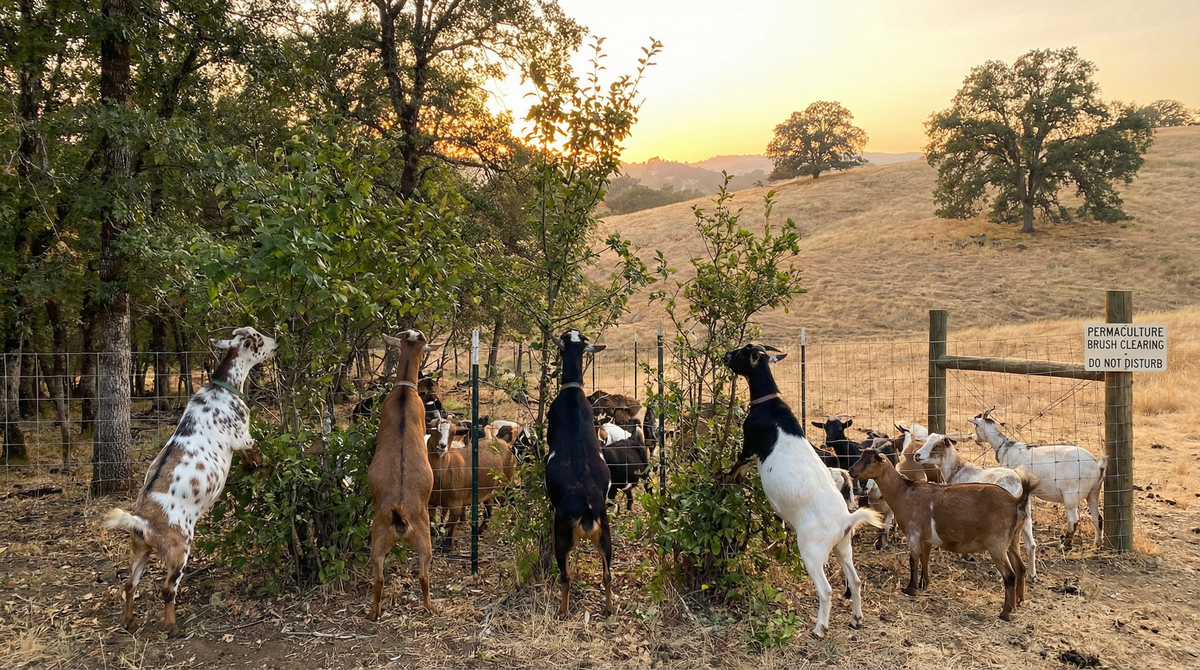
A browser eats woody shrubs, vines, and tree leaves preferentially. A grazer eats grass. Goats will eat grass when better browse is unavailable, but they will leave a pasture for a hedgerow of blackberry, smilax, or vine maple every time they are given the choice. On my central Florida site (USDA zone 9b), that preference is the entire job description: my small herd of Nigerian Dwarf and Spanish-cross does earn their feed clearing fence-line brush, kudzu, and beautyberry that would otherwise demand the brush cutter every six weeks from April through October.
Permaculture Role
Goats fill four useful niches on a permaculture site: brush and weed control, milk and meat production, manure for the compost pile, and dairy-goat soap economics that can pay a small homestead bill or two.
Brush and weed control
Goats are the right tool for clearing overgrown thickets of blackberry, kudzu, multiflora rose, and woody invasives that sheep and cattle ignore. USDA-ARS targeted-grazing studies in the Appalachians and Pacific Northwest show goats reducing target weed cover by 50 to 90 percent over two to three growing seasons when stocked correctly. Stocking density is the lever: too few goats and they cherry-pick the best browse and leave the rest; too many and they strip the site bare and start eating the bark off your young fruit trees.
Dairy and meat
Heat-tolerant breeds for the Gulf coast and Deep South include Nigerian Dwarf (small dairy, 1 to 2 quarts per day, easy on small properties), Nubian (large dairy, longer ears help with heat tolerance), Spanish (range meat breed, parasite-resistant), Kiko (New Zealand meat breed bred for hardiness), and Boer (meat breed widely available in the South). Saanens, Alpines, and other Northern European dairy breeds will produce more milk per day in cool weather but struggle through the Gulf-coast summer.
Manure and compost
Goat manure comes in pellets that are dry, almost odorless, and can be added directly to garden beds without composting first. A single doe produces 1 to 2 pounds of manure per day. Bedding stripped from the shelter (oak leaves, pine shavings, used hay) composts into a high-quality soil amendment in 4 to 6 months on the Gulf coast.
Housing & Fencing
Goats are infamous escape artists, and almost every goat-keeping failure I have witnessed locally has traced back to inadequate fencing rather than feed, predators, or health. Build the fence first.
Fencing
The working baseline in the southeast is 48-inch woven-wire field fence with a hot top strand at 52 to 54 inches and one electrified offset strand at goat-chest height (roughly 18 inches) on the inside to keep them from leaning into and stretching the woven wire. Electric high-tensile alone is workable but demands more training and more frequent maintenance. Barbed wire is not adequate and not appropriate. Cattle panels are excellent for small permanent paddocks but expensive per linear foot.
Shelter
A three-sided run-in shed with the open face turned away from prevailing wind (southwest in Florida) is sufficient in zones 8 and warmer. Allow at least 16 square feet per goat under roof, with raised wooden sleeping platforms 8 to 12 inches off the ground to keep the herd off damp bedding. In colder zones, an enclosed barn with passive ventilation is the safer build. Avoid sealed sheds; respiratory disease in goats is almost always a ventilation problem.
Footing
Hooves overgrow fast on soft Gulf-coast pasture. Trim every 6 to 10 weeks, more often in the wet season. A few large rocks or a concrete pad near the water trough wears the toe naturally between trims.
Feeding & Browse
A goat is a browse machine. The closer you can get its diet to free-choice browse plus a grass-hay supplement plus the right mineral block, the healthier the goat will be and the lower the feed bill.
Browse
Useful browse species on the Gulf coast include mulberry, moringa, pigeon pea, tagasaste (tree lucerne, marginal in FL summer), live-oak limb trimmings, and seasonal access to blackberry and kudzu thickets. Most southern-US fodder-tree research from UF/IFAS and Texas A&M Extension highlights mulberry and moringa as the top warm-climate forage trees by combined yield and protein.
Hay and supplements
Coastal bermudagrass or bahiagrass hay is the standard supplement. Alfalfa is appropriate for lactating does and growing kids in measured amounts but is too rich as a sole forage. Avoid feeding moldy hay; listeriosis from spoiled feed is a recurring problem in southeastern goat herds.
Minerals
A goat-specific mineral (never a sheep block) is non-negotiable. Goats need copper at levels toxic to sheep, and the most common preventable goat death on smallholdings I have visited is copper deficiency from accidentally feeding a sheep-and-goat mineral block.
Toxic plants
Fatal or high-toxicity browse to exclude or fence off includes yew, oleander, rhododendron, mountain laurel, lantana, and wilted leaves of red maple and wild cherry. Lantana is especially common as an ornamental in Florida yards and is a frequent cause of hepatotoxicity in browsing goats.
Health
Goats kept on dry, well-drained ground with appropriate browse and minerals are remarkably healthy. On wet, year-round pasture, they are walking parasite buffets. Florida and the broader Gulf-coast region have the worst small-ruminant parasite pressure in the continental US.
Parasites
The barber pole worm (Haemonchus contortus) is the dominant killer of goats and sheep in the southeastern United States. It is a blood-feeding stomach worm that causes severe anemia. The industry-standard management tool is the FAMACHA eye-color anemia scoring system, originally developed by University of Pretoria researchers and now taught by the American Consortium for Small Ruminant Parasite Control. Combined with selective deworming (only treat goats showing clinical anemia, score 4 or 5) and rotational grazing across at least three paddocks, FAMACHA scoring slows the development of resistance to dewormers.
Hooves
Trim every 6 to 10 weeks. Foot rot (Dichelobacter) is uncommon on dry sand but common in low-lying wet paddocks; the fix is improving drainage rather than chasing it with antibiotics.
Vaccines
CDT (Clostridium perfringens C and D plus tetanus) is the universal annual goat vaccine. Other vaccines (CL, sore mouth, rabies in some states) depend on local disease pressure. Consult a local small-ruminant veterinarian.
Coccidia
Kids under 6 months on damp bedding are the highest-risk group for coccidiosis. Clean bedding, good drainage, and prophylactic coccidiostat in feed during the first 4 months keep losses low.
Field notes, central Florida. I keep a small herd of three Nigerian Dwarf does and two Spanish-cross does on roughly an acre split into three rotational paddocks. FAMACHA-scored monthly, I deworm maybe 1 to 2 goats per year out of 5 rather than the whole herd on a calendar. Hooves are trimmed every 7 weeks during the May to October wet season, every 9 to 10 weeks the rest of the year. I lost one kid to coccidia in year one before I learned to keep bedding dry; since then the only routine kid loss has been to a stray dog that came through a section of fence I had let lapse.
Integration
Goats integrate well with silvopasture, brush-and-fence-line management, and small-scale dairy. They integrate poorly with actively planted food forests under 5 years old unless you are willing to trunk-wrap every fruit tree, because a goat will girdle a young loquat in a single afternoon.
Silvopasture
Mature canopy (live-oak, pecan, slash pine in Florida) at 40 to 60 percent cover gives goats welcome shade and reduces summer-stress weight loss. Avoid pastures dominated by red maple (wilted leaves are toxic to ruminants) and oak in heavy mast years (excess acorns cause tannin toxicity).
Brush clearing rotation
Use a portable electric paddock to concentrate goats on a target patch for 7 to 14 days, then move them off before they strip preferred species and start on the rest. Repeat the cycle 4 to 6 weeks later when regrowth has reached 6 to 12 inches.
Co-grazing with sheep or cattle
Goats and sheep share parasites and should be on separate rotations or treated as a single epidemiological unit. Cattle do not share most goat parasites and make excellent co-grazers, breaking the worm cycle by hoovering up larvae that goats deposit.
Guardian animal
Coyote, stray-dog, and (in some areas) bobcat predation makes a livestock guardian dog, donkey, or llama essential for any small herd left on pasture overnight. One bonded donkey per 50 to 75 goats is the working ratio.
Frequently Asked Questions
How many goats do I need?
At least two. Goats are herd animals and a solo goat will be loud, lonely, and prone to escape looking for company. Two does, or a doe and a wether (castrated male), is the minimum.
How much land per goat?
A quarter to half an acre of mixed browse and pasture per goat is workable if you supplement with hay. For brush-clearing rotations, stock heavier in shorter windows.
Are goats good with children?
Small breeds (Nigerian Dwarf, Pygmy) are typically calm and approachable when handled from kidhood. Bucks (intact males) become aggressive during rut and are not appropriate for child contact regardless of breed or temperament.
Can I keep goats on a quarter-acre suburban lot?
Yes, in many jurisdictions, with Nigerian Dwarf does or wethers. Check city ordinances on livestock and minimum-distance setbacks from neighboring dwellings before buying.
What is the difference between a doe, a buck, and a wether?
A doe is an intact female. A buck is an intact male. A wether is a castrated male. Wethers are the calmest, easiest to handle, and the most commonly recommended starter goat for new keepers.
References
- American Consortium for Small Ruminant Parasite Control. FAMACHA Anemia Scoring. wormx.info/famacha
- University of Florida IFAS Extension. Meat Goat Production in Florida. edis.ifas.ufl.edu — AN145
- USDA Agricultural Research Service. Targeted Grazing with Goats. ars.usda.gov/research
- Langston University E. Kika de la Garza American Institute for Goat Research. Goat Nutrition and Forage. luresext.edu/goat
- Penn State Extension. Goat Health and Disease Prevention. extension.psu.edu/goats
Field notes and central-Florida observations in this article are from Lucas Summer’s permaculture site in USDA zone 9b. Herd composition, rotational paddock setup, and FAMACHA-based deworming experience reflect on-site practice; parasite biology, fodder-tree research, and vaccine schedules are drawn from the extension and research sources cited above.
Foraging Behavior
Goats are active and selective foragers, known as browsers, not grazers. They prefer to eat shrubs, tree leaves, and weedy plants over grass. They have a split upper lip that allows them to be selective in what they eat and can forage on a wide variety of plants.
Fencing Requirements
Fencing for goats should be at least 4 feet (120cm) high and robust, as they are agile climbers and jumpers. Predator protection is crucial, and using livestock guardian animals like llamas is an effective strategy. Separate fencing is required to keep bucks and does apart.
Shelter Requirements
Goats need a simple, three-sided shelter to protect them from wind, rain, and sun. The shelter should be dry and well-ventilated. They are social animals and should be housed with at least one other goat.
Permaculture Notes
Goats are a valuable component of permaculture systems, offering a multitude of benefits. Their primary role is often as land-clearers and weed-managers. As browsers, they have a preference for woody plants, shrubs, and invasive species that other livestock might avoid, making them excellent for clearing overgrown areas and preparing land for planting. This natural behavior reduces the need for mechanical or chemical clearing methods, aligning with permaculture principles of using biological resources.\n\nIn a silvopasture system, goats can be integrated with trees and pasture. They help manage undergrowth, reduce fire risk, and their manure fertilizes the soil, contributing to a closed-loop system. Rotational grazing is a key practice when using goats in any pasture-based system to prevent overgrazing and parasite buildup. Their manure is a valuable soil amendment, being relatively dry and easy to handle. It can be added directly to garden beds or composted to create a rich fertilizer.\n\nGoats also provide a variety of products, including milk, meat, and fiber. Dairy goats can provide a steady supply of fresh milk, which can be consumed raw or processed into cheese, yogurt, and other dairy products. Meat goats, such as the Boer breed, are efficient at converting browse to meat. Fiber goats, like the Angora and Cashmere breeds, produce valuable fiber for textiles. This diversity of products enhances the resilience and self-sufficiency of a permaculture homestead.\n\nHowever, managing goats in a permaculture system requires careful planning and infrastructure. Goats are notorious escape artists, so robust fencing is essential to protect gardens, orchards, and other sensitive areas. Predator protection is also a major consideration, and the use of livestock guardian animals is a common and effective strategy. Providing adequate shelter and a varied diet is crucial for their health and well-being. By understanding their natural behaviors and needs, goats can be a highly beneficial and productive element in a permaculture design.