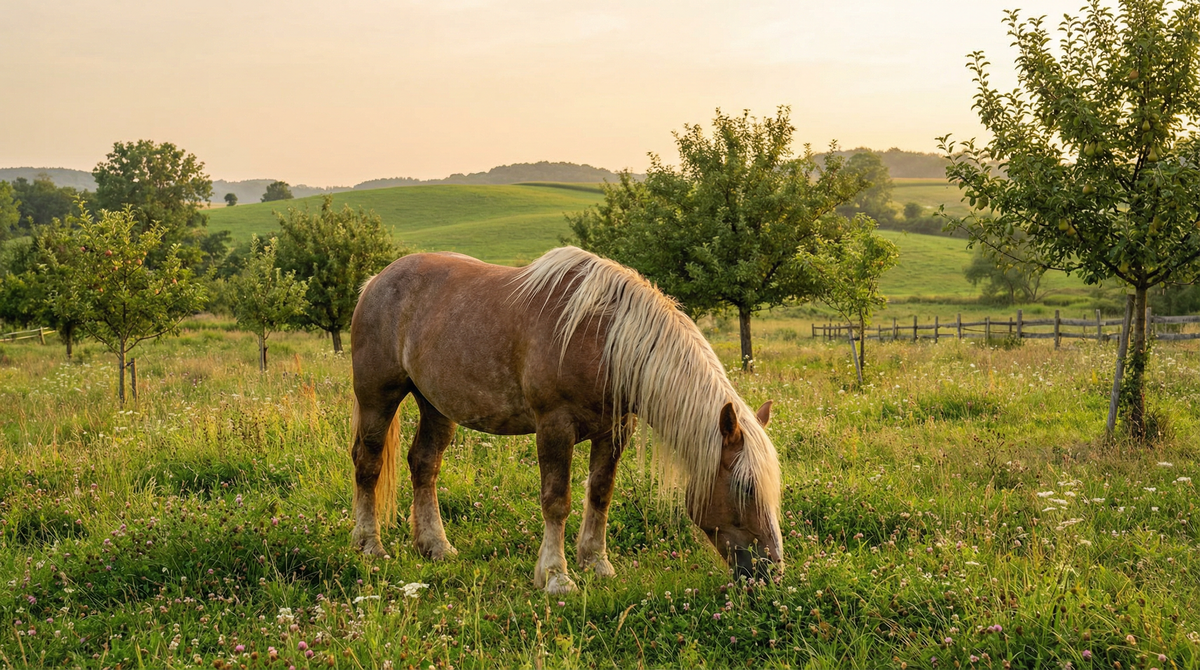
Overview
The horse (Equus ferus caballus) is a single-toed grazing equine domesticated on the Eurasian steppe roughly 6,000 years ago. The species transformed human history through transport, draft power, and warfare. In a modern permaculture context the horse is a more honest fit as a personal-recreation animal than as a working livestock species, simply because its space and feed requirements are an order of magnitude larger than those of any other animal on this site.
That said, where the land base and the labor budget exist, a horse remains a useful element. Manure is plentiful and excellent. Light draft work (logging, small-scale tillage, cart use) is feasible. Pasture management with rotational grazing reduces parasites and improves grass quality. On my central Florida site (USDA zone 9b), I have kept neighbors’ horses on shared pasture twice for short stretches but have not owned one myself; the math of 1 to 2 acres per horse plus year-round hay supplementation pencils out only if the animal is also doing real work or carrying a riding function that no smaller animal can provide.
Permaculture Role
The four functional niches a horse can fill on a working permaculture site are pasture management, manure production, light draft work, and personal-transport / riding utility on terrain that is hard for a vehicle.
Pasture management
Horses are selective grazers and will create “lawns and roughs” on a single pasture if left to free-graze, eating preferred grasses to the ground while letting weeds and rougher grasses set seed. Rotational paddock management across 3 to 6 cells, each grazed for 3 to 7 days, fixes the problem and improves pasture quality over 2 to 3 years. UF/IFAS Extension and Penn State Extension both publish detailed rotational-grazing plans for the southeastern US.
Manure
A 1,000 lb horse produces roughly 40 to 50 pounds of manure per day. Composted for 3 to 6 months at proper carbon-nitrogen ratios, it becomes a high-quality soil amendment. Fresh horse manure carries viable parasite eggs and weed seeds and should not be applied directly to vegetable beds.
Light draft and transport
Heavy breeds (Belgian, Percheron, Suffolk Punch, Norwegian Fjord) and draft crossbreeds remain useful for logging small woodlots, plowing market-garden plots, and pulling carts on terrain a tractor cannot easily reach. The fuel and maintenance bill for the horse is not actually lower than a small tractor for most operations; the choice is usually about scale, terrain, and craft rather than economics.
Personal mobility
A trained horse remains the most efficient cross-country transport on rough or boggy ground and is the working choice on cattle ranches across the western and southeastern United States.
Housing & Fencing
Horses tolerate cold well in a dry, draft-free shelter and tolerate heat well with shade and water. The real housing problems on a small homestead are space (1 to 2 acres of pasture per horse is the working minimum), fencing visibility, and footing in wet weather.
Shelter
A three-sided run-in shed with the open face turned away from prevailing wind is sufficient in zones 7 and warmer. Allow at least 12 by 12 ft per horse, with 14 by 14 ft preferred for larger breeds. Stalls in an enclosed barn are useful for veterinary care, foaling, or short confinement but are not the everyday housing standard.
Fencing
The single biggest difference between horse fencing and cattle fencing is visibility. Horses run into low or hard-to-see fences at speed and injure themselves. Three-rail wood, vinyl, or coated high-tensile wire at 48 to 54 inches with a top sight rail is the standard. Barbed wire is categorically inappropriate for horses; UF/IFAS Extension and AAEP both publish injury data showing barbed-wire lacerations as a leading source of preventable veterinary emergencies on small horse properties.
Footing and turnout
Florida sand drains well, which is an advantage. Low spots become mud and breeding ground for fly larvae and thrush. A sacrifice paddock with crushed shell, or a dry-lot near the shelter for wet-weather use, protects pasture during the rainy season.
Water
A 1,000 lb horse drinks 5 to 15 gallons per day, doubling in summer heat and during heavy work. An automatic waterer or a 100-gallon trough kept clean is the working standard.
Feeding & Forage
Horses are hindgut-fermenting grazers and do best on continuous low-volume forage intake rather than large meals. The standard rule of thumb is 1.5 to 2.5 percent of body weight in dry-matter forage per day, with grain only when work intensity, lactation, or growth demands it.
Pasture
On the Gulf coast, warm-season grasses are the working forage base. Bermudagrass and bahiagrass pastures, managed to a 4 to 6 inch grazing height and rested 21 to 30 days between rotations, support a horse on 1 to 2 acres without continual hay supplementation in the growing season.
Hay
Mature grass hay (coastal bermuda or timothy) is the default for adult horses at maintenance. Alfalfa is appropriate for hard-working, growing, or lactating animals only and is too rich as a sole forage.
Grain and concentrates
Most adult horses at light work do not need grain. A balanced ration balancer (1 to 2 lb per day) covers mineral and vitamin gaps without adding starch. Working, breeding, or growing horses are the exceptions.
Minerals and salt
Free-choice salt block and a horse-specific mineral supplement matched to the local forage profile. Florida soils are typically low in selenium and copper; a regional ration balancer or a UF/IFAS forage test informs the right supplement.
Toxic plants
Fatal or high-toxicity species to exclude from pasture include yew, oleander, red maple (wilted leaves), black walnut (shavings and leaves), oak acorns in quantity, bracken, and alsike clover. Buttercup in pasture is generally avoided by horses but causes mouth irritation if they have nothing else to eat.
Health
The horse industry has more veterinary infrastructure than any other species in this list, which is fortunate because horses are also more fragile and more expensive to treat than the alternatives.
Hooves
Trim or shoe every 5 to 8 weeks. Shorten the interval in the wet season. Thrush (anaerobic bacterial infection of the frog) is the most common Gulf-coast hoof problem and traces to wet, dirty footing.
Parasites
Florida supports a year-round parasite load. Fecal-egg-count-based deworming (rather than blanket calendar deworming) is the current UF/IFAS Extension and American Association of Equine Practitioners (AAEP) recommendation. Strongyles, ascarids, and tapeworms are the main targets.
Colic
Equine colic (abdominal pain from gut dysfunction) is the leading cause of premature horse death. Prevention is fresh water always available, gradual feed changes, continuous forage rather than large meals, and prompt veterinary attention for any horse off feed or rolling repeatedly.
Vaccines
AAEP core vaccines for the southeastern US include Eastern and Western equine encephalitis, West Nile virus, tetanus, and rabies, all administered annually. Booster boosters for EEE and WNV are common in late spring to prepare for mosquito season.
Dental
Annual dental floating (filing of sharp enamel points) by an equine veterinarian is the standard.
Field notes, central Florida. I have hosted two of a neighbor’s Quarter-Horse geldings on a rotational paddock setup for short stays during fencing repairs on her side. The biggest lesson from those stays was just how much pasture a horse consumes compared with my donkey on the same ground: roughly 5 to 8 times the daily forage intake. For a working homestead without a riding or draft job that justifies it, the math pointed me back to the donkey as the practical equine. The horses themselves were calm, no veterinary problems, and the manure was a welcome addition to the compost windrows.
Integration
Horses integrate well with silvopasture, rotational grazing, and co-grazing with cattle. They integrate poorly with goats and sheep (parasite overlap is moderate but the more important issue is size and behavior mismatch) and do not integrate at all with active food-forest plantings, which they will trample and browse.
Silvopasture
Mature canopy (live-oak, pecan, slash pine in Florida) at 30 to 50 percent cover gives horses welcome summer shade. Avoid pastures dominated by red maple (wilted leaves are fatally toxic) and be cautious of black walnut anywhere near turnout areas.
Co-grazing with cattle
Horses and cattle do not share most parasites, so following one with the other on rotation interrupts worm cycles for both species. Cattle clean up rough patches horses leave behind, and horses tolerate cattle-grazed pastures without complaint.
Manure system
Daily pickup from sacrifice paddocks and shelter areas into a covered compost windrow keeps fly populations down and produces finished compost in 3 to 6 months. UF/IFAS Extension and Rutgers Equine Science Center both publish best-practice manure-management guides.
Draft and work
Light draft (cart, harrow, single-bottom plow) is appropriate on 5 acres and up. Larger draft operations require draft-bred horses and a trained teamster.
Frequently Asked Questions
How much land do I need for one horse?
The working minimum is 1 acre of good pasture per horse with rotational management and hay supplementation during dry spells. Two acres per horse is a more comfortable target.
Can horses and donkeys live together?
Yes, often very well. Mixed equine herds are common. Donkeys can sometimes be aggressive toward horses they did not grow up with, so introductions should be gradual.
What is the cheapest horse to keep?
An easy-keeper grade horse on good pasture with minimal grain. There is no truly cheap horse; veterinary, farrier, hay, and shelter costs are roughly $2,500 to $5,000 per horse per year in the southeastern US even before tack and training.
What is the difference between a horse, a pony, and a miniature horse?
Horses are over 14.2 hands (about 58 inches) at the withers. Ponies are 14.2 hands and under but over 8.5 hands. Miniature horses are 8.5 hands (34 inches) and under and are considered a separate breed category.
Should I geld my colt?
Yes, unless you have specific breeding plans. Intact stallions require separate housing, careful handling, and are not appropriate for most homestead settings.
References
- American Association of Equine Practitioners. Vaccination and Parasite Control Guidelines. aaep.org/horsehealth
- University of Florida IFAS Extension. Horse Management in Florida. edis.ifas.ufl.edu — horses
- Penn State Extension. Equine Rotational Grazing. extension.psu.edu/horses
- Rutgers Equine Science Center. Manure Management for Horse Farms. esc.rutgers.edu
- USDA Natural Resources Conservation Service. Conservation Practices for Horse Properties. nrcs.usda.gov
Field notes and central-Florida observations in this article are from Lucas Summer’s permaculture site in USDA zone 9b. Pasture-consumption comparison against the on-site donkey and the decision to keep a donkey rather than a horse reflect on-site practice; veterinary, parasite, and vaccine guidelines are drawn from the AAEP, UF/IFAS, and Penn State sources cited above.
Foraging Behavior
Horses are herbivores that are adapted to grazing on grasses. In a natural setting, they will spend 16-20 hours a day foraging. They are selective grazers, preferring to eat young, tender grasses and avoiding more mature, tougher plants.
Fencing Requirements
Secure and visible fencing is essential for containing horses. Electric fencing is a popular choice for rotational grazing systems. Natural fences can also be used, but care must be taken to select non-toxic plant species.
Shelter Requirements
Horses need protection from extreme weather. A simple three-sided shelter that provides shade and a windbreak is often sufficient. The shelter should be located in a dry, well-drained area.
Permaculture Notes
Horses can be valuable additions to a permaculture system, but their large size and specific needs require careful planning. They excel in rotational grazing systems, where they can be used to manage pasture and build soil health. Their manure is a rich source of nutrients for compost and can be used to fertilize gardens and orchards. Integrating horses into a silvopasture system, where trees are grown in the pasture, can provide shade, shelter, and additional forage for the horses, while also producing timber or other tree crops. However, it is important to manage their grazing to prevent overgrazing and soil compaction. A well-designed permaculture system for horses will include a variety of forages, a reliable water source, and adequate shelter.