Overview
The domestic sheep (Ovis aries) is a small ruminant domesticated from the wild Asian mouflon at least 10,000 years ago in the Fertile Crescent. Sheep were among the first livestock species kept by humans and remain one of the most widely distributed, with global populations above 1.2 billion animals according to the FAO. They produce meat, milk, wool, and hides; they fertilize and graze pasture; and they integrate readily with silvopasture, orchard, and rotational-grazing systems.
On the Gulf coast, the critical breed decision is wool vs hair. Wool breeds (Suffolk, Hampshire, Merino) struggle through Florida summer humidity, require annual shearing, and are at higher risk of flystrike on soiled fleece. Hair breeds (Katahdin, St. Croix, Royal White, Dorper, Barbados Blackbelly) shed their winter coats naturally each spring, tolerate heat and humidity well, and are the practical choice in zones 8 and warmer. On my central Florida site (USDA zone 9b), I keep a small flock of Katahdin and St. Croix ewes paired with a donkey jenny guardian on roughly two acres of mixed bahiagrass and live-oak shade.
Permaculture Role
Sheep fill four useful permaculture niches: pasture and orchard ground-cover management, lamb and dairy production, manure for fertility, and (with wool breeds) fiber.
Pasture and orchard management
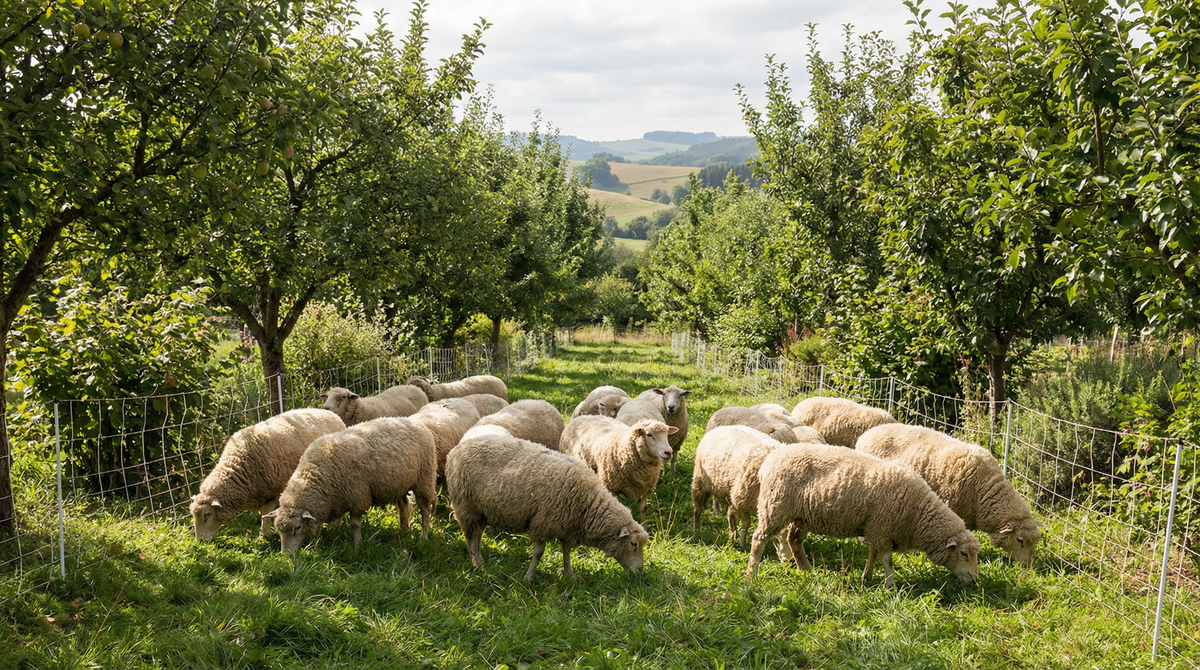
Sheep are selective grazers that prefer forbs (broadleaf weeds) over grasses, which makes them excellent for grass-and-broadleaf weed control in established orchards, vineyards, and silvopasture. They graze closer to the ground than cattle and do not pull plants by the root the way goats do, so they are gentler on perennial plantings.
Lamb and dairy production
A Katahdin or St. Croix ewe produces 1 to 3 lambs per year (twins are common in good condition). Lambs finish to 90 to 110 lb live weight in 6 to 9 months on pasture. Dairy sheep (East Friesian, Lacaune) produce 200 to 600 lb of milk per 5 to 7 month lactation, useful for cheese and yogurt production. Most homestead flocks are meat-only.
Manure
A 100 lb ewe produces 3 to 5 lb of manure per day. Sheep manure pellets are dry, low in odor, and low enough in nitrogen to apply directly to garden beds without burn risk.
Wool and fiber
Wool breeds remain commercially relevant in temperate regions. On the Gulf coast, wool production is mostly a heritage or hobby pursuit.
Housing & Fencing
Sheep housing on a working homestead is simpler than goat housing because sheep do not climb or test fences with their bodies the way goats do. The recurring challenges are predator protection, footing, and parasite management on permanent pasture.
Shelter
A three-sided run-in shed with the open face turned away from prevailing wind is sufficient in zones 7 and warmer. Allow 12 to 20 sq ft per ewe under roof, more for lambing space. Hair sheep tolerate Florida summers in open shade without active cooling; wool sheep often need fans.
Fencing
48-inch woven-wire field fence with a hot top strand at 52 inches is the working baseline. Multi-strand electric high-tensile (5 strands at 6, 12, 20, 30, 42 inches) is an alternative for perimeter or rotational paddocks. Predator-proofing the outside perimeter against coyote and stray-dog pressure matters more than containing the sheep themselves.
Lambing jugs
4 by 4 ft pens within the shelter for ewes with newborn lambs through the first 2 to 3 days. Bonding time in a small space reduces lamb mortality from accidental separation or chilling.
Footing
Wet pasture causes hoof rot and overgrowth. Trim every 8 to 12 weeks, more often in the wet season. A dry-lot or sacrifice paddock near the shelter protects pasture during heavy rains.
Feeding & Forage
Sheep are pure grazers, more grass-oriented than goats but more selective than cattle. The right pasture mix plus a species-appropriate mineral block is the foundation; grain and concentrates are for production stages, not maintenance.
Pasture
On the Gulf coast, bermudagrass and bahiagrass at 3 to 5 inch grazing height in a rotational system support ewes at maintenance through the growing season. Perennial peanut at 10 to 20 percent of the pasture mix improves crude protein significantly.
Hay
Coastal bermudagrass or timothy hay through winter. Alfalfa is appropriate for lactating ewes and growing lambs in measured amounts. Avoid moldy hay; listeriosis is a recurring problem in southeastern sheep flocks.
Minerals
A sheep-specific mineral block (not a sheep-and-goat mineral) is non-negotiable. Sheep are extremely sensitive to copper toxicity; goat or cattle minerals can kill them. Florida soils are typically low in selenium; a regionally formulated mineral covers the gap.
Toxic plants
Fatal or high-toxicity species to exclude from pasture include yew, oleander, rhododendron, mountain laurel, lantana, milkweed, bracken, white snakeroot, and St. John’s wort. Oak acorns in heavy mast years cause tannin toxicity. Wilted red maple leaves are fatally toxic.
Health
Sheep on dry, well-drained ground with appropriate forage are healthy. On wet, year-round southeastern pasture they share the same parasite-pressure problem as goats. Florida has the worst small-ruminant parasite pressure in the continental US.
Parasites
The barber pole worm (Haemonchus contortus) is the dominant killer of sheep and goats in the southeastern US. The American Consortium for Small Ruminant Parasite Control teaches the FAMACHA eye-color anemia scoring system as the practical management tool. Combined with selective deworming (only treat clinical anemia score 4 or 5) and rotational grazing across at least three paddocks, FAMACHA scoring slows the development of dewormer resistance.
Hooves
Trim every 8 to 12 weeks. Foot rot (Dichelobacter nodosus) is uncommon on dry sand but common in low-lying wet paddocks. The fix is improving drainage, not chasing it with antibiotics.
Vaccines
CDT (Clostridium perfringens C and D plus tetanus) annually for the whole flock; ewes boosted 4 to 6 weeks before lambing to pass immunity to lambs. Rabies depending on local incidence.
Lambing
Hair-sheep ewes typically lamb easily and twin without assistance. Provide a dry, draft-free lambing area, iodine for navel dipping, and a 24-hour check to make sure each lamb is up and nursing. Hypothermia of newborn lambs is the leading lamb-loss cause on small flocks.
Flystrike
Wool sheep are highly vulnerable; hair sheep are nearly immune. Daily inspection of the hindquarters in hot wet weather catches problems early.
Field notes, central Florida. My working flock is 6 Katahdin/St. Croix-cross ewes and one Katahdin ram bred for fall lambs, paired with a single guard donkey jenny across three rotational paddocks. FAMACHA monthly, deworm only animals scoring 4 or 5 (typically 0 to 2 head per year out of 7). The donkey has stopped every coyote and stray-dog incursion I have observed, and ended a black-vulture lamb-loss issue we had before her arrival. Lamb weights at 6 months average 70 to 85 lb live, which finishes at the local processor for roughly 35 to 45 lb dressed.
Integration
Sheep integrate well with silvopasture, orchards, vineyards, and rotational grazing alongside cattle. They integrate poorly with goats (parasite overlap) and with intensive food-forest plantings under 5 years old without trunk protection.
Silvopasture
Mature live-oak, pecan, slash-pine canopy at 30 to 50 percent cover gives sheep summer shade and reduces heat-stress weight loss. Avoid pastures dominated by red maple (wilted leaves are fatally toxic).
Orchard and vineyard
Sheep grazed under mature fruit trees or established vines control grass and broadleaf weeds without herbicide. Babydoll Southdown and Olde English Babydoll sheep are popular for vineyards because their small size limits damage to grape clusters at low canopy heights.
Co-grazing with cattle
Sheep and cattle do not share most parasites and graze complementary parts of the pasture (sheep take broadleaf weeds and shorter grasses, cattle take taller stems). Co-grazing or sequential rotation improves total stocking efficiency by 20 to 30 percent in most published trials.
Guardian animal
Coyote, stray-dog, bobcat, and (in some areas) black-vulture predation makes a livestock guardian essential. One bonded donkey jenny or a livestock guardian dog (Great Pyrenees, Anatolian Shepherd, Maremma) per flock under 100 head is the working standard.
Frequently Asked Questions
What is the best sheep breed for the southeast?
Hair sheep: Katahdin (most widely available), St. Croix (parasite-resistant), Royal White, Dorper (meat type), and Barbados Blackbelly (small, tropical-adapted). Avoid wool breeds unless you have a specific wool market.
How much land per sheep?
1/4 to 1/2 acre per ewe on good rotational pasture, less if hay supplements winter feeding. Smaller acreage works with intensive management; larger acreage allows lower management intensity.
Can I keep just one sheep?
No. Sheep are flock animals and a solo sheep will be stressed, vocal, and prone to escape. Two ewes is the minimum.
Do sheep need shearing?
Wool breeds yes, once a year. Hair breeds no, they shed naturally each spring.
What is the difference between a sheep and a goat?
Same family (Bovidae), different genus and species. Sheep prefer grass and forbs; goats prefer browse and woody plants. Sheep flock more tightly; goats are more independent. Sheep are sensitive to copper; goats need it. The two species require different minerals and somewhat different management.
References
- American Consortium for Small Ruminant Parasite Control. FAMACHA Anemia Scoring. wormx.info/famacha
- University of Florida IFAS Extension. Sheep Production in Florida. edis.ifas.ufl.edu — sheep
- Langston University. Small Ruminant Nutrition and Forage. luresext.edu
- USDA-APHIS National Wildlife Research Center. Livestock Guardian Animals. aphis.usda.gov/wildlife-damage
- Penn State Extension. Sheep Health and Disease Prevention. extension.psu.edu/sheep
Field notes and central-Florida observations in this article are from Lucas Summer’s permaculture site in USDA zone 9b. Flock composition, donkey-guardian setup, FAMACHA-based deworming pattern, and lamb-weight figures reflect on-site practice; parasite biology, vaccine schedules, and guardian-animal recommendations are drawn from the ACSRPC, UF/IFAS, and USDA-APHIS sources cited above.
Foraging Behavior
Sheep are diurnal grazers, foraging for 8-12 hours a day in multiple bouts. They are selective grazers, preferring forbs, and will graze closer to the ground than cattle. They have a strong flocking instinct and will graze as a group.
Fencing Requirements
Woven wire or high-tensile electric fencing is recommended. Fences should be at least 4 feet high to deter predators. Electric fencing requires multiple strands and proper grounding.
Shelter Requirements
A simple three-sided shed open to the south or east is often sufficient. Sheep need protection from wind and rain, but are tolerant of cold temperatures if they have a full fleece. Ensure good ventilation to prevent respiratory issues.
Permaculture Notes
Sheep are a valuable addition to many permaculture systems. Their ability to convert pasture into a variety of products makes them a versatile and productive animal. In silvopasture and agroforestry systems, sheep can be used to manage undergrowth, reducing the need for mowing and herbicides. Their manure provides a natural fertilizer, enriching the soil and promoting plant growth. Rotational grazing is a key practice when integrating sheep into a permaculture design. By moving sheep between paddocks, you can prevent overgrazing, improve pasture health, and break parasite cycles. This mimics the natural grazing patterns of wild herbivores and helps to build soil fertility. Sheep can also be integrated into orchards and vineyards to control weeds and fertilize the soil. However, care must be taken to protect young trees from being damaged by the sheep. One of the main challenges of raising sheep is predator protection. Good fencing is essential, and livestock guardian animals such as dogs or donkeys can be a valuable asset. It is also important to be aware of plants that are toxic to sheep and to ensure that your pastures are free of them. With proper management, sheep can be a low-maintenance and highly productive element of a permaculture homestead.