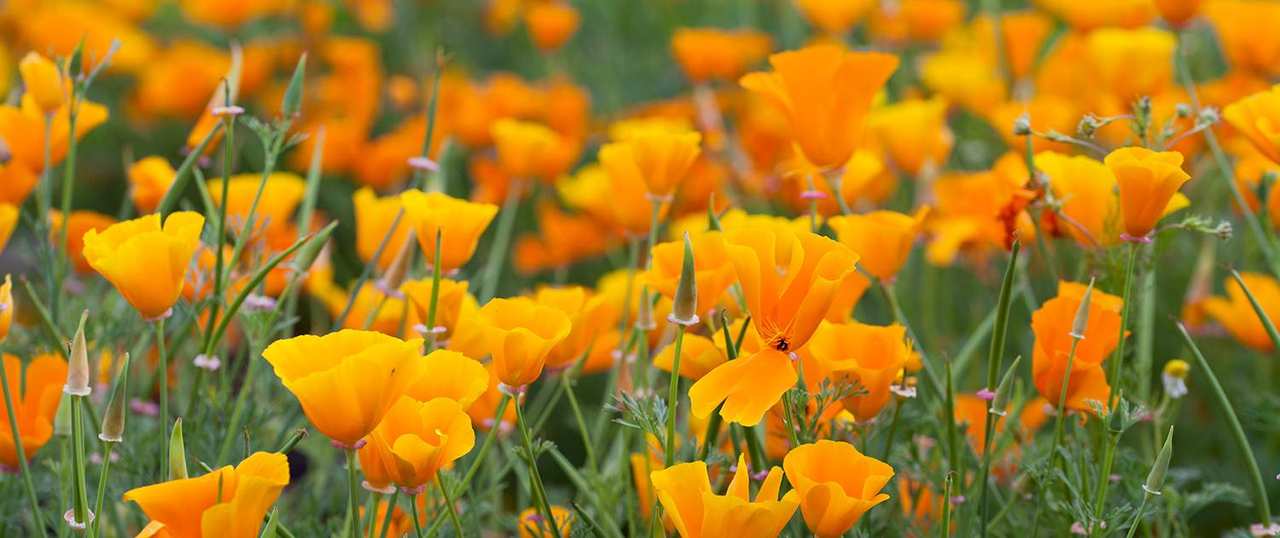
California poppy is the state flower of California, and it's technically illegal to pick one from the wild. Most people have heard that. What almost nobody mentions is that this plant has no opium in it whatsoever, shares almost no chemistry with Papaver somniferum, and yet it's been quietly used for centuries as a gentle sedative and pain reliever by tribes like the Chumash long before anyone called it a poppy. Two plants, same common name suffix, completely different pharmacology, and one of them gets all the notoriety. The other one just keeps blooming.
I've scattered California poppy seed into more marginal spots than I can count, the kind of places where nothing else wanted to cooperate: caliche-heavy banks, bone-dry gravel strips, the neglected strip along a south-facing fence. It thrives there in a way that feels almost pointed, like the plant is making an argument. Give it rich soil and regular water and you get leggy plants with fewer flowers. Give it neglect and poor drainage and it lights up like something's on fire. That tension between what we think plants need and what this one actually wants is where its whole story lives.
California Poppy Origin and History
Botanical Background and Native Habitat
Few plants wear their origins as visibly as the california poppy. Eschscholzia californica is primarily an annual, completing its full life cycle in as little as 6 to 12 weeks under the right conditions, though in mild-winter climates it can persist as a short-lived perennial for two to three years, occasionally longer.[1][2][3] Its native range stretches from British Columbia south through California, Oregon, Washington, Nevada, Arizona, and into Baja California and northern Mexico, with the densest populations concentrated across California's valleys, coastal dunes, and chaparral slopes.[4][5][6] It climbs from sea level to roughly 2,000 meters, though it performs best below 1,000 meters where the Mediterranean climate is most pronounced.[7][8]
Its whole biology reflects a landscape shaped by long dry summers, mild wet winters, and periodic fire. The plant thrives in open, often disturbed ground: roadsides, grasslands, coastal bluffs. It tolerates saline and impoverished soils but draws the line at heavy clay or waterlogged conditions.[4][6] Seeds persist in the soil bank, and smoke or heat from fire actually stimulates germination, making California poppy one of the first plants to carpet burned chaparral in a wave of orange.[9][10] That post-disturbance opportunism is exactly what draws me to it as a regenerative gardener. Every time a patch self-sows into the thin, gravelly edge of a path I forgot to tend, I'm watching that same resilience play out on a smaller scale. The California Native Plant Society lists it as a common native with no conservation concerns,[11] which is both reassuring and, honestly, a little remarkable given how thoroughly it has been loved by gardeners worldwide.
Visual Characteristics
The plant itself is easy to recognize. It typically reaches 20 to 60 centimeters tall (occasionally to 80 cm in ideal conditions), forming a low, bushy mound anchored by a deep taproot that is its primary drought-survival tool.[4][12] The stems and finely dissected, fern-like leaves are glaucous, that distinctive cool blue-green that signals the plant is built for sun and dry air.[4][6] I've noticed the blue sheen becomes more pronounced under intense summer light, almost silver at the leaf margins. The waxy coating reduces water loss, which pairs neatly with that taproot to explain how this plant outlasts everything around it in drought.[13]
Flowers are cup-shaped, four-petaled, typically brilliant orange, though wild populations and cultivars range from pale yellow through pink and red to white.[14][2] They open in full sun and close reliably at night and on cloudy days, a habit that has become a kind of garden clock for me: when my poppies fold up in early afternoon, a weather change is usually coming.[15][14] Once fertilized, each flower produces a slender seed capsule 2 to 5 centimeters long that splits explosively at maturity, flinging 50 to 100 tiny dark seeds surprising distances.[6][16] That taproot, by the way, is one thing I wish someone had told me earlier: once established, this plant does not transplant. Direct sow it where you want it and leave it alone.
Cultural and Traditional Significance
The scientific name traces back to 1821, when Adelbert von Chamisso collected and described the plant during a Russian scientific expedition to California. The genus Eschscholzia was named in honor of the expedition's botanist, Johann Friedrich von Eschscholtz, cementing this quintessentially Californian wildflower in European botanical history.[17] From there, 19th-century cultivation introduced it to similar climates around the world, where it naturalized enthusiastically and became a garden staple far beyond its western North American homeland.
Long before European botanists arrived, Indigenous peoples across California had been working with this plant for generations. The Chumash and other tribes used it as a gentle sedative and analgesic, treating pain, headaches, insomnia, and anxiety, and incorporated it into ritual and dye practices.[18][19] I'm not an ethnobotanist, but years of working with native-plant communities has deepened my respect for how precisely those traditional applications mapped onto the plant's actual chemistry. Modern herbalists still use it for exactly the same calming purposes. California's legislature formalized the plant's cultural centrality in 1903, designating Eschscholzia californica as the official state flower under Assembly Bill No. 481.[20][21] Picking it on public land is restricted in California and many other states; I've made a habit of enjoying wild poppies where they stand and collecting seed only from my own cultivated plants.[22]
Fun Facts About California Poppy
California poppy's fire-adapted ecology is genuinely fascinating. Seeds lying dormant in the soil bank respond to smoke compounds and heat, germinating rapidly after a burn to colonize bare ground before competing vegetation can recover.[23][10] The same opportunism shows up in any disturbed garden soil: a patch of scraped ground or freshly turned earth is an open invitation. Its low-mounding habit and dense foliage suppress weeds once it gets going, and the deep taproot stabilizes soil on slopes.
The daily flower-closing behavior follows a short-day blooming pattern requiring long nights to trigger flowering,[24] which partly explains why it blooms so prolifically in spring and early summer rather than midsummer's longest days. The glaucous, drought-tolerant foliage and ability to enter dormancy during extended dry spells round out a plant that has spent millennia solving the riddle of California summers.[13][4] Watching a self-seeded volunteer thrive in the worst corner of a garden, where everything else sulked, has a way of making you appreciate ecological intelligence in a plant. It really is built for exactly this kind of low-fuss, high-reward existence.
California Poppy Varieties and Where to Buy Them
Notable Cultivars of Eschscholzia californica
The wild-type california poppy gives you that iconic, unbeatable orange, but the cultivated world has run with it in every direction. Modern selections of Eschscholzia californica now span yellow, white, pink, red, salmon, peach, and rich bicolors.[13][25][26] Breeding has focused on enhanced flower color and form, compact growth for container use, disease resistance, and selections that hold up in dry conditions.[27][26] Those are exactly the traits I look for when speccing plants for xeriscapes and low-water polycultures.
For containers and tight spaces, compact varieties shine. 'French Dwarf' tops out around 10 cm, 'Pixie' at 15 cm, and 'Micro Chip' stays similarly tidy.[28][26] I think of them the way I think of portulaca: great performance in shallow soil, minimal fuss, and they look intentional rather than weedy even in a small pot. For visual drama in meadows and borders, I keep going back to the doubles and bicolors. 'Golden West' gives you full, ruffled golden-orange blooms, 'Sahara' is a deep orange double specifically selected for drought performance, and 'Pagosa' and 'Sunset Bicolor' bring that two-tone contrast that stops people mid-path.[28][26][26] Growing several of these side by side, I've noticed the double-flowered types like 'Golden West' and 'Sahara' draw noticeably more hoverflies and solitary bees than single-flowered cultivars, which makes them my first recommendation for pollinator guilds. The 'Mission Bells' mix is a reliable workhorse if you want a cheerful range of colors without sourcing a dozen packets. For tough sites, 'Alaska' handles colder winters better than most, and 'Esperanto' offers real disease resistance.[28][29]
One honest caveat from design practice: cultivars can escape gardens and naturalize aggressively outside the native range, potentially crowding out local flora.[30][31] I've seen certain bicolor types reseed more vigorously than others in garden edges near natural areas. If you're working near sensitive habitat, deadhead before seed set or choose less prolific named varieties.
Sourcing California Poppy Seeds and Plants
As California's official state flower, Eschscholzia californica is about as available as any annual gets: seeds, seedlings, and mature plants show up at nurseries, garden centers, and online suppliers across the U.S. and internationally.[32][33] Seed packets typically run $2 to $10 depending on variety and quantity; individual seedlings usually fall between $3 and $8. My preference, though, is to skip the big-box rack and order through Native Seeds/SEARCH or Seed Savers Exchange.[34][35] They preserve regional genetics rather than optimizing purely for visual uniformity, which matters when you're trying to support local pollinators rather than just fill a border.
California poppy is not considered invasive in the U.S. and is actively promoted for pollinator gardens and habitat restoration.[36][4][37] One thing worth knowing: collecting wild plants or seeds in California state parks and many public lands is illegal without permits.[4][38] A seed packet costs almost nothing; there's no reason to pull from wild populations, and honestly, the roadside drifts are far better left where they are. Buy seeds, grow your own colony, and let the wild ones keep doing what they do.
How to Grow California Poppy from Seed: Propagation and Planting Guide
Every time I recommend California poppy to someone new to wildflower gardening, my first sentence is always the same: direct sow it and don't touch it again. That's not quite the whole story, but it's the part that matters most. Seed is by far the most reliable propagation method, with germination success rates running 70-90% under good conditions.[28][39] The reason transplants are essentially off the table is that deep taproot. Those feathery blue-green seedlings look impossibly delicate, but if you try to dig one up even a few weeks after germination, you'll find a thick white taproot already driving several inches into the soil. Move it and you've likely killed it.
Propagation Methods for California Poppy
The seeds themselves are worth understanding before you sow them. They're tiny, dark brown to black, about 1 to 1.5 mm across, with a hard water-impermeable coat that creates physical dormancy.[6][40] This is the plant's adaptation to Mediterranean summers: seeds can sit in dry soil for months waiting for the cool, moist conditions that signal a safe window for germination. In the garden, that dormancy breaks naturally through dry storage or by keeping seeds cool. I store my harvested California poppy seed in a sealed envelope in the refrigerator and consistently get strong germination the following season, and often the one after that. Properly dried seed kept at 4-10°C with humidity below 50% stays viable for 2-5 years; freeze it at -18°C with low moisture content and viability can stretch to decades.[41][42]
One thing worth knowing if you're saving seed from named cultivars: don't expect the offspring to match the parent. California poppy is primarily outcrossing in the wild, with 70-95% of pollinations in natural populations coming from other plants via bees and other insects.[43][44] The first year I grew 'Orange King' and let it self-seed, the volunteers that came back the following spring were a surprise mix of pale yellow, cream, and soft apricot alongside the expected orange. Charming in a meadow context, but something to plan around if you're designing for a specific color. Cuttings are possible in theory, with semi-ripe material taken in late summer achieving roughly 40-60% success with rooting hormone,[28] but I've never found a reason to bother when seed performs this well.
Soil, Site, and Sun Requirements
California poppy evolved in chaparral, coastal scrub, and sandy grasslands, places where the soil is lean, drainage is sharp, and summers are bone dry.[4][45] That ecology is your planting guide. Sandy loam, rocky soil, low organic matter: these are not obstacles to work around, they're the target. When I've made the mistake of amending a bed with rich compost before sowing, the plants respond with lush, floppy foliage and noticeably fewer flowers. Low fertility keeps them compact and blooming hard.
Soil pH between 6.0 and 7.5 is the sweet spot.[46][47] I always do a quick soil test before establishing a new planting area; it takes twenty minutes and saves a lot of guesswork. Outside that range, you'll see chlorosis and stunted growth, and diagnosing it mid-season is frustrating. Heavy clay or waterlogged ground is a dealbreaker entirely. Full sun is equally non-negotiable: 6 to 8 hours of direct light daily.[48][49] The waxy cuticle on those glaucous leaves is built for open, exposed sites; shade reduces bloom significantly and produces the weak, etiolated stems that make the plant look like a totally different species.
Planting Technique, Spacing, and Germination Timeline
The single most common reason California poppy seed fails to germinate is being buried too deep.[50][51] These seeds need light to germinate. Surface sow or cover no more than 1/8 inch, then press gently to ensure contact with the soil.[52][53] I learned this by comparing two adjacent patches one spring: one surface-sown, one barely covered at a quarter inch. The surface-sown row was thick and uniform within two weeks; the other was patchy and slow.
Timing depends on your climate. In mild climates, fall sowing lets seeds stratify naturally over winter for a strong spring flush. In colder zones, early spring sowing before the last frost works well because the seeds are cold-tolerant. For a meadow planting, broadcast at roughly 1-2 grams per square meter, then thin seedlings to 6-12 inches apart once true leaves appear.[52][53] That spacing might feel generous when the seedlings are tiny, but mature plants spread 12-24 inches and need airflow. Keep seedlings consistently moist until they're established; after that, back off and let the drought tolerance do its work.
Germination typically takes 10 to 21 days at soil temperatures between 55 and 75°F.[28][54] From there, expect flowers in 45 to 60 days under optimal conditions, with the full seed-to-seed cycle completing in about 3 to 4 months. Once you've had a successful season and let some pods go, the plant largely propagates itself. That first packet of seed can become a self-sustaining colony that returns year after year with almost no help from you, which is exactly what you want from a plant going into a low-intervention polyculture.
California Poppy Care Guide
Every care decision you make with California poppy should start from the same mental image: a single orange cup blazing out of a gravelly roadside cut, no irrigation anywhere nearby. That plant isn't struggling. It's thriving exactly as it evolved to. The whole care philosophy follows from that picture.
Sunlight Requirements
California poppy wants full sun, at least 6-8 hours of direct light per day, and it will tell you loudly when it doesn't get it.[55][33] I've grown plants in a spot that got just under six hours and they were leggy, floppy, and stingy with flowers. The same seed sown twenty feet away in full sun produced compact, blooming-their-hearts-out plants all spring. Coastal gardeners in persistent fog belts can manage on morning sun with afternoon overcast, but expect a reduced bloom count.[56] Shade also raises the stakes for disease; humid, low-light conditions invite powdery mildew, and the best prevention is simply giving the plant the bright, airy spot it wants.[57]
Water Needs
Once established, California poppy is one of the most drought-tolerant flowering plants I grow. The combination of a deep taproot, glaucous leaves that cut transpiration, and the ability to go fully dormant in summer heat means a mature plant can go 3-6 months without supplemental water in zones 7-10.[4][58] In my garden, the self-sown volunteers in the gravel path get zero irrigation and consistently outlast the beds I fuss over. A little neglect really is love with this species.
The one exception is the seedling stage. For the first 4-6 weeks, young plants need light, consistent moisture every 2-3 days to establish that taproot.[54][59] Once they're established, back off sharply. Mature plants during dry spells only need water every 1-2 weeks, and in winter with adequate rainfall, none at all.[45][52] I've killed young plants by watering them on the established-plant schedule before learning this distinction. Yellowing leaves starting at the base and mushy crowns are the classic overwatering tells; wilting with dry soil an inch down means they're thirsty.[45] Always let the soil dry completely between waterings.
Feeding and Soil Fertility
Here's the mistake I see most often, and I've made it myself: enriching the soil before sowing. California poppy prefers lean, well-drained ground with nitrogen in the 20-40 ppm range.[60][61] Push nitrogen above that and you'll get a gorgeous mound of feathery blue-green foliage with almost no flowers. Every lean-soil wildflower meadow I've installed has had California poppy as its star; every time I've enriched a bed, the poppies sulked. Phosphorus and potassium matter more here than nitrogen, supporting root establishment, bloom production, and drought resilience.[60]
If your soil is genuinely poor to the point of compaction or near-zero organic matter, a single early-spring application of half-strength 5-10-10 is the most intervention you should offer.[52][62] Test your soil before adding anything. The default assumption should be that no fertilizer is necessary.
Heat Tolerance
California poppy handles Mediterranean summer heat well, tolerating daytime temperatures up to 100°F with an optimal growth range around 60-85°F.[63] Above 82-90°F, though, you'll start seeing wilting, leaf scorch, flower drop, and shortened bloom periods; seedlings are especially vulnerable above 86°F.[64] The plant is really relying on drought-avoidance strategies (taproot depth, stomatal closure) rather than true physiological heat tolerance, so the threshold matters. In my hot, humid summers I drape 30-40% shade cloth over young plants during peak afternoon heat and the difference in bloom duration is noticeable. A 2-3 inch layer of organic mulch and deep early-morning watering of about an inch per week help carry plants through the worst of it.[65] Above 90°F, expect the plant to enter summer dormancy and die back; that's normal, not failure.
Frost Tolerance
California poppy is hardy in USDA zones 6-10, with established plants handling light frost down to around 20°F.[45][66][4] Hard freezes below 25°F will damage or kill above-ground growth; buds, young leaves, and seed pods are the most vulnerable parts, while roots tucked into well-drained soil survive considerably more cold.[28][67] A 2-4 inch mulch of straw or bark after the first frost, combined with a south-facing, well-drained site to avoid frost pockets, covers most edge-zone situations.[68] In zones 6-7, the plant is technically a short-lived perennial but in practice self-seeding is far more dependable than trying to overwinter crowns.[45][4] I treat mine as an annual in marginal conditions and let it seed around freely; that's always worked better than mulching heavily and hoping.
Pruning, Maintenance, and Seasonal Rhythm
The main active task in California poppy care is deadheading. Remove spent blooms just above the foliage regularly and you'll extend the flowering season noticeably.[54][28] After the main spring flush winds down, I cut plants back hard to 3-6 inches. Some guides skip this step, but in my garden it consistently produces a smaller, welcome second flush once autumn temperatures cool back toward the 60-70°F sweet spot. Plants rarely need staking (they're compact at 12-18 inches) and a light gravel mulch around the base suppresses weeds without holding the moisture that invites root rot.[69][70]
If seed saving is on your list, let some pods dry on the plant until they rattle and turn brown (4-6 weeks after flowering), then shake them into a paper bag, dry indoors for a week or two, and store cleaned seed in an airtight container below 40°F where it'll stay viable for 2-3 years.[71][72] The seasonal rhythm overall looks like this: germination with fall or early spring rains, peak flowering March through June, seed set, then summer dormancy once temperatures consistently push past 90°F.[4][73] My biggest ongoing maintenance task is honestly just reminding myself not to water. Once the taproot is down and the plant hits its stride, it wants you to step back and let it do its thing.
When and How to Harvest California Poppy
I've grown California poppy in meadow patches for years, and the honest truth is that I think of it as an ornamental and medicinal herb first, with seed saving as the main practical harvest goal. The edible angle exists, but I'll get to why it stays firmly in the "occasional nibble" category rather than the salad bowl.
Timing: From Bloom to Seed Maturity
In temperate gardens, California poppy typically blooms from March through May, with seed harvest coming in June through August once the capsules turn brown, dry out, and start to rattle.[74][75][45] From the moment a flower opens to the point where the seed is fully mature runs about 30 to 45 days depending on temperature and how much moisture the soil has held.[76][77] In my Mediterranean-climate garden that window shifts a couple of weeks earlier in a wet spring versus a dry one, so I've learned to watch the plants rather than the calendar.
Harvest Techniques for Flowers and Seeds
For cut flowers, harvest in the early morning when buds are just cracking open or half-open, cutting stems at the base with sharp shears.[50][52] I always try to be done before 9 a.m. because the petals close up by midday in summer heat, and you'll find your half-open bud has shut tight by the time you get it into water. The good news is that cutting early blooms doesn't reduce seed production later in the season.[75] For california poppy seed pods, patience is everything. Let them mature and dry on the plant until they're fully brown and you can hear the seeds shift inside when you move the stem, then collect before they split open completely.[50][52] I learned the hard way to mark my seed patches early in the season because once those pods go brown, they shatter fast and what you were planning to harvest becomes next year's volunteers instead.
Edible Yield, Flavor, and Important Safety Notes
Young leaves, flowers, buds, and seedpods have traditionally been nibbled in small quantities and can be added sparingly as a garnish.[74][78] The flavor is mildly peppery with a slight bitterness, and the petals carry a delicate citrus-floral note fresh; dried, that brightness fades into something more earthy and herbal.[79][78] The seeds can stand in as a mild flavoring substitute for true poppy seeds, though they're not a culinary staple by any stretch.[74]
Here's the hard stop, though. All parts of the plant contain alkaloids including protopine and allocryptopine, and eating more than a token amount can be mildly toxic.[80][74] I keep California poppy firmly in the medicine garden and the flower border rather than the salad bowl; the alkaloid profile makes that a very clear boundary for me. If you're growing it for cut flowers, place stems immediately in cool water and they'll hold for five to ten days in a vase.[50][81] That's where this plant genuinely earns its keep at harvest time.
California Poppy Preparation and Uses
Culinary Considerations and Safety
Let me be direct here: california poppy is not a culinary herb. The same alkaloids -- californidine, protopine, and others -- that give it medicinal value can cause sedation, nausea, and other adverse effects when ingested in quantity.[45][82][83] I've had clients reach for the petals in a kitchen garden tour thinking "edible flower," and I always redirect them quickly.
There is a narrow historical footnote here. Some California Native peoples, including the Cahuilla, used tiny amounts of young leaves and fresh petals as a sparse garnish; harvested before full bloom, when alkaloid levels are lower, they carry a faint peppery-citrus quality.[18][84] The nutritional contribution is genuinely modest, roughly 20-30 kcal per 100g fresh weight with trace vitamins A and C and small amounts of potassium and calcium.[84][85] Roots and mature plant parts contain far higher alkaloid concentrations and should never be eaten. The Cahuilla occasionally roasted seeds as well, but those practices were context-specific and are not a recommendation for modern use.[45][86] Treat all of this as ethnobotanical history, not a recipe invitation.
I always tell clients to learn the petal-base differences before foraging any poppy. California poppy lacks the dark basal spots of Papaver rhoeas and has a completely different pod structure from the opium poppy; misidentifying any of these could lead to ingesting plants with far stronger narcotic alkaloids.[87][88] Cooking doesn't reliably neutralize the alkaloids, the FDA has not approved any part for food use, and anyone pregnant, breastfeeding, or taking sedative medications should avoid ingestion entirely.[89][83]
Traditional Medicinal Preparations
The aerial parts -- stems, leaves, and flowers -- are harvested during flowering for medicinal use, and this is where the plant genuinely earns its place in an herbal toolkit. The most common forms are a simple tea (1-2 teaspoons of dried herb steeped in 8 ounces of hot water for 10-15 minutes), a tincture (1:5 in 50-60% alcohol, typically 10-40 drops up to three times daily), or standardized capsules at 300-500 mg.[90][91][92] When I make tinctures I label every jar with the harvest date and intended use -- sleep support versus occasional anxiety -- because it reinforces deliberate, measured practice rather than casual self-dosing.
The effect is a mild central nervous system depression, useful for occasional sleeplessness, low-level anxiety, or tension. Compared to something like lemon balm, I find california poppy extract a bit more sedating but shorter-acting; useful to calibrate expectations before someone tries it for the first time. It's considered non-addictive at standard doses, but it can potentiate other sedatives, alcohol, and CNS depressants, so professional guidance matters before combining it with anything.[92][93] Honestly, I grow this plant mostly for its beauty and the pollinators it feeds, but I keep a small jar of dried aerial parts for the occasional evening cup when the season gets stressful, always staying well within that 1-2 gram range.
Non-Food Applications
California poppy's primary identity will always be ornamental and ecological. As the official state flower of California, it anchors wildflower meadows, slopes, and drought-tolerant garden designs across the West, and its fibrous root system knits disturbed soil together with impressive speed.[94][74] After years of designing native-plant meadows on sunny exposed slopes, I've come to rely on it as one of the fastest stabilizers I have available for bare ground, while simultaneously feeding native bees and other pollinators through the spring hunger gap.
Beyond the garden, its flowers yield a soft yellow-orange natural dye for fabric, and the dried petals and leaves store remarkably well -- up to one to two years in sealed containers kept cool and dry -- provided you test a small batch each season before use.[95] The citrus brightness fades with age and the aroma turns earthier; a quick sniff tells you more than any calendar date. The Cahuilla, Costanoan, Yokuts, and other tribes also used the plant ceremonially and medicinally for insomnia, anxiety, pain, and wounds, a tradition that remains its most meaningful human application beyond the ornamental.[18][78] In the end, the most honest way to relate to california poppy is to grow it for the pollinators, appreciate it for its beauty, and approach any medicinal use with intention and respect for its chemistry.
California Poppy Health Benefits and Medicinal Uses
Before anything else, I want to address the confusion I run into constantly: California poppy is not an opium poppy. Eschscholzia californica belongs to the same botanical family as Papaver somniferum, but it contains no morphine, codeine, or other opiates. When I cut a stem, there's no milky latex. When I look at the seed pod, the shape is completely different. They are distinct plants with distinct chemistry, and conflating them does a disservice to a genuinely useful herb with its own compelling story.
Traditional and Modern Medicinal Applications
Native American tribes used California poppy for centuries as a mild tranquilizer, applying it to conditions we'd recognize today as insomnia, anxiety, headaches, toothaches, and colic.[18][96] That's a remarkably coherent traditional profile, and modern pharmacological research has gone a long way toward explaining why it worked. The plant exhibits a range of documented activities including anti-inflammatory, antioxidant, analgesic, antimicrobial, and sedative effects.[97][98]
The core of the sleep and anxiety story is GABAergic. California poppy's alkaloids bind non-competitively to the benzodiazepine site on GABA_A receptors, enhancing the calming neurotransmitter activity that helps quiet an overactive nervous system.[99][100] Think of it as operating on a similar pathway to chamomile or lemon balm, but with a somewhat more direct mechanism. Its anti-inflammatory activity adds another layer, involving inhibition of COX-2 expression and NF-κB activation, which reduces pro-inflammatory cytokine production.[101][102] Flavonoids and alkaloids also scavenge free radicals in DPPH assay studies, pointing to antioxidant potential.[103] Preclinical work has identified weak opioid receptor agonism as one contributor to its analgesic effects, though it's far less potent than standard opioids.[97] Rounding things out, there's evidence for neuroprotective activity via NMDA receptor antagonism, antispasmodic effects through calcium channel blockade, and some antimicrobial action.[103][104]
Here's where I always have to pump the brakes a little with clients who are excited about this plant as a sleep or anxiety remedy. Animal model studies are robust, and there are limited clinical findings suggesting benefit for mild insomnia and anxiety, often when combined with other herbs like valerian.[105][106] But most human studies are small, uncontrolled, and lack placebo comparisons.[107][80] Larger randomized controlled trials are genuinely needed. I see California poppy as a supportive herb with a compelling traditional and preclinical record, not a standalone treatment for serious conditions.
Key Phytochemicals: Alkaloids, Flavonoids, and Phenolics
The primary drivers of California poppy's medicinal activity are its isoquinoline alkaloids, with protopine typically making up 20-50% of the total alkaloid content.[108][109] Alongside protopine you'll find allocryptopine, californidine, eschscholtzine, and smaller quantities of chelerythrine and sanguinarine. These are supported by a cast of flavonoids including rutin, quercetin, isorhamnetin, and kaempferol glycosides, plus phenolic acids like ferulic acid, caffeic acid, and chlorogenic acid.[108][110] Minor secondary metabolites include scopoletin (a coumarin), terpenoids, saponins, and the unusual carotenoid rhodanthin responsible for some of those vivid flower pigments.[108][111]
Where you harvest matters. Alkaloid concentrations peak in the flowers and roots, run moderate in leaves, and drop in stems, fruits, and seeds.[112] What I've observed in my own gardens backs this up: plants harvested after a dry stretch tend to taste more intensely bitter, which aligns with research showing that drought stress and certain soil conditions can push alkaloid concentrations up by as much as 30%.[113][114] Cultivar differences compound this further, with up to 20-fold variation in total alkaloid content documented between chemotypes. These alkaloids exist primarily as chemical defenses against herbivores, though the plant keeps concentrations lower in nectar and pollen to avoid harming pollinators.[115]
Nutritional Profile and Edible Uses
California poppy is a medicinal and ornamental plant, not a food crop. Young leaves and flowers are technically edible in small amounts, with the flowers offering a mild citrusy flavor, but seeds are not recommended for consumption.[45][74] Nutritional data is sparse; rough estimates suggest around 20-30 kcal per 100g fresh weight, with modest protein, some fiber, and trace vitamins and minerals including calcium, magnesium, and iron in dried leaves.[116][4] No USDA FoodData Central entry exists for this plant, which should tell you something about how seriously to weigh it as a nutritional source. Typical preparation involves serving sizes of just 1-5 grams, with boiling or wilting recommended to reduce bitterness.[45] I've tossed the occasional flower into a garden salad for color, and they do add a pretty, faintly citrus note, but I'd never frame this as a nutritious green. Your kale is doing more work.
Safety Considerations and Potential Side Effects
The good news is that Eschscholzia californica is considered non-toxic to mildly toxic for humans, pets, and livestock, and unlike its distant botanical relative Papaver somniferum, it carries no dangerous opiates and has no significant addiction potential.[117][118][119] Alkaloid content varies considerably by plant part, with roots running highest (0.8-2.0%), aerial parts moderate (0.3-0.8%), and flowers and seeds lowest.[120] Overconsumption can produce mild symptoms including drowsiness, nausea, dizziness, or gastrointestinal upset in people; dogs may experience sedation, ataxia, or low blood pressure. No serious poisoning cases or fatalities are widely reported.[121][122]
Where I get firm is with the hard contraindications. I never recommend California poppy during pregnancy or breastfeeding; safety data simply doesn't exist to justify it.[80][93] I don't recommend it for children, and I always ask clients about their medications before they start using it as a tincture or tea, because its GABA_A activity means it can stack dangerously with benzodiazepines, barbiturates, opioids, alcohol, and antihistamines.[119] The plant has no FDA GRAS designation, and use should stay short-term. If you're working with a healthcare provider on anxiety or sleep issues, loop them in before adding this herb to your routine. The traditional record and preclinical science are genuinely interesting, but they don't replace a conversation with someone who knows your full health picture.
California Poppy Pests and Diseases
Natural Pest Resistance and Common Insect Pests
California poppy comes to the garden with a surprisingly robust chemical defense system already in place. Its isoquinoline alkaloids, bitter latex sap, and surface trichomes make it genuinely unpalatable to most herbivores,[123][45] and when insects do start feeding, the plant releases volatile organic compounds that actively recruit natural predators and parasitoids.[124] I've watched this play out firsthand: a small aphid colony appears on a patch, and within a few days ladybugs and lacewings are working the stems without any help from me. Compared to other ornamentals, this plant effectively calls its own cavalry. It also shows stronger comparative pest resistance than close Papaveraceae relatives like Papaver rhoeas,[6][125] which says something given how susceptible some of those poppies can be.
That said, cultivated garden settings do see more pest pressure than wild populations,[126] and a short list of insects will still show up on occasion. Aphids cause distorted new growth and honeydew residue; spider mites produce fine webbing and stippled leaves, especially during hot dry spells; flea beetles punch tiny holes, mostly in seedlings; and cutworms can sever young plants at the soil line overnight.[127][128][129][130] Slugs and snails are worth watching in wetter climates, and seed weevils can reduce viability if you're saving seed.[131] Importantly, none of these typically vector serious diseases into the plant,[126] so an infestation is an annoyance rather than a cascade. No cultivars have been specifically bred for enhanced pest resistance; breeding has focused on flower color, height, and bloom time.[132][133] I select for color and form too, then rely on cultural practices to do the protective work.
My IPM approach here is simple: cultural controls first (good spacing, full sun, avoiding overhead water), then biological controls like encouraging those ladybug populations, and neem or horticultural oil only as a genuine last resort.[127][52] In California gardens, aphids and slugs warrant the closest watch; Pacific Northwest growers should keep an eye on drainage before anything else; and in the arid Southwest, spider mites in dry heat are the more likely visitor.[134]
Disease Resistance and Common Issues
California poppy's adaptation to dry, fast-draining soils built in antimicrobial chemistry that holds most fungal pathogens at bay under normal conditions.[135][4] The main exception is root rot from Phytophthora or Pythium, which appears almost exclusively in waterlogged or compacted soil.[136][137] The shallow root system is particularly unforgiving of even one prolonged saturation event, which is why in my designs I always specify raised beds or sandy soil amendments for this plant before anything else. Most disease conversations about California poppy begin and end with drainage.
Powdery mildew (Erysiphe spp.) can show up during humid coastal springs or when plants are crowded, but it's generally mild and not life-threatening.[138][139] Unlike zinnia, which can collapse under real mildew pressure, California poppy usually shrugs it off once air circulation improves.[140] Verticillium wilt has been documented in Southern California coastal areas and shows up as wilting with vascular discoloration,[141] but in years of working with this plant in native plant landscapes I can count my encounters with it on one hand. Downy mildew, botrytis, Alternaria or Septoria leaf spots, and bacterial issues are uncommon when the plant has full sun and good drainage;[135] rust fungi have been predicted based on related species but not confirmed in Eschscholzia californica itself.[137] Well-drained soil at pH 6.0-8.0, six or more hours of direct sun, and temperatures in the 60-80°F range let the plant's own defenses do most of the work.[137][52] Give it that, and disease becomes a rare conversation rather than a routine concern.
California Poppy in Permaculture Design
If you've ever watched a hillside erupt in orange after a wildfire or a wet winter, you've seen California poppy doing exactly what it was designed by evolution to do: rush in, stabilize bare ground, and feed every early-foraging bee in a five-mile radius. That pioneer instinct is precisely what makes it so useful in a designed system. I reach for it whenever I'm building a new bed that isn't ready for permanent planting yet, or when I need to stitch together the gaps in an established guild without spending money or time on something more demanding.
Ecosystem Roles and Guild Placement
As a colonizer of disturbed sites and open grassland, California poppy is one of the earliest reliable pollen and nectar sources in the spring garden, drawing in bumblebees, solitary Andrena and Perdita bees, hoverflies, butterflies, and beetles before much else is open.[142][143] I've noticed that on warm spring mornings, native bees work the orange cups with a kind of focused intensity I don't see on borage or phacelia nearby. The cup shape opens wide in morning sun and closes at night or under cloud cover,[144] which means peak foraging lines up almost perfectly with peak bee activity. Cross-pollination by those visitors increases seed set by 20 to 30 percent over self-pollination alone,[144] so the relationship benefits the plant as much as the bees.
Below ground, the taproot is doing real work. I used California poppy on a sloped bed in one of my earlier food forest designs where I was losing topsoil every winter, and within two seasons that slope was visibly more stable. The root system binds soil, aerates compacted layers, and improves water infiltration; when the plants die back, the decomposing biomass adds organic matter that slowly builds fertility.[142][145] The plant also shows allelopathic properties that suppress competing weeds, and it associates with arbuscular mycorrhizal fungi that help it pull phosphorus from nutrient-poor soils where other annuals would starve.[146][147] Sparrows and finches also pick the seed capsules clean before you get a chance to collect them, which adds a small but real wildlife dimension to the plant's usefulness.[148]
Worth pairing it with lupines, asters, salvias, or buckwheat to extend the pollinator window and increase visitation density across the whole bed.[149] These California poppy companion plants share similar sun and drainage needs, so the guild stays coherent without much management. Two caveats to hold alongside all of this: California poppy is not a nitrogen-fixer, so it won't replace legumes in that role, and outside dry-summer climates similar to its native range it can naturalize aggressively and outcompete indigenous species.[150] Use it thoughtfully if you're gardening in Australia, New Zealand, or elsewhere where it has established beyond its native range.
Climate Adaptation and Hardiness Zones
California poppy is native to Mediterranean-climate zones across western North America, from sea level up to around 2,000 meters, and it has naturalized in analogous dry-summer regions including parts of Europe, the UK, and Australia.[151][152] In USDA zones 6 through 10, it behaves as a short-lived perennial where winters are mild and a prolific self-seeding annual where they're not.[153][4] The picture that description paints is: hot dry summers, mild wet winters, fast-draining soil. That's the sweet spot.
Germination is best between 55 and 75°F, growth is happiest at 60 to 75°F, and established plants handle heat up to 100°F before they start to bolt or reduce flowering.[28][50] On the cold end, plants can take light frost down to about 20°F and survive to 14°F in sheltered spots, though they'll die back and depend on self-sown seed to return the following spring.[45][4] The plant dislikes humidity and wants 12 to 20 inches of annual precipitation, most of it in winter.[4][6] If you're in a humid subtropical climate, drainage becomes everything. I've seen it rot out in heavy clay soil during a wet spring when the same seeds thrived in a nearby sandy raised bed without any supplemental water at all.
Forest Layer and Companion Planting
In permaculture layer terms, California poppy sits in the herbaceous layer or ground-cover position. It grows 10 to 60 cm tall with finely divided blue-green foliage that's open enough to let light reach the soil surface,[4][154] which means it plays well as a living mulch between shrubs and perennials without shading them out. After my first year establishing a planting, I've found it reliably self-seeds back into the sunny edges of the guild each spring, filling gaps that would otherwise invite weeds. That self-renewing quality basically eliminates replanting labor in established beds, which is exactly what you want from an herbaceous layer plant.
It thrives in the low-fertility, sandy, or gravelly soil conditions that often characterize the edges and sunny clearings of food forests, where richer-soil plants won't perform well.[56] I've grown it successfully in spots where almost nothing else would establish without amendment, and it has always looked better for it. On the safety side: the alkaloids in California poppy are real, and while they're what gives the plant its gentle medicinal properties, they also mean it shouldn't be treated as a food plant or left accessible to children or livestock who might graze on it freely.[4] Site it for its ecological value and its beauty, not for the dinner table.
The Plant That Taught Me to Stop Trying So Hard
I once spent a full season babying a California poppy bed, amending the soil, watering on a schedule, doing everything right. The plants were fine. Forgettable. Then a handful of seeds escaped into the gravel path beside it, and those volunteers were electric, exactly the orange you see in pictures of Antelope Valley in April. I've gardened differently ever since.
Sources 154
- California Poppy (Eschscholzia californica) - Missouri Botanical Garden ↩
- California Poppy - Lady Bird Johnson Wildflower Center ↩
- USDA PLANTS Database - Eschscholzia californica ↩
- Eschscholzia californica ↩
- Biota of North America Program (BONAP) ↩
- Flora of North America - Eschscholzia californica ↩
- Eschscholzia californica ↩
- Eschscholzia californica ↩
- Eschscholzia californica ↩
- Fire Ecology of California Poppy ↩
- Conservation Status of California Poppy ↩
- Eschscholzia californica - California Poppy ↩
- Eschscholzia californica ↩
- California Poppy (Eschscholzia californica) ↩
- California Poppy (Eschscholzia californica) - UC Agriculture & Natural Resources ↩
- Eschscholzia californica - Missouri Botanical Garden ↩
- History of the California Poppy ↩
- California Poppy Medicinal Uses ↩
- State Symbols USA - California State Flower ↩
- State Flowers: The California Poppy ↩
- California State Flower: California Poppy ↩
- Picking Wildflowers in California ↩
- Fire ecology of California: Eschscholzia californica ↩
- Eschscholzia californica - Missouri Botanical Garden ↩
- Eschscholzia californica ↩
- California Poppy Varieties ↩
- California Poppy Cultivars and Breeding ↩
- Eschscholzia californica ↩
- Pollinator Garden Plants: California Poppy Varieties ↩
- Eschscholzia californica ↩
- Eschscholzia californica CalPop ↩
- Eschscholzia californica ↩
- Eschscholzia californica ↩
- California Poppy Seeds ↩
- California Poppy ↩
- California Poppy ↩
- Noxious and Invasive Weed List ↩
- Native Plant Protection ↩
- California Poppy (Eschscholzia californica) ↩
- Seed Dormancy and Germination in Eschscholzia californica ↩
- Seed Storage of Horticultural Crops ↩
- Seed Longevity and Storage Conditions for California Native Plants ↩
- The Breeding System of Eschscholzia californica ↩
- Reproductive Ecology of Eschscholzia californica (California Poppy) in the Pacific Northwest: Frequency of Floral Morphs and Self-Incompatibility ↩
- Growing California Poppies: Eschscholzia californica ↩
- Growing California Poppy ↩
- California Poppy (Eschscholzia californica) Plant Fact Sheet ↩
- Eschscholzia californica - Plant Profile ↩
- Physiological Adaptations of Eschscholzia californica to Mediterranean Climate ↩
- Growing California Poppies: Harvesting Seeds and Flowers ↩
- Eschscholzia californica ↩
- How to grow California poppy ↩
- California Poppy (Eschscholzia californica) ↩
- Eschscholzia californica (California Poppy) ↩
- University of California Agriculture and Natural Resources - California Poppy ↩
- California Native Plant Society - Native Plants for Coastal California Gardens ↩
- Growing California Poppies ↩
- California Native Plant Society - The California Poppy ↩
- The Spruce - Growing California Poppies: Tips for Planting and Care ↩
- University of California Cooperative Extension - Native Plant Gardening Guide: California Poppy - Soil Fertility ↩
- Missouri Botanical Garden Plant Finder - Eschscholzia californica ↩
- IPM UC - California Poppy Production ↩
- Missouri Botanical Garden - Eschscholzia californica ↩
- University of California - California Poppy Care: Handling Heat and Drought Stress ↩
- University of California - California Poppy (Eschscholzia californica) - Growing Guide ↩
- Royal Horticultural Society - Eschscholzia californica ↩
- University of California - Frost Tolerance of Annual Flowers ↩
- University of California - Frost Protection Methods for Annuals and Perennials ↩
- IPM UCANR - Pest and Disease Management for California Poppy ↩
- Missouri Botanical Garden - California Poppy Growing Guide ↩
- IPM UCANR - California Poppy: Eschscholzia californica ↩
- California Native Plant Society - Seed Saving Guide for California Natives ↩
- California Native Plant Society - California Poppy ↩
- California Poppy Cultivation Guide ↩
- How to Collect Seeds from California Poppy ↩
- California Poppy: Eschscholzia californica ↩
- Seed Production in Papaveraceae ↩
- Ethnobotany of California Poppy ↩
- Aromatic Profiles of Native Wildflowers ↩
- Safety and Toxicity of Eschscholzia californica ↩
- Postharvest Handling of Cut Flowers ↩
- Phytochemical and Pharmacological Profile of Eschscholzia californica ↩
- California Poppy ↩
- Traditional Uses and Nutritional Aspects of Wild Edible Plants in California ↩
- Antioxidant Activity of California Poppy (Eschscholzia californica) Extracts ↩
- Ethnobotany Database Search - Native American Ethnobotany ↩
- Plants of the World Online: Eschscholzia californica ↩
- Biological Flora of Central Europe: Papaver rhoeas ↩
- Poison Control: California Poppy Toxicity ↩
- California Poppy - Eschscholzia californica ↩
- Eschscholzia californica Monograph ↩
- Herbal Medicine: Biomolecular and Clinical Aspects - California Poppy ↩
- Eschscholzia californica (California Poppy) Safety and Interactions ↩
- Eschscholzia californica - USDA Plants Profile ↩
- Drying and Storing Flowers for Longevity ↩
- California Poppy in Traditional Medicine - Kew Science ↩
- Pharmacological Review of Eschscholzia californica ↩
- Pharmacology of California Poppy (Eschscholzia californica): A Review ↩
- GABA_A Receptor Modulation by California Poppy Alkaloids ↩
- Anxiolytic Effects of Eschscholzia californica Alkaloids on GABA_A Receptors ↩
- Anti-inflammatory Effects of Eschscholzia californica ↩
- Anti-inflammatory Flavonoids in Eschscholzia californica ↩
- Antioxidant and Neuroprotective Properties ↩
- Antimicrobial Activity of Poppy Alkaloids ↩
- Anxiolytic Effects of Eschscholzia californica in Animal Models ↩
- Clinical Trial of California Poppy and Valerian for Insomnia ↩
- Clinical Trial on Anxiety and Sleep with California Poppy ↩
- Phytochemical and Pharmacological Review of California Poppy (Eschscholzia californica Cham.) ↩
- Alkaloids of California Poppy (Eschscholzia californica Cham.) ↩
- Flavonoids and Phenolics in California Poppy ↩
- Carotenoid Profiles in Papaveraceae: Focus on Rhodanthin ↩
- Phytochemical and Pharmacological Profile of Eschscholzia californica ↩
- Secondary Metabolites of Eschscholzia californica: Influence of Environmental Factors ↩
- Variation in Alkaloid Content in California Poppy Cultivars ↩
- Chemical Defense in California Poppy: Role of Secondary Metabolites Against Herbivores ↩
- Nutritional Composition of Selected Wild Edible Plants ↩
- Missouri Botanical Garden - Eschscholzia californica ↩
- ASPCA - California Poppy Toxicity ↩
- Natural Medicines Database - California Poppy ↩
- Phytochemistry of California Poppy (Eschscholzia californica) ↩
- University of Michigan Health - California Poppy ↩
- Pet Poison Helpline - California Poppy ↩
- Chemical and Physical Plant Defenses Against Herbivores ↩
- Volatile Emissions from Damaged California Poppy ↩
- Kew Science Plants of the World Online: Eschscholzia californica ↩
- California Poppy (Eschscholzia californica) - Pest Management ↩
- Pests and Diseases of California Poppy - UC IPM ↩
- Insect Pests of Ornamental Plants: Aphids ↩
- Flea Beetles and Leaf Beetles ↩
- Cutworms and Armyworms ↩
- Insect Pests of Ornamental Poppies - Extension Publication ↩
- Missouri Botanical Garden Plant Finder ↩
- Royal Horticultural Society Plant Page ↩
- UC Master Gardener Program - California Native Plants ↩
- Diseases of California Poppy (Eschscholzia californica) ↩
- Missouri Botanical Garden Plant Finder ↩
- Eschscholzia californica Plant Guide ↩
- Royal Horticultural Society Plant Search ↩
- Powdery Mildew on California Poppy in Arid Regions - ASHS Journal Article ↩
- Annual Wildflowers: Disease Resistance Comparison ↩
- Verticillium Wilt Incidence in Papaveraceae - USDA Plant Pathology Report ↩
- California Native Plant Society - Eschscholzia californica ↩
- IPM UCANR - Biology of California Wildflowers: Eschscholzia californica ↩
- American Journal of Botany - Self-Compatibility and Fruit Set in Eschscholzia californica ↩
- Ecological Society of America - Erosion Control Using Native Wildflowers ↩
- Weed Science - Allelopathy in Eschscholzia californica ↩
- New Phytologist - Mycorrhizal Associations in California Annuals ↩
- CNPS - Biomass Accumulation and Wildlife Benefits of California Poppy ↩
- UCANR - Companion Planting to Attract Pollinators ↩
- Biological Invasions - Invasive Grasses and Competition for Pollinators ↩
- Royal Horticultural Society - Eschscholzia californica ↩
- Kew - California Poppy ↩
- Missouri Botanical Garden - California Poppy ↩
- Missouri Botanical Garden - Eschscholzia californica ↩
About the Author
As an herbalist, Rhianna's mission is to bridge the healing capacities of nature to her community through her writing and crafted formulas, offering ancient pathways to health.