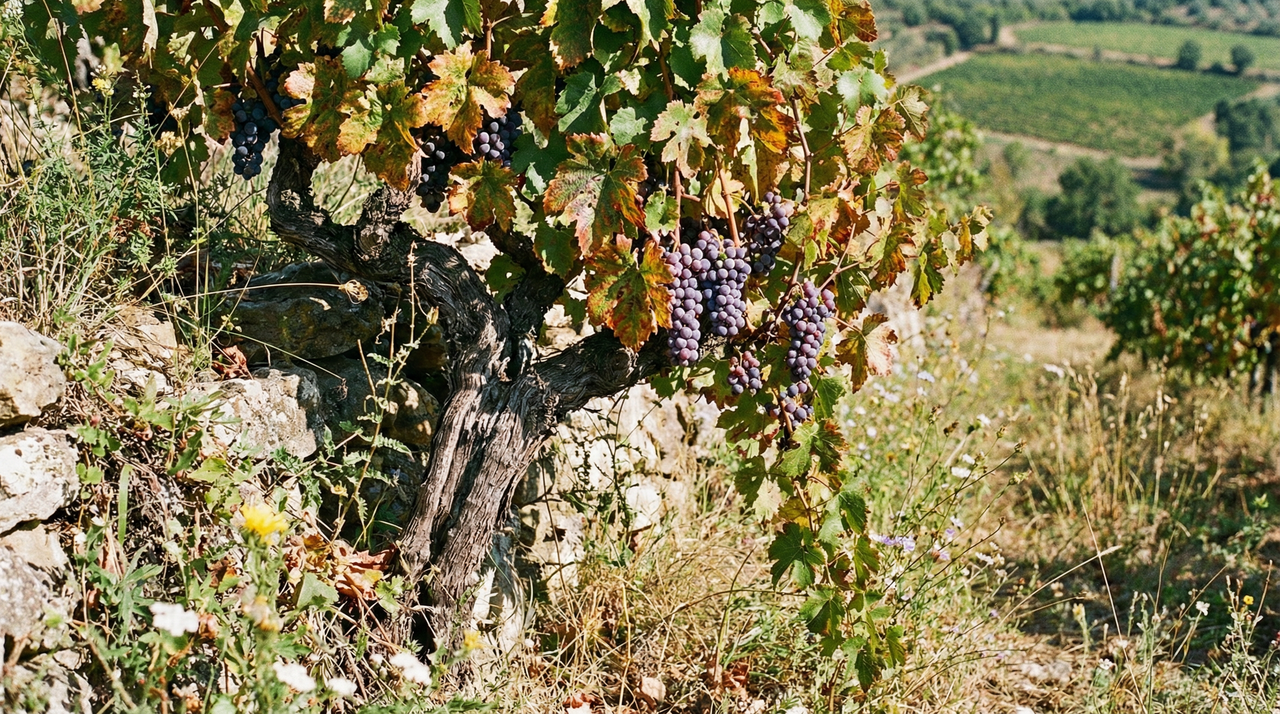
Most people think of grapes as a fruit crop, something you trellis, prune obsessively, and harvest once a year if the birds don't get there first. But the vine I'm standing next to right now, on a property in the foothills of northern California, was planted in the 1880s. It's gnarled at the base like something from a fairy tale, the trunk thicker than my forearm, and it produced a full crop last fall without a drop of irrigation. That's not a novelty. Some of the oldest documented Vitis vinifera vines in the world are still fruiting after 400 years.[1] We talk about grapes like they're a garden annual we need to coddle, when what we're actually dealing with is one of the most tenacious, long-lived perennials in temperate horticulture.
What shifts everything for me, as a designer, is thinking about grapes not as a trellis plant that produces fruit but as a structural organism with an 8,000-year relationship with human hands.[2] That history shapes every decision you make about placement, training, companions, and harvest timing; and ignoring it is why so many backyard vines either take over completely or limp along producing sour little clusters nobody wants to eat. Understanding what this vine actually is changes how you grow it.
Origin and History of Grapes (Vitis vinifera)
Few cultivated plants carry as much human history as the grape. The story of Vitis vinifera, the European wine grape, begins in the South Caucasus, in what is now Georgia and Armenia, where archaeological evidence places wine production from domesticated vines at approximately 6000 BCE.[3][4] That's eight thousand years of people selecting, propagating, and caring for this vine, which means a single species has been in active cultivation for longer than writing has existed.
Botanical Background and Lifespan
Vitis vinifera is a polycarpic perennial deciduous vine that climbs by coiling tendrils, reaching 20 to 30 meters when left unmanaged but settling into a more civilized 3 to 10 meters on supports.[5][6] What I find remarkable is how long these vines actually live. With thoughtful management, a grapevine can produce fruit for 30 to 50 years in temperate climates, and with the right site and care, well over a century.[7] Vines past the 50-year mark are often called "old vines," and there's good reason winemakers seek them out: they yield less fruit, but what they produce is more concentrated and complex.[8] I've walked rows of 80-year-old Zinfandel in California and seen exactly that: gnarled, shredding trunks with sparse clusters that punch well above their weight in flavor. Getting a vine to that age means starting with well-drained, fertile loamy soil at pH 6.0 to 7.0[9] and staying ahead of threats like phylloxera, powdery mildew, downy mildew, and black rot, which are the primary forces that cut a vine's life short.[10]
Visual Characteristics and Identification
The vine's climbing habit comes from modified stems that act as tendrils, coiling around any available support opposite the leaves.[11] Young stems are smooth to slightly fuzzy; older wood becomes rough and shreddy in a way that's quite distinctive once you've seen it. The leaves are broadly ovate with a heart-shaped base, palmately lobed into 3 to 5 sections, serrated along the margins, and anywhere from 5 to 20 centimeters across. They emerge bright green, mature to a dark leathery green, and shift to yellow, red, or purple in autumn.[12][13] Flowers are small, greenish-white, clustered in panicles of 100 to 300 blooms, with cultivated varieties mostly hermaphroditic, blooming May through June.[14][15] The familiar berries run 1 to 2 centimeters in diameter, round to oval, colored green through red, purple, and near-black by anthocyanin content.[16]
Distinguishing V. vinifera from its North American relatives takes a second look. Vitis labrusca carries dense fuzz on the leaf underside and produces the slip-skin "foxy" fruit familiar to anyone who's eaten a Concord straight off the vine.[17] I learned this the hard way after labeling a young seedling incorrectly one season because first-year leaf shapes can look deceptively similar. Vitis rotundifolia, the muscadine, doesn't climb by tendrils at all but twines by its petioles, and its thick-skinned berries run noticeably larger at 1.5 to 2.5 centimeters.[18][19]
Traditional and Cultural Uses Across Civilizations
From its Caucasian origins, V. vinifera spread to Mesopotamia by 6000 to 5000 BCE, reached Egypt by 3000 BCE where it appeared in ceremonies and as a symbol of prosperity; it arrived in Greece by 2000 BCE and became bound to Dionysian tradition, eventually traveling through Europe on the back of Phoenician trade and Roman expansion.[20][21] Benedictine and Cistercian monks carried viticulture forward from the 8th century onward, developing clones like Pinot Noir that are still grown today.[22] That kind of living agricultural inheritance is something I think about every time I propagate a heritage cutting. The vine arrived in California with Spanish missionaries in 1769.[23]
Christian symbolism gave the grape another dimension entirely, with Christ described as the "true vine" in John 15:1 and the fruit standing in for the Eucharist across centuries of European practice.[24] Meanwhile, medicinal use stretches back to at least 5000 BCE in both Ayurvedic and Chinese traditions, where grape leaves were applied to treat varicose veins and hemorrhoids and seed oil used for skin conditions.[25][26] Across the Atlantic, Cherokee and Creek peoples had their own deep relationship with native species like V. rotundifolia and V. labrusca, using them for food, teas to treat fever and sore throat, and ritual purposes long before European contact.[27][28] The same genus, two hemispheres, parallel reverence.
Fascinating Facts About Grapevines
Vitis vinifera now accounts for over 99 percent of global wine production, with roughly 70 percent of the world's harvest going to wine, 20 percent to table grapes, and the remainder to raisins and juice. The oldest known living specimen, the "Stara Trta" in Maribor, Slovenia, was planted around 1600 AD and still produces fruit today.[29] That a single vine planted over four centuries ago is still fruiting says everything about what good siting and consistent care can accomplish.
The vine manages its own biology across seasons through winter dormancy, with ecodormant buds that protect against cold stress until spring triggers bud break.[30] And while the European grape gets most of the cultural attention, the muscadine has its own living monument: the Mother Vine in Manteo, North Carolina, a Vitis rotundifolia estimated at over 400 years old and spanning 500 feet.[31] Muscadines are predominantly dioecious with naturally separate male and female plants, and their thick, tough skins confer remarkable fungal resistance[32] -- a trait I genuinely admire when I see them thriving in the humid Southeast where a European vine would be struggling. The genus, taken whole, is a study in resilience across wildly different climates and human cultures.
Grape Varieties and Cultivars
With over 10,000 named cultivars of Vitis vinifera alone,[33][34] the single most useful thing I can tell a new grower is this: start with your goal, not a name you recognize from a wine label. The entire grape world organizes itself around intended use, and once you understand that, the right cultivar for your site becomes much clearer.
Wine, Table, and Raisin Grapes: Understanding the Main Categories
Vinifera cultivars fall into three main horticultural categories: wine grapes, table grapes, and raisin grapes.[35][36][37] Wine grapes like Cabernet Sauvignon, Pinot Noir, and Chardonnay are managed for high sugar and acidity, typically hitting 20-25 °Brix at harvest with intentionally low yields of 1-3 tons per acre through cluster thinning.[38] They need a long, warm season to accumulate enough sugar, and honestly, most backyard gardeners will find them more demanding than rewarding. Table grapes like Thompson Seedless are a different animal entirely: thin-skinned, seedless, sweet enough to eat straight off the vine, and bred for appearance as much as flavor.[39] Raisin types share that high sugar profile but prioritize berry size and yield for efficient drying.[40] If fresh eating is the goal, a home grower will be far happier with Thompson Seedless or a muscadine than chasing a cabernet grape that demands precision canopy management.
Cold-Hardy and Disease-Resistant American Grapes
Outside the vinifera world, two American species solve real regional problems. Concord, the classic Vitis labrusca type grown across the Northeast and Midwest, produces large clusters of deep bluish-purple berries with that distinctive musky "foxy" flavor most of us associate with grape jelly and juice.[41] It's cold-hardy, high-yielding, and forgiving in ways that vinifera simply is not. The slip-skin texture, where the pulp pops right out of the skin with light pressure, is a dead giveaway at harvest and practically a childhood memory for anyone who grew up in grape country. Muscadine (Vitis rotundifolia), on the other hand, is built for the South: thriving in zones 7-10 and producing thick-skinned berries in shades from bronze to deep purple-black with a musky, sweet-tart flavor all their own.[42] I've grown muscadines in Central Florida where they needed almost no disease intervention, while nearby vinifera required careful, consistent canopy management just to stay healthy. Cultivars like Scuppernong and Carlos cover the bronze types; Noble and Supreme bring the dark-fruited options.[43][44][45]
Rootstock Species and Grafting
Vitis rupestris, the Rock Grape, produces small tart fruit with no commercial value, but its phylloxera resistance and tolerance of poor, calcareous, droughty soils made it one of the quiet heroes of modern viticulture.[46][47] Most commercial vinifera in the U.S. is grafted onto phylloxera-resistant rootstocks, including 101-14 Mgt (V. riparia x V. rupestris) and 3309 C, as well as pure rupestris selections like 'St. George.'[48][49] I've visited vineyards running St. George in sandy soils and seen firsthand how much more drought-tolerant and vigorous those vines perform compared to ungrafted material. For backyard growers, the takeaway is simple: buy grafted.
Sourcing Healthy Grape Vines
I only buy from nurseries that guarantee true-to-type, virus-tested stock. Replacing a mislabeled vine after three years of waiting for fruit is an expensive lesson I've watched too many client gardens absorb. Specialty sources like Double A Vineyards in New York and Wine Grapes Direct on the West Coast are reliable starting points for vinifera, with prices typically running $10-$85 per vine depending on age and rootstock.[50] Muscadine vines are more widely available at Southern nurseries and online, generally $10-$30 each,[44][51] and Concord runs $20-$40 through most regional nurseries and online retailers.[52] If you're tempted to import material from abroad, know that USDA APHIS requires a permit, a phytosanitary certificate, and potentially post-entry quarantine for any grapevines entering the country.[53] Match rootstock to your local soil and pest pressure, not to the prettiest photograph on a nursery website.
Grape Vine Propagation and Planting Guide (Vitis vinifera)
If you've ever wondered why you can't just crack open a grape, plant the seeds, and grow the same variety you love, the answer comes down to genetics. Vitis vinifera is highly heterozygous, which means seed-grown vines produce offspring that are genetically diverse and almost never true to the parent plant.[54][55] On top of that, seedlings take 4 to 7 years to produce their first fruit.[56] That's why vegetative propagation -- cuttings, layering, and grafting -- dominates both home and commercial practice.
Propagation Methods for Grapes: Cuttings, Layering, Grafting, and Seeds
Commercially, grafting is the standard approach for a very good reason: phylloxera. Grafting vinifera scions onto resistant American hybrid rootstocks like 101-14 Mgt, 3309 Couderc, 5BB, 110R, and 1103 Paulsen[57][58] protects against the soil-dwelling pest that devastated European vineyards and remains a threat in most growing regions today. I never propagate from a neighbor's vine no matter how good the fruit tastes -- the risk of introducing virus or phylloxera to my soil is too high, and the research on systemic infection is clear. I always start with certified, virus-free stock. Full stop.
For home growers, hardwood cuttings are the most accessible and reliable method, and they work beautifully. Take dormant one-year-old wood in late winter, January through March, selecting stems at least a quarter inch in diameter with three to four buds and cutting them to 12 to 18 inches long.[59] Treat the basal cut end with IBA rooting hormone at 2000 ppm (a range of 1000 to 3000 ppm works), stick them in sterile rooting media -- a 1:1 mix of sand and perlite, or peat and perlite, at pH 5.5 to 6.5 -- and maintain bottom heat at 70 to 80°F with humidity around 80 to 90%.[60][61] Done right, you can expect 60 to 90% success with roots forming in four to eight weeks. What I watch for before transplanting is that first flush of white, brittle new roots -- they're fragile and easy to break if you rush it. Give them another week or two past the point where you think they're ready.
Layering is even simpler if you have an established vine nearby. Mound or tip layering in spring or summer consistently achieves 70 to 90% success with minimal equipment.[59][62] It's my recommendation for anyone nervous about cuttings. Softwood cuttings taken in June or July are possible but more demanding, requiring misting systems and yielding only 40 to 60% success -- not worth the trouble for most home gardeners.[59]
Seed propagation exists but belongs to breeders. The seeds require scarification plus 60 to 90 days of cold stratification at 39 to 41°F before sowing, and average germination runs 20 to 80%.[56][63] Interesting as a science project; impractical for growing grapes you actually want to eat. Throughout any propagation method, sanitation matters: Botrytis and Phomopsis are common propagation failures, so use sterile media, maintain good air circulation, and avoid overhead watering.[61] Once cuttings have rooted, acclimate them gradually from high humidity before moving them to full sun with trellis support, and water every two to three days until roots anchor in.[64]
Soil, Site Selection, and Sunlight Requirements for Grapevines
The single biggest mistake I see -- and one I made early in my own practice -- is planting in a low spot that sits wet through spring. One client's newly planted vines collapsed by June, showing the classic Phytophthora symptoms: yellowing leaves, wilting, and mushy brown roots.[65] Vitis vinifera has almost no tolerance for waterlogging. Sandy loam, loam, or gravelly soils with excellent drainage are what you want;[66] if your site is heavier, build raised beds or work in organic matter and sand before you plant anything. I now do a simple percolation test on every site before committing to permanent vine plantings.
Soil pH should sit between 6.0 and 7.0, with 6.5 being the sweet spot for nutrient availability.[67] Drop below 5.5 and you risk aluminum and manganese toxicity; push above 7.5 and iron, manganese, and zinc become unavailable to the plant.[68] Muscadine and Concord types prefer a slightly more acidic range of 5.5 to 6.5.[69] Get a soil test before planting, then adjust with lime to raise pH or elemental sulfur to lower it.
Roots need room: plan for at least 24 to 36 inches of workable soil depth, though in ideal conditions grapevine roots explore 6 to 20 feet.[70] Compaction is a silent yield-killer -- bulk density above 1.4 g/cm³ restricts roots and can reduce yields by 20 to 30%.[71] Keep organic matter between 2 and 5%; above that threshold, vines tend to throw too much leaf at the expense of fruit quality.[72] Organic mulch helps conserve moisture and moderate soil temperature, just keep it pulled back from the trunk. For sunlight, don't compromise: eight to ten hours of direct sun is ideal, with six hours as the minimum.[73][74] Shade produces poor fruit set and opens the door to fungal disease.
Spacing, Planting Technique, and Establishment Timeline
Plant dormant bare-root stock in late winter to early spring, February through April after the last frost in colder zones, so roots get a head start before summer heat arrives.[75] For vinifera, standard in-row spacing runs 4 to 8 feet with 6 feet being common, and 8 to 12 feet between rows depending on the training system, site fertility, and whether you need equipment access.[76] Muscadine vines need significantly more room, 12 to 20 feet in-row, to accommodate their greater vigor.[77]
I've learned through hard experience that erring wider on spacing pays off. In my own garden on fertile soil, vines at 6 feet became a management headache by year four -- constant summer hedging to keep the canopy from swallowing the row. On rich sites I now go 7 to 8 feet in-row unless I'm using a dwarfing rootstock. Have your trellis in place at planting, not as an afterthought in year two. A grafted vine should produce its first fruit in two to three years under good conditions;[78] proper spacing and early training with a system like Vertical Shoot Positioning sets up the airflow and light penetration that keeps disease pressure manageable from the start.[79] Local university extension services are your best resource for fine-tuning rootstock and cultivar choices to your specific region, soil, and climate.[80]
Grape Vine Care Guide: Sunlight, Water, Nutrients, Temperature, and Pruning
Caring for a grapevine well means understanding one foundational truth: this plant has spent millennia adapting to a specific kind of environment, and the closer you get to mimicking those conditions, the less you'll be fighting the vine and the more you'll be working with it. That said, grapes are grown successfully across a remarkable range of climates, and a lot of that comes down to how attentively you manage the details below.
Sunlight Requirements for Healthy Growth and Fruit Production
Grapevines need at least 6 to 8 hours of direct sun daily, and in my experience anything less shows up immediately in pale, poorly colored clusters with thin skins and weak sugars.[81][5] South-facing sites maximize ripening exposure, but excessive light combined with low soil moisture triggers leaf scorch, berry sunscald, and reduced photosynthetic efficiency across the genus.[82][83] What I've learned from designing hot-climate food forests is to remove just enough foliage around clusters to improve airflow without leaving fruit naked to direct midday sun. I've seen over-thinned commercial blocks where every cluster baked on the outside while the center stayed green, and it's a hard mistake to reverse mid-season. For gardeners in the humid Southeast, muscadine grapes have thicker, waxier leaves that help them acclimate to high light intensities where European varieties can struggle.[84]
Seasonal Growth Rhythm and Phenology
Understanding the vine's annual cycle is what makes every other care task make sense. Bud break comes in spring, flowering follows about 6 to 8 weeks later, then fruit set, veraison in mid-summer when berries shift color and sugar starts moving, and finally harvest in late summer to fall before the vine drops into winter dormancy.[85] Optimal growing temperatures run between 15 and 30°C (60 to 85°F) and you need a frost-free window of at least 150 to 180 days to carry a crop through to harvest.[81][86] Flowering and fruit set are the most vulnerable stages; a cold snap, heavy rain, or temperature extreme during those few weeks can devastate your yield without touching the vine itself.[85] Concord grapes bloom May through June and reach harvest 100 to 120 days later in late summer to early fall, a reliable rhythm for gardeners in the Northeast and Midwest.[87] Watching for veraison in my own garden never gets old; the shift from hard green berries to soft, colored fruit happens surprisingly fast, and it signals that the vine's whole energy is now moving toward ripening.
Watering Needs and Drought Tolerance
Grapevines want deep, infrequent watering rather than frequent shallow wetting. Getting water down 60 to 90 cm (2 to 3 feet) is the goal; sandy soils need roughly 1 to 2 inches every 7 to 10 days, while clay soils take 2 to 4 inches every 10 to 14 days.[88][89] Young vines need 1 to 2 gallons per day during establishment; mature vines use 5 to 20 gallons per week during active growth and fruiting, then drop close to zero once dormant.[88] What I find compelling from a permaculture standpoint is that Vitis vinifera can push roots 10 to 20 feet deep and tolerate 4 to 6 weeks without irrigation once established, using stomatal regulation and osmotic adjustment to manage stress.[90] Running vines at 50 to 70% of crop evapotranspiration (regulated deficit irrigation) can actually concentrate flavor with minimal yield loss. The vines tell you when they're hitting that sweet spot of mild stress: leaves soften slightly but don't wilt, and that's when the flavor compounds really build. Overwater instead and you're dealing with chlorosis, root rot from Phytophthora, and a vine that's putting energy into canopy instead of clusters.[91]
Heat Tolerance and Heat Stress Management
Vitis vinifera achieves optimal physiological performance between 20 and 30°C. Heat stress begins above 35°C, and anything sustained above 40°C causes serious damage: leaf scorch, flower drop, berry sunscald, and uneven ripening that no amount of irrigation fully corrects.[92][93] Flowering and veraison are especially vulnerable to these spikes. Muscadine grapes handle this territory better, with physiological adaptations including heat shock proteins, thicker cuticles, and osmotic adjustment that let them tolerate sustained temperatures above 35°C where European varieties falter.[94]
If you're growing vinifera in a hot climate, there's a real toolkit available. A 30 to 50% shade cloth drops canopy temperature by 5 to 10°C;[95] 2 to 4 inches of organic mulch cools the soil another 3 to 5°C; 50% porosity windbreaks reduce heat accumulation by around 15%; and wider 6 to 8 foot vine spacing improves airflow through the canopy.[96] Combined approaches can cut yield and quality losses by 20 to 40%. Cultivar selection matters too: Syrah, Grenache, and Flame Seedless push heat tolerance further than most, while Carlos and Noble work well in muscadine territory.[97]
Frost Tolerance and Winter Protection
Fully dormant Vitis vinifera buds can tolerate down to -20°C to -25°C at peak winter hardiness, but active buds in spring are damaged at just -2°C to -4°C and flowers at -1°C to -2°C, which can mean total crop loss from a single late frost.[98][99] I learned this the hard way when a warm March pulled my vines out of dormancy early and an April freeze killed the primary buds. The vine came back from secondary buds, but the crop was a fraction of what it should have been. Now I always delay pruning until after the worst cold risk has passed, and I site new vines on south-facing slopes with good cold air drainage where frost pools are less likely to settle.
Cold acclimation happens naturally as days shorten and temperatures drop toward 10 to 15°C in autumn, so don't rush late-season management.[100] Hilling soil or mulch 8 to 12 inches around the base and delaying pruning are the most reliable protection strategies for marginal zones.[101] Muscadines handle down to around -12°C to -18°C dormant with good mulching, though they're far less cold-tolerant than North American species like Concord.[102] Watch for bark splitting and bud blackening after cold events; vines often regrow if the crown and main stems survive, but split bark is an open door to disease.[103]
Feeding and Nutrient Management
Vitis vinifera is a moderate feeder, and the single most important thing I tell gardeners about fertilizing grape vines is this: test first, feed second. I've seen gorgeous, lush canopies producing tiny, flavorless grapes because the grower fed by the calendar instead of by the soil. A soil test every three years at 6 to 12 inches depth, paired with tissue testing during the season, tells you what you're actually working with.[104][105] Target soil pH between 6.0 and 7.0 for vinifera; muscadines and Concord grapes prefer a slightly more acidic 5.5 to 6.5.[106]
Nitrogen drives vegetative growth (20 to 80 lbs per acre per year in split applications), potassium supports fruit quality and disease resistance, and phosphorus matters most for root development when it's deficient.[107] Micronutrient deficiencies show up frequently in calcareous or sandy soils: iron and manganese chlorosis, zinc-related stunting, magnesium deficiency as interveinal yellowing between leaf veins.[108] Apply the bulk of fertilizer at bud break, with possible summer splits for nitrogen or a post-harvest potassium application to support root reserves. Compost, aged manure, and cover crops are my preferred base inputs; they build soil biology in a way synthetic fertilizers alone won't. Muscadine is a noticeably lighter feeder than Concord, which can handle more aggressive nitrogen regimens.[109]
Pruning, Training, and Seasonal Maintenance
Pruning is where you actually direct a grapevine's energy, and it's my favorite winter task in the garden. The timing rule is consistent: late winter dormancy, typically February through March, after the worst cold risk has passed but before bud break.[110][111] The choice between cane pruning (6 to 10 buds per cane for varieties like Pinot Noir) and spur pruning (2 to 4 buds per spur for Cabernet Sauvignon) depends on your cultivar and training system. Wine grapes are pruned severely, down to 20 to 40 buds per vine, to concentrate flavor; table grapes stay lighter at 40 to 80 or more buds for yield and cluster size. Muscadines need 80 to 90% of prior season growth removed, leaving just 4 to 6 spurs with 20 to 30 buds per vine, plus summer tipping to manage vigor.[97][112]
Training system matters too. Vertical shoot positioning (VSP) on a 6 to 7 foot trellis with cordons at 3 to 4 feet works well for vinifera and Concord; muscadines do better on a Geneva Double Curtain or high cordon system.[113] Through the growing season, aim for a leaf-to-fruit ratio of roughly 10 to 15 square feet of canopy per pound of fruit; once I started tracking that ratio on my backyard vines and combining it with cluster thinning to 20 to 40 clusters per vine, consistency improved noticeably over those first overly vigorous seasons.[114] Remove suckers every 2 to 4 weeks, keep 2 to 4 inches of mulch around the base, and run drip irrigation at the vine rather than overhead to keep foliage dry and disease pressure low.[87]
Harvesting Grapes: Timing, Technique, and Post-Harvest Care
Harvest is the moment everything converges. All the pruning, trellising, and irrigation decisions made over the past season either pay off or fall short right here. And with grapes, unlike tomatoes or stone fruit, you don't get a second chance at the kitchen counter. Table grapes don't ripen after picking.[115][116] What you pull off the vine is what you get.
When to Harvest Vitis vinifera and Related Species
The formal maturity indicators for Vitis vinifera are sugar content (Brix), pH, total acidity, seed color, skin color, phenolic development, and berry firmness.[117][118] In practice, I use a refractometer every season, and I've learned that a few extra days of hang time after veraison dramatically improves flavor balance in ways that sugar alone doesn't predict. The numbers matter, but so does your palate. From full bloom to maturity, V. vinifera typically takes 90 to 150 days, with veraison to harvest running another 60 to 90 days.[119][120] Muscadines clock in at 90 to 120 days from bloom in the Southeast, while Concords are usually ready in 90 to 100 days.[69][121]
Calendar dates are a starting point, not a rule. In California, vinifera harvest typically runs late August through mid-October; Oregon's cooler districts can stretch into November.[122][118] Muscadines peak from August through September, Concords from late August through September.[123][121] I've grown muscadines in Central Florida, and the heat pushes them earlier than any printed schedule suggests. I've stopped trusting dates entirely and started watching the berries. When a muscadine is ready, ideally at 15 to 20° Brix with full color change to bronze, purple, or black,[69][124] it slips from the pedicel with the gentlest press. That tactile cue is more reliable than any date on a spreadsheet.
Best Practices for Picking and Handling Grapes
Hand harvesting with pruning shears in the cool of the morning is the standard for quality fruit, whether you're cutting wine clusters or filling a basket for the table.[125][69] Early morning preserves the natural bloom on the skin, keeps berry temperature low, and gives you the chance to leave anything that's not fully ready. I treat every bunch as if it's going straight to the table even when most of the harvest is headed for jelly jars, because rough handling at this stage shortens shelf life faster than almost any other factor.
After picking, sort immediately and remove anything split or damaged. A rinse with cool water, rapid forced-air cooling to near 0°C within hours of harvest, and a brief curing period of 2 to 4 days at 15 to 20°C can help seal minor wounds and reduce moisture loss before cold storage.[115][126][116] I once left a tray of clusters in a shaded garage for three hours on a warm September afternoon and watched the shelf life shrink noticeably compared to clusters I'd refrigerated immediately. The university extension recommendations aren't overcautious. They're real.
Yield Expectations, Flavor at Peak Ripeness, and Storage
A fully ripe vinifera table grape is something worth lingering over: sweet and juicy, with layered notes of green apple, pear, and berry balanced by just enough acidity to keep it bright.[127] Muscadines are a different experience entirely, thick-skinned, seedy, and intensely aromatic with a sweet-tart pulp and a slightly bitter finish.[128] Concords have that signature foxy persistence, a volatile richness that lingers for 10 to 30 seconds after the berry is gone.[129] I genuinely love all three, but for completely different reasons and occasions.
Yields vary enormously. Exceptional commercial vinifera vines in California can produce up to 34 kg per vine; Concords average 8 to 12 tons per acre under good management.[130][131] Backyard vines will land well below those numbers, but poor post-harvest handling can erase 20 to 50% of whatever you do harvest through decay and dehydration.[115] For storage, table grapes hold best at 0 to -0.5°C with 90 to 95% relative humidity, with controlled-atmosphere conditions extending shelf life to 4 to 8 weeks depending on the cultivar.[126][132] Even a modest harvest of home-grown fruit, picked at the precise moment of peak ripeness, tastes like something the grocery store never quite manages to replicate. That gap is the whole point of growing your own.
Grape Preparation and Uses
Culinary Applications and Edible Parts
The edible parts of a grape vine are more varied than most people realize. The fruit itself is the obvious starting point, eaten fresh, dried into raisins, fermented into wine, or pressed into juice, jams, and jelly.[12] Young leaves are also edible once blanched, forming the wrapper for dolmades across Mediterranean and Middle Eastern kitchens.[133] Seeds can be eaten raw or roasted, or cold-pressed into oil.[134] Stems, bark, and sap are not edible, and unripe fruit and seeds contain tannins that can cause gastrointestinal discomfort in large amounts, so moderation with raw seeds is sensible.[135]
I always wash home-grown and store-bought grapes thoroughly before eating, even when I know exactly what went on them.[136] If you're foraging native species like muscadine or fox grape, careful identification is non-negotiable. I once mistook young poison ivy tendrils for grape shoots in early spring, a humbling experience that made me far more deliberate about checking leaf shape, vine texture, and berry clusters before assuming anything is wild grape. Moonseed (Menispermum canadense) is the most dangerous look-alike: its berries cluster similarly but contain toxic alkaloids, and it lacks the grape's characteristic tendrils and serrated leaf margins.[12] Avoid foraging near roadsides, agricultural fields, or industrial areas regardless of how confident you are in your ID.[137]
Nutritionally, 100g of fresh grapes delivers around 69 kcal, 18g carbohydrates, and meaningful vitamin C, with resveratrol concentrated in the skins at roughly 0.5 to 2mg per 100g.[138][139] Grape leaves are a surprisingly good calcium source, running 300 to 400mg per 100g raw.[133] Muscadine grapes edge out vinifera on fiber and vitamin C per serving, with their thick, nutrient-dense skins adding ellagitannins that vinifera simply doesn't match.[140][141] I grew both European vinifera cultivars and muscadine vines in my Central Florida garden, and those muscadine skins are noticeably more tannic eaten fresh off the vine. I use them almost exclusively for jelly or wine rather than fresh eating.
For homes with pets, fallen fruit must be collected for composting elsewhere to prevent any risk of ingestion.[142]
Flavor Profiles and Culinary Pairings
Vinifera table grapes are built around juicy, mild sweetness with low acidity, while wine grapes carry anthocyanins and phenolics that add astringency and berry complexity, flavors that shift entirely through fermentation.[143] Green and white varieties get their fresh, floral character from terpenes like linalool and geraniol; raisins trade those aromatics for caramel and prune depth as volatiles concentrate and transform during drying.[144] Warmer growing conditions intensify fruit esters; cooler seasons preserve acidity and herbaceous edge, which is something I notice directly in how my own vines taste after a cooler-than-average spring.[145]
Muscadine offers a completely different sensory experience: intensely sweet with a musky, fruity aroma and skin tannins that make fresh eating an acquired taste for some.[146] Concord is its own category entirely. That "foxy" flavor, sweet and musky with candied strawberry and a hint of earthiness, comes primarily from methyl anthranilate, and it's what makes Concord grape jelly and Welch's juice instantly recognizable.[147] For pairings, fresh vinifera grapes are natural on cheese boards alongside nuts and cured meats, while Concord's intensity suits spiced preserves and pairs beautifully with cinnamon and nutmeg in baked goods.[148] Muscadine finds its best expressions in sweet wines, jellies, and fruit vinegars rather than on a fresh platter.[149]
Medicinal Preparations and Dosages
Grape has a long history of use for digestive complaints, inflammation, and cardiovascular support, with most of the documented benefit tracing back to the proanthocyanidins in the seeds and the resveratrol in the skins.[150] For supplemental use, I personally take 200mg of standardized grape seed extract daily through the hot humid growing season. I recommend looking specifically for products standardized to 95% proanthocyanidins because that's the concentration used in the clinical research, not a generic powdered extract.[151][152] The standard adult range runs 100 to 300mg daily for seed extract, while a tincture doses at 1 to 2mL two to three times daily, and a simple leaf infusion can be made at 1 to 2 teaspoons per cup, up to three cups per day.[153]
One important caution: muscadine grape compounds can inhibit CYP3A4 enzymes in the liver, the same pathway affected by grapefruit juice, which means they can alter how your body processes statins, immunosuppressants, and blood thinners.[154] If you're on any of those medications, talk with your doctor before adding muscadine products or high-dose grape seed extract to your routine.
Non-Food Uses and Traditional Crafts
Beyond the kitchen and medicine cabinet, the grape vine has a long material history. The woody canes have been used for basketry and twine, the berries yield rich purple and red dyes, and the wood itself has served in barrel-making and small furniture.[155][156] Raisins have functioned as portable sweeteners and preserved food since at least 2000 BCE, which is a useful reminder that processing grapes for storage is genuinely ancient technology.[157]
American species extend the craft tradition considerably. Muscadine vines were used by Native American communities for woven baskets, cordage, and dye,[158] and muscadine seed oil is now used in skincare formulations for its light texture and high antioxidant content.[159] Concord and labrusca pomace, the pressed skins and seeds left after juice production, are increasingly valued for nutraceuticals, cosmetics, and biofuels rather than being discarded.[160] In my own permaculture designs I keep the pruned canes for trelliswork and small craft projects rather than chipping everything. A grape vine that has been well-managed for twenty years produces beautiful, hard canes worth saving.
Grape Health Benefits and Medicinal Uses
The health story of grapes isn't really about any single compound. It's about an entire chemical ecosystem that the vine builds to protect itself, and that we happen to benefit from enormously when we eat the fruit. Once you understand that, the research stops feeling like a scattered list of claims and starts making sense as a whole.
Key Compounds in Grapes: Resveratrol, Proanthocyanidins, and Anthocyanins
Grapes synthesize an impressive range of secondary metabolites, with phenolic compounds doing most of the heavy lifting. The major players include anthocyanins (which give red and purple grapes their color), flavonols like quercetin and catechin, phenolic acids such as gallic and caffeic acid at concentrations up to 200-300 mg/kg, and condensed tannins concentrated in the skins and seeds.[161][162] Then there's the class that gets most of the press: the stilbenes, particularly resveratrol and its derivatives, which the vine produces as a direct response to stress. Up to 90% of a grape's total phenolic load lives in the fruit, skins, and seeds.[161]
What I find fascinating as a grower is that you can actually taste and see this chemistry shifting in real time. After years of growing both European and native grapes through Central Florida's punishing humidity, I've noticed that drought-stressed vines reliably produce berries with noticeably deeper skin color and seeds that pucker your mouth more aggressively. That isn't just my imagination; environmental stresses like drought, UV radiation, and pathogen pressure can elevate resveratrol production two to five fold compared to vines growing under comfortable conditions.[163][164] Cultivar choice matters just as much; Cabernet Sauvignon runs high in anthocyanins by genetics, and total phenolics can swing 20-30% from one season to the next in the same vine.[164] Muscadine grapes (V. rotundifolia) outperform V. vinifera in both resveratrol and ellagic acid, while Concord grapes carry unique methyl anthocyanins that give them that distinctive foxy character and a polyphenol profile all their own.[165][166] Wild species like V. riparia and V. rupestris frequently exceed their cultivated relatives in total stilbene content, which is worth keeping in mind if you have native vines growing on your property.[167] The minor supporting players, saponins and coumarins and phytosterols, are present but the research on them remains thinner; I'd treat them as background actors for now.
Evidence-Based Health Benefits from Clinical Research
Traditional medicine got here long before the clinical trials did. Mediterranean cultures used grape leaves and fruit for wound healing and digestive support, TCM incorporated the vine for liver and kidney strengthening, and various Native American peoples used wild Vitis species for everything from blood sugar management to topical skin treatments. The interesting thing is that modern research keeps circling back to those same applications and finding biochemical mechanisms that explain them.
The cardiovascular evidence is the strongest we have. Meta-analyses show that grape seed extract measurably reduces oxidative stress markers, and Concord grape juice trials have demonstrated modest but consistent blood-pressure lowering effects and improved endothelial function in human subjects. We're talking roughly 1.5 mmHg systolic reductions across meta-analyses, which isn't dramatic in isolation but becomes meaningful for people managing borderline hypertension over time. I've tracked blood pressure informally in a few family members who added daily Concord juice to their routine, and the pattern I've seen at home is consistent with what the trials report. The mechanism runs through resveratrol's activation of SIRT1 and Nrf2 pathways (which govern antioxidant gene expression) and its suppression of NF-κB inflammatory signaling. Grape seed extract and proanthocyanidins add another layer through direct free-radical scavenging. Muscadine and rock grape data extend these benefits and add promising preclinical anticancer signals through ellagic acid and apoptosis pathways, though the human clinical evidence there is still developing. One honest caveat on resveratrol specifically: its oral bioavailability is actually quite poor in isolated supplemental form. The whole-food matrix of grapes, plus the urolithins that gut bacteria produce from grape polyphenols, appears to be where much of the real benefit is delivered.
Nutritional Profile of Grapes
Per 100 grams, fresh V. vinifera grapes run around 69 calories, 18 grams of carbohydrates, 191 mg of potassium, 14.6 µg of vitamin K, and modest vitamin C at 3.2 mg. It's a solid everyday nutritional profile, nothing extraordinary on paper. The real standout is what the micronutrient numbers don't capture: red and purple grapes beat green grapes substantially on resveratrol and anthocyanin content, and muscadine and Concord types deliver higher overall antioxidant capacity and polyphenol loads thanks to their thicker skins and larger seeds. Processing matters too. Drying concentrates phenolics two to three fold compared to fresh fruit, while juicing without the skins and seeds can strip out a large portion of what made the grape interesting in the first place. I always leave the skins on when I'm blending grapes into smoothies, and I try to convince anyone I share fruit with to chew rather than peel.
Safety Considerations for Grapes and Grape Products
I need to open here with something non-negotiable: grapes are acutely toxic to dogs and cats, full stop. Even small amounts, including a single raisin, can trigger acute kidney injury. As someone who grows grapes and keeps dogs, I treat every part of the vine as completely off-limits to my animals, every cluster, every dropped berry on the ground. The toxic principle in grapes hasn't been definitively identified, though tartaric acid and proanthocyanidins are the leading suspects, and this applies across all Vitis species, not just cultivated varieties. Symptoms include vomiting, lethargy, and kidney failure within 24-72 hours. If a dog eats any amount of grape or raisin, that's an emergency vet call, not a wait-and-see situation.
For humans, ripe fruit and young cooked leaves are generally safe and have a long history of culinary use across multiple cultures. Allergies do occur: grape pollen is a known hay fever trigger, oral allergy syndrome is reported in people sensitive to related pollens, and contact dermatitis shows up occasionally with prolonged skin contact with leaves or juice. Drug interactions deserve attention if you're taking warfarin, since grape products can potentiate its effects, and resveratrol inhibits the CYP3A4 enzyme system that metabolizes a wide range of medications. High-dose extracts during pregnancy fall into the limited-data category and are generally not recommended. On misidentification: poison ivy has palmate compound leaves and no tendrils. Moonseed, which is genuinely toxic, produces grape-like clusters but lacks the tendrils and has crescent-shaped seeds rather than grape's round-pointed ones. I teach a simple check in my workshops: find the tendril growing opposite a leaf, because that's a grape, and nothing dangerous mimics that combination reliably. For more on preparing wild-harvested and home-grown fruit safely, the preparation and uses section covers washing, leaf handling, and seed use in detail.
Grape Pests and Diseases: Challenges for Vitis vinifera
No plant in the Western horticultural record has had a more dramatic run-in with pests and disease than the European grape. In the mid-1800s, phylloxera (Daktulosphaira vitifoliae) swept through France and then most of the wine-producing world, killing vines by the millions and nearly collapsing entire regional economies. The eventual fix wasn't a spray or a prayer; it was grafting V. vinifera scions onto resistant American rootstocks, particularly those derived from Vitis riparia and Vitis rupestris, whose thick corky root periderm and evolutionary co-existence with the pest gave them near-total resistance.[168][169] I've grafted several V. vinifera cultivars myself onto riparia and rupestris-based rootstocks and the difference in long-term vine health is not subtle. That historical crisis still shapes every purchasing and planting decision a grower makes today.
Disease Susceptibility and Management in European Grapes
V. vinifera is genuinely not well-armed against fungal diseases. Most cultivars rate 2-4 on a 1-9 resistance scale for both powdery and downy mildew, where 1 is highly susceptible.[170][171] Genetic resistance to powdery mildew is rare in pure vinifera; virtually every cultivar is affected at high levels under the right conditions.[172] Chardonnay and Pinot Noir, two of the most planted wine grapes on earth, sit among the most susceptible to both mildew diseases.[173] Add black rot (Guignardia bidwellii), which hits V. vinifera hard in humid summers,[174] and Pierce's disease (Xylella fastidiosa), which in endemic regions rates vinifera at 1-2 out of 9 for resistance and effectively ends a vine's life within a few seasons,[175] and you start to understand why growing European-style grapes in a humid subtropical climate like mine requires real vigilance. Botrytis bunch rot adds another layer of complexity, with tighter-clustered varieties at the higher end of risk; most vinifera cultivars rate 2-5 depending on berry packing.[176]
Compare that to muscadine grapes (Vitis rotundifolia), which carry high resistance to Pierce's disease (often considered effectively immune), strong resistance to downy mildew and black rot, and moderate to high resistance to powdery mildew.[177][178] Muscadine growers in the Southeast are dealing with a fundamentally different disease burden. When I watch a muscadine sail through a wet Gulf Coast summer that would have my V. vinifera vines showing diseased grape vine leaves within weeks, the contrast is stark. Vitis amurensis carries specific resistance loci -- Run1 and Rpv1 -- that have become valuable breeding targets for disease-tolerant hybrid varieties.[179] Concord (V. labrusca) sits somewhere in the middle: moderate to high resistance against downy mildew and black rot, moderate against Phomopsis, but still low to moderate against powdery mildew.[180]
For V. vinifera, practical disease management is non-negotiable. Removing 80-90% of canes during winter dormancy improves airflow and sun penetration enough to meaningfully reduce fungal pressure; drip irrigation keeps foliage dry, and sanitizing tools with a 10% bleach solution between vines limits the spread of Eutypa dieback, which itself rates only moderate resistance in most vinifera (around 4-6 on the same scale).[181][182] I also track weather patterns the way UC's Powdery Mildew Risk Index recommends: integrating temperature and humidity data to time any protective sprays rather than spraying on a rigid calendar.[183] That kind of monitoring keeps inputs lean while catching pressure before it becomes a diseased grape vine situation that's difficult to reverse.
Common Insect Pests and Natural Defenses
Phylloxera remains the defining insect threat: every V. vinifera scion ever planted is susceptible, and without grafting onto resistant rootstock, vine decline is essentially inevitable.[184][185] Muscadines, by contrast, can grow on their own roots because of their inherent resistance to the pest, and populations of spider mites on muscadines run 50-70% lower than on susceptible varieties.[186] Riverbank grape (V. riparia) and rock grape (V. rupestris) carry that same phylloxera resistance through thick root periderm, which is exactly why rootstocks like St. George, 3309 Couderc, and 110 Richter are built around them.[168]
Beyond phylloxera, grape berry moth (Paralobesia viteana) causes 20-75% cluster losses in untreated Eastern vineyards, making it one of the most economically damaging grape vine pests in that region.[187][188] Spider mites deserve serious attention during dry spells; under drought stress, Tetranychus urticae populations can cause 60-80% defoliation, and I've found that mite outbreaks are almost always linked to a previous broad-spectrum spray that took out their natural predators.[189] My first-line response is releasing predatory mites before populations spike rather than reaching for a miticide. Japanese beetles chew leaf margins and cause 15-30% defoliation with no meaningful resistance in vinifera cultivars,[190] while leafhoppers (Erythroneura spp.) peak in summer and respond reasonably well to natural enemies when the spray history hasn't wiped them out.[191]
V. vinifera does bring its own defense toolkit: phenolics, tannins, and resveratrol produced as phytoalexins all deter insect feeding and slow digestion, while volatile organic compounds and jasmonic acid signaling coordinate responses to herbivore damage.[192][193] Those defenses are real but insufficient on their own, which is exactly why integrated pest management is the framework that makes vinifera growing sustainable. Monitoring, threshold-based decisions, cultural controls, and targeted applications when necessary, layered with strategic use of American rootstocks where inherent resistance can reduce the overall chemical burden, is the approach I come back to every season.[194][195] With grapes, prevention through site selection, airflow, and consistent monitoring will always outperform reactive spraying.
Grape in Permaculture Design
Of all the productive vines I've worked with over the years, the grapevine rewards thoughtful placement more than almost anything else I grow. Get the climate match right, build a sensible guild around it, and you've got a perennial structural anchor that produces food for decades. Miss the match, and you're fighting the plant every single season.
Climate Adaptation and Hardiness Zones
Vitis vinifera is a Mediterranean plant at heart, originating in the hot, dry summers and cool winters of the Csa and Csb climate zones, and that heritage shapes everything about how it behaves in the garden. It performs best in USDA zones 7-9, though hardier cultivars can survive in zone 6, and it genuinely needs 2,000 to 3,500 growing degree days plus a winter chill period below 45°F to cycle through dormancy correctly.[35][196][197] On the cold end, fully dormant buds can handle -5°F to -15°F in good years, but primary bud damage starts creeping in around 10-15°F, and young spring shoots are toast at anything below 28°F.[198][98] On the hot end, photosynthesis starts declining around 95°F and serious leaf scorch and berry sunburn set in above 104°F.[199][200]
Humidity matters just as much as temperature. V. vinifera prefers 40-60% relative humidity and 20-30 inches of annual rainfall, and it really struggles in the muggy subtropical conditions you'd find pushing into zone 10 without careful microclimate selection.[201][202] I learned this firsthand working in landscapes on the edge of Florida's climate influence: even where the plants technically survive, the summer humidity turns fungal pressure into a relentless management problem rather than an occasional one.
If your site is warmer and wetter, the Vitis genus still has you covered. Muscadine (V. rotundifolia) is the vine for humid southeastern climates, thriving in zones 7-10 with 40-60 inches of rain, 60-90% humidity, and strong resistance to fungal diseases and Pierce's disease that would ruin a vinifera planting.[203][44] For cold northern gardens in zones 4-8, Concord and other Vitis labrusca selections tolerate down to -25°F and handle more precipitation, though they still need good canopy airflow to keep fungal issues in check.[204][205] Think of V. vinifera as the classic choice for drier, Mediterranean-style guilds and use those native American species when your climate genuinely calls for them.
One forward-looking note: climate change is shifting budburst, flowering, and harvest progressively earlier in vinifera, which creates new frost exposure windows even as summers grow hotter.[206][207] In my own tracking over recent seasons I've noticed bloom coming noticeably earlier, and I've adjusted my frost cloth protocols accordingly. Siting vines on slopes with good cold air drainage or behind a windbreak on the north side isn't overcaution; for marginal climates it's just good design.
Ecosystem Functions and Services
One thing I love about watching a mature grapevine settle into a landscape is how quickly wildlife finds it. Increased bird activity and beneficial insect traffic around established vines is something I've observed consistently in my own designs, and the ecology backs up what I'm seeing: in Mediterranean ecosystems and well-managed vineyards, V. vinifera provides food and habitat for birds, insects, and other wildlife, stabilizes soil through extensive root systems, and contributes to biodiversity when surrounded by cover crops and companion plantings.[208][209] Those deep roots also do real erosion control work on slopes, which is worth remembering when you're looking at a steep site that needs anchoring.[210]
For pollination, the good news is that V. vinifera is self-fertile with hermaphroditic flowers, primarily wind-pollinated, so you don't need multiple plants for fruit set the way you might with kiwi or some currants.[211][212] Bees provide supplementary benefit, particularly for muscadine and labrusca types, but the vine doesn't depend on them the way fruiting trees do.[213] Flowering goes best at 68-77°F with moderate humidity and a light breeze; cold snaps below 50°F or drenching rain during bloom will hurt fruit set even when everything else looks perfect.[214]
The grape has clear functional limits: it doesn't fix nitrogen and isn't a strong dynamic accumulator in the way comfrey or yarrow are, though its roots do pull minerals from deeper soil layers.[215][216] That's a job for the companions you design around it. The broader Vitis genus shows a more impressive accumulation story: V. labrusca supports over 50 bird and mammal species in eastern North American forests and cycles potassium, phosphorus, and trace minerals back into the system,[204] while muscadine is genuinely a keystone species in southeastern ecosystems, feeding over 30 bird and mammal species and hosting Lepidoptera larvae.[217] Cover crops like clover and rye between rows, along with mulching and nitrogen-fixing companions nearby, are how you give V. vinifera's guild the soil-building function the vine itself doesn't supply.[72]
Forest Layer Role and Guild Design
Grapevines occupy the vertical canopy layer in forest systems, and that's both their greatest asset and the thing that most often catches new designers off guard. On a trellis V. vinifera typically runs 15-25 feet, but unsupported it can exceed 50 feet by climbing trees via tendrils.[5][218] That vigor is impressive until it starts shading everything beneath it. I've trained grapevines on both formal trellises and living tree supports, and in both cases I had to think hard about what I wanted growing underneath before I committed to placement, because a well-established vine in summer leaf is genuinely dim at ground level.
That understory suppression reality shapes guild design directly. The companions that work best under and around grapevines are ones that tolerate some shade mid-season or that complete their growth cycle before the canopy fully closes: nitrogen-fixers like clover, beans, and peas do the soil-building work the vine can't do itself, while comfrey handles dynamic accumulation, and aromatic companions like garlic, basil, and marigolds discourage certain pest insects.[219] I think of it similarly to how I plan around passionfruit or kiwi vines: all three are vigorous light-seekers that define the vertical layer and need thoughtful underplanting chosen for shade tolerance and pest deterrence rather than maximum sun exposure. What to avoid is equally important: potatoes, tomatoes, and brassicas near the root zone increase disease pressure, so keep nightshades well clear.[220]
Training system choice is a real design decision, not just a production decision. Vertical shoot positioning (VSP) keeps wine grapes compact and manageable; a high-wire bilateral cordon at 5-6 feet suits table grapes and muscadines well; and a pergola or arbor system is my favorite for home gardens where you want shade, beauty, and food from the same structure.[221][112] Muscadine and labrusca vines can climb 30-50 feet in forest settings when they're happy, providing dense wildlife cover, while rock grape (V. rupestris) tends to sprawl lower at 3-20 feet and excels as a groundcover for erosion control on rocky slopes.[222][47] Escaped V. vinifera can form problematic thickets in some regions, though cultivated garden vines managed with annual pruning pose minimal invasive risk.[223] The key word is managed: a vine you're pruning every year is a vine in dialogue with you, not one running its own agenda through your food forest.
The Vine I Keep Pruning Back and Always Forgive
I've ripped grapevines off structures they had no business climbing, wrestled them back from trees I was trying to establish, and cursed the powdery mildew on a humid August morning more times than I can count. And every fall, without fail, I stand at the end of a row with a cluster still warm from the sun and remember exactly why I planted them. Some plants earn their place quietly. Grapes negotiate theirs loudly, and I respect that.
Sources 223
- The World's Oldest Vines | Wine Spectator ↩
- The dual domestication of grape | Nature Plants ↩
- The Domestication of Grapevine: Genetic Evidence ↩
- The Origins and Ancient History of Wine ↩
- Vitis vinifera - Missouri Botanical Garden ↩
- Vitis vinifera ↩
- Grapevine Longevity and Productivity - UC Davis Viticulture ↩
- Wine Folly: Old Vines ↩
- Soil and Climate Requirements for Grapes - Penn State Extension ↩
- Pests and Diseases of Grapevines - Cornell University ↩
- Missouri Botanical Garden Plant Finder ↩
- Vitis vinifera - Missouri Botanical Garden ↩
- Vitis vinifera - Royal Botanic Gardens, Kew ↩
- Grape Inflorescence and Flower Development ↩
- Flowering in Grapevines ↩
- Morphology of Grape Berry - UC Davis Viticulture ↩
- Vitis labrusca - Missouri Botanical Garden ↩
- Vitis rotundifolia ↩
- Vitis rotundifolia - Wikipedia ↩
- The Origins and Ancient History of Wine ↩
- Wine in Ancient Egypt ↩
- Wine and the Vine: An Historical Geography of Viticulture and the Wine Trade ↩
- Tracing the history of wine in California ↩
- Biblical Symbolism of the Grape Vine ↩
- Historical Uses of Vitis vinifera in Traditional Medicine ↩
- Grape (Vitis vinifera L.): A Review on Traditional Uses and Pharmacology ↩
- Native American Ethnobotany ↩
- Native American Uses of Vitis rotundifolia ↩
- The Oldest Grape Vine in the World ↩
- Grapevine Physiology ↩
- The Mother Vine: North Carolina's Oldest Grape Vine ↩
- Vitis rotundifolia ↩
- USDA Agricultural Research Service Grape Germplasm ↩
- UC Davis Viticulture and Enology ↩
- Vitis vinifera - Wikipedia ↩
- Grape Varieties - UC Davis Viticulture and Enology ↩
- Table Grapes - International Table Grape Organisation ↩
- USDA PLANTS Database: Vitis vinifera ↩
- UC Davis Grape Variety Profiles ↩
- Royal Horticultural Society: Grape (Vitis vinifera) ↩
- Concord (grape) - Wikipedia ↩
- Muscadine Grapes - North Carolina State University Extension ↩
- Muscadine Grape Cultivars - USDA ARS ↩
- Muscadine Grapes in Florida - University of Florida IFAS Extension ↩
- Muscadine Grape Varieties - NC State Extension ↩
- Grape Rootstocks - UC Davis Viticulture ↩
- USDA Plants Database - Vitis rupestris ↩
- Rootstock Guide for Grape Cultivation - Cornell University ↩
- Grape Rootstocks for the Eastern U.S. - Cornell University ↩
- Recommended Grape Vine Nurseries - Cornell University ↩
- Muscadine Grape Vines ↩
- Cornell University Cooperative Extension - Grape Varieties for Cool Climates ↩
- APHIS Import Requirements for Grapevines ↩
- Grape Propagation: Seeds vs. Cuttings ↩
- Genetic Variability in Seed-Propagated Grapevines ↩
- Growing Grapes from Seed ↩
- Grape Rootstock Selection Guide ↩
- Propagation of Grapes ↩
- Grapevine Propagation ↩
- Propagation of Grapes by Cuttings ↩
- Propagating Grapes from Cuttings ↩
- How to Grow Grapes: Propagation ↩
- Propagation of Grapevines ↩
- Home Fruit Production: Grapes ↩
- Phytophthora Root Rot of Grapevines ↩
- Grape Cultivation: Soil Requirements ↩
- Soil pH and Nutrient Availability for Grapevines ↩
- Managing Soil pH in Vineyards ↩
- Muscadine Grape Production Guide ↩
- Root Distribution of Grapevines ↩
- Soil Compaction in Vineyards ↩
- Soil Management for Grapevines ↩
- Vitis vinifera (Grape) - Missouri Botanical Garden ↩
- Extension Services - Grapevine Light Requirements ↩
- Grape Planting Guide - Missouri Botanical Garden ↩
- Grapevine Spacing and Training Systems ↩
- Muscadine Grapes in the Home Garden ↩
- Grapevine Propagation and Nursery Stock ↩
- Grape Growing Basics ↩
- Vineyard Establishment Guidelines ↩
- Vitis vinifera - Grape ↩
- Grape Production: Light and Shade Management ↩
- Sunburn and Sunscald in Grapes ↩
- Physiological Adaptation of Vitis rotundifolia to Environmental Stress ↩
- Grapevine Phenology ↩
- Grape Production Manual ↩
- Grapevine Irrigation ↩
- UC Davis Viticulture and Enology: Irrigation Management ↩
- RHS: How to Grow Grapes ↩
- Grapevine Physiology and Stress Responses ↩
- Irrigation Management for Grapes ↩
- High Temperature Effects on Photosynthesis and Berry Composition in Vitis vinifera ↩
- Grapevine Responses to Increasing Temperature ↩
- Physiological Responses of Muscadine Grape to Heat Stress ↩
- Shade Cloth Effects on Grapevine Heat Stress ↩
- Managing Heat Stress in California Vineyards ↩
- Heat Stress Management in Muscadine Grapes ↩
- Grape Cold Hardiness ↩
- Frost Protection for Grape Crops ↩
- Cold Acclimation in Grapevines ↩
- Grape Winter Protection ↩
- Winter Protection of Grapevines ↩
- Frost Injury to Grapevines ↩
- Nutrient Management for Grapes in Minnesota ↩
- Grapevine Nutrition and Fertilization ↩
- Sustainable Fertilization Practices for Grapevines ↩
- Fertilizing Wine Grapes ↩
- Grape Nutrient Deficiency Symptoms ↩
- Muscadine Grape Production in North Carolina ↩
- Pruning and Training Grapevines ↩
- Pruning and Training Grapes in the Home Vineyard ↩
- Pruning and Training Muscadine Grapes ↩
- Grape Training Systems ↩
- Canopy Management for Yield and Quality ↩
- Postharvest Technology of Horticultural Crops ↩
- Postharvest Handling of Grapes ↩
- Grape Maturity and Harvesting ↩
- Wine Grape Harvest Timing in the United States ↩
- Grape Grower: A Practical Guide to Vine Establishment, Care, and Management ↩
- Phenological Stages of Vitis vinifera ↩
- Phenology and Harvest Timing of Vitis labrusca ↩
- Grape Harvest Season in California ↩
- Muscadine Grape Production in the Home Garden ↩
- Maturity Indices for Muscadine Grapes ↩
- Hand vs. Mechanical Grape Harvesting: Pros and Cons ↩
- Postharvest Technology of Perishable Horticultural Commodities ↩
- Table Grapes: Sensory Characteristics and Consumer Preferences ↩
- NFREC - Muscadine Grapes - NC State University Extension ↩
- Grape Varieties: Concord - Cornell University ↩
- University of California Agriculture & Natural Resources - Wine Grape Yields ↩
- Concord Grape Production Guide ↩
- Storage of Table Grapes ↩
- USDA FoodData Central - Grape leaves, raw ↩
- Nutritional Composition of Grape Seeds - Review Article ↩
- Journal of Food Science: Tannin Content in Muscadine Grapes ↩
- FDA Guidelines on Fresh Produce Safety ↩
- University of Georgia Extension: Muscadine Grapes for the Home Garden ↩
- USDA FoodData Central - Grapes, American type (slip skin), raw ↩
- Resveratrol in Grapes and Wine ↩
- USDA FoodData Central - Muscadine grapes, raw ↩
- Polyphenolic Composition of Muscadine Grapes ↩
- Grapes Toxic to Dogs - ASPCA ↩
- Vitis vinifera Flavor Compounds Review ↩
- Flavor Compounds in Vitis vinifera ↩
- Terroir and Wine Flavor: A Review ↩
- Flavor and Aroma Profile of Muscadine Grape Cultivars ↩
- Methyl Anthranilate and Ripening in Concord Grapes ↩
- Missouri Botanical Garden Plant Finder - Vitis labrusca ↩
- Muscadine Grapes in the Home Garden ↩
- Medicinal Uses of Grapes - NCBI Bookshelf ↩
- Grape Seed Extract - Mayo Clinic ↩
- Grape Seed - NCCIH (NIH) ↩
- Traditional Uses and Phytochemistry of Vitis rotundifolia ↩
- Clinical Pharmacokinetics: Grape Juice-Drug Interactions ↩
- Vitis vinifera - Kew Gardens ↩
- Ethnobotanical Uses of Vitis vinifera in the Mediterranean Region ↩
- The Oxford Companion to Food ↩
- Native American Uses of Southeastern Plants ↩
- USDA PLANTS Database - Vitis rotundifolia ↩
- Grape Pomace Utilization - ScienceDirect ↩
- Secondary Metabolites in Vitis vinifera: A Review ↩
- Phenolic Compounds in Muscadine Grapes (Vitis rotundifolia) ↩
- Stilbenes in Grapes (Vitis vinifera L.): Biosynthesis, Analysis, and Biological Activities ↩
- Seasonal and Environmental Influences on Grape Phenolics ↩
- Phytochemical Composition of Vitis labrusca ↩
- Secondary Metabolites in Vitis Species ↩
- Phytochemical Composition and Antioxidant Activity of Vitis rupestris Scheele ↩
- Grape Phylloxera Management ↩
- Phylloxera Resistance in Vitis Rootstocks ↩
- Grapevine Cultivar Susceptibility to Powdery and Downy Mildew ↩
- Cornell CALS: Downy and Powdery Mildew of Grape ↩
- Epidemiology of Powdery Mildew in Grapevines - Peer-Reviewed Study ↩
- Grapevine Varietal Disease Susceptibility ↩
- Penn State Extension: Black Rot of Grape ↩
- UC IPM: Pierce's Disease of Grapevine ↩
- Botrytis Bunch Rot Management in Grapes ↩
- Resistance to Grapevine Diseases in Vitis rotundifolia ↩
- Pierce's Disease of Grapes ↩
- Powdery Mildew Resistance in Vitis amurensis ↩
- Cornell Grape Disease Resistance Chart ↩
- University of California Integrated Pest Management - Grape Disease Management ↩
- Eutypa Dieback of Grapevines ↩
- Grapevine Powdery Mildew - UC IPM ↩
- Grape Phylloxera Management ↩
- Phylloxera Management in Vineyards ↩
- Muscadine Grapes: Production Characteristics and Diseases ↩
- Journal of Economic Entomology Research on Grape Berry Moth ↩
- Grape Berry Moth Management in Eastern U.S. Vineyards ↩
- UC IPM: Grape Pest Management ↩
- Japanese Beetle Management in Grapes ↩
- UC IPM: Grape Pest Management Guidelines ↩
- Physical and Chemical Leaf Traits in Grapevine Resistance to Insects ↩
- Jasmonic Acid Signaling in Grapevine Defense Against Herbivores ↩
- UC IPM: Grape Pest Management ↩
- Cornell NYS IPM: Grapes ↩
- Grape Cultivation Climate Requirements - UC Davis ↩
- USDA Hardiness Zone Map for Grapes ↩
- Cold Hardiness of Grapevines ↩
- Grapevine acclimation to water deficit and heat stress: A review ↩
- Temperature Effects on Vitis vinifera: Heat Stress Thresholds ↩
- Grape Growing - Penn State Extension ↩
- Climate Requirements for Grapevines - UC Davis Viticulture ↩
- Muscadine Grapes - North Carolina State University Extension ↩
- USDA PLANTS Database - Vitis labrusca ↩
- Cold Hardiness of Grape Varieties ↩
- Climate Change Impacts on Viticulture ↩
- Phenological Shifts in Grapevines under Climate Change ↩
- Ecological Roles of Vitis vinifera in Mediterranean Ecosystems ↩
- Sustainable Viticulture and Biodiversity - FAO ↩
- Soil Erosion Control by Grapevine Roots ↩
- USDA PLANTS Database - Vitis vinifera ↩
- Pollination in Grapevines - UC Davis Viticulture ↩
- Role of Bees in Vineyard Pollination ↩
- Grape Pollination and Environmental Factors ↩
- Invasive Potential of Grapevines in California ↩
- Invasiveness of Vitis vinifera - Invasive Plant Atlas ↩
- Vitis rotundifolia - Muscadine Grape ↩
- Climbing habit of Vitis in forests ↩
- Permaculture Research Institute - Grapevines in Guilds ↩
- Grape Growing Guide - Penn State Extension ↩
- Pruning and Training Grapes for Production ↩
- Vitis rotundifolia - Missouri Botanical Garden ↩
- Invasive Plants of California - Cal-IPC ↩