Overview
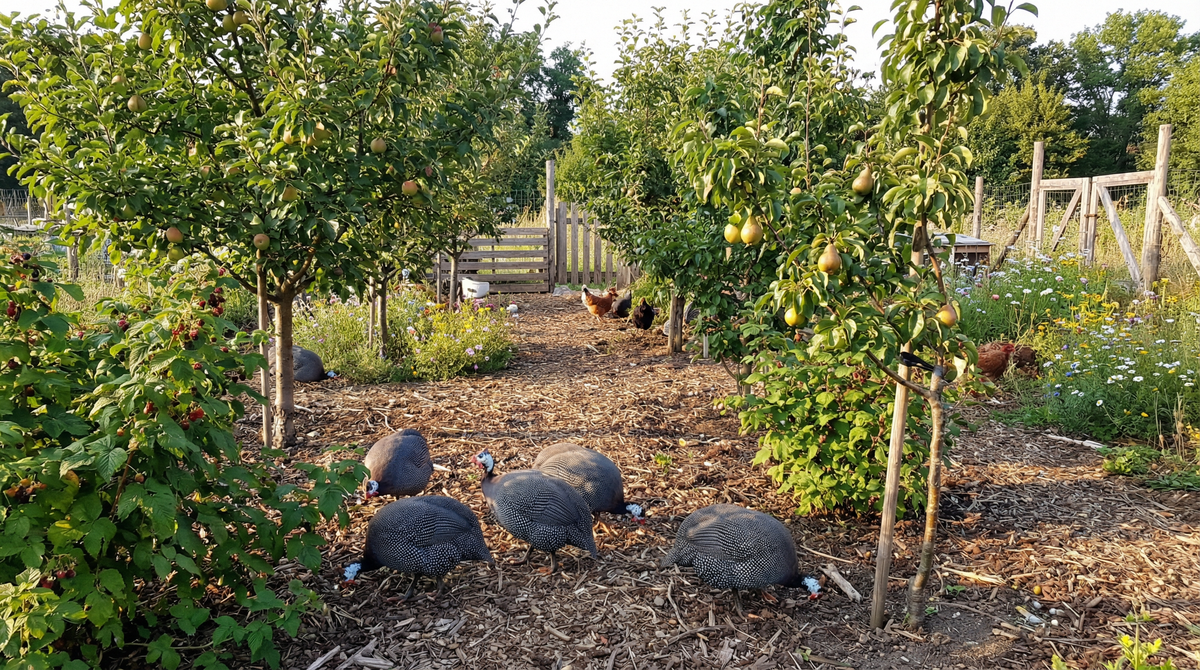
Guinea fowl (Numida meleagris) are a hardy, ground-foraging gamebird native to sub-Saharan Africa. They have been kept by humans for at least 2,000 years, first as a domestic bird in West Africa and later as a curiosity, an ornamental, and finally as a working tick-and-insect-control bird across Europe and the Americas. They are not chickens. They look a bit like chickens at a distance, but every management assumption that works for chickens needs to be rechecked when applied to guineas.
The pearl gray, lavender, royal purple, and white varieties are the most common in the United States. All carry the distinctive helmet-like casque and the loud, repetitive alarm call that makes guineas the single best avian sentinel I have ever kept. On my central Florida site (USDA zone 9b), an early-warning flock of 8 to 12 keets has done more to control fire ants, lone star ticks, and palmetto bugs in the transitional zone between the food forest and the open pasture than any chemical baiting program I have tried, and at zero ongoing cost beyond water and a daily scoop of cracked corn at sundown.
Permaculture Role
Guineas earn their keep on four counts: tick and insect control, snake awareness, alarm-calling against aerial and ground predators, and a modest but real meat and egg yield.
Tick and insect control
The University of Rhode Island TickEncounter Resource Center and several Texas A&M AgriLife Extension publications cite small flocks of guineas (5 to 15 birds on a typical homestead) significantly reducing lone star, dog, and deer tick populations in pasture and yard edges. The mechanism is simple: guineas are obligate visual foragers and they cover ground at a relentless walking pace, picking off every moving insect in their path. They prefer ticks, grasshoppers, slugs, beetles, and any caterpillar they can find, in roughly that order.
Snake awareness
A flock of guineas will mob a rat snake, copperhead, or moccasin and call until the snake leaves the area. They do not generally kill snakes, but they make snake activity highly visible. On my place, the guineas have flagged three venomous snakes (two cottonmouths in the pond margin, one copperhead in the compost area) over four years that I would otherwise have walked past.
Sentinel for aerial predators
Cooper's hawks, red-shouldered hawks, and great horned owls are the main aerial predators of small poultry on the Gulf coast. Guineas spot hawks earlier than chickens do and broadcast a loud, distinctive alarm that sends the rest of the poultry under cover. Chickens kept with a guinea flock have measurably fewer hawk losses, in my experience and in NC State and UF/IFAS extension reports.
Meat and eggs
Guinea meat is darker, leaner, and gamier than chicken, similar to pheasant. Eggs are smaller than chicken eggs (about 60 percent the size), pointed, and seasonal: a hen lays 80 to 120 eggs from April through September, then stops entirely.
Housing & Fencing
The single most important fact about guinea fowl is that they will not return to a coop on their own unless they were raised in it from the keet stage. An adult guinea introduced cold to a new property will fly straight up into the nearest oak tree at dusk and become owl food within a week.
Keet brooder
Keets (baby guineas) are fragile for the first 6 to 8 weeks. They cannot tolerate wet bedding, drafts, or cold. A brooder with a heat plate or lamp set to 95°F for the first week and dropping 5°F per week is the working protocol. UF/IFAS Extension publications on small-flock poultry brooding apply directly. Game-bird starter (28 percent protein) for the first 6 weeks, then transition to a 20 percent grower.
Coop training
Lock keets in the coop they will eventually free-range from for at least 6 weeks before any open-door release. Once released, let only one or two birds out at a time over the first week so the rest of the flock pulls them back at dusk. A bowl of cracked corn or millet at the coop door at sundown is the behavioral hook that brings adults home reliably.
Coop
An 8 by 8 ft coop with high roosts (4 to 5 ft) handles 12 to 15 adult guineas. Guineas roost higher than chickens and prefer thick branches over flat boards. Ventilation matters more than insulation in the southeast.
Fencing
Guineas fly. A 6 ft fence will not contain them. The choice is between full enclosure under poultry netting (uncommon, defeats the foraging purpose) or accepting that the flock will range across the whole site and home themselves at sundown. Wing-clipping helps for the first season but does not stop a determined adult.
Feeding
An adult guinea on free range covers most of its own feed from foraged insects, weed seeds, and fallen fruit from May through October. December through March, particularly during cold snaps, the flock relies more heavily on supplied feed.
Free-range diet
Insects (50 to 70 percent), seeds (15 to 25 percent), greens (5 to 15 percent), and small vertebrates (mice, lizards, the occasional small snake) make up the foraged diet. On my place the flock works the perimeter of the blueberry block from March through May for thrips and beetles, then shifts to the pecan grove in summer for fallen caterpillars and grasshoppers, then back to the pasture edge in fall.
Supplemental feed
A 16 to 20 percent layer ration or game-bird grower, available free-choice in the coop, supplements free-range foraging year-round. In central Florida summers the daily intake drops sharply because foraged insects are abundant; in winter it climbs to roughly 0.25 lb per bird per day.
Water and grit
Fresh water in the coop and at a second station near the range edge. Insoluble grit (coarse sand or commercial granite grit) is essential for any free-ranging guinea eating whole seeds and hard-bodied insects.
Health
Adult guineas are remarkably disease-resistant compared with chickens. The hard mortality bottleneck is the keet stage; once a keet reaches 8 weeks and is fully feathered, it usually has a long, healthy life ahead of it.
Keet mortality
Wet keets die. Cold keets die. Drafted keets die. Keep the brooder at the right temperature, absolutely dry, and predator-secured. Plan for 20 to 40 percent mortality from hatch to 8 weeks even with good management; it is part of the species.
Predators
Hawks and owls take adult guineas regularly. Raccoons and foxes take roosting guineas if the coop is not closed at dusk. The flock will alarm reliably, but unlike chickens they do not retreat to cover well, so a hawk-attentive adult is still a vulnerable adult.
Parasites
External parasites (lice, mites) are uncommon in free-ranging guineas because of constant dust bathing. Internal parasites (coccidia, capillaria) are uncommon in adults but a leading cause of keet loss in wet conditions. Coccidiostat in the starter feed for the first 8 weeks is standard practice.
Weather
Adult guineas tolerate Gulf-coast summer heat better than chickens and are surprisingly cold-hardy in dry shelter, but they cannot handle prolonged wet, especially in cold weather.
Field notes, central Florida. I keep a flock that has stabilized at 10 to 12 adults with annual replacement from a few keets I hatch under broody chicken hens (guinea hens are unreliable mothers). Tick incidence on my dogs has dropped to maybe 1 or 2 ticks per dog per year since the flock matured, from 15 to 20 per dog per year before. The trade-off is the noise: the alarm call carries about a quarter mile and goes off at every red-shouldered hawk fly-over, every UPS truck, and most afternoon thunderclaps. Closer neighbors than a quarter-mile, and I would not have done it.
Integration
Guineas integrate well with mature food forests, orchards, market gardens after seedlings are established, and silvopasture. They integrate poorly with new garden plantings (they scratch and trample, though less aggressively than chickens) and with very close neighbors (noise).
Orchard and food forest
A guinea flock through a blueberry, mulberry, or pecan block during fruit-bug season is the closest thing to free pest control I have found. The flock should be excluded from soft, ripe-fruit areas only during the actual harvest window because they will eat fallen fruit.
Market garden
Once vegetable transplants are 6 to 8 inches tall and established, a small guinea flock cycled through the garden 30 to 60 minutes before dusk picks off cabbage worms, cucumber beetles, and Colorado potato beetles without significant plant damage.
Mixed with chickens
Guineas and chickens can share a coop but should be raised together from the keet/chick stage. Adult guineas dropped into an established chicken flock will bully roosters and chase pullets. The reverse (chicks added to an established guinea coop) is even worse.
Pasture rotation
In rotational grazing systems, a guinea flock following cattle or sheep through the pasture eats fly larvae in fresh manure and any visible ticks that detach from the ruminants, breaking the parasite cycle. The benefit is meaningful but hard to quantify on a small property.
Frequently Asked Questions
How many guineas do I need for tick control?
For a typical 1 to 5 acre homestead, 8 to 15 birds is the working flock size. Smaller flocks (3 or 4 birds) wander too much and lose to predators; larger flocks become unmanageable noise.
Are guineas loud?
Yes. Hens have a two-syllable “buck-wheat” call that goes off constantly. Males have a single-syllable shriek. Both are extremely loud. Suburban or close-neighbor settings are usually not compatible with guinea fowl.
Can guineas live with chickens?
If raised together from hatch, yes. If introduced as adults, the integration is rough and often fails.
Do guinea fowl really kill snakes?
Not usually. They mob and alarm at snakes and may peck at smaller ones. The benefit is awareness, not direct snake control.
Will guineas damage my garden?
Less than chickens, but yes if turned loose on small seedlings or tender greens. Wait until plants are well-established and use the flock for pest patrol rather than general foraging in the bed itself.
References
- University of Rhode Island TickEncounter Resource Center. Tick-Eating Birds. web.uri.edu/tickencounter
- University of Florida IFAS Extension. Small Flock Poultry Brooding and Care. edis.ifas.ufl.edu — PS029
- Texas A&M AgriLife Extension. Guinea Fowl Production. agrilifeextension.tamu.edu — poultry
- NC State Extension. Raising Guinea Fowl. content.ces.ncsu.edu — guinea fowl
- Cornell Lab of Ornithology. Helmeted Guineafowl. birdsoftheworld.org/helgui1
Field notes and central-Florida observations in this article are from Lucas Summer’s permaculture site in USDA zone 9b. Flock size, tick-load comparison on dogs, sundown corn-bait habit, and noise-distance caveats reflect on-site practice; keet management, brooder temperatures, and tick-control mechanism are drawn from the extension and research sources cited above.
Foraging Behavior
Guinea fowl are relentless foragers, constantly moving and scratching at the ground in search of food. They are known for their flocking behavior, covering large areas as a group, which makes them excellent for pest control in pastures and gardens. Their diet consists mainly of insects, but they also consume weeds, seeds, and some small vertebrates.
Fencing Requirements
Guinea fowl are known for their ability to fly and wander. To contain them, a covered run or aviary is recommended. Alternatively, clipping one wing's flight feathers can prevent them from flying over standard-height fences. A secure fence is also crucial to protect them from ground predators.
Shelter Requirements
A simple, dry, and well-ventilated shelter is sufficient for Guinea fowl. It should provide protection from predators, drafts, and wet weather. A coop or shed with roosting perches is ideal, as they prefer to roost off the ground at night.
Permaculture Notes
Guinea Fowl are a valuable addition to a permaculture system, primarily for their unparalleled pest control services. They are voracious consumers of insects, including ticks, grasshoppers, and slugs, which can significantly reduce the need for chemical pesticides in orchards, gardens, and pastures. Their constant foraging and scratching also provides a light tillage effect, helping to aerate the soil and incorporate organic matter.\n\nIn a food forest or silvopasture system, Guinea Fowl can be integrated to manage pests and weeds without damaging established trees and shrubs. They are less destructive to gardens than chickens, as they are less prone to scratching up seedlings and eating leafy greens. However, they can still cause some damage to young plants, so it's best to introduce them to a garden area after plants are well-established or to use protective measures for vulnerable crops.\n\nOne of the challenges of raising Guinea Fowl is their tendency to wander and their reluctance to be confined. They are strong fliers and can easily clear standard fences. To keep them contained, a covered run or clipped wings are often necessary. They are also notoriously noisy, which can be a nuisance in more urban or suburban settings. Despite these challenges, their benefits as a low-maintenance, disease-resistant, and productive member of a permaculture system make them a worthwhile consideration for many homesteaders.