Overview
The domestic guinea pig (Cavia porcellus), called cuy in the Andes, is a small herbivorous rodent in the family Caviidae. It was domesticated in the high Andes of Peru, Bolivia, and Ecuador at least 5,000 years ago as a meat animal and continues to be an important source of protein in Andean rural households, with annual consumption in Peru alone estimated by the FAO at over 65 million animals. In the rest of the world, the same species is overwhelmingly kept as a pet rather than as livestock, and the welfare expectations placed on it reflect that.
Guinea pigs are gentle, quiet, social, and easy to handle. They are also temperature-sensitive in ways that matter on a Gulf-coast permaculture site. The species evolved at 8,000 to 14,000 ft of elevation in cool, dry, high-altitude climates and prefers an ambient range of about 65 to 75°F. On my central Florida site (USDA zone 9b), where afternoon highs stay above 85°F for roughly 130 days of the year, that single fact is the dominant design constraint. I have looked at guinea pigs as a small-livestock option here twice and concluded both times that they cannot live outdoors year-round without active cooling, which puts them in a different category than the rest of this site’s warm-climate-friendly animals.
Permaculture Role
Where the climate cooperates, guinea pigs offer a useful set of niches: quiet rotational grazing, cold-manure production, vegetable-scrap processing, child-friendly small-livestock education, and a modest meat yield where local culture supports it.
Rotational grazing in a tractor
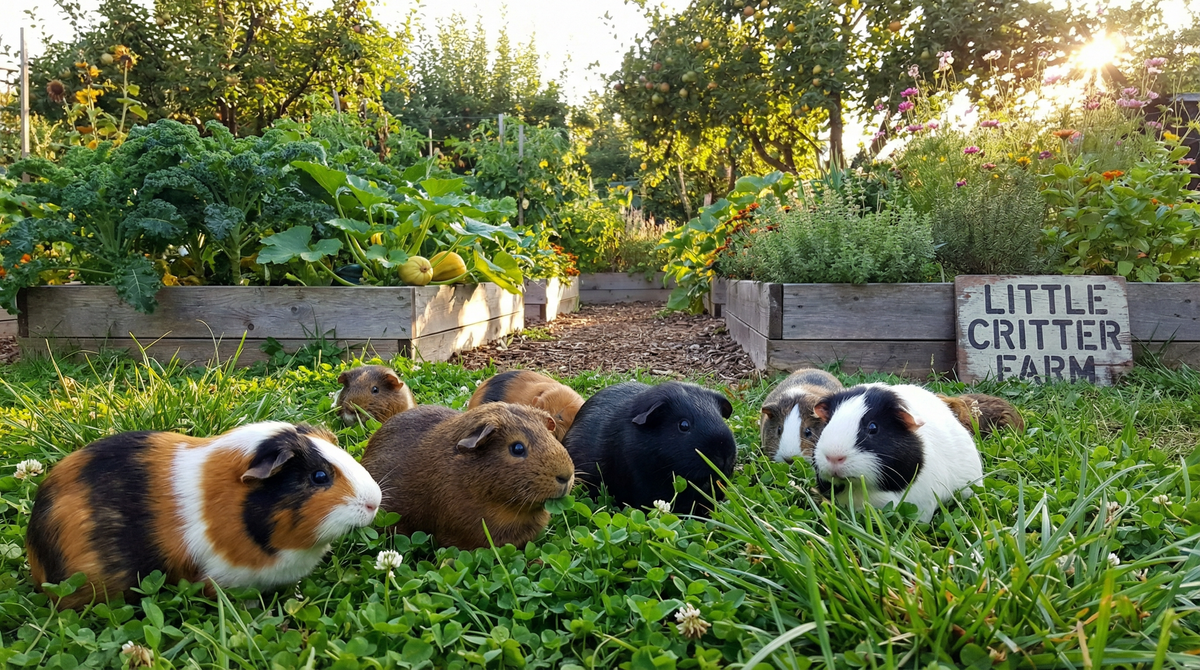
A movable bottomless pen (“guinea pig tractor”) 4 by 6 ft houses 2 to 4 animals and moves daily across a lawn or grass-and-weed bed. The animals graze without scratching, which is the main difference from chickens. Their grazing is uneven but real, and they do not damage established perennial plantings the way a goat or rabbit would.
Manure
Guinea pig droppings are dry, almost odorless pellets that can be applied directly to garden beds. Compared with chicken manure, they are lower in nitrogen and pose no burn risk. A pair of adults produces 0.5 to 1 pound of manure per week, enough to enrich a 10 by 10 ft bed over a season.
Vegetable scrap processing
Guinea pigs convert kitchen and garden trim (carrot tops, lettuce ends, cucumber peel, comfrey, dandelion greens, parsley) into manure efficiently. A small household generates more than enough trim for a pair.
Cuy meat production
In Andean systems, large breeding colonies in stacked hutches produce 1 to 2 lb dressed-weight carcasses at 3 to 4 months. The FAO has documented this as one of the most efficient small-livestock protein systems in the world by feed conversion ratio. In the US, the practice is uncommon outside Peruvian and Ecuadorian immigrant communities and is sometimes regulated locally.
Housing
Guinea pig housing in a subtropical climate has to solve two problems that do not exist in temperate regions: summer heat and tropical humidity.
Indoor hutch
The simplest setup is an indoor C&C (cube and coroplast) cage in a climate-controlled room, providing 7.5 sq ft minimum for one animal and 10.5 sq ft for a pair. The Humane Society of the United States and University of California Davis School of Veterinary Medicine both recommend that size or larger.
Outdoor hutch
An outdoor hutch must be predator-proof (snake-proof hardware cloth on all openings including the floor mesh), shaded, and ventilated. In zones 8b and warmer, plan on 6 to 8 hours of daily afternoon indoor relocation from June through September, or use a fan-cooled shade structure with ambient temperature kept below 80°F. A frozen 2-liter bottle in the hutch each afternoon helps but is not sufficient on a 95°F day.
Movable tractor
A bottomless wire tractor with a 50 percent shaded roof, used only in early morning and evening on summer days, lets guinea pigs graze without overheating. Skip midday use entirely in central Florida from mid-May through mid-September.
Bedding
Kiln-dried pine shavings or paper-based bedding indoors; clean grass and hay for outdoor tractor use. Avoid cedar shavings (phenols irritate the respiratory tract) and avoid corn-cob bedding (mold risk in humid weather).
Feeding
Guinea pigs are obligate herbivores with a digestive quirk that matters: they cannot synthesize vitamin C and must take in 10 to 30 mg of it daily through their diet. A guinea pig fed only generic rodent pellets and grass hay will develop scurvy within weeks.
Hay
Unlimited timothy or meadow-grass hay is the dietary foundation, providing the long-stem fiber that keeps the gut moving and wears down continuously-growing teeth. Alfalfa hay is appropriate for young, pregnant, or nursing animals only; it is too rich and calcium-heavy for adult maintenance.
Fresh greens
One cup of fresh greens per adult per day, ideally including a high-vitamin-C source: bell pepper, parsley, kale, cilantro, or strawberry tops. Florida-friendly garden greens that work well include comfrey (in moderation), dandelion greens, plantain, sweet potato vine, and young mulberry leaves.
Pellets
A small amount (1/8 cup per adult per day) of a guinea-pig-specific fortified pellet ensures vitamin C and trace mineral coverage. Pellets formulated for rabbits or generic rodents are not adequate.
Water
Fresh water from a sipper bottle or open bowl daily. In Florida summer heat, expect intake to double or triple compared with cool weather.
Toxic plants
Fatal or high-toxicity plants to keep out of the diet include avocado, rhubarb, raw potato tubers and any potato foliage, tomato leaves and stems, onion, garlic, and most ornamental bulb foliage.
Health
Guinea pigs hide illness well, like most prey animals, and a sick guinea pig can deteriorate from “looks fine” to non-responsive in 24 hours. Daily handling and weighing is the standard early-detection tool used by guinea-pig veterinarians.
Scurvy (vitamin C deficiency)
Lethargy, rough coat, swollen joints, bleeding gums, weight loss. Prevent with daily fresh vitamin-C source plus fortified pellets. Treat acute cases with 50 to 100 mg of oral vitamin C daily until resolved and consult a veterinarian.
Heat stress and heat stroke
Above 85°F, healthy adults show open-mouth breathing, drooling, and lethargy. Above 90°F sustained, mortality climbs sharply. The American College of Laboratory Animal Medicine guidelines for guinea-pig housing specify a maximum of 79°F ambient as the safe upper limit.
Dental overgrowth
Continuously growing teeth need long-stem hay to wear properly. Misaligned (malocclusion) teeth require veterinary trimming and are a hereditary problem in some lines.
Bumblefoot (pododermatitis)
Caused by wire-floor cages without solid resting platforms or by damp bedding. Provide solid flooring and dry bedding.
Respiratory disease
Bordetella bronchiseptica and Streptococcus pneumoniae cause snuffles and pneumonia. Drafty or ammonia-fouled housing is the usual trigger. Prompt veterinary care is essential because untreated cases progress quickly.
Field notes, central Florida. I evaluated guinea pigs as a small-livestock option on my place twice and decided against it both times. The math just does not work: from late May through mid-September, outdoor afternoon temperatures sit between 88 and 95°F most days, which is above the documented safe ceiling for the species. Keeping them well would mean an air-conditioned shed or indoor housing for roughly four months of the year, at which point they are pets, not livestock integrated with the rest of the system. They are a great fit for someone with an indoor space they are already cooling, or for cool climates and high-elevation properties; on the Gulf coast they are an indoor-only commitment.
Integration
Guinea pigs integrate well with small-space, climate-controlled, or temperate-climate permaculture systems. They do not integrate well into open-pasture or unsheltered Gulf-coast systems for the temperature reasons above.
Indoor or patio system
A C&C cage in a climate-controlled mudroom or covered patio, fed daily on garden trim and kitchen scraps, with the bedding refreshed weekly into a compost pile, is the realistic setup in subtropical climates.
Movable tractor on grass
In temperate climates (zone 7 and cooler), a moveable tractor of 2 to 4 animals will mow a small lawn or grass strip cleanly across a growing season. The animals must be brought in before any frost and during heat waves.
Manure and compost
Bedding and droppings go directly onto garden beds or into a hot compost pile. The material is low-odor, low-pathogen, and gentle enough to use without aging.
Cuy production system
Where culturally and legally appropriate, a colony of 6 to 8 breeding females in a climate-controlled shed produces a steady supply of meat carcasses. Check local livestock and food-safety regulations before scaling.
Frequently Asked Questions
Can guinea pigs live outside year-round in Florida?
No. Summer afternoon temperatures regularly exceed the safe upper limit for the species. Outdoor use is possible spring and fall only, with indoor relocation through the summer.
Can guinea pigs live alone?
No. They are highly social and a solo guinea pig will develop stress behaviors and shortened lifespan. Keep at least two same-sex animals or a neutered male with a female.
How long do guinea pigs live?
5 to 8 years is typical for well-cared-for animals. Under stress, in poor conditions, or with untreated illness, lifespans drop quickly.
Are guinea pigs good for children?
Yes, with adult supervision. They are gentle, calm, and tolerate handling well once accustomed to it. Young children should always sit on the floor when holding them to prevent drop injuries.
What size cage do two guinea pigs need?
At least 10.5 sq ft. Larger is better. The Humane Society and most exotic-pet veterinarians recommend 12 to 14 sq ft for a pair.
References
- FAO Animal Production and Health. Backyard Guinea Pig Production (Cuy). fao.org/animal-production
- UC Davis School of Veterinary Medicine. Guinea Pig Husbandry and Care. vetmed.ucdavis.edu
- The Humane Society of the United States. Guinea Pig Care. humanesociety.org — guinea pig care
- American College of Laboratory Animal Medicine. Standards for Laboratory Guinea Pig Housing. aclam.org
- RSPCA. Guinea Pig Welfare and Housing. rspca.org.uk — guinea pigs
Field notes and central-Florida observations in this article are from Lucas Summer’s permaculture site in USDA zone 9b. The honest evaluation against the species’ summer-temperature ceiling reflects on-site decision-making; nutrition, vitamin-C requirements, housing standards, and lifespan figures are drawn from the veterinary and welfare sources cited above.
Foraging Behavior
Guinea pigs are natural foragers that spend a significant amount of time searching for food. In the wild, they graze on grasses, herbs, and other plants throughout the day and night. They often forage in groups and may drag food to a safe, hidden location to eat, a behavior stemming from their instincts as prey animals.
Fencing Requirements
Secure fencing is needed to protect from predators like foxes, especially when housed outdoors. When using movable tractors, the tractor itself provides the fencing. For indoor or patio settings, simple barriers can be used to block off unsafe areas.
Shelter Requirements
A secure, comfortable enclosure is essential to protect them from predators and extreme weather. This can be a hutch, an indoor cage, or a movable 'guinea pig tractor'. The shelter must be well-ventilated, draft-free, and provide bedding.
Permaculture Notes
Guinea pigs are a useful, multi-functional animal for small-scale permaculture systems like backyard gardens, rooftops, and homesteads. Their primary role is as a quiet and effective lawnmower and weeder. Housed in movable 'guinea pig tractors', they can be rotated through garden beds or orchard areas to keep grasses and weeds under control without the noise and fossil fuels of machinery. Unlike chickens or rabbits, they do not dig or scratch aggressively, making them less disruptive to soil structure and plant roots, which is a significant advantage in maintaining established garden systems. One of the most valuable outputs from guinea pigs is their manure. It is a 'cold' fertilizer, meaning it is not high in nitrogen and can be applied directly to the garden without the need for composting, providing a gentle and steady source of nutrients. They are also excellent recyclers of kitchen scraps, converting vegetable and fruit waste into valuable fertilizer, thus closing a loop in the household food system. This function can even be scaled to process waste from local cafes or restaurants, reducing landfill and creating fertility for the landscape. While they are a low-cost and low-effort animal to maintain, there are challenges. Guinea pigs are prey animals and require secure housing to protect them from predators. They are also sensitive to extreme temperatures and need well-ventilated, draft-free shelter that provides shade in the summer and protection from cold in the winter. Their foraging can be somewhat random, so they may not clear an area as systematically as other grazers. However, their gentle nature, quiet disposition, and suitability as children's pets make them a delightful and productive component of an integrated permaculture design.