Overview
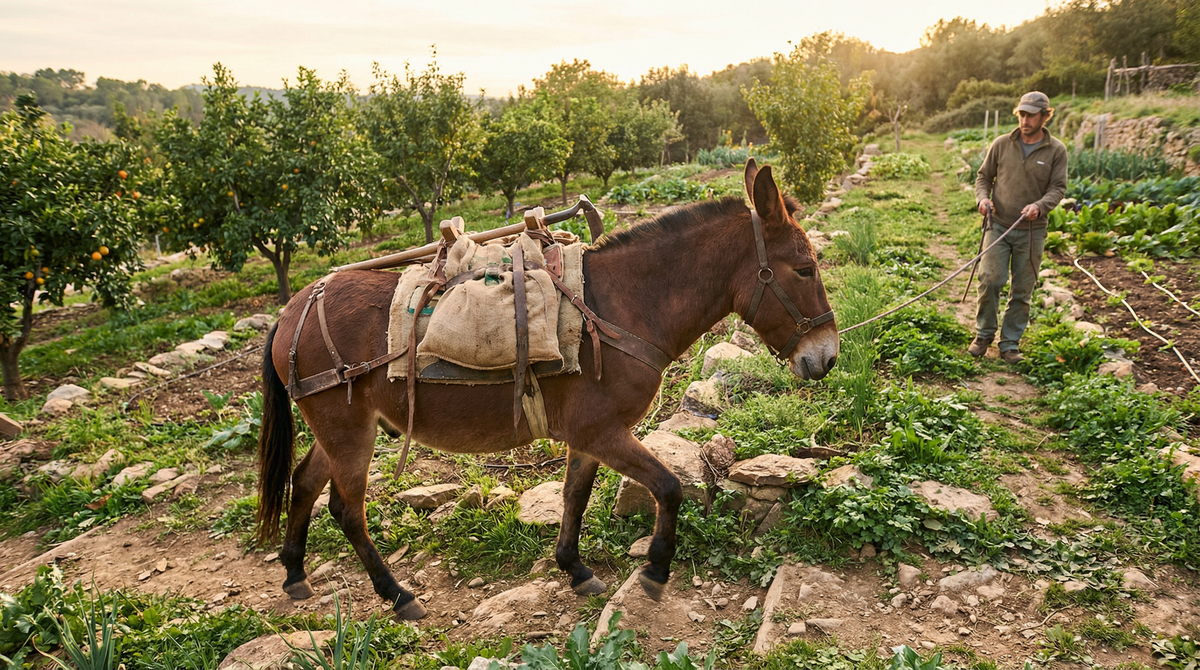
A mule is the sterile hybrid offspring of a male donkey (jack) and a female horse (mare). Mules inherit the donkey’s hardiness, foot quality, parasite tolerance, and patient temperament, combined with the horse’s size, speed, and trainability. The combination is called hybrid vigor, and in working contexts a good mule outperforms either parent species at the same task while eating less and requiring less veterinary care.
Mules were the workhorses of American farming from the 1830s through the 1940s, with peak US populations above 5 million animals before tractors displaced them. They remain the working animal of choice for pack outfits in the western US wilderness, for Amish farming communities, and for back-country freight in much of Latin America and Africa. On my central Florida site (USDA zone 9b), I have ridden and packed a friend’s saddle mule on flatwoods trails alongside her Quarter Horse many times, and the heat-tolerance gap between the two is striking; the horse sweats and slows by noon in July, the mule keeps moving.
Permaculture Role
Mules earn their keep in three working niches: draft and pack, riding on rough terrain, and pasture management with manure production. They are not commonly used as livestock guardians (donkeys handle that role at smaller size and feed cost) and they are not fiber animals.
Draft and pack
A 1,000 lb working mule can pull or carry roughly the same load as a 1,200 lb horse, on roughly 75 percent of the feed, with measurably fewer veterinary issues. Logging mules in the Appalachians and pack mules in the Sierra Nevada both depend on these efficiencies. USDA Forest Service Backcountry Trail Crew and US Marine Corps Mountain Warfare Training Center both still maintain mule packing programs.
Riding on rough terrain
Mules are famously sure-footed. The strong sense of self-preservation that gets miscalled “stubbornness” is actually a refusal to do anything they perceive as dangerous, which is exactly the quality you want on a wet limestone trail or in a hurricane-prone palmetto thicket.
Pasture and manure
A working mule on 1.5 to 2 acres of warm-season grass pasture in rotation produces 30 to 40 lb of manure per day, drier than horse manure and easier to handle. Composted for 2 to 3 months, it is an excellent vegetable-bed amendment.
Housing & Fencing
Mule housing is, with one or two exceptions, very similar to horse housing. The exceptions matter and are worth flagging up front.
Shelter
A three-sided run-in shed with the open face turned away from prevailing wind is sufficient in zones 7 and warmer. Allow 12 by 12 ft per mule. Unlike horses, mules do not grow a heavy winter coat and are more vulnerable to cold rain than horses; in zones 6 and colder, an enclosed barn or a blanket for the wettest days is appropriate.
Fencing
Mules respect fences better than horses and test them less than donkeys. A 4.5 to 5 ft woven-wire or three-rail board fence with a hot top strand works well. Barbed wire is categorically inappropriate. Mules are intelligent and will figure out latches, so chains, snap-clips, or padlocks on gate hardware are common.
Footing
Mule hooves are notoriously tough, more upright and smaller than horse hooves, and trim or shoe every 6 to 10 weeks. Many working mules are kept barefoot. Florida sand is hard on the white line in wet weather; a dry-lot area for wet-weather standing helps.
Water
5 to 12 gallons per day for an adult mule, doubling in summer heat and work.
Feeding & Forage
Mules eat less than horses for their size and tend toward easy-keeper metabolisms inherited from the donkey side. Overfeeding is a more common problem than underfeeding.
Pasture
Warm-season grass pasture is the Gulf-coast working forage base. Bermudagrass and bahiagrass at 4 to 6 inch grazing height in rotation support adult mules at maintenance with minimal hay supplementation in the growing season. Perennial peanut is too rich as a sole forage and should be limited.
Hay and straw
Mature coastal bermudagrass or timothy hay is the default winter feed. Working or growing mules benefit from alfalfa or alfalfa-grass blends in measured amounts. Clean barley straw can stretch the ration for easy-keeper mules at light work, similar to donkey feeding practice.
Grain
Most adult mules at light work need no grain. A balanced ration balancer (1 lb per day) covers vitamin and mineral gaps. Hard-working mules earn a measured grain ration scaled to the workload, not the calendar.
Toxic plants
Fatal or high-toxicity species to exclude from pasture include yew, hemlock, foxglove, rhododendron, ragwort, oleander, red maple (wilted leaves), and black walnut. Oak acorns in heavy mast years are a problem; light exposure is typically tolerated.
Health
Mules are typically healthier and longer-lived than horses. A working mule routinely reaches 30 to 40 years with sound feet and good teeth. The same parasites and infectious diseases that affect horses affect mules, but mules tend to handle them with less clinical illness.
Hooves
Trim every 6 to 10 weeks. Mule hoof quality is generally excellent.
Parasites
Florida supports a year-round parasite load. Fecal-egg-count-based deworming, rotational grazing, and cross-grazing with cattle are the current UF/IFAS Extension and AAEP recommendations.
Colic
Mule colic risk is lower than horse colic risk for the same management, but the prevention principles are identical: continuous forage, fresh water, gradual feed changes.
Vaccines
AAEP core vaccines for the southeastern US (tetanus, EEE/WEE, WNV, rabies) are recommended annually. EEE and WNV pressure is high in Florida from May through November.
Heat tolerance
Mule heat tolerance is between donkey (best) and horse (least best), closer to donkey. Shade and water are sufficient management on the Gulf coast; misters or active cooling are not typically required.
Field notes, central Florida. I have ridden a friend’s 15-year-old saddle mule on summer trail rides through the Withlacoochee State Forest several times. The same trail ridden on her Quarter Horse the same week left the horse soaked in sweat by mid-morning; the mule stayed dry behind the ears and willing to keep moving. She trims her mule and her horse on the same 8-week cycle and the mule’s feet always look better than the horse’s at the appointment. For a working homestead in the Deep South that needed a riding equine, a mule would be my recommendation over a horse the same way a donkey is for the lower-energy work.
Integration
Mules integrate well with silvopasture, rotational grazing, and co-grazing with cattle. Like horses, they do not integrate at all with food-forest plantings under 5 years old.
Silvopasture
Mature live-oak, pecan, slash-pine canopy at 30 to 50 percent cover gives mules summer shade. Avoid red maple in pasture.
Co-grazing with cattle
Mules and cattle do not share most parasites. Following one with the other on rotation interrupts worm cycles for both species.
Draft and pack work
A trained driving mule plows market-garden plots, hauls logs from a small woodlot, and moves compost and feed at scales that suit a 10 to 50 acre operation better than a tractor in some cases. The trade-off is the training and handling skill required.
Manure system
Composted at proper carbon-nitrogen ratios for 2 to 3 months, mule manure becomes a high-quality soil amendment. Fresh manure carries weed seeds and parasite eggs.
Frequently Asked Questions
What is the difference between a mule and a hinny?
A mule has a donkey father and a horse mother. A hinny is the reverse: horse father and donkey mother. Mules are far more common because the cross is easier to produce and the offspring are more useful.
Are mules really stubborn?
No. Mules are cautious and have a strong sense of self-preservation. They refuse to do things they perceive as dangerous, which is often safer than the alternative. Patient, consistent handling produces a mule that does almost anything a horse will do.
Can mules reproduce?
Almost never. Mules are sterile because horses and donkeys have different chromosome counts. Documented exceptions are extremely rare and typically involve assisted reproduction.
How much land per mule?
Roughly 1.5 to 2 acres of good pasture per mule with rotational management and hay supplementation. Less than a horse but similar in scale.
Are mules good for beginners?
A well-trained adult mule is an excellent beginner mount because of its sure-footedness and self-preservation instincts. A young or untrained mule requires more skill than the equivalent horse because mules do not tolerate inconsistent or rough handling.
References
- American Mule Association. Mule Handling and Care. americanmuleassociation.org
- USDA Forest Service. Backcountry Pack Stock Operations. fs.usda.gov
- University of Florida IFAS Extension. Equine Parasite Control. edis.ifas.ufl.edu — VM097
- Penn State Extension. Equine Rotational Grazing. extension.psu.edu/horses
- American Association of Equine Practitioners. Vaccination Guidelines. aaep.org/horsehealth
Field notes and central-Florida observations in this article are from Lucas Summer’s permaculture site in USDA zone 9b. The horse-versus-mule heat-tolerance and hoof-condition comparisons from shared trail rides reflect on-site practice; veterinary, parasite, and vaccine guidelines are drawn from the AAEP, UF/IFAS, and Penn State sources cited above.
Foraging Behavior
Mules are grazing animals adapted for a continuous intake of high-fiber roughage. They are efficient foragers, inheriting the ability to effectively digest energy and protein from their donkey parentage, and will browse on a variety of grasses and other pasture plants.
Fencing Requirements
Mules require strong, secure, and visible fencing, similar to horses. A height of at least 4.5 to 5 feet is recommended. Options include woven wire, high-tensile wire, or wooden board fencing.
Shelter Requirements
A simple three-sided shelter is sufficient to provide protection from wind, rain, and sun. Mules may not grow a thick winter coat and might require blanketing in colder, wet climates.
Permaculture Notes
Mules are exceptionally well-suited for permaculture and small-scale farming systems due to their hardiness, efficiency, and versatility. Their primary role is providing draft power for tasks such as plowing, cultivation, and logging, reducing the reliance on fossil fuels. Their sure-footedness makes them ideal for working on varied and uneven terrain, such as in food forests or on terraced slopes. As grazers, they can be integrated into rotational grazing systems to manage pasture, control weeds, and fertilize the land with their manure. Their efficient metabolism means they require less feed than a horse of similar size, making them a more economical choice for a self-sufficient homestead. However, their diet must be carefully managed to prevent obesity and metabolic issues; they thrive on lower-quality, high-fiber forage. Their intelligence and cautious nature require patient and consistent handling. With proper management, mules are a resilient and long-lived component of a sustainable agricultural system. In a permaculture design, mules can be used to create and maintain swales on contour, haul materials for building projects, and transport produce from the garden to the market. Their manure is a valuable soil amendment, contributing to a closed-loop system of fertility. By integrating mules into a permaculture system, a farmer can reduce their carbon footprint, build soil health, and create a more resilient and productive landscape.