Overview
The domestic turkey (Meleagris gallopavo) is a large North American gamebird domesticated from the wild turkey by indigenous peoples of central Mexico more than 2,000 years ago. The species is the foundation of the US Thanksgiving meal and one of the most economically important poultry species in the world, but the industrial Broad-Breasted White turkey behind most commercial production is essentially a different animal than the heritage breeds suited to permaculture systems.
Heritage breeds (Royal Palm, Narragansett, Bourbon Red, Standard Bronze, Black Spanish, Slate, Beltsville Small White, Midget White) retain natural mating ability, slower growth, better foraging, and better heat tolerance than industrial breeds. The Broad-Breasted White cannot breed naturally and has welfare problems beyond about 6 months of age. On my central Florida site (USDA zone 9b), I have run a small Royal Palm flock for two short seasons under live-oak and pecan canopy, and the breed choice is the single decision that made the project workable in the Gulf-coast climate.
Permaculture Role
Turkeys fill three permaculture niches: pasture pest and insect control, holiday-meat production on mast and pasture, and (less commonly) egg production for breeding rather than table use.
Pasture insect and pest control
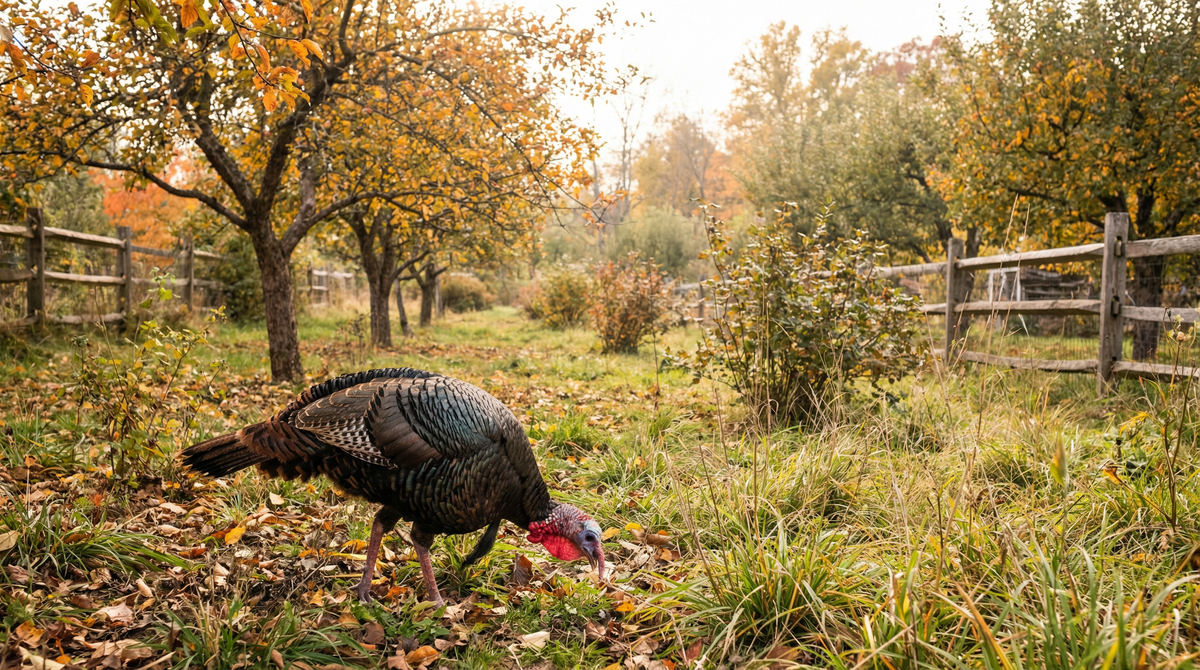
Heritage turkeys are aggressive foragers and patrol large areas in flocks of 4 to 20 birds. They consume grasshoppers, beetles, slugs, snails, and the occasional small vertebrate. NC State Extension and University of Kentucky Cooperative Extension publications document them as effective patrol birds for fields and orchards.
Mast-finished meat production
The classic American smallholder turkey calendar starts with poults in April or May, builds growth through summer pasture and supplemental feed, and finishes on autumn oak acorn and pecan mast for harvest at the end of November. The mast finish replaces 30 to 50 percent of grain feed in good mast years and changes the flavor profile noticeably.
Eggs and breeding
Heritage hens lay 60 to 100 eggs per year during the spring and early summer. Most of those eggs are typically reserved for hatching replacement stock rather than the table.
What turkeys are not
Turkeys are not a year-round egg-laying species, not as efficient at converting feed to meat as chickens, and not compatible with chickens in close confinement (blackhead disease risk). They are a seasonal protein-and-pest-control tool, used well, not a generalist poultry replacement.
Housing & Fencing
Heritage turkeys are smaller, hardier, and more flight-capable than industrial Broad-Breasted stock, which simplifies some housing decisions and complicates others.
Brooder
Poults (baby turkeys) are fragile for the first 6 to 8 weeks. They are more vulnerable to cold and wet than chicks. A draft-free brooder set to 95°F for the first week, dropping 5°F per week, with a game-bird starter at 28 percent protein for the first 6 weeks, is the working setup.
Coop
A predator-proof coop with high roosts (4 to 6 ft off the floor) and at least 4 to 8 sq ft per adult bird is the working baseline. Heritage turkeys roost higher than chickens and prefer to roost well off the ground. Owls take roosting turkeys readily, so the coop must close fully at dusk.
Fencing
48-inch electric poultry netting contains young turkeys and most heritage hens. Adult heritage toms can fly easily and may clear a 6-foot fence; wing-clipping helps but does not guarantee containment. The working approach in the southeast is a secure coop at night and a tolerant attitude during the day, similar to guinea fowl management.
Shade and water
Above 85°F turkeys need shade, breeze, and unlimited water. Live-oak, pecan, or pole-barn shade is sufficient in zones 8 and warmer; full sun is not. Industrial Broad-Breasted birds suffer serious heat stress in central Florida summers without active cooling; heritage birds typically manage with shade alone.
Feeding
Heritage turkeys on pasture defray feed costs significantly. A flock pastured on mixed grass with access to mast in fall will consume 50 to 100 lb of supplemental grain per finished bird, against 150 lb per bird in confinement. Feed quality matters more than quantity.
Poult starter
28 percent protein game-bird starter for the first 6 weeks. Use a non-medicated starter if the flock is to be raised without coccidiostat; manage coccidiosis through clean bedding and rotation instead.
Grower and finisher
20 percent protein grower from 6 to 16 weeks, then 16 to 18 percent finisher from 16 weeks to harvest. Free-range birds eat less of the formulated ration than penned birds.
Pasture and mast
Bermudagrass, bahiagrass, and chufa (a tuber-producing sedge often planted for turkey forage) all work as pasture base. Mulberry drops in May and June, pecan drops in October and November, and oak mast in October through January are the high-value autumn forages.
Toxic plants
Avoid oleander, mountain laurel, lantana, rhubarb leaves, and ornamental bulb foliage. Heritage turkeys are smarter about toxic plants than commercial breeds but will sample anything when bored.
Health
Heritage turkeys on pasture are typically healthy. The two recurring concerns on small Gulf-coast operations are blackhead disease and predator pressure.
Blackhead disease (histomoniasis)
Histomonas meleagridis is a protozoan parasite carried by chicken cecal worms that is lethal to turkeys but causes few symptoms in chickens. Mixed chicken-and-turkey flocks in close proximity routinely have blackhead outbreaks. UF/IFAS Extension and USDA-ARS publications recommend keeping turkeys at least 75 to 100 yards from any chicken yard and not rotating chickens through pasture that turkeys will use within 6 months.
Predators
Owls, hawks, raccoons, foxes, coyotes, and stray dogs all take turkeys. Owls take roosting turkeys at night, so a fully enclosed coop at dusk is essential. Hawks take young poults and the occasional small hen during the day.
Mycoplasma and respiratory disease
Mycoplasma gallisepticum and synoviae are the main commercial-turkey respiratory pathogens. Buy poults from NPIP-certified hatcheries to manage this risk.
Lameness
Industrial Broad-Breasted breeds suffer lameness from rapid muscle growth on relatively weak skeletons by 4 to 6 months. Heritage breeds avoid this entirely.
Field notes, central Florida. I ran 4 Royal Palm hens and 1 tom for two seasons on roughly an acre under live-oak and pecan canopy, with the coop on the opposite side of the property from the chickens (about 150 yards separation). Poults arrived in April both years; harvest was the third week of November. The pecan-and-oak mast finish reduced grain use by maybe 30 to 40 percent in the last 8 weeks. The biggest single management adjustment from chicken keeping was the blackhead-disease separation rule, which dictates where the coop sits, what the rotation looks like, and which pastures get either species.
Integration
Turkeys integrate well with silvopasture, pecan and walnut orchards, established food forests, and rotational pasture systems. They integrate poorly with active chicken operations and with young vegetable plantings.
Silvopasture
Mature live-oak, pecan, and slash-pine canopy at 30 to 50 percent cover gives turkeys shade and mast. The classic American smallholder turkey-on-oak-mast system is centuries old and remains the ideal Gulf-coast integration.
Orchard pest control
A small flock cycled through a pecan, peach, or fig orchard in late summer consumes fallen fruit (reducing pest reservoirs), grasshoppers, and beetles. Plant-damage risk is lower than with chickens.
Garden margin
Turkeys can patrol garden margins for grasshoppers and tomato hornworm but will damage soft-fruit and leafy-green plantings if turned into the bed itself. Use a temporary electric fence at planting boundaries.
Pasture co-grazing
Turkey-and-cattle co-grazing breaks parasite cycles for both species and improves total stocking efficiency. Skip turkey-and-chicken co-grazing because of blackhead disease.
Frequently Asked Questions
What is the best heritage turkey for the southeast?
Royal Palm (small, calm, heat-tolerant, ornamental), Bourbon Red (medium-large, traditional Kentucky table bird), Narragansett (medium-large, hardy), and Standard Bronze (largest heritage breed). All tolerate Florida heat with shade.
Can I raise turkeys with my chickens?
Not in close proximity. Blackhead disease can wipe out a turkey flock kept near chickens. Maintain 75 to 100 yards of separation and do not rotate either species through the other’s pasture within 6 months.
How long does it take to raise a turkey to harvest?
Heritage breeds: 24 to 30 weeks (April to November for a Thanksgiving bird). Industrial Broad-Breasted: 16 to 20 weeks.
Do turkeys really need that much space?
For pasture: yes, 1/4 acre or more per 10 birds with rotational moves. For confinement: less, but health and meat quality drop.
Are heritage turkeys hard to find?
Less than they used to be. The Livestock Conservancy and several regional hatcheries supply most of the breeds listed above.
References
- The Livestock Conservancy. Heritage Turkey Breeds. livestockconservancy.org — heritage turkeys
- University of Florida IFAS Extension. Small Flock Turkey Production. edis.ifas.ufl.edu — PS033
- NC State Extension. Raising Heritage Turkeys. content.ces.ncsu.edu
- USDA Agricultural Research Service. Blackhead Disease (Histomoniasis). ars.usda.gov
- Penn State Extension. Turkey Management and Husbandry. extension.psu.edu/poultry
Field notes and central-Florida observations in this article are from Lucas Summer’s permaculture site in USDA zone 9b. The Royal Palm flock setup, blackhead-disease separation rule, and pecan/oak-mast feed savings reflect on-site practice; brooder temperatures, blackhead biology, and breed information are drawn from the Livestock Conservancy, UF/IFAS, and USDA-ARS sources cited above.
Foraging Behavior
Turkeys are active foragers that will happily roam pastures, eating a wide variety of plants, seeds, berries, insects, and grubs. They will scratch and dig at the soil, which can be beneficial for light tillage. Their foraging behavior helps to control pests and fertilize the land.
Fencing Requirements
A 48-inch tall electric net fence is recommended to contain turkeys and protect them from predators. For heritage breeds that can fly, wing clipping may be necessary to prevent them from flying over fences.
Shelter Requirements
Turkeys require a shelter with a roof and at least two sides to protect them from sun, wind, rain, and snow. The shelter should have high roosting bars, providing about 15 inches of space per bird. It is crucial to enclose the shelter at night to protect the turkeys from predators, especially owls.
Permaculture Notes
Turkeys are a valuable addition to a permaculture homestead, offering a range of products and services. They are particularly well-suited for rotational grazing systems, where they can be moved to fresh pasture regularly to provide fertilization and pest control. This practice also prevents the build-up of manure and pathogens in one area. In orchards and food forests, turkeys can help to control pests and weeds, while also providing manure to fertilize the trees and plants. Their scratching and foraging behavior can help to lightly till the soil, improving its structure and aeration. When integrating turkeys into a permaculture system, it is important to consider their housing and fencing needs. A secure, predator-proof shelter with high roosting bars is essential for their safety and well-being. Electric netting is an effective fencing option for containing turkeys and protecting them from ground predators. For heritage breeds, which are capable of flight, wing clipping may be necessary to keep them within the desired area. Turkeys are excellent foragers, but they will also require supplemental feed to ensure they receive adequate nutrition, especially for meat production. Their protein requirements vary with age, with poults needing a higher percentage of protein than adult birds. A diet of grains, legumes, and greens, supplemented with their foraged findings, will keep them healthy and productive. By carefully managing their grazing and providing for their basic needs, turkeys can be a highly beneficial and productive element in a permaculture design.