Overview
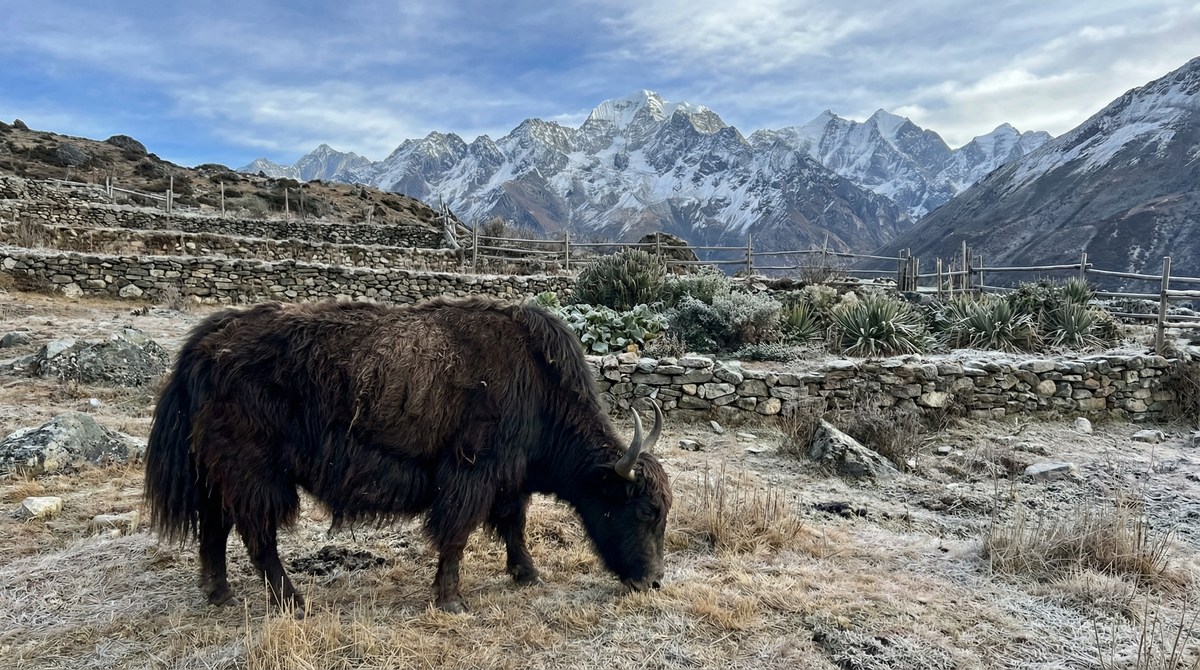
The domestic yak (Bos grunniens) is a large, long-haired bovid domesticated on the Tibetan Plateau roughly 5,000 years ago and now kept by pastoral peoples across Tibet, Mongolia, Nepal, Bhutan, and the Himalayan ranges of India and Pakistan. The species evolved at elevations of 10,000 to 16,000 ft and is one of the most cold-adapted large mammals on the planet, with a double coat that insulates against ambient temperatures down to roughly -40°F.
For permaculture purposes, yaks are a real but tightly constrained option: excellent for cold-climate, high-elevation operations, completely unsuited to anywhere with hot summers. On my central Florida site (USDA zone 9b), where summer afternoons routinely exceed 90°F, yaks are a non-starter; the species suffers heat stress above 59°F and dies in sustained warm humidity. I include yaks in this profile because they are an excellent fit for Colorado, Wyoming, Montana, northern New Mexico, Maine, and the higher elevations of the Pacific Northwest, where they fill a niche that no other domestic livestock fills as well.
Permaculture Role
Yaks fill four permaculture niches in cold-climate operations: marginal-pasture and rough-terrain grazing, low-volume but high-quality dairy and meat production, fiber production, and light draft and pack work in mountain country.
Marginal pasture and high-elevation grazing
Yaks extract more nutrition from low-quality, fibrous, cold-climate forage than any beef breed. They graze efficiently on the wet meadows, alpine sedges, and short native grasses of high-elevation summer pasture that would not finish a steer in a useful timeframe.
Dairy and meat
A yak cow produces 2 to 5 lb of milk per day at 5 to 8 percent butterfat, far less volume than dairy cattle but exceptional fat and protein content. Yak meat is lean, dark, and similar to high-quality grass-fed beef. The US Yak Association lists artisan dairies and meat producers across the Rocky Mountain and Pacific Northwest regions.
Fiber
The downy undercoat (khullu) is fine, soft, and comparable to cashmere; the coarse outer guard hair is used for rope and rugged textiles. A mature yak yields 1 to 2 lb of khullu and 2 to 4 lb of guard hair per year, both shed naturally and harvested by combing in late spring.
Pack and draft
Yaks remain the working pack animal across the Himalaya for high-altitude expeditions and trade. In the US, they are occasionally used for mountain pack trips at scales similar to llamas.
Housing & Fencing
Yak housing is the easiest of any large livestock species in a cold climate and one of the hardest in a warm one. Cold tolerance is essentially unlimited; heat tolerance is the controlling constraint.
Shelter
In zones 5 and colder, a three-sided wind-break shelter or a dense stand of conifers is all the structure required. Yaks routinely lie down on snow without distress. In warmer zones (6 through 8), deep summer shade and access to cool water are non-negotiable. In zones 9 and warmer, yak keeping is generally not recommended without active cooling, and most operators give up on the project after the first hot summer.
Heat management
Above 59°F sustained, yaks slow down. Above 70°F sustained, productivity drops and stress mounts. Above 85°F, heat stroke risk is real and mortality is documented. Annual spring combing-out of the undercoat helps but does not solve the problem in southern climates.
Fencing
4 to 5 ft high-tensile woven wire or 4-strand barbed wire (acceptable for yaks, unlike horses) holds yaks under normal conditions. Yaks are calm and rarely test fences; the main containment risk is breeding-season bull behavior.
Water
10 to 15 gallons per adult yak per day. Yaks prefer cool, fresh water and will not drink stagnant warm troughs.
Feeding & Forage
Yaks are extraordinarily efficient grazers. The single most common feeding mistake among new yak owners is overfeeding rich pasture or grain to an animal that has evolved on sparse, fibrous alpine forage.
Pasture
Native cool-season grasses, sedges, fescues, and short cool-season pastures are appropriate. Lush improved pasture and high-protein crops cause digestive upset and obesity.
Hay
Mature grass hay (timothy, brome, orchardgrass, native meadow) is the gold standard winter feed. Alfalfa is appropriate only for lactating cows and growing calves in measured amounts.
Grain
Most yaks at maintenance need no grain. Working pack yaks and growing calves earn a small measured ration of oats or barley scaled to workload, not the calendar.
Minerals and salt
Free-choice salt and a cattle mineral block matched to the local forage profile. Selenium and copper requirements are broadly similar to cattle.
Toxic plants
Fatal or high-toxicity species to exclude from pasture include yew, oleander (less likely in yak country but worth noting), rhododendron, larkspur, locoweed, and water hemlock. Oak acorns in quantity cause tannin toxicity.
Health
Yaks in a cold-climate, low-density pasture system are remarkably healthy. The recurring concerns are heat stress where the climate is marginal, parasites in any humid pasture, and altitude-sickness-equivalent issues at very low elevations where the species is uncomfortable.
Heat stress
The defining health problem in any US location below the high mountain west or the northern tier of states. Open-mouth breathing, drooling, lethargy, and refusal to graze in mid-afternoon are the early signs. Shade, cool water, and reduced handling are the only mitigation tools.
Parasites
Yaks share most parasites with cattle. Fecal-egg-count-based deworming and rotational grazing are the standard tools. Low-elevation, warm-climate parasite pressure exceeds what high-altitude Tibetan herds face and is one reason yaks tend to do better at elevation in the US.
Vaccines
Cattle vaccine programs (blackleg, IBR-PI3-BVD-BRSV, leptospirosis where applicable, brucellosis surveillance) generally apply. Consult a large-animal veterinarian with yak experience where possible; most US yak operations are in regions with willing-but-not-specialist veterinary care.
Calving
Yak cows calve once every 1 to 2 years on a gestation of about 9 months. Calves are typically dropped in late spring and are robust enough to handle late-season snow. Dystocia is uncommon.
Longevity
A productive yak cow can milk and breed into her 20s. Lifespans of 20 to 25 years are routine in well-managed cold-climate herds.
Field notes, central Florida. I have never owned yaks and never seriously considered them for my own site, because the climate match is wrong by something like 30°F. The species is included here for completeness, not because it is a Gulf-coast option. If I were designing a homestead in Colorado above 7,000 ft, in northern Vermont, or in the Cascades, yaks would be on the candidate list alongside Highland and Galloway cattle and the parasite-resistant hair sheep. For Florida, water buffalo are the right hot-climate analog and the better fit for the small-dairy niche that yaks occupy in the high country.
Integration
Yaks integrate well with cold-climate silvopasture, with rotational grazing on cool-season pasture, and with fiber-and-dairy small-scale homestead operations in the mountain West and northern New England. They integrate poorly with anything south of zone 6, with low-elevation hot summers, and with intensive food-forest plantings (they are too large).
Cold-climate silvopasture
Open conifer-and-aspen canopy, alpine meadows, and rough mountain pasture are the natural fit. Yaks distribute grazing pressure across the landscape rather than concentrating on the best patches the way cattle do.
Mixed-species pasture
Yaks and sheep co-graze easily and share little parasite overlap. Yaks and cattle co-graze well but compete for the same forage and shade.
Pack and trail
Trained pack yaks open up high-elevation routes that horses and mules find difficult above 10,000 ft. The carrying capacity is similar to llamas but in larger units.
Manure
Yak manure is similar to cattle manure in nutrient content and handling. Composted at proper ratios for 2 to 3 months, it becomes a high-quality soil amendment.
Frequently Asked Questions
Can I raise yaks in the southern US?
Generally no. Below about 5,000 ft elevation in the Deep South and Gulf coast, summer heat and humidity exceed the species’ tolerance. The few attempted southern operations have typically failed within 1 to 3 summers.
How much land per yak?
1 to 2 acres of cool-season pasture per adult yak with rotational management. Mountain operations on extensive range may stock at lower densities.
How do yaks compare with cattle?
Yaks tolerate cold better, eat poorer forage more efficiently, and produce richer milk in smaller volume. They tolerate heat worse, grow more slowly to harvest weight, and yield less meat per animal.
Where do I buy yaks?
The US Yak Association and the International Yak Association both maintain breeder directories. Most stock comes from established Rocky Mountain and Pacific Northwest herds.
Is yak milk widely available?
No. US yak dairy is a small specialty market; most production is butter, cheese, and yogurt rather than fluid milk for sale.
References
- US Yak Association. Yak Husbandry Guide. usyaks.org
- International Yak Association. Yak Breeds and Production. iyak.org
- Colorado State University Extension. Yaks for Small-Acreage Producers. extension.colostate.edu — agriculture
- FAO. Domestic Yak: A Critical Asset for Mountain Communities. fao.org/animal-production
- USDA-APHIS. Brucellosis Surveillance in Bovids. aphis.usda.gov — livestock
Field notes and central-Florida observations in this article are from Lucas Summer’s permaculture site in USDA zone 9b. The explicit climate-mismatch decision and the recommendation to consider water buffalo for the Gulf coast as the hot-climate analog reflect on-site decision-making; husbandry, breed, and disease information are drawn from the US Yak Association, FAO, and Colorado State Extension sources cited above.
Foraging Behavior
Yaks are primarily grazers, well-adapted to digesting tough, low-quality forage found in high-altitude environments. They are sure-footed and efficient foragers, capable of navigating steep, rocky terrain to find food. Their large rumen allows them to consume large quantities of forage and extract maximum nutrients.
Fencing Requirements
A sturdy fence of at least 4-5 feet high is recommended, as yaks are strong animals. While a standard 4-wire barbed wire fence can be sufficient, more secure options like woven wire or high-tensile fencing are preferable. Wood or metal posts should be used for durability.
Shelter Requirements
Yaks are extremely cold-hardy and do not require elaborate housing. A simple three-sided shelter or a dense stand of trees is sufficient to provide a windbreak and protection from the elements. In areas with heavy snowfall, a roofed structure can provide additional comfort.
Permaculture Notes
In permaculture systems, yaks serve as a low-input, multi-functional livestock choice, particularly for cold climates and high-altitude homesteads. Their ability to thrive on marginal pasture and browse makes them excellent for land management in silvopasture and food forest systems, where they can control undergrowth and provide manure for fertilization without the high impact of conventional cattle. Their calm demeanor and trainability also make them suitable for use as draft animals for light farm work, reducing reliance on fossil fuels. The products derived from yaks are numerous and of high quality. Their meat is leaner and richer than beef, and their milk, while lower in volume, is exceptionally high in fat, making it ideal for producing butter and cheese. The most valuable product in many systems is their luxurious fiber; the soft downy undercoat is comparable to cashmere and can be a significant source of income, while the coarser guard hairs can be used for making durable ropes and textiles. Even their horns and hides can be utilized, embodying the permaculture principle of 'use and value all resources'. Integrating yaks requires consideration of their specific needs. They are intolerant of heat and humidity, making them unsuitable for warmer climates. While their fencing and shelter requirements are minimal, providing a simple, sturdy three-sided shelter is important for protection against extreme weather. Due to their slow growth rate compared to commercial cattle, raising yaks requires a long-term perspective, aligning well with the patient, observational approach of permaculture. Their lower methane emissions compared to cattle also make them a more climate-friendly choice for sustainable livestock farming.