
A greywater system captures the gently used water that flows from your showers, bathroom sinks, and washing machine and redirects it to irrigate the landscape instead of sending it down the sewer or into a septic tank. In a typical household, this stream can add up to a substantial share of daily indoor water use, and nearly all of it is clean enough to grow plants. Reusing household water this way stretches every gallon further, keeps ornamentals and trees alive through dry spells, and reduces the load on both your water bill and your local watershed. For dry-climate gardeners and off-grid homesteaders especially, a well-designed greywater system is one of the highest-return investments you can make in garden resilience.
This guide walks through what counts as greywater, why grey water recycling makes sense, the simplest safe systems you can build yourself, which soaps keep your soil healthy, and the health and legal cautions that keep the whole thing responsible. It fits alongside the broader strategies covered in our whole-garden water management hub.
What Counts as Greywater (and What Doesn't)
Greywater is wastewater from sources that never contacted human waste. The three main streams are:
- Shower and bathtub water — usually the largest and cleanest source.
- Bathroom sink water — small in volume but easy to divert.
- Washing machine (laundry) water — abundant and, because the machine already pumps it, the simplest to capture.
What you must never route into a greywater system is blackwater: anything from toilets, which carries pathogens and requires full septic or sewer treatment. Kitchen sink and dishwasher water sit in a gray zone of their own. Because they carry grease, food solids, and a heavy organic load that clog systems and attract pests, many jurisdictions classify kitchen water as blackwater and exclude it from simple reuse. When in doubt, leave the kitchen line alone and focus on showers, bathroom sinks, and laundry.
Why Reusing Household Water Makes Sense
The case for greywater is strongest where water is scarce or expensive. In arid and Mediterranean climates, summer rainfall may be near zero for months, yet showers and laundry keep producing water every single day. Diverting that steady flow to fruit trees, shrubs, and ornamentals means your landscape draws far less from the tap. Off-grid households gain even more: every gallon of greywater irrigated onto the land is a gallon that doesn't need to be hauled, pumped, or stored. If you are planning a self-reliant property, greywater pairs naturally with the strategies in our off-grid living guide.
Greywater also complements, rather than replaces, other water-catching methods. Rainwater is seasonal; greywater is daily. Together with rainwater harvesting from your roof, the two sources cover the calendar and give a garden two independent lifelines during drought.
The Simplest Safe Greywater System Designs
You do not need pumps, filters, or storage tanks to reap most of greywater's benefits. In fact, the golden rule of home greywater design is to keep it simple and keep it moving: distribute the water directly to the soil the same day it is produced, and never store raw greywater for more than about 24 hours, because the nutrients in it feed bacteria and it quickly turns foul. The three approaches below, roughly in order of ease, cover most residential needs. Whichever you choose, the same core rules apply to every greywater system: send the water below mulch, keep it moving, and match output to what your plants can actually absorb.
Laundry-to-Landscape
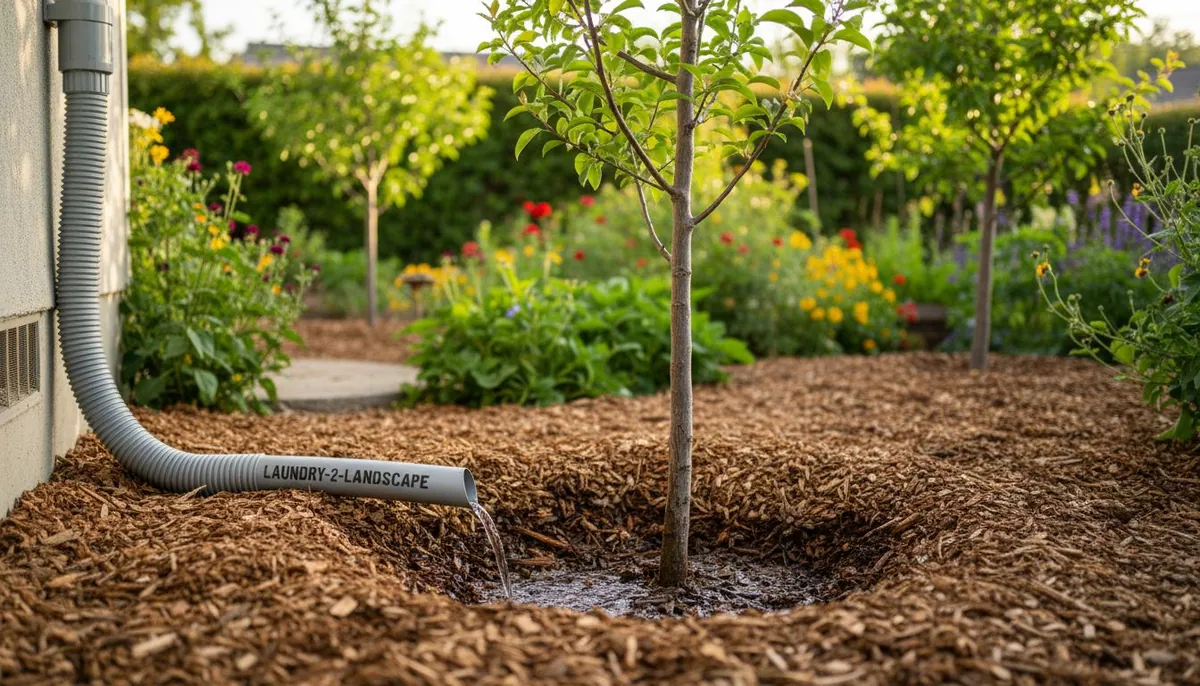
The laundry-to-landscape system is the most popular DIY greywater project, and for good reason: it is affordable, requires no cutting into household drain plumbing, and is legal without a permit in many places. The washing machine's internal pump already pushes water out under pressure, so you simply attach a diverter valve to the machine's drain hose and run a one-inch flexible tube out to the yard. From there the line branches to a series of mulch-filled basins, each with an outlet near a tree or shrub.
Because you never cut into the home's DWV (drain-waste-vent) plumbing, laundry-to-landscape carries the lowest regulatory hurdle. A three-way valve lets you switch back to the sewer instantly for a bleach load or whenever you don't want that water on the garden. Keep the run relatively level or gently downhill, avoid uphill pushes beyond what the pump can handle, and end each outlet in a mulch basin rather than a bare pipe.
Branched Drain Systems
For shower and bathroom-sink water, a branched drain system moves greywater entirely by gravity. A single drain line splits repeatedly through a series of plumbing fittings, dividing the flow evenly until each branch delivers water to its own mulch basin. There are no pumps and no moving parts to fail, which makes branched drains reliable and nearly maintenance-free once installed.
The trade-off is that gravity systems require consistent downhill slope from the fixture to every outlet, so they suit sloping lots far better than flat ones. Branched drains usually involve cutting into existing drain plumbing, which in most areas triggers permit requirements. If you are comfortable with that step, they are the most elegant long-term solution for a shower's steady output.
Simple Shower and Sink Diversion
At the smallest scale, you can divert a single fixture. A bucket in the shower to catch warm-up water, or a sink line rerouted through the wall to a nearby planting bed, delivers greywater to the garden with almost no infrastructure. These low-tech diversions are a good way to test the concept before committing to a plumbed system, and they shine in rentals or off-grid cabins where major plumbing changes aren't practical.
Mulch Basins: Where Greywater Meets Soil
Every safe greywater system ends the same way: not in a pond or a sprayer, but in a mulch basin. A mulch basin is a shallow, wood-chip-filled depression around a tree or shrub where greywater is released below the mulch surface. The mulch does the filtering and the soil biology does the treatment. This design solves several problems at once:
- It prevents water from pooling on the surface, which stops mosquito breeding and odor.
- The coarse mulch keeps outlets from clogging with lint and hair.
- Soil microbes and mulch break down soaps and organic matter before the water reaches deeper groundwater.
- Roots draw the water and dissolved nutrients directly, so nothing is wasted.
Size each basin to the plant it serves and top up the wood chips as they decompose. If you already mulch heavily elsewhere in the garden, you'll find the same material and logic apply here. Deep-rooted, hungry plants like comfrey planted at the basin edge help take up nutrients and keep the system balanced.
Greywater-Safe Soaps and Products
Whatever runs down your drain ends up on your soil, so the products you use matter as much as the plumbing. The two ingredients to avoid are sodium and boron. Sodium (common in many powdered detergents and water softeners) degrades soil structure over time, and boron, a frequent additive in laundry boosters, is toxic to plants even at low concentrations. Bleach, whiteners, and strong disinfectants also harm the soil life your mulch basins depend on.
Look for products labeled plant-friendly or greywater-safe, choose liquid detergents over powders (powders often use sodium salts as fillers), and favor biodegradable formulas low in salts and phosphates. A useful shortcut: products that are gentle on your skin are usually gentle on soil. When you run a load with bleach or a harsh cleaner, simply flip the diverter valve back to the sewer for that cycle.
Health and Legal Cautions
Greywater is safe to use, but it is not drinking water, and a few boundaries keep it that way.
What Not to Water With Greywater
- Never apply greywater to the edible parts of crops. The safest practice is to keep greywater off vegetable gardens and any produce eaten raw or where the water could contact the harvested part.
- Ornamentals, lawns away from foot traffic, and fruit trees are ideal targets. With fruit trees, water goes to the root zone via subsurface mulch basins, never sprayed on foliage or fruit.
- Keep it below the surface. Greywater should always discharge under mulch or soil, never sprayed or ponded where people or pets contact it.
Legal and Design Ground Rules
Greywater regulations vary widely by state, county, and city, so check your local code before building anything plumbed. That said, a few principles are nearly universal: don't store raw greywater more than about a day, keep it out of surface water and away from wells, avoid runoff onto neighboring property, and never cross-connect greywater lines with your drinking-water supply. Simple laundry-to-landscape systems are permit-exempt in many places precisely because they follow these rules by design.
Fitting Greywater Into a Whole-Garden Water Plan
A greywater system is one tool in a larger toolkit, and it works best as part of a layered strategy. Think of your garden's water as coming from three complementary sources: rain you catch and slow down, greywater you produce daily, and tap or well water you use as sparingly as possible.
On the demand side, the biggest lever is choosing plants and layouts that need less water in the first place. Xeriscaping with drought-adapted species shrinks the amount of irrigation any system has to supply, which means your greywater stretches across more of the landscape. For the beds that do need supplemental water, pairing greywater basins with efficient delivery like drip irrigation on your freshwater lines minimizes waste everywhere.
On the supply-and-storage side, shaping the land to absorb water pays dividends. A rain garden captures roof and surface runoff during storms, while earthworks and heavy mulch hold moisture in the soil between events. Greywater then keeps the root zones alive through the dry stretches when neither rain nor rain gardens are contributing. Taken together, these techniques form the integrated approach detailed in our water management guide — a garden that captures, reuses, and conserves water at every step rather than relying on the tap alone.
Start small. A single laundry-to-landscape line feeding two or three fruit trees will teach you how greywater behaves on your soil, and you can expand from there with confidence. Few home projects return as much resilience, and as many living, thriving trees, for as little cost.
Sources
- United States Environmental Protection Agency (EPA) — WaterSense and water reuse guidance
- United States Department of Agriculture, Natural Resources Conservation Service (USDA NRCS) — soil and water conservation practices
- University of Arizona Cooperative Extension — residential greywater and rainwater harvesting publications
- Oregon State University Extension Service — home greywater reuse guidance
- Greywater Action — educational resources on laundry-to-landscape and branched drain systems
About the Author
Lucas is a writer and researcher focused on sustainable agriculture and permaculture practices.