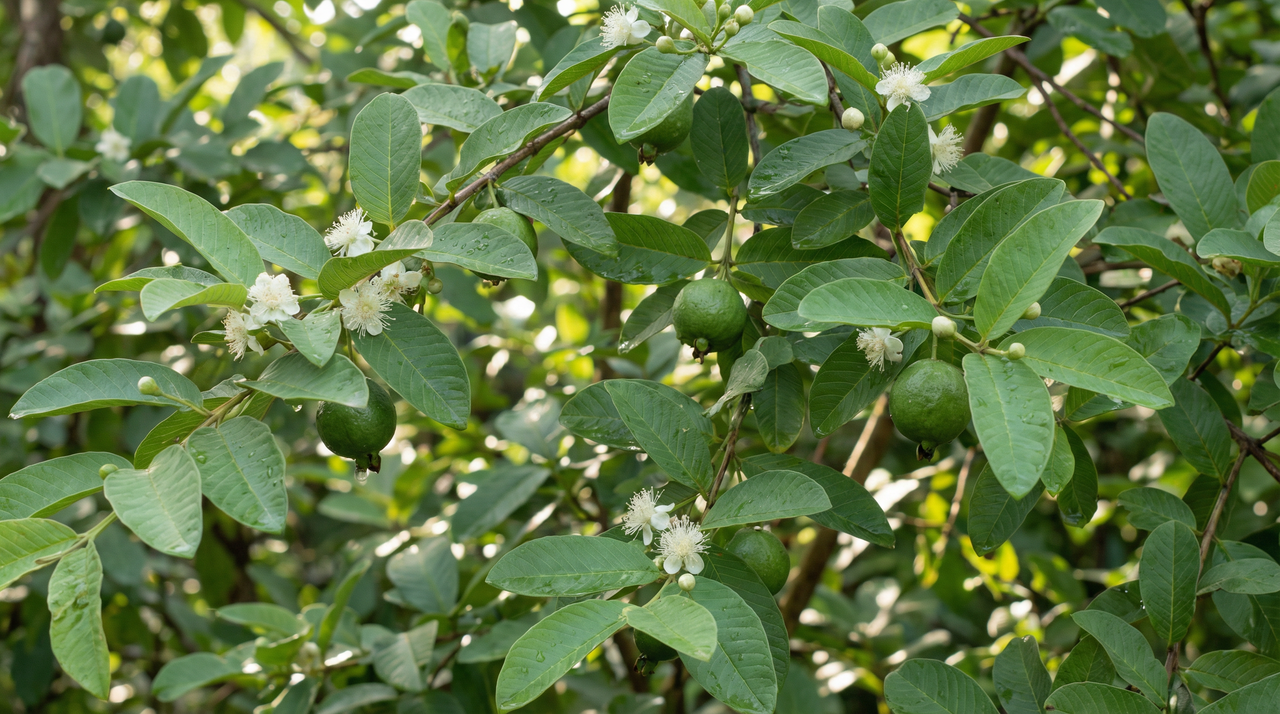
Nobody warns you about the smell of a ripe guava. I mean that as a compliment. The first time I stood under a loaded guava in full fruit, somewhere between the tree and the harvest basket I stopped moving entirely. It's not sweet the way mango is sweet, not floral the way lychee is floral. It's something older and more insistent, a musky, tropical funk that's equal parts strawberry jam and something faintly fermented, animal almost. It hits you before you even touch the fruit. Once you know it, you'll never confuse it with anything else growing in your food forest.
What I find genuinely strange, given how arresting that sensory experience is, is that most North American gardeners treat guava like a novelty rather than a serious food tree. They'll fuss over a fickle avocado for years but overlook a plant that can fruit twice or three times annually, hit 100 pounds of yield per tree, and do it on soils that would make most fruit trees sulk.[1] There's real depth here, ecologically and historically, that most introductions to this plant don't even gesture toward. That's what I want to dig into.
Guava Origin, History, and Botanical Background
Guava (Psidium guajava) calls the Americas home, tracing its origins across a broad sweep of tropical and subtropical terrain from southern Mexico down through Central America and into northern South America, including Brazil, Colombia, Venezuela, and Peru.[2][3] In that native range it grows as an evergreen shrub or small tree, typically reaching somewhere between 3 and 10 meters, with a spreading, often multi-stemmed habit that makes it look generous and a little unruly all at once. The bark peels in thin layers, light brown to gray, revealing smooth wood beneath; the opposite leaves are aromatic when you crush them. The flowers are hermaphroditic, meaning a single tree can set fruit without a partner.[4][5]
What I find remarkable about this plant is how well its biology explains its global success. Guava is polycarpic, capable of flowering and fruiting two to three times a year in the tropics, and with proper care a tree can remain productive for 30 to 50 years.[6][7] Seed-grown plants typically take 2 to 4 years to bear fruit, though I've seen that stretch longer when drainage is poor or temperatures dip too often. In southern Florida, guava is naturalized rather than native, and can be confused with strawberry guava (Psidium cattleianum), a related species with smaller fruit and a more aggressive invasive profile.[8][9]
Native Range and Traditional Uses by Indigenous Peoples
Long before any European ever tasted one, guava was already deeply woven into the lives of Mesoamerican and Caribbean peoples. The Maya, Aztecs, Taino, and Arawak cultivated it for food and medicine, using the fruit, leaves, and bark in decoctions to treat diarrhea, dysentery, respiratory infections, and wounds. In Mayan culture it carried symbolic weight as a sign of fertility and abundance; in Caribbean traditions it appeared in spiritual contexts as well.[10][11] The first detailed European record came from Spanish physician Francisco Hernández, who documented Aztec uses of "guayaba" during his expedition of 1570 to 1577, with the work published in 1651; Bernardino de Sahagún recorded similar medicinal applications in the Florentine Codex.[12][13]
Portuguese traders carried it to Goa in the 16th and early 17th centuries, and from India it spread rapidly across Asia and Africa.[14] It was absorbed into Ayurvedic practice almost immediately, used as a leaf tea for diarrhea and dysentery, and that same preparation appears independently across Latin America, Africa, and the Philippines, where guava also became a symbol of resilience and appeared in ceremonial offerings.[15][16] I think of guava leaf tea the way I think of ginger or mint: a remedy so sensible and so portable that cultures on opposite sides of the world arrived at the same conclusion independently.
Physical Characteristics of Psidium guajava
The flowers are one of guava's quiet pleasures. White, fragrant, about 2 to 3 centimeters across with five petals, they appear intermittently year-round in warm climates and draw in pollinators reliably.[2][17] The species is largely self-compatible, though cross-pollination improves fruit set, and in its native range the plant supports biodiversity by feeding wildlife that simultaneously disperse its seeds.[18] Crushing a leaf in your hand releases that sharp, resinous, tropical scent that tells you exactly what you're working with. For a permaculture garden it's genuinely multi-functional as a visual screen, a pollinator resource, and an aromatic sensory element all in one plant.
Global Spread, Cultural Significance, and Modern Context
Guava's fast growth, averaging 2 to 3 feet of new growth per year under good conditions, combined with fruit that contains 10 to 15 seeds each, goes a long way toward explaining how it naturalized so thoroughly after the 16th century.[19][20] That same productivity is now a problem in Hawaii, Florida, Polynesia, and parts of Africa, where guava outcompetes native flora aggressively.[21] Wild populations in parts of Mexico and Central America have seen reductions of up to 30% since the 1990s from overharvesting, and biopiracy concerns surround patents on guava-derived compounds that often cut out the indigenous communities whose knowledge made those discoveries possible.[22][23]
When I choose cultivars or start plants from seed, I keep the indigenous communities who first understood this plant squarely in mind. Growing guava responsibly, containing its spread with root barriers and consistent sucker management in vulnerable zones, and sourcing from ethical nurseries rather than collecting indiscriminately from wild populations: that's the baseline for anyone who wants to call themselves a regenerative gardener. The plant is generous. We should be too.
Guava Varieties and How to Source Them
Guava cultivars cover an enormous range of fruit experiences. Flesh color is the primary sorting system: white, pink, and red types each carry distinct flavor tendencies, with pink and red selections like Ruby Supreme leaning sweeter and more aromatic, while white-fleshed types like Allahabad Safeda tend toward a milder, less musky profile.[24] Fruit size swings wildly too, from petite 50-gram specimens to monsters over 500 grams, and the difference between a seed-studded variety and something approaching seedless (like 'Seedless Lucknow') matters enormously if you're growing for fresh eating.[25][24]
Notable Guava Cultivars by Flesh Color, Flavor, and Climate Adaptation
For most subtropical home growers, a handful of cultivars will come up repeatedly. Ruby Supreme is the one I recommend most often: it's red-fleshed, genuinely sweet, and was developed through University of Florida breeding programs specifically for disease resistance in humid climates.[5][26] In a humid Florida summer, a healthy Ruby Supreme can deliver two to three cropping cycles in a year, which is a different proposition entirely from California's more typical one to two flushes under drier Mediterranean conditions.[24][27] For California growers, 'Fan Retief' and the appropriately named 'Pineapple' tend to perform more reliably without the humidity those Florida selections prefer.
If cold tolerance is your main constraint, 'Homestead' is the cultivar to know. It came out of the same University of Florida program and was selected specifically for zone 9 margins where occasional dips into the mid-20s°F are possible.[24][28] I've planted young guavas in 9B and nursed them through cold snaps with frost cloth; site selection on a south-facing wall helps more than people expect. One useful distinction worth knowing: apple guava (the common white-to-pink fleshed type) is larger and milder than yellow guava, which runs smaller with tangier, almost citrusy fruit and distinctly yellow skin at maturity.[29]
Sourcing Guava Plants: Availability, Pricing, and Regulations
Finding good guava stock is straightforward in Florida, California, and Hawaii, where nurseries regularly carry seedlings, grafted trees, and occasionally mature specimens.[30] Seed packets run $5 to $15, small plants $20 to $80, and mature trees can reach $100 to $300 depending on size and container. I grew my first guavas from seed and waited several years for variable, mediocre fruit. Grafted disease-resistant stock from a reputable nursery costs more upfront, but you get true-to-type fruit faster and with meaningfully lower disease pressure. That's a lesson I learned the slow way.
Before ordering from out of state, check the 7 CFR 301.32 interstate quarantines. Movement of guava plants and fruit out of Florida and Hawaii into non-quarantined states requires permits or inspection to prevent spreading invasive pests like Caribbean fruit fly.[31] It's not bureaucracy for its own sake; it's genuinely how we keep fruit flies out of new regions. Imports from Latin America and Thailand face even stricter USDA APHIS phytosanitary requirements including fumigation or cold treatment certification.[32] For most home growers, sourcing locally through your state extension service's recommended nursery list sidesteps all of it cleanly. And if you're in Florida or Hawaii, check your local invasive species list before planting; guava has naturalized in both states and can spread aggressively outside managed garden contexts.[8]
Guava Propagation and Planting Guide
Propagation Methods: From Polyembryonic Seeds to Grafting
One of the things I genuinely love about guava is what happens when you sow a single seed and watch three or four vigorous, nearly identical seedlings push up from the same spot. That's polyembryony at work. Guava seeds regularly contain multiple embryos: some zygotic (sexually produced, genetically unique) and some nucellar (asexual clones of the mother plant).[33][34][35] The nucellar embryos usually predominate, which means seed-grown trees often come true to type -- a biological shortcut that feels almost too good to be real. The zygotic seedling in the mix is typically the weakest one; I cull it early and keep the vigorous matched pair or trio.
That said, getting those seeds to germinate at all requires some attention. Guava seeds are small, 1 to 3 mm, ovoid to kidney-shaped, with a hard woody seed coat that imposes physical dormancy.[36][37] Early in my trials I skipped scarification and wondered why germination was patchy and slow. Lesson learned. Now I nick the seed coat lightly with sandpaper or soak seeds in warm water for 24 hours before sowing. With scarification and consistent bottom heat at 25 to 30°C, germination rates improve to 50 to 80 percent and sprouts appear within 10 to 30 days.[37][38] Keep seedlings in partial shade with high humidity for the first few weeks; damping-off is a real risk if you rush them into full sun too soon.
For named cultivars where flavor and fruit quality are non-negotiable, vegetative propagation is the more reliable path. Veneer or cleft grafting onto compatible rootstocks (including P. guajava or P. cattleianum) succeeds at 70 to 90 percent, and semi-hardwood cuttings treated with IBA root at 60 to 90 percent under mist with bottom heat.[39][40] Air-layering is popular in tropical regions and tissue culture is used commercially for disease-free elite stock. Seeds are most practical for raising rootstocks or for breeding work where you actually want that genetic variability from the zygotic embryo.
Seed Storage, Viability, and Germination Timeline
The timeline question matters enormously when you're deciding how to start your guava. Seed-grown trees can take anywhere from 1 to 8 years to first fruit depending on climate and care.[41][42] Grafted trees often fruit in 1 to 2 years under good tropical conditions. That difference alone drives most productive gardeners toward grafted stock for eating fruit and seeds for rootstock production. If you do save seed, store it at 4 to 5°C with moisture around 5 to 10 percent for long-term viability (up to 80 to 90 percent germination after five years under those conditions), though some researchers treat guava seed as moisture-sensitive and recommend cooler storage around 15 to 25°C in moist media.[43][44] What the literature agrees on is this: room-temperature storage drops viability below 50 percent within two years, so test older seed with a tetrazolium stain or a simple germination trial before you commit a whole tray to questionable stock.[45] I label every tray with the collection date because guava seedlings look remarkably similar to other Myrtaceae in their first month, and a mystery tray of unlabeled seedlings is a frustrating thing to deal with in spring.
Soil, Site Selection, and Sun Requirements
Before you plant anything, dig a test hole about 12 inches deep, fill it with water, and see how fast it drains. If the water sits for more than an hour, you need to either amend heavily or choose a different spot. Guava wants well-drained sandy loam or loam, and its shallow roots make it particularly unforgiving of waterlogged conditions -- Phytophthora root rot can take a young tree fast.[41][5] In heavier Florida soils, I now amend every planting hole with coarse sand or perlite; it's a step I skipped early on and regretted. Soil pH between 5.5 and 7.5 is ideal, with tolerance stretching to 4.5 or 8.5 at the extremes, and working in a few inches of well-rotted compost or aged manure before planting helps establish a healthy root environment.[4][46]
Full sun is non-negotiable. Guava needs a minimum of 6 to 8 hours of direct light daily, and I've watched plants grown in anything less become spindly and reluctant to fruit.[41] It's less forgiving of shade than citrus, which can manage in dappled light and still produce. Guava in shade just... gives up on fruiting. Site it where it'll get the most sun you can offer, and keep that in mind when placing companion plants around it. Once established, the tree handles moderate drought reasonably well, though it appreciates consistent moisture during flowering and fruit set.[42][24] Frost sensitivity below 5°C places it firmly in USDA zones 9 through 11, which the permaculture design section addresses in more depth.
Spacing, Planting Technique, and Establishment
Plan for a mature tree of 10 to 20 feet tall with a canopy spread of 10 to 15 feet, and left fully unpruned they'll push past 30 feet.[24][4] For standard home-garden or food-forest planting, spacing of 12 feet within rows and 20 feet between rows gives the canopy room to develop without trees fighting each other for light. High-density plantings can go as tight as 6 to 8 feet by 10 to 12 feet, but only if you're genuinely committed to annual pruning.[47] I keep my own trees around 12 feet through post-harvest cuts each year. It keeps the fruit reachable, opens the canopy to airflow, and I've noticed far fewer fungal problems compared to unpruned trees in the same neighborhood.
Guava's suckering habit is worth factoring into your spacing plan from day one. New shoots regularly emerge from the base and from surface roots, and if you plant too close together, you'll have a thicket rather than a managed food tree within a few seasons. Dig your planting hole to about twice the width of the root ball, backfill with your amended mix, and water in thoroughly to settle any air pockets. Mulch heavily around the base but keep it a few inches away from the trunk. The first season's job is root establishment, so consistent moisture and protection from frost are your main priorities before the tree is large enough to fend for itself.
Guava Care Guide: Sunlight, Water, Feeding, and Maintenance
Caring for a guava tree well means understanding what its native habitat was asking of it all along: warm temperatures, honest rainfall, rich-enough soil, and a lot of sun. Get those fundamentals right and the tree will reward you generously. Push against them and you'll spend more time troubleshooting than harvesting.
Sunlight Requirements for Optimal Growth and Fruiting
Guava needs a minimum of 6 to 8 hours of direct sun daily for reliable flowering and fruit production.[24][4] In cooler climates, every hour of that sun counts for ripening fruit that might otherwise stay tart and underdeveloped.[48] That said, guava isn't entirely bulletproof in the blazing afternoon heat of zone 9b. It can develop leaf scorch and photoinhibition when intense light hits a heat-stressed canopy without warning.[49][50] I watch leaf color daily during the hottest stretches of summer; pale, slightly bronzed new leaves are my signal that the tree needs some afternoon relief, whether that's a light shade cloth or a smarter placement on the east side of a larger canopy.
Water Requirements and Drought Tolerance
The native range of guava spans the moist riverbanks and disturbed edges of tropical Central and South America, where annual rainfall typically runs between 800 and 1,200 mm.[4][51] That background tells you exactly what it wants: consistent moisture that drains quickly rather than pooling. For mature trees, aim for 1 to 2 inches of water per week delivered deep enough to reach 12 to 18 inches of root zone; young trees need more frequent attention, roughly every two to three days, until they're established.[24][4] Once settled in, a mature tree can survive two to four weeks of drought, but wilting typically starts showing around day seven to ten without irrigation.[24] During flowering and fruiting, bump that weekly delivery up to 2 to 3 inches; this is not the moment to let the tree coast. My shallow-rooted guavas have taught me that letting the top two inches of soil stay dry for more than five days in summer visibly shrinks the fruit and dulls the sweetness by harvest time. Underwatering shows as marginal leaf scorch and smaller fruit; overwatering shows as yellowing lower leaves and wilting despite wet soil, which usually means Phytophthora root rot is already working.[4][24] Keep irrigation water pH between 6.0 and 8.5 and avoid high-salinity sources; the shallow root system simply doesn't have the buffer that a deeper-rooted tree would.[52][53]
Fertilizer Needs and Nutrient Management
Guava is a hungry tree, and the amount it needs scales sharply with age. A first-year tree wants roughly 0.25 to 0.5 lb of actual nitrogen annually; that climbs to 0.5 to 1 lb for trees between one and three years old, and a mature bearing tree may need 1 to 4 lbs depending on its size and output.[24][54] A balanced 6-6-6 or 8-3-9 works well for general maintenance, but I shift toward a lower-nitrogen, higher-potassium blend like an 8-10-10 or 5-10-20 once buds are forming, because heavy nitrogen at that stage pushes lush foliage at the expense of fruit set.[24][55] Split the annual total into three or four applications timed to post-harvest, early spring, and pre-flowering; skip winter entirely.[24][55] Soil pH should sit between 6.0 and 7.0 for the best micronutrient availability; outside that range, iron, zinc, and manganese lock up fast.[56][24] I've learned to watch new leaves for interveinal yellowing, which is almost always iron deficiency, and I apply a chelated iron foliar spray before it spreads rather than waiting for the whole flush to go pale. A soil test before you set a fertility schedule is the single highest-ROI step a home grower can take; over-fertilizing doesn't just waste money, it invites pests and sends nutrients into Florida's groundwater.[57][58] Compost and well-rotted manure are excellent complements to synthetic programs because they slow the release down and genuinely improve soil structure in the sandy mixes that dominate a lot of zone 9b and 10 growing sites.
Frost and Cold Protection
Guava is rated for USDA zones 9b through 11, which means minimum temperatures need to stay above roughly 25 to 30°F to keep the tree alive.[5][8] A mature tree can shrug off a brief dip to 26 or 28°F, but roots suffer below 20°F and anything in flower or fruit is damaged the moment temperatures touch 30°F.[5] Frost damage reads as blackened leaves, stem dieback, and sudden fruit drop; flowers simply abort without visible drama.[48][59] I keep breathable row covers on hand for young trees because I once lost a promising 'Thai White' to an unexpected 28°F night that the forecast had marked as a close call. Since then, I plant young guavas against south-facing walls or inside the warm air pocket created by a mature canopy overhead. When a freeze does hit, post-frost recovery means pruning out dead wood cleanly, then pushing extra water and a balanced fertilizer to help the tree redirect energy into new growth.[48][28] The tree prefers consistent temperatures above 50°F for active growth; below that, it slows down and becomes far more vulnerable to secondary problems.
Heat Tolerance and Stress Mitigation
Guava is genuinely heat-adapted, placed in AHS Heat Zone 12 and capable of sustaining growth at 35 to 40°C with brief spikes toward 45°C.[60][61] The catch is flowering. Above 35°C, pollen viability drops, flowers abort, and some subtropical orchards see 50 to 70% flower drop during heat events.[24][62] I noticed this with my passionfruit vines as well; both will drop flowers almost simultaneously when a heat spike rolls through, which is a useful dual signal for me to act. The moment a multi-day forecast above 95°F appears, I deploy 35 to 50% shade cloth over trees that are in bud or bloom, which can pull canopy temperature down by 5 to 10°C.[63] Deep organic mulch at 8 to 10 cm conserves soil moisture, and I run drip irrigation in the early morning rather than midday, aiming for around 40 to 60 liters per tree weekly during those stretches.[64] If you're selecting a new cultivar with heat-spike summers in mind, 'Allahabad Safeda' and 'Taiwan Pink' have shown better tolerance than many standard selections.[65]
Pruning, Maintenance, and Seasonal Rhythm
Annual pruning after the last harvest, typically late winter or early spring in subtropical gardens, is one of the highest-leverage practices in guava care. Removing water sprouts, crossing branches, and congested interior growth opens the canopy to light and air, reduces disease pressure, and can increase yield by 20 to 30% compared to an unpruned tree.[41][4] Every three to four years, heavier rejuvenation pruning encourages a flush of new fruiting wood. My hard-won rule from an early overzealous session: never remove more than 20 to 30% of the canopy in a single cut. The first time I ignored that, the tree spent the better part of a season sulking rather than fruiting, and recovery took longer than I expected. Once fruit sets, thin it to 6 to 8 inches apart along the branches so the tree can put its energy into sizing up what remains rather than spreading it thin across too many small fruits.[30] Container growers in cooler microclimates may also need to hand-pollinate indoors when no pollinators are present. The seasonal rhythm of prune, feed, water consistently through flowering and fruiting, then harvest is deeply satisfying once it becomes second nature, and a well-managed mature tree can deliver a remarkable volume of fruit year after year.
Harvesting Guava: When, How, and What to Expect
Timing and Ripeness Cues
Once a guava tree flowers, you're typically looking at 90 to 120 days until harvest, though the window can stretch anywhere from 60 to 150 days depending on cultivar and how warm the season runs.[41] Heat accelerates everything, which in Central Florida means a fruit that sets in June can be on your kitchen counter by late August. After watching a few crops ripen in the humid Florida summer, you stop needing to count days and start reading the tree instead.
The signals are reliable once you know them. Color is the first tell: the skin shifts from a deep lime green to a lighter, more pastel green, then pushes toward yellow or a soft blush pink, usually starting at the base and shoulders of the fruit rather than all at once.[41][66] A gentle press at the stem end tells you the rest; ripe fruit yields slightly without feeling mushy. The clincher is the aroma. On a warm afternoon, a ready guava announces itself from several feet away with that unmistakable musky, tropical sweetness. When you can smell it before you see it, pick it.
Florida's main harvest runs from August through November, with good cultivar selection making multiple crops per year possible.[41][5] California growers in coastal and southern regions generally harvest October through December with one to two crops annually, while Hawaii can produce year-round with a peak from November through March.[67][66]
Flavor, Texture, and Yield at Harvest
Walking past a ripe guava tree in August is a sensory event. The aroma is a layered thing: strawberry and pineapple up front, with citrus, pear, and something faintly floral and resinous underneath, built from more than 300 identified volatile compounds.[68] The flavor follows suit: sweet and tangy with a lingering musky finish that reminds me of a riper, more tropical version of pear and passionfruit. As the fruit matures, the sugar-to-acid ratio shifts dramatically, from roughly 5:1 in an underripe fruit all the way to 20:1 at full ripeness.[69][70] I always taste a small piece first because overripe guavas ferment quickly in our heat, and that beautiful sweetness tips into something unpleasant fast.
The texture surprises people who haven't tried fresh guava before. The flesh is juicy but granular, studded with anywhere from 100 to 500 tiny hard seeds, and the thin edible skin shifts from green to yellow or pink depending on variety.[71] Think of biting into a very ripe tomato crossed with a kiwi; there's juice, there's give, and there's that slight sandy resistance from the seeds. Tropical cultivars tend toward sweeter, fruitier profiles while subtropical types can run more acidic and green.[72]
A well-tended mature tree can produce 50 to 100 pounds of fruit per year, with Florida selections like 'Homestead' capable of hitting the upper end of that range.[24] From my own 8-foot trees in Central Florida after a few years of consistent pruning, 60 to 80 pounds in a good season is a realistic expectation. If you can't process everything immediately, store harvested fruit at 45 to 50°F with 85 to 90 percent relative humidity for a shelf life of two to four weeks.[73] Fruits picked at around 25 percent yellow hold longer in storage than those left to go fully golden on the tree, which is a lesson I learned after losing a few batches to the refrigerator before I got the timing right.
Guava Preparation, Culinary Uses, and Medicinal Applications
Culinary Uses: From Fresh Fruit to Goiabada and Beyond
One thing I love about guava is that you can eat the whole fruit without apology: skin, seeds, and pulp are all nutritious, delivering vitamin C, fiber, and potassium in every bite.[74] The flavor is unmistakable, sweet-tart and tropical, driven by a complex mix of esters and terpenes like ethyl acetate and methyl butanoate.[75] If you've ever opened a ripe guava and immediately thought of something halfway between pineapple and pear, that's not your imagination; it's the same ester chemistry that makes a ripe mango or fresh pineapple smell the way it does.
After years of harvesting my own trees, I've learned that slightly underripe fruit holds its shape beautifully in jams, chutneys, and guava preserves, while fully tree-ripened fruit is best eaten fresh or blended straight into juice or smoothies. That ripeness distinction matters for guava jam recipes because overripe fruit turns mushy and loses that bright tartness you want. Speaking of cultural staples, Brazilian goiabada, a firm guava paste often served with soft cheese, is the most iconic processed form, but the possibilities extend through syrups, desserts, empanadas, marmalades, salsas, and cocktails.[5][76] Unripe guava also has a culinary life of its own in savory chutneys and curries across South Asia and the Caribbean, where its firm texture and astringency work in its favor.[77] Cooking or fermenting also reduces tannins and oxalates, which improves both flavor and nutrient availability, a practical bonus for anyone working with large harvests.
Worth knowing if you're processing fruit: juicing preserves most of the esters but reduces overall volatile compounds by around 20 to 30 percent, and heat cooking shifts the flavor profile toward caramel notes as fresh esters diminish and furaneol increases.[78][79] I prefer minimal processing for that reason; fresh or lightly cooked guava keeps the bright tropical character that makes it worth growing in the first place.
Preparing Guava Leaf Tea and Other Medicinal Forms
Guava leaves have a long tradition in Latin American, Caribbean, and Asian herbalism as a tea for digestive upset, diarrhea, and blood sugar support, and there's reasonable clinical evidence backing those uses.[80] The leaves taste nothing like the fruit; eugenol and cineole give them a green, medicinal character rather than anything sweet.[81] I harvest young leaves for a milder bitterness and steep them fresh when I have them, dried when I don't, about a small handful per cup for ten minutes. I treat guava leaf extracts with the same respect as any concentrated herbal preparation; one to two cups of tea a day fits comfortably in my routine, but I always recommend checking with a healthcare provider if you're on diabetes medications or blood thinners, since there are real interaction risks. Start with tea rather than standardized extracts; the long-term human data on high-dose supplementation is still thin.
Non-Food Uses: Biomass, Dyes, Fiber, and More
A mature guava produces an almost embarrassing amount of biomass. Every pruning session in my food forest yields armloads of branches and leaves that go straight into the chipper for mulch or into the compost pile.[82] The wood itself is dense and durable, traditionally used for fuel and small crafts, and bark fibers have historically served as rope and twine in some regions. Unripe fruits and leaves also yield natural dyes in yellow to green hues for textiles, a traditional use that's enjoyable to experiment with. From where I stand as a designer, the biomass cycle alone justifies the tree's place in any permaculture system; it feeds the soil that feeds the tree that feeds you.
Guava Health Benefits and Medicinal Uses
I stopped buying expensive imported citrus the day I did the math on my backyard guavas. Two or three ripe fruits from the tree cover my family's daily vitamin C needs with room to spare, which makes sense once you look at the numbers: a 100g serving of raw guava delivers 228.3 mg of vitamin C, more than 254% of the daily value.[83] Oranges clock in at around 53 mg per 100g.[83] It's not a close contest.
Nutritional Powerhouse: Vitamins, Minerals, and Fiber
That same 100g serving comes in at just 68 calories while packing 2.55g protein, 5.4g dietary fiber, 417mg potassium, and 49μg folate.[83] The FAO has flagged guava as a key fruit for addressing micronutrient deficiencies across tropical regions, and one to two whole guavas daily can meaningfully move the needle on both vitamin C and fiber intake for most people.[84] Practically, that means eating the skin, the pulp, and yes, those small crunchy seeds, which I find genuinely satisfying. The fragrance of a fully ripe guava tells me more about its readiness than any color chart could.
A quick processing note: heat is hard on vitamin C, cutting it by 20-50% during cooking or juicing, but phenolic compounds and carotenoids tend to hold up well or even concentrate with drying.[85] Oxalic acid and tannins are present in small amounts and can mildly limit mineral absorption, but at guava's naturally low levels this isn't a concern for most people eating moderate amounts.[86]
Key Phytochemicals Behind Guava's Benefits
Guava's nutrition profile is impressive, but the phytochemical picture is where things get genuinely interesting. Every part of the plant carries a distinct chemical signature: leaves are richest in phenolics and flavonoids (quercetin, kaempferol, rutin, ellagitannins), fruit pulp concentrates carotenoids like lycopene and β-carotene alongside phenolic acids, seeds contribute polyunsaturated fatty acids, and the bark runs high in tannins.[87] Leaf essential oils add another dimension through terpenes like β-caryophyllene, limonene, and eucalyptol, which contribute meaningfully to antimicrobial activity.[88]
Total phenolic content in leaf extracts commonly ranges from 100 to 300 mg GAE/g, and growing conditions shape that range substantially. Higher soil nitrogen, full sun, peak ripeness, and dry-season stress all push phenolic production upward by 20-30%.[89][90] My guavas grown in full Central Florida heat, without much shade, produce leaf tea that's noticeably more astringent and aromatic than anything I've brewed from nursery-grown plants kept in partial shade. That aligns with what the research says, and it reinforces something I tell every permaculture student: how you grow your medicine matters.
Proven Medicinal Properties and Traditional Uses
Across Latin America, Asia, and Africa, communities have relied on guava leaves and fruit as decoctions and teas for treating diarrhea, diabetes, hypertension, fever, wounds, and respiratory complaints for centuries.[91] Modern pharmacology has spent the last few decades catching up to that empirical knowledge, and the results are largely validating.
The antioxidant case is solid: vitamin C, carotenoids, quercetin, gallic acid, and ellagic acid work together to scavenge free radicals and reduce oxidative stress.[92] Anti-inflammatory effects follow the same compound roster, with flavonoids and phenolic acids shown to inhibit NF-κB pathways and reduce pro-inflammatory cytokine activity in animal models.[93] The antidiarrheal reputation is backed by real mechanism: astringent ellagitannins tighten intestinal tissue and inhibit pathogenic bacteria including E. coli and Staphylococcus aureus, with some studies even finding synergy between guava phenolics and antibiotics like amoxicillin.[94][93]
The antidiabetic research is probably the most translatable to human use. Leaf extracts have shown α-glucosidase inhibition and AMPK activation in both animal models and limited clinical trials, suggesting real potential for blunting postprandial blood sugar spikes.[95] If you're already taking metformin or other antidiabetic medications, this matters: guava leaf extract may potentiate those drugs' hypoglycemic effects, and its mild anticoagulant activity can interact with warfarin.[96] Tell your prescriber you're drinking the tea regularly. Preclinical findings on anticancer and anxiolytic activity are intriguing, but the human evidence isn't there yet, so I file those under "watching with interest."[97]
Safety Profile and Cautions
Guava fruit has an excellent safety record. It's non-toxic to dogs and cats in moderate amounts[98], and even excessive fiber intake is just a mild GI inconvenience rather than anything serious.[8] Leaf tea is considered safe for short-term adult use at 1-3g dried leaves per cup; higher doses can cause nausea or constipation.[99]
Pregnancy is where I get cautious. I enjoy guava fruit year-round, but during pregnancy I limit leaf tea to one cup a day and always check with my care provider first, because long-term human data on concentrated extracts is still thin.[99][100] The seeds are safe to eat, though swallowing large quantities of whole hard seeds can occasionally cause minor GI irritation.[101] Allergies are rare but real: people with birch or mugwort pollen sensitivities can experience oral allergy syndrome cross-reactivity, and latex-fruit syndrome is something I mention when sharing harvests with neighbors who have Myrtaceae allergies.[102] Sourcing from clean soil matters too, since the plant can accumulate heavy metals from contaminated ground.[103] Grown responsibly and eaten sensibly, though, guava is one of the most benign and generous plants in the tropical garden.
Guava Pests and Diseases
Guava has moderate overall pest resistance for a tropical fruit tree, but "moderate" comes with real asterisks once you're gardening in a warm, humid climate. The plant brings genuine built-in defenses: the essential oils in the foliage do exactly what they evolved to do: compounds like α-pinene and limonene, have documented insect-repellent and larvicidal properties,[104] and the phenolic tannins in the foliage deter feeding and interfere with insect nutrient absorption.[105] Still, those defenses only go so far when summer humidity sits above 80% for weeks at a time.
Major Diseases of Guava and Their Management
The disease roster for guava reads like a who's-who of tropical fungal pathogens: anthracnose, Fusarium wilt, bacterial blight, rust, fruit rot, leaf spots, and Phytophthora root rot are the main offenders.[106][107] Anthracnose and Fusarium wilt are the two that concern me most in practice. Anthracnose shows up on fruits, leaves, and new shoots whenever conditions stay humid, and I've learned to catch the earliest signals in young plantings: tiny leaf spots that look almost like freckles appearing right as the rainy season kicks in. Improving airflow through light pruning and acting early makes a real difference. Fusarium wilt is the more sobering one because it causes vascular damage that can kill the tree outright, with high mortality in susceptible varieties.[108][109]
Rust, Phytophthora root rot, and the various leaf spot fungi sit at a moderate impact level, and while some cultivars like Beaumont and Thai White show tolerance to Phytophthora, complete resistance is rare.[110][111] Cultivar selection is genuinely your first line of defense. For anthracnose, Paluma, Allahabad Safeda, and Lucknow-49 have shown solid resistance; for Fusarium wilt, Chittidar, Sarey, and Taiwan Pink hold up better than average; in Florida specifically, Ruby Supreme and Homestead are worth prioritizing.[112][113] None of this is a guarantee, especially in zone 9B humid summers, and I always recommend running a quick soil test through your local extension office before planting rather than assuming your site is disease-suppressive. Well-drained soil, a pH between 6.0 and 7.5, and good sanitation habits reduce fungicide needs dramatically.[114][115]
Common Pests and Integrated Pest Management for Guava
Fruit flies are the headline pest, and they deserve that billing. Ceratitis capitata, Anastrepha species, and Bactrocera dorsalis can cause over 50% pre-harvest fruit loss, and in many regions they trigger quarantine restrictions that affect how you can move fruit off your property.[116][117] I've grown several cultivars side by side and consistently seen lower infestation on thicker-skinned selections. Lucknow-49 and Allahabad Safeda both showed noticeably better results against Bactrocera dorsalis than thinner-skinned types planted right next to them,[118][119] which lines up with the research on how skin thickness physically limits oviposition.
Beyond fruit flies, the pest roster includes mealybugs, scale insects, leaf miners, fruit borers, psyllids, mites, and root-knot nematodes in some soils.[120][30] High humidity accelerates fungal issues and emboldens mites and piercing-sucking pests, while drought stress opens the door to borers by weakening the tree's resin response.[121] Nursery conditions concentrate leaf miners and psyllids in particular, so I check new transplants carefully for the first few months. Catching a leaf-miner outbreak early in a young planting has saved me from losing significant canopy more than once.
For IPM, the permaculture-compatible toolkit is genuinely good here. I interplant marigolds and basil throughout my guava guilds; beyond the published evidence for disrupting fruit fly host-finding,[122] it's halved the time I spend scouting because those companions draw beneficial insects that handle secondary pest pressure. Protein bait stations and methyl eugenol traps for monitoring, parasitoids like Fopius arisanus for biological control, and neem-based biopesticides when thresholds are exceeded round out a solid program that avoids broad-spectrum sprays.[56][123] Sanitation stays non-negotiable regardless of which tactics you layer on top: fallen fruit needs to leave the site, not just the orchard floor.
Guava in Permaculture Design
Guava is one of those plants that rewards you generously when sited well and punishes you with headaches when it isn't. Before you fall in love with its productivity, you need an honest conversation about climate fit, because this tree designed into the wrong system isn't a permaculture win, it's future management debt.
Climate and Hardiness Zones for Guava
Guava thrives in subtropical to tropical conditions, with optimal growth between 23-28°C during the day and nights staying above 15°C.[30][124] That puts it squarely in USDA zones 9b through 11, where it also appreciates 60-90% humidity and somewhere between 1,000-2,000 mm of annual rainfall.[5][125] Mature trees can survive brief dips to around -3°C (27°F), but young plants and any new flush of growth will take damage at -1°C, so in zone 9b you're always one cold event away from a setback.[30] I've learned to tuck mine against a south-facing structure and keep a thick mulch layer year-round; windbreaks help too, both with cold air drainage and with the heat stress that kicks in above 35°C and can cause fruit drop above 40°C.[110][30]
The distribution map tells a useful story: guava's natural climate home is Köppen-Geiger Af, Am, and Aw, covering humid tropical forests through seasonal savannas.[125] Florida sits at the ragged northern edge of that range, which means permaculture designers here are working with a plant operating near its tolerance limits. That context matters for plant placement decisions. And it matters for another reason: guava is listed as invasive in Florida and Hawaii, where it spreads readily via bird-dispersed seed and forms dense thickets that crowd out native vegetation.[126][127] Designing it into your system responsibly means accepting that reality from day one, not as an afterthought.
Ecological Functions and Guild Integration
When guava is managed well, its ecological contributions are genuinely impressive. The flowers open in the morning and draw honeybees and stingless bees as primary pollinators, with flies, butterflies, and the occasional hummingbird rounding out the visitor list.[128] Cross-pollination measurably improves both fruit set and quality over self-pollination alone, with optimal conditions sitting at 20-30°C and 50-70% relative humidity.[129] In my own Central Florida food forest, the guavas surrounded by diverse flowering perennials consistently set heavier crops than isolated trees. That's the guild logic made visible.
Beyond pollination, guava pulls its ecological weight in several other directions. Its fruit feeds birds, bats, and mammals, all of which support broader food-web diversity.[8] As a dynamic accumulator, it cycles potassium, calcium, and magnesium back to the soil surface through leaf litter.[130] In my experience, guava leaf litter breaks down faster than most of the other fruit trees I grow in humid subtropical conditions, and the soil under established trees has a noticeably different texture over time. Its spreading root system also stabilizes soil against erosion, and planted in rows it can double as a windbreak.[131] Intercropping with nitrogen-fixing legumes like Leucaena improves soil fertility, and guava forms mycorrhizal associations that enhance its own nutrient uptake in return.[132]
That said, every one of those wildlife-friendly traits, the abundant fruit, the prolific seed production, is exactly what makes guava so aggressive in introduced habitats. Bird dispersal is efficient and wide-ranging, and the resulting seedlings form dense thickets that alter soil nutrients, increase fire risk, and suppress native vegetation.[126][133] I've seen it naturalize along fence lines here in zone 9b, and that observation has permanently changed how I manage harvest timing. The research on dispersal is real; it requires active engagement, not wishful thinking.
Forest Layer Placement and Companion Planting
Guava typically reaches 4-6 meters in cultivation, though it can push toward 10 meters left unpruned.[4] Its root system spreads laterally up to 6-8 meters rather than diving deep, which positions it naturally as a mid-layer or understory tree in a food forest design.[131] I learned the hard way that placing it near slower-growing native shrubs without a management plan leads to shading problems within just a few seasons. Now I treat it as a managed mid-layer species, not a set-and-forget pioneer.
The companion planting guild that works well around guava includes nitrogen-fixing legumes at the same or canopy layer, banana for mutual shade benefits, comfrey or other ground-layer dynamic accumulators, and aromatic plants like marigolds, basil, or lemongrass around the drip line for pest deterrence.[24][131] The mycorrhizal network that develops in a well-established guild gives guava a real uptake advantage, which is one reason I prioritize avoiding synthetic fungicides near established trees.
In Florida and Hawaii especially, responsible placement means monitoring for volunteer seedlings regularly, harvesting fruit before it fully softens to reduce bird dispersal, and keeping the tree integrated into an actively managed guild rather than a semi-wild edge.[134][135] That's not a reason to avoid growing guava; it's a reason to grow it intentionally, inside a system where you're paying attention.
The Tree That Taught Me to Stop Waiting for Perfect
My first guava fruited in August, the hottest, most suffocating week of a Central Florida summer, and I stood there in the humidity eating warm fruit off the branch like I had nowhere else to be. It wasn't perfectly sized or perfectly timed. It was just ready, and so was I. That's the thing about guava; it doesn't wait for ideal conditions, and after years of working with it, neither do I.
Sources 135
- Guava Growing in the Florida Home Landscape, University of Florida IFAS Extension ↩
- Royal Botanic Gardens, Kew: Psidium guajava ↩
- Psidium guajava - Kew Science Plants of the World Online ↩
- Psidium guajava - Missouri Botanical Garden ↩
- Guava Growing in the Florida Home Landscape - University of Florida IFAS Extension ↩
- Guava Production Management - USDA ARS ↩
- Guava Production in Tropical Climates - FAO ↩
- USDA PLANTS Database - Psidium guajava ↩
- Strawberry Guava - Psidium cattleianum - University of Florida IFAS Extension ↩
- Guava (Psidium guajava L.) - CABI Compendium ↩
- Traditional uses of guava in Caribbean folk medicine ↩
- The Expedition of Francisco Hernández ↩
- The Florentine Codex: General History of the Things of New Spain ↩
- Guava: Botany, Production and Uses - FAO ↩
- Ethnobotany of Psidium guajava in Traditional Medicine ↩
- Guava in Filipino Traditional Medicine and Symbolism ↩
- Royal Horticultural Society - Guava ↩
- Psidium guajava - Missouri Botanical Garden ↩
- Missouri Botanical Garden ↩
- University of Florida IFAS Extension ↩
- Invasive Species Profile: Psidium guajava - IUCN ↩
- Sustainability and Overharvesting of Wild Guava Populations - FAO ↩
- Biopiracy and Patents on Guava Derivatives - WIPO ↩
- Guava Cultivars and Characteristics - University of Florida IFAS Extension ↩
- Guava - Wikipedia ↩
- University of Florida Tropical Research and Education Center: Subtropical Fruit Breeding ↩
- Guava Cultivars for California ↩
- Missouri Botanical Garden - Psidium guajava ↩
- Guava Growing in the Florida Home Landscape ↩
- Guava Growing in the Florida Home Landscape ↩
- Importation of Fruit from Hawaii ↩
- Guidelines for Importing Fresh Fruits & Vegetables ↩
- Polyembryony in Guava (Psidium guajava L.) ↩
- Polyembryony and Seed Propagation in Guava (Psidium guajava L.) ↩
- Seed Propagation in Guava: Role of Polyembryony ↩
- Psidium guajava L. ↩
- Seed Germination and Dormancy in Psidium guajava ↩
- Morphological Traits and Germination Ecology of Guava Seeds ↩
- Guava Propagation Methods Review ↩
- Advances in Guava Horticulture ↩
- Guava Growing in the Florida Home Landscape ↩
- Guava Production Technology ↩
- Storage behaviour of tropical tree seeds: Psidium guajava ↩
- Seed storage behaviour of guava (Psidium guajava L.) ↩
- Seed Viability Testing in Psidium guajava Using Tetrazolium Chloride ↩
- USDA Plants Database ↩
- Guava Production Guidelines - Texas A&M AgriLife Extension ↩
- Guava Growing Guide - University of Florida IFAS Extension ↩
- Photoinhibition and High Light Stress in Guava (Psidium guajava L.) ↩
- UC Agriculture & Natural Resources - Guava Production ↩
- Psidium guajava L. ↩
- Guava Production Guide ↩
- Irrigation Water Quality for Agriculture ↩
- Tropical Fruit Fertilization Guide - Texas A&M AgriLife Extension ↩
- Guava Cultivation Practices ↩
- Nutrient Deficiencies in Guava - University of Florida IFAS Extension ↩
- Soil Fertility Guidelines for Fruit Crops - University of Florida ↩
- Guava Cultivation - Royal Horticultural Society ↩
- Frost Protection for Tropical Fruits ↩
- Guava Growing in the Florida Home Landscape ↩
- Temperature Effects on Guava (Psidium guajava L.) Growth and Physiology ↩
- Heat Stress Effects on Guava (Psidium guajava L.) ↩
- Shade Net for Guava Orchard: Benefits and Implementation ↩
- Mulching Practices in Fruit Crops under Heat Stress ↩
- Heat Tolerance in Guava Cultivars: A Review ↩
- Postharvest Handling Technical Bulletin ↩
- California Rare Fruit Growers - Guava ↩
- Volatile Composition and Sensory Characteristics of Guava (Psidium guajava L.) Fruits ↩
- Changes in Sugar, Acid, and Volatile Compounds During Guava Ripening ↩
- Guava Fruit Sensory Evaluation ↩
- Psidium guajava L. - Tropical Fruit Descriptions ↩
- Volatile Composition of Guava Fruit and Juices: A Review ↩
- Postharvest Handling of Guava Fruits ↩
- Guava - The Nutrition Source ↩
- Volatile Compounds in Guava Fruit - International Journal of Food Science ↩
- Guava in Hawaiian Cuisine - University of Hawaii Extension ↩
- Psidium guajava - Kew Science ↩
- Effect of Processing on Guava Juice Flavor ↩
- Thermal Effects on Volatile Compounds in Guava ↩
- Medicinal Uses of Psidium guajava Leaves ↩
- Aroma Compounds in Guava Leaves and Essential Oils ↩
- Uses of Guava Wood and Traditional Applications - FAO ↩
- USDA FoodData Central: Guava, raw ↩
- FAO Nutritional Composition of Guava ↩
- Effect of Processing on Vitamin C in Guava - Journal Article ↩
- Anti-nutritional Factors in Tropical Fruits - Review ↩
- Phytochemical and Pharmacological Properties of Psidium guajava: A Review ↩
- Chemical Composition of Essential Oils from Psidium guajava Leaves ↩
- Influence of Soil Nutrients on Phenolic Content in Guava ↩
- Phytochemical Variation Among Guava Cultivars ↩
- Systematic Review of Guava in Traditional Medicine ↩
- Antioxidant and Anti-inflammatory Properties of Guava ↩
- Pharmacological Activities of Psidium guajava: A Review ↩
- Antimicrobial Activity of Psidium guajava Leaf Extracts ↩
- Antidiabetic potential of guava through AMPK activation and α-glucosidase inhibition ↩
- Pharmacological Activities of Psidium guajava: A Review ↩
- Induction of apoptosis in cancer cells by Psidium guajava extracts involving caspases ↩
- Guava - ASPCA ↩
- Guava: Overview, Uses, Side Effects - WebMD ↩
- Guava Uses, Benefits & Dosage - Drugs.com ↩
- Cyanogenic Glycosides in Tropical Fruits: Presence and Safety ↩
- Allergens in Psidium guajava: A Review ↩
- Toxicity and Safety Studies of Psidium guajava in Rats and Humans ↩
- Insecticidal properties of Psidium guajava L. (guava) leaf essential oil ↩
- Phenolic compounds in guava leaves and their role in insect resistance ↩
- Diseases of Guava and Their Management ↩
- Guava Diseases and Pests: A Guide for South Florida Producers ↩
- Guava Anthracnose: Symptoms, Management ↩
- Management of Guava Wilt Disease - ICAR Indian Institute of Horticultural Research ↩
- Guava Production in Hawaii - University of Hawaii CTAHR ↩
- Guava Growing in the Florida Home Landscape ↩
- University of Florida IFAS Extension: Guava Production Guide ↩
- Breeding for Disease Resistance in Guava ↩
- Environmental Factors in Guava Diseases ↩
- Guava Diseases and Their Management - Texas A&M AgriLife Extension ↩
- Guava Pests and Diseases ↩
- Major Insect Pests of Guava (Psidium guajava L.) and Their Management ↩
- Guava Fruit Fly Resistance Varieties ↩
- Evaluation of Guava Varieties 'Lalith' and 'Patiala' Against Pests ↩
- Mealybug and Scale Insect Incidence on Psidium guajava ↩
- Journal of Stored Products Research (Peer-Reviewed) ↩
- Permaculture Companion Planting for Guava ↩
- Management of Fruit Flies in Guava - University of Hawaii CTAHR ↩
- Guava (Psidium guajava L.) ↩
- Guava Production - FAO ↩
- Invasive Species Compendium - Psidium guajava ↩
- Florida Exotic Pest Plant Council's List of Invasive Species ↩
- Pollination in Guava (Psidium guajava L.) ↩
- Pollination Biology of Guava (Psidium guajava L.) in Kenya, East Africa ↩
- Dynamic Accumulators in Permaculture ↩
- Root Interactions in Multilayered Agroforestry: Case of Guava ↩
- Agroforestry Systems with Guava and Nitrogen Fixers - Research Article ↩
- Invasive Potential of Psidium guajava in Introduced Ranges ↩
- Invasive Plant Atlas of the United States: Psidium guajava ↩
- Florida's Invasive Species: Guava ↩