Most fruit rewards patience. Pears punish the lack of it. Pick one too late and you'll bite into something gritty, brown at the core, already rotting from the inside out; pick one too early and it'll sit on your counter for two weeks doing absolutely nothing. The window where a European pear is actually perfect, that brief, buttery, dripping-down-your-wrist moment, is something you have to learn to engineer. And here's what took me years to fully absorb: a pear that ripens on the tree will almost never reach that moment. You have to pick it before it looks ready, then coax it the rest of the way yourself.
That counterintuitive harvest logic is just the beginning of what makes pears genuinely fascinating to grow. They're one of the longest-lived fruit trees in a temperate food forest, capable of outlasting entire generations of gardeners, yet the bloom opens weeks before the last frost date in most of the climates where they thrive. They're beloved for their sweetness but carry a phytochemical profile in the skin that most people peel off and throw away. And while the standard grocery pear is a fine thing, it represents only a narrow slice of a genus with thousands of cultivars, two major domestication stories on opposite sides of the planet, and a role in traditional medicine that goes back further than most of us want to think about.
So if you've ever grown a pear and felt vaguely defeated by it, or if you're just starting to wonder whether one belongs in your food forest, you're in the right place.
Pear Origin, History, and Botanical Background
Few fruit trees carry as much history as the pear. The European pear, Pyrus communis, is the scientific name behind nearly every classic variety in a Western orchard, and it's been growing in hedgerows and woodland margins from the British Isles to the Caucasus long before anyone thought to plant it intentionally.[1][2] Its wild progenitor, Pyrus pyraster, still turns up in old hedgerows across Europe, and the species' tendency to outcross freely with birds and mammals dispersing seed is exactly why Pyrus communis shows such extraordinary genetic diversity today.[1][3]
Botanical Characteristics and Native Range of European Pear
What makes pear such a compelling tree for a food forest is the sheer commitment of the thing. On standard rootstock it can reach 10 to 20 meters; on dwarfing quince rootstock you're looking at a manageable 3 to 5 meters.[1][4] Productive orchard life typically runs 30 to 50 years, but a well-sited tree can push 200 years or more, flowering and fruiting every single year throughout that span.[1][5] That polycarpic quality is part of why human cultures kept coming back to it.
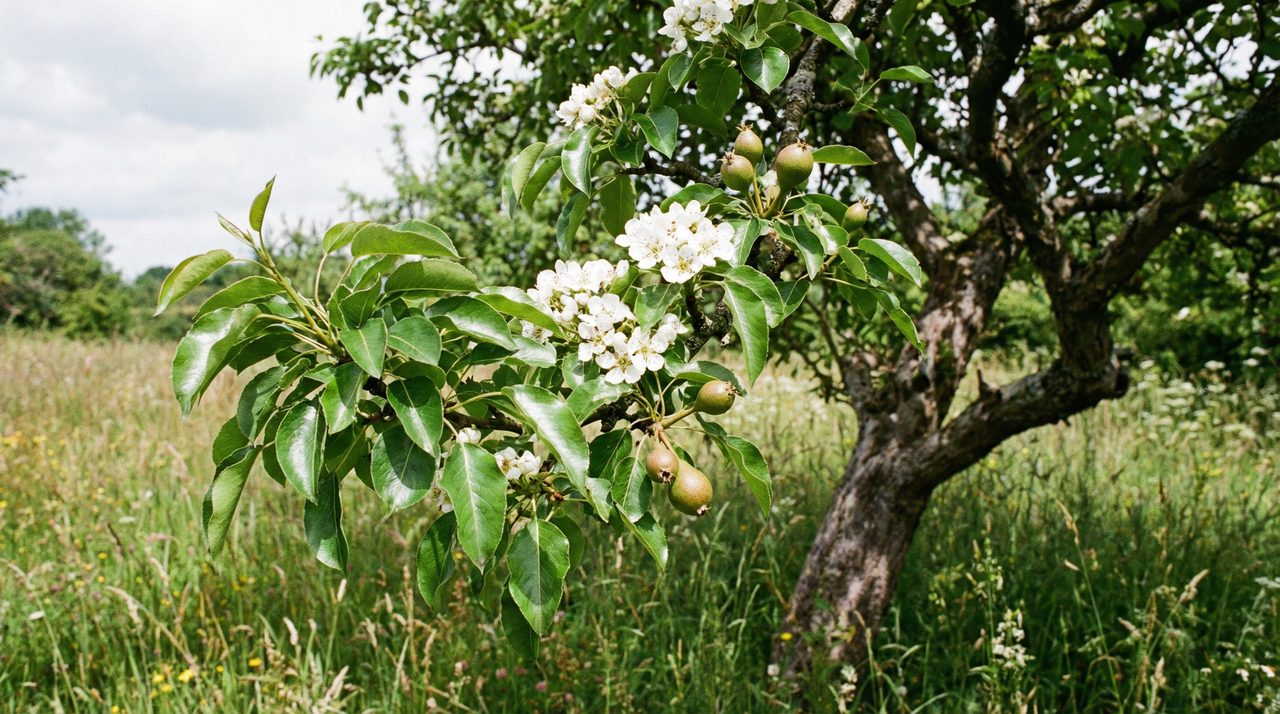
In the field, identification is straightforward once you know what you're looking at. The leaves are glossy dark green, ovate to lanceolate with finely serrated margins, turning yellow in autumn. White flowers open in corymbs of four to six, often with a blush of pink in bud, and the bark on a mature tree is gray-brown, rough, and deeply fissured.[6] I once spent fifteen minutes second-guessing a mature specimen on a client's property before those fissured bark plates and the finely serrated leaf margins confirmed it; nearby Callery pear volunteers had glossier, wavy-edged leaves and tiny hard fruits that were clearly not worth anyone's harvest.[7] Hawthorn, rowan, and apple can all cause momentary confusion, but a close look at leaf shape and fruit form settles it quickly.[8]
The genus itself spreads well beyond Europe. Asian pear (Pyrus pyrifolia), native to temperate China, produces round, apple-shaped fruits with a crispness that comes from an abundance of stone cells; the texture is nothing like a ripe Bartlett.[9] The Himalayan pear (Pyrus pashia) pushes even further, thriving at elevations up to 3,600 meters with small astringent fruits that few Western gardeners would recognize as relatives of their supermarket pears.[10]
Traditional and Cultural Uses Across Continents
Pear domestication happened independently on two continents, which tells you something about how useful the fruit is. European pear was cultivated in the Caucasus and Mesopotamia as far back as 2000 to 3000 BCE, with roots that stretch into Neolithic Europe.[11] Asian pear followed its own path in China's Yangtze River valley, with archaeological traces at Banpo dating to 4800 BCE and spread into Korea and Japan over the following millennia.[12] Theophrastus and Pliny documented over thirty pear varieties between them; Roman expansion, medieval monasteries, Arab traders, and eventually colonial ships carried those cultivars into every temperate corner of the world.[13]
The cultural symbolism runs deep on both ends of the Silk Road. Greeks and Romans associated pears with Hera and Aphrodite, treating them as emblems of fertility and immortality; Pliny also recorded their use for digestive complaints and fevers.[14][15] In East Asia the fruit carries meanings of longevity and purity, though in China the homophone for "pear" and "separation" created a tradition of never sharing one between friends.[16] European folk medicine fermented pears into perry, used them as laxatives and diuretics, and wove them into wedding customs and harvest festivals.[17] The fact that two distinct civilizations independently assigned pears roles of longevity and prosperity is the kind of convergence that makes ethnobotany fascinating.
Modern pear production has drifted a long way from that hedgerow diversity. Monoculture orchards carry real costs: high pesticide and water inputs, fire blight vulnerability amplified by genetic uniformity, and insufficient recognition of wild relatives like Pyrus ussuriensis that hold untapped breeding value.[18] In my own designs I sidestep that trap by avoiding single-variety blocks and pairing trees with pollinator-supporting companions, which is a small act but a meaningful one.
Fun Facts and Notable Records
A pear tree planted around 1650 in St. Remy, France is still alive today, making it over 400 years old and one of the oldest known fruit trees in Europe.[4] On the other end of the scale, the heaviest pear ever recorded weighed 1.99 kg (just under 4 lb 6 oz), grown in Pakistan in 2020.[19] The textural contrast between European and Asian pears is worth savoring too: bite into a ripe Bartlett and you get that soft, buttery give from cell-wall breakdown; bite into a Hosui or Shinseiki and there's a firm, almost apple-like crunch driven by high concentrations of stone cells packed with lignin and pectin.[20][21] Same genus, completely different eating experience, and both worth growing if your climate allows it.
Pear Varieties and Cultivars
Pyrus communis has been cultivated since Roman times, shaped by centuries of monastic selection and refined through modern breeding programs that increasingly target fire blight resistance, pear psylla tolerance, and drought resilience as organic production demands grow.[22][23] That history gives growers an enormous palette to choose from, and the right cultivar really does depend on your climate, your kitchen priorities, and how long you're willing to wait for the first bite.
Notable European Pear Cultivars
Think of the five classic European cultivars as a ripening relay that runs from late summer through early winter. 'Bartlett' (also called Williams) opens the season in August and September with medium-large fruit around 2.5 to 3 inches across.[24] It's the most widely recognized pear in North American supermarkets, but its storage window is short at one to three months, so plan for fresh eating and canning rather than a long cellar run.[24] 'Anjou' follows in September and October, also in that 2.5 to 3 inch range, often harvested while still green; it's cold-hardy to roughly -15 or -20°F and keeps up to five or six months in proper refrigeration, making it the storage workhorse of the group.[24][25]
'Bosc' ripens in October with its distinctive elongated pyriform silhouette and russeted skin, and I've noticed in my own packing shed that the russet finish hides minor handling marks far better than smooth-skinned types do. It shows moderate fire blight resistance and holds in storage for two to four months.[24][26] 'Comice' arrives in October and November as the flavor showpiece of the genus; that rich, buttery sweetness has made it the go-to gift pear, though its two to three month storage life means you need to move it quickly.[24] Closing the season, 'Conference' ripens September through October, sizes out at two to two and a half inches, and performs well for canning with a storage life around three months.[24][27] If you want fire blight resistance woven directly into your variety selection rather than managed through sprays, look at 'Moonglow,' 'Harrow Sweet,' and 'Magness,' all bred specifically for disease toughness.[28]
Asian Pear Options for Diversity
Pyrus pyrifolia brings a genuinely different eating experience to the genus. Cultivated in East Asia for over 2,000 years, it produces round, apple-shaped fruit that stays crisp and low-acid even fully ripe, with popular cultivars including Hosui, Shinseiki, and 20th Century.[29][30] Chill requirements for most cultivars fall between 400 and 1,000 hours, which opens the door for lower-chill gardens that struggle with European types.[31] I've grown Hosui alongside European pears for years and watched it fruit reliably in seasons when a late frost wiped out the Bartlett blossoms entirely. Hosui's brown russet skin, like Bosc's, also shrugs off superficial storage blemishes with grace. The fire blight resistance profile on Asian types tends to be better than most European cultivars, which matters a great deal if you're in a humid climate trying to grow organically.[32]
Sourcing Pear Trees and Rootstocks
Before price enters the conversation, two things should shape your purchase: disease resistance and pollination. Most Pyrus communis cultivars are self-incompatible, meaning a single tree will produce spectacular bloom and essentially no fruit.[33] I learned this the embarrassing way early in my career. Plant at least two cultivars with overlapping bloom, full stop.
Young bare-root European pear trees typically run $25 to $75, with quince-based dwarfing rootstocks pushing prices toward the higher end and organic-certified stock adding another 15 to 25 percent.[34][35] Dave Wilson Nursery, Raintree Nursery, and Stark Bro's are reliable starting points for disease-resistant bare-root stock.[36][37][38] For scionwood or rare genetics, the USDA ARS National Clonal Germplasm Repository in Corvallis, Oregon, and exchanges through California Rare Fruit Growers chapters are worth exploring.[39][40] Always buy certified disease-free stock. USDA APHIS regulations and state-level quarantines for fire blight and brown marmorated stink bug can restrict what ships to certain ZIP codes, and I now check my state extension's quarantine list before placing any order after once having a shipment held at the border.[41][42] Certified stock from a reputable nursery is the simplest way to avoid importing trouble you'll spend years managing.
Pear Propagation and Planting Guide
If you want a pear tree that produces recognizable, reliable fruit in your lifetime, grafting is the answer. Full stop. Growing a pear tree from seed is biologically fascinating and genuinely useful for breeders chasing disease resistance, but for anyone planting in a home garden or food forest, seeds mean genetic surprise, unpredictable fruit quality, and a much longer wait. The practical path runs through a nursery, a rootstock, and a sharp grafting knife.
Propagation Methods for Pears
Whip-and-tongue grafting is the technique most commercial propagators rely on, with success rates between 70 and 85% when the cambium layers are aligned precisely and the union is sealed immediately.[43][44] Cleft grafting runs a bit lower at 60 to 80%, and chip or T-budding lands around 50 to 70%, timed for late winter or late summer depending on the method.[45] I'll admit my early grafting results were humbling, hovering around 50% until I invested in a proper grafting knife and started being obsessive about cambium contact. Once I got those two things right and started waxing the union immediately after tying, my take rates climbed above 80%. The difference between a decent graft and a failed one is often millimeters.
Rootstock choice matters as much as technique. European pears graft well onto quince, Pyrus betulifolia, or the OHxF (Old Home x Farmingdale) series; Asian pears prefer betulifolia or calleryana-derived rootstocks and should stay away from quince due to incompatibility issues.[46] Sterilize your tools between cuts, protect the union from frost and drying out for four to six weeks post-graft, and check regional quarantine rules before sourcing scion wood, since fire blight restrictions vary by state.[47]
Seeds are a different project entirely. European pear seeds are orthodox, meaning they store well when dried to low moisture and kept cold, with viability maintained for up to 20 years under proper conditions.[48] To break physiological dormancy, they need 60 to 90 days of cold stratification at roughly 34 to 41°F, after which germination runs 50 to 70%.[49] I've done this on my propagation bench for rootstock experiments, and it's genuinely satisfying to watch the seeds pop and send up those first seedling leaves. But the fruit those seedlings eventually produce won't resemble the parent reliably, because self-incompatibility and high genetic variability make pear seed propagation a breeding tool, not a cropping strategy.[50] For anyone learning to grow a pear tree from seed, the experience is worthwhile; just go in knowing you're playing a long, unpredictable game.
Soil and Site Selection for Growing Pears
Pears are not forgiving of bad siting. They need at least six to eight hours of direct sun daily; less than that and you'll see leggy growth, pale foliage, and a fruit set that barely justifies the space.[51][28] Asian pears are even stricter about sun; they really don't tolerate shade compromises the way a European pear might barely survive them.[52]
Below ground, the target is a well-drained, fertile loam with pH between 6.0 and 7.0 and at least two to five percent organic matter, with roots able to go down 90 to 120 cm without hitting hardpan or standing water.[4][53] I learned the drainage requirement the hard way: an early planting in unamended clay started declining in its second year, showing chlorosis and stunted growth before I figured out what was happening. Now I always do a simple percolation test before I dig a hole. Pour water in, come back an hour later, and if it's still sitting there, fix the drainage first or find a different spot. Raised beds or significant compost incorporation are non-negotiable on heavy soils.[54] Sandy sites need extra organic matter to hold moisture between waterings. Either way, topping the root zone with four to six inches of organic mulch kept well clear of the trunk helps regulate temperature, retain moisture, and suppress weeds through the establishment years.[55]
Spacing, Planting Technique, and Establishment
Rootstock choice doesn't just affect graft compatibility; it sets the entire footprint of your tree for the next several decades. Standard trees on seedling rootstock can reach 18 to 30 feet tall with a spread to match, requiring 15 to 20 feet between trees and 20 to 25 feet between rows.[5] Semi-dwarfs on OHxF rootstock come in at 12 to 18 feet, and true dwarfs run 8 to 12 feet with spacing as tight as 8 feet in high-density plantings.[56] In my design work I've used dwarf OHxF trees repeatedly for food forest canopy layers where space is tight; they fit into a guild planting in a way that a standard seedling tree simply cannot, and they're productive enough to justify the spot. The wider spacing on standard trees isn't just about mature size; it's about airflow, and airflow is your first line of defense against fire blight.
Bare-root trees go in the ground from late winter through early spring while they're still dormant, roughly February through April depending on your climate. Container-grown stock is more flexible, though fall planting in mild regions gives roots extra establishment time before the tree has to support a canopy.[57] Planting depth is where I see people go wrong most often. The graft union belongs two to four inches above the soil surface, not at ground level and certainly not buried.[5] Burying the union encourages scion rooting, which defeats the purpose of the dwarfing or fire-blight-resistant rootstock you paid for, and it can trigger heavy suckering. Keeping that union above soil has prevented both problems across every pear I've planted. Stake young trees in windy sites, but check the ties regularly; constriction from a forgotten stake wire causes more long-term damage than most people realize.[58]
Germination Timeline and First Fruiting Expectations
A grafted European pear will typically begin bearing meaningful fruit three to five years after planting, though two to seven years is the realistic range depending on cultivar, rootstock, and growing conditions.[59] Seed-grown trees take five to eight years or more just to reach first fruit, and full production on either takes around seven to ten years.[60] Asian pears follow a similar grafted timeline of three to five years, though seed-grown plants push out even further.[52] Those initial crops are usually light, which is actually fine; the tree needs that energy for root and scaffold development. I label every grafted tree I plant with the rootstock, cultivar, and graft date, because the wait is long enough without losing track of what you're waiting for.
Pear Tree Care Guide: Sunlight, Water, Fertility, and Seasonal Maintenance
A pear tree planted well and managed thoughtfully can outlive its planter by decades. I've seen specimens in old homestead gardens that are still producing after 80 years, and every one of them shares the same fundamentals: the right amount of light, consistent deep watering, restrained fertility, and annual pruning that never lets the canopy close up. Get those four things right and a pear tree rewards you generously. Get them wrong and you spend years chasing problems that trace back to day one.
Sunlight Requirements for Healthy Pear Trees
European pear needs full sun, meaning at least 6 to 8 hours of direct light daily, to produce well and resist disease.[5][4] Trees in partial shade do survive, but vigor drops, fruit quality suffers, and fungal diseases find it much easier to gain a foothold. That said, full sun doesn't mean unlimited heat is fine. Above roughly 30 to 35°C, especially when soil moisture is low, you start seeing leaf scorch, curling margins, fruit sunscald, and stalled growth.[61][62] I always watch young trees carefully during their first few summers. If a newly planted pear is wilting by midday on a site that gets reflected heat off a nearby wall or driveway, that's a design problem worth fixing early, not something to water around indefinitely.
Watering Needs and Irrigation Best Practices
The target during the growing season is 1 to 2 inches of water per week, delivered deeply enough to reach roots 18 to 36 inches down.[5][63] In the first year, young trees need that consistency two to three times a week because their root systems haven't spread far enough to buffer dry spells. Established trees are more forgiving and can handle short droughts of two to four weeks, but "established" takes a few seasons to get there. I check soil moisture by pushing a finger or a thin rod down 12 to 18 inches rather than trusting how the surface looks; surface soil can look dry while the root zone is fine, and vice versa.
Underwatering shows up as wilting, leaf scorch, and premature fruit drop. Overwatering is less obvious but just as damaging: yellowing leaves, fungal activity, and root rot in poorly drained soils.[64][65] If your municipal water is hard or alkaline, pear irrigation water ideally stays between pH 6.5 and 8.0 with an EC below 1.5 to 2.0 dS/m; high salinity causes chlorosis over time.[66][67] Catching rainwater when you can is a simple fix. Whatever your water source, keep a 2 to 4 inch layer of organic mulch over the root zone, pulled back from the trunk, to buffer both drought and oversaturation while moderating soil temperature through the extremes of summer and winter.[68][4]
Feeding and Nutrient Management for Pears
Pear is a moderate feeder, and the single most useful thing I tell people before their first fertilizer application is: get a soil test first. In one project I worked on, a test revealed a boron deficiency that had been causing corky, russeted fruit for years. A targeted foliar spray corrected it the following season. No amount of general-purpose fertilizer would have fixed that, and more nitrogen certainly would have made things worse.
A mature tree generally needs 0.2 to 0.5 lb of actual nitrogen per year, split between early spring and post-harvest, using a balanced formulation like 10-10-10. Young trees need less, around 0.1 to 0.2 lb.[69][70] Calcium and boron are worth paying particular attention to; deficiencies in either cause fruit cracking, internal browning, and uneven texture, and a soil pH between 6.0 and 7.0 helps keep both available.[71][72] I've seen fire blight flare dramatically after heavy spring nitrogen applications, which makes sense: excess nitrogen pushes lush, tender growth that the bacterium moves through quickly.[73][74] Cover crops and compost mulch are better long-term soil builders than annual fertilizer applications anyway, and they don't carry that risk.
Frost and Cold Hardiness
European pear handles cold remarkably well in dormancy, surviving winter lows down to -20°F to -30°F across USDA zones 4 through 9.[75][5] The paradox is that the same tree that shrugs off a brutal February can lose its entire crop to a light frost in April. Green tip damage sets in at 24°F, tight cluster at 27°F, and full bloom is vulnerable anywhere below 28 to 30°F.[76][77] After losing early blooms to a late frost a few years back, I started planting pears on gentle rises with windbreaks on the cold-air side and keeping that critical-temperature chart handy from pink bud through petal fall. A simple overhead sprinkler running through a frost event has saved blooms more than once; the ice formation actually insulates the tissue.
Site selection is the first line of defense, since cold air pools in low spots and against solid barriers. From there, 3 to 4 inches of mulch protects roots, and trunk wraps help young trees through severe winters.[78][79] Think of protection strategies as a layered decision: get the site right first, then mulch, then consider active methods only if the first two aren't enough.
Heat Tolerance and Summer Stress Management
European pear fits AHS Heat Zones 1 through 8 and can handle summer highs up to 95 to 100°F under normal conditions.[80][81] The trouble starts when temperatures stay above 86°F during flowering and nights don't drop below 68°F. Pollen germination and fruit set can drop 20 to 50% under that kind of sustained heat,[82][61] which in warmer gardens makes cultivar choice genuinely important. I've shifted toward 'Bartlett' over 'Anjou' in warmer microclimates because I've observed better pollen viability and fruit set on the hot days that seem to arrive earlier every year.
During the heat wave that hit one of my food forest projects a few summers ago, I watched young pear trees show leaf scorch and wilt by early afternoon. Bumping the mulch from 2 to 4 inches and switching to morning-only drip irrigation made a clear difference: the trees recovered overnight instead of staying stressed, and we didn't lose fruit set the way I'd feared. For severe heat, 30 to 50% shade cloth, deep weekly irrigation of 20 to 30 gallons, and windbreaks on the hot-wind side are the practical toolkit.[83][84]
Pruning, Maintenance, and Seasonal Rhythm
The two highest-return practices in annual pear care are open-canopy pruning and staying ahead of fire blight, and they're deeply connected. Late winter dormancy is the time to prune, using either a central-leader or open-center system to remove crossing, diseased, and dead wood, heading scaffolds at 45-degree angles to encourage outward growth and light penetration through the center.[85][4] A closed, shaded canopy is a humid canopy, and humid canopies invite disease. In smaller gardens where space is tight, I've had good results with modified central-leader espalier systems that keep trees productive and manageable against a fence or wall while still allowing air movement.
Through the season, remove water sprouts and suckers as they appear, avoid any late-summer nitrogen (it pushes tender growth that frost and disease both love), and soil test every three to four years rather than guessing at amendments.[86][87] The seasonal backbone of a pear tree runs like this: winter dormancy requiring 800 to 1,200 chill hours below 45°F, spring bud break and flowering, then roughly 150 to 200 days of fruit development after bloom, closing with late summer to early fall harvest.[58][88] That 150 to 200 day window is the one I use to schedule summer irrigation intensity and fruit thinning to 6 inches apart; getting both right is what turns a decent crop into a genuinely good one.
Harvesting Pears: Timing, Technique, and Post-Harvest Care
Pears are one of the few fruits that actually suffer if you leave them on the tree too long. European pears (Pyrus communis) are harvested mature but not ripe, then finish ripening off the tree. Get that timing wrong in either direction and you end up with something mealy, bland, or just plain disappointing.
When to Harvest European Pears
There's no single magic date. What you're really working with is a cluster of indicators: skin shifting from deep green toward yellow-green, flesh firmness reading 15-20 lbs on a pressure tester, soluble solids around 13-15% Brix, and days from full bloom (roughly 120-140 days for Bartlett, 140-160 for d'Anjou).[89][90][91] Below 12 lbs of firmness and the fruit will turn mealy; above 22 lbs and it won't ripen properly.[89] Most backyard growers don't own a pressure tester, so I use the neck test: cup the fruit and press a thumb gently just below the stem. If there's a slight give there before the shoulders, it's ready. I've found this works reliably for both Bartlett and Bosc once you've done it a season or two.
Bartlett comes off in August for most of the U.S., Bosc in September, and d'Anjou into October or even November.[92][93] Asian pears (Pyrus pyrifolia) are a different story entirely: they're picked at eating ripeness, stay crisp even when fully mature, and use similar Brix targets (12-15%) but don't need the off-tree ripening phase European types require.[94]
How to Harvest Pears
Pick in the morning when the fruit is dry and cool. The technique is a gentle twist-and-lift: cradle the fruit, rotate it slightly, and it should separate cleanly at the stem. Pulling straight down tears the spur and damages next year's crop.[95][4] Work from the outer canopy inward, since fruit at the perimeter typically matures first. Leave the stem on; I've noticed that stemless fruit rots significantly faster, no matter how careful the storage.
European pears are highly sensitive to ethylene, which matters both for storage and ripening.[96] I once stored a batch next to apples in the refrigerator and had the whole lot go soft and mealy within a week. Keep them isolated. For actual storage, aim for 30-32°F with 90-95% relative humidity; controlled atmosphere can extend shelf life to 3-6 months, though that's commercial-scale territory.[96][97] Don't let temperatures drop below 29°F or you risk chilling injury.[98] To ripen fruit intentionally, move it to a 60-70°F room; a week or two there will bring most cultivars to peak.[99]
Expected Yields, Flavor at Harvest, and Storage for Peak Quality
A mature, well-managed standard pear tree typically delivers 100-400 lbs annually, with around 200 lbs as a realistic middle estimate; dwarf trees land in the 50-150 lb range, semi-dwarf in the 150-300 lb range.[100] The well-pruned 10-year-old tree in my home orchard reliably gives me 150-200 lbs of usable fruit. A neighbor's unpruned tree sets heavily every other year but produces small, flavorless pears that confirm, season after season, that pruning is worth every hour.
Flavor chemistry in European pears is driven by fructose, glucose, and sorbitol for sweetness, balanced by malic acid, with esters building during ripening that shift the aroma from grassy and green toward fruity, floral, and slightly spicy.[101][102] Texture moves from firm and tart when underripe to that characteristic juicy, buttery melt at peak, then collapses into mealiness if you wait too long.[103] Cultivar differences are real and worth paying attention to: Bartlett goes sweet and floral, d'Anjou runs mild and buttery, and Bosc develops a distinct cinnamon-spice quality, especially when ripened slowly in a cool pantry rather than rushed at room temperature.[104] Asian pears, by contrast, stay crisp through ripening, their esters leaning toward melon and citrus with none of the butter.[105] After tasting them at a local market, I understood why some growers prefer them for fresh eating; there's something satisfying about fruit you can eat straight off the tree without the waiting game.
Pear Preparation, Culinary Uses, and Traditional Applications
Culinary Uses of Pears: Fresh, Cooked, and Preserved
Few fruits handle as many roles in the kitchen as European pear. You can eat it straight off the tree, bake it into a tart, slip it into jam, press it into juice, or ferment it into perry, the ancient pear cider that Romans were making long before Bartlett became a grocery staple.[106][107] My favorite thing to do with a slightly under-ripe Bosc is poach it. I pick fruit that still has a little firmness because it holds its shape in the liquid rather than collapsing into mush. What I didn't understand until I'd done it a dozen times is that the heat is actually doing something chemically interesting: poaching hydrolyzes esters into alcohols and acids that deepen the sweetness and smooth out any astringency.[108][109] The kitchen smells extraordinary when that's happening with cinnamon and cloves in the pot.
For pairings, I keep coming back to the same combinations: ripe pear with Roquefort or Stilton, warm spices like ginger and cardamom, and a glass of Chardonnay or Pinot Noir.[110] If you're preserving a big harvest, drying is worth the effort. Slice thin, treat with ascorbic acid to prevent browning, and dry at 135 to 145°F for six to ten hours until the slices are leathery.[111] Pear blossoms are edible as garnishes or candied, and leaves from unsprayed trees can be steeped into a light herbal tea. I only harvest both from my own trees and I steep the leaves briefly; going too long pulls bitterness out of them.[112]
Asian pear is a different creature entirely. It's primarily eaten raw, often unpeeled, to preserve that crisp, apple-like snap that never softens the way a Comice does.[29][113] I always label them separately in a fruit salad because guests assume both types will behave the same, and the texture difference surprises people. Asian pear shines in savory dishes, sliced into salads with greens and ginger, or pickled in the Korean tradition. It also pairs naturally with pork, sake, and green tea.
Traditional Medicinal Preparations from Pear
Long before pears were dessert fruit, they were medicine. European folk traditions used the fruit, leaves, and bark for assorted gastrointestinal and diuretic remedies, utilizing leaf and bark infusions for these localized treatments.[17][114] I respect that heritage, though I'd frame it exactly that way: historical ethnobotany rather than a prescription I'd hand anyone.
In Traditional Chinese Medicine and Korean Hanbang, Asian pear carries its own parallel tradition, valued for cooling and moistening properties that address coughs, dry lungs, indigestion, throat inflammation, and hangover recovery.[115] Leaves and bark serve similar anti-inflammatory and diuretic roles across both traditions. The most practical everyday application is the simplest one: pear's fiber content supporting regular digestion, which is something the fruit just does naturally when you eat it.
Non-Food Uses: Wood and Beyond
Pear wood has a density and fine grain that makes it genuinely exceptional. Historically it was sought for tool handles, furniture, and musical instruments, particularly through Renaissance Europe when craftspeople understood how to work with its tight, consistent structure.[116] I've used pear-handled pruning tools and noticed how the grip resists wear in a way softer woods simply don't. There's something satisfying about a tree that sustains people in the kitchen, the apothecary, and the workshop across centuries.
Pear Health Benefits and Medicinal Uses
The health story of pear is quieter than that of goji or acai, and I think that's actually a point in its favor. This is an everyday fruit with millennia of use behind it and a genuinely interesting phytochemical profile, not a miracle cure dressed up for a supplement label. The evidence is strongest for digestive support, cardiovascular function, and glycemic regulation, and most of it runs through two compounds: soluble pectin and a diverse cast of phenolics. Understanding how those two things work, and where in the fruit they concentrate, changes how you grow and eat pears.
Traditional European and Asian Uses
European herbalists utilized pears long before clinical science provided a biochemical explanation. In traditional folk medicine, the fruit was valued as a mild laxative and digestive soother, while decoctions from the leaves and bark were applied to diarrhea, dysentery, and inflammatory conditions for their astringent, anti-inflammatory properties.[117][118] Asian pear (Pyrus pyrifolia) comes from a different angle entirely. Classified in Traditional Chinese Medicine as cool and sweet, it was directed at the lung and stomach meridians to quench thirst, moisten dryness, and relieve dry cough. Leaves and bark were similarly used for astringency and wound healing across Chinese and Korean practice.[119][120][121] The two traditions are complementary rather than redundant: European use centered on the gut, East Asian use on the respiratory and fluid systems. Both are consistent with what the science is now showing about fiber and anti-inflammatory phenolics.
Nutritional Profile of Pears
A medium European pear (around 178g) comes in at roughly 100 calories, with about 5.5g of dietary fiber, 27g of carbohydrates, and barely any fat.[122] Asian pear runs leaner still, closer to 42 kcal per 100g, with similar fiber and an even higher water content around 88%.[123] Neither species is going to win a vitamin C competition; pears clock in around 4-5mg per 100g, modest by any measure.[122][124] Where pears earn their keep nutritionally is in soluble fiber (especially pectin) supporting gut health, cholesterol management, and blood sugar control, alongside potassium at around 116-121mg per 100g and a cholesterol-free, low-sodium profile that suits daily eating without much thought.[122][125]
The fruit's skin is where the phytochemical profile gets much more interesting. Phenolics, flavonoids, carotenoids, and triterpenoids concentrate there at two to five times the levels found in the flesh, and peeling strips away 20-50% of those compounds.[125][126] I've always found that unpeeled, home-ripened pears have a noticeably more complex flavor than their peeled or cold-stored counterparts, and this is probably why. Cultivar choice matters here too: Conference and Comice tend toward higher antioxidant activity, while among Asian pears, Hosui often leads on phenolics and vitamin C.[127][128] When I'm designing a planting and someone asks which variety to choose, I now factor in phenolic potential alongside flavor and disease resistance.
Key Phytochemical Compounds in Pears
Pyrus communis has a rich phenolic profile built around chlorogenic acid, procyanidins, quercetin glycosides, catechins, kaempferol, and phloridzin, a dihydrochalcone that in some cultivars accounts for up to 90% of total phenolics.[129][130] Leaves and bark contain substantially more total phenolics (150-300mg GAE per 100g) and tannins than the fruit, and within the fruit, peel concentrates these compounds at two to five times the levels in flesh.[131][132] Asian pear shifts the emphasis: higher arbutin (0.8-3.2mg/g DW in peel), more chlorogenic acid and quercetin-3-O-glucoside, and stronger triterpenoid presence, while European pear tends to lead on procyanidins and epicatechin.[133]
In lab assays, pear extracts show antioxidant activity comparable to berries (DPPH IC50 of 20-50 µg/mL), plus antimicrobial effects against E. coli, S. aureus, and Candida, and anti-inflammatory activity through NF-κB inhibition and COX-2 suppression.[134][135] Asian pear additionally activates the Nrf2-ARE pathway, a cellular defense mechanism that's attracted considerable research attention.[136] These concentrations aren't fixed: drought stress and UV exposure can increase phenolics by 30-50%, which is one reason garden-grown fruit under natural conditions often punches above commercial equivalents.[136] Pear seeds do contain amygdalin, but at low levels and requiring hundreds of seeds for any meaningful risk; simply avoid eating them.[137]
Scientific Research and Potential Health Benefits
Systematic reviews link regular pear consumption to reduced cardiovascular disease risk and improved glycemic control, with the evidence running primarily through observational studies and the combined action of fiber and phenolics.[138] Preclinical work builds a more detailed picture: hypolipidemic effects, alpha-glucosidase inhibition suggesting antidiabetic potential, anti-inflammatory and antioxidant mechanisms in animal models, and animal studies showing reduced paw edema and protection against oxidative damage in liver and gut tissue from leaf and bark extracts.[139][140] Asian pear research extends the picture with mechanistic leads on hepatoprotective and neuroprotective effects, plus preclinical antiproliferative activity.[141]
What I try to be honest about, though, is the gap between those findings and clinical confirmation. Pyrus communis doesn't appear in the European Pharmacopoeia or German Commission E monographs for specific therapeutic indications, and large randomized controlled trials are largely absent.[142][143] Limited human clinical data does show modest benefits for blood sugar and inflammation markers, which is consistent with what we'd expect given the fiber and polyphenol load. Compared to berries, pears often get overlooked as a functional food. I'd push back on that: the phenolic antioxidant capacity is genuinely comparable to many more glamorous fruits, and pears come with the added advantages of being tree-grown, longer-lived, and well-suited to temperate food forest systems most of us are actually working in.
Safety Considerations for Pear Consumption
The fruit itself is very safe. LD50 values for extracts exceed 2000mg/kg, and pear flesh is non-toxic to pets in moderation.[144][145] Normal eating carries negligible risk, as you would need to deliberately consume hundreds of seeds to approach any toxicity threshold with their trace compounds.[146] Don't feed seeds, stems, or leaves to pets, where the margin is narrower. The caveat I mention to anyone with a birch pollen allergy is Oral Allergy Syndrome: pear carries the Pyr c 1 allergen, which cross-reacts in 50-70% of birch-sensitized individuals, causing mouth tingling or itching.[147][148] In the general population, incidence is low; I'd introduce pears cautiously, the same way I recommend with any new Rosaceae fruit for sensitive individuals. Those with IBS or fructose malabsorption may also find the high fiber and fructose content aggravating in larger servings.[149] Pears are safe during pregnancy and lactation, providing useful folate and fiber with no known contraindications, no significant drug interactions have been documented, and washing commercial fruit thoroughly reduces pesticide residues by around 80%.[150][151]
Pear Pests and Diseases
I learned this lesson the hard way: plant a 'Bartlett' in a humid climate and you're basically daring fire blight to show up. After losing a young tree to that disease in a warm, wet spring, I shifted entirely to resistant cultivars and never looked back. Resistance in European pear is never absolute, but cultivar choice is the single biggest lever you have, and making the right call before you plant saves years of grief.
Major Diseases of European Pear
Fire blight (Erwinia amylovora) is the most serious threat to European pear, and cultivar susceptibility varies enormously. 'Bartlett' sits at the high-risk end; 'Harrow Sweet', 'Moonglow', and 'Magness' show strong resistance.[152][26][153] The disease peaks when temperatures sit between 75 and 85°F alongside high humidity, exactly the conditions you get during a typical humid-region bloom period.[26] It's severe across the humid eastern U.S., the Midwest, and the Pacific Northwest.[154] My fire blight treatment approach now starts at planting: choose resistant stock, prune only during dry weather, and sterilize tools between cuts without exception.
Pear scab (Venturia pirina) is the other headliner for humid eastern growers, requiring cool temperatures around 59 to 68°F and more than 9 hours above 80% relative humidity to really take hold, and it's far less of a problem in the drier West.[155][156] Those pear tree black spots on leaves and fruit are its calling card. Cultivars like 'Harrow Delicious' and 'AC Harrow Crisp' combine resistance to both fire blight and scab, which is a genuinely useful combination for anyone in a high-pressure region.[157][153]
Pear rust (Gymnosporangium spp.) is easy to prevent if you know about it: remove junipers or eastern red cedar within 500 feet, since the fungus alternates between those hosts and your pear tree.[158] Phytophthora root and crown rot deserves mention too, because it often masquerades as drought stress. I've watched yellowing leaves and stunted growth reverse themselves after improving soil drainage and dialing back irrigation; the disease is overwhelmingly a soil-condition problem, not an inevitable one.[159][160] Keeping pH between 6.0 and 7.0, avoiding compaction, and not overwatering are the practical defenses.[161] Good airflow from open pruning, consistent sanitation, and restraint with nitrogen fertilizer reduce pressure from all of these pear tree diseases simultaneously.[162] Asian pears share exposure to many of the same issues but tend to show better fire blight tolerance overall, with their own vulnerabilities to bacterial and Valsa canker in wet conditions.[163]
Common Insect Pests and Their Management
Pear psylla and codling moth are the two insects that will keep you up at night. European pear is highly susceptible to both, and no cultivar gives you a free pass.[164][165][166] Psylla produces sticky honeydew that coats leaves and fruit in sooty mold; I've seen it on my own trees and it looks disturbingly similar to the mess that builds up on aphid-hammered lindens nearby. Beyond the cosmetic damage, psylla can transmit pear decline. Codling moth larvae bore directly into developing fruit. Drought stress makes both problems worse by weakening the tree's natural defenses.[167][168]
Pear itself isn't defenseless. The tree deploys phenolic glycosides, condensed tannins, and flavonoids as chemical deterrents, while glandular trichomes and leaf pubescence create physical barriers.[169] When herbivores attack, European pear even releases volatile compounds that recruit predatory insects, and Asian pear does the same with the added reinforcement of a tougher, waxier fruit skin.[170][163] Cultivars like 'Forelle', 'Seckel', and 'Harrow Sweet' show enhanced tolerance to psylla through antibiosis and antixenosis mechanisms; several Asian pear selections including 'Shinseiki' also carry useful resistance to both psylla and codling moth.[171][172]
My actual pest management routine starts with monitoring. I hang codling moth pheromone traps at a rate of one or two per 2.5 acres and check them weekly; that timing data tells me when to intervene and has prevented several unnecessary spray events over the years.[173] Dormant horticultural oil handles overwintering psylla and scale before buds break; summer applications of insecticidal soap, neem, or kaolin clay address in-season pressure when thresholds are genuinely exceeded. I apply those materials only when monitoring shows I need to, and I follow label rates carefully to keep lacewings and lady beetles alive in the orchard.[174][175] Ground covers that support parasitoid habitat, consistent irrigation to prevent drought stress, and removing fallen fruit and mummified material from around the base round out the system. Once fruits reach about marble size, bird netting goes on to protect the developing crop.[4] Most years, consistent observation and sound cultural practices do more work than any spray.
Pear in Permaculture Design
European pear is one of those trees that rewards the designer who does their homework upfront. Get the site right and you'll have a productive, wildlife-supporting canopy tree for decades. Rush the siting decision and you'll spend years fighting disease, frost damage, or a tree that simply never fruits well. I've learned to treat chill hours as my first filter when a client asks about adding pear to their food forest, because no amount of clever guild design compensates for a climate that can't meet the tree's dormancy needs.
Climate Requirements and Suitable Zones for European Pear
Pyrus communis evolved in temperate oceanic and humid continental climates, and its requirements reflect that origin. It needs 800 to 1,200 chill hours (hours below 45°F) to break dormancy reliably and set fruit, though cultivar choice matters considerably; 'Bartlett', for instance, comes in around 800 hours.[176][177] Without sufficient chilling, you get erratic foliation, poor flower development, and frustrating harvests. In my experience, this makes European pear a better fit for zones 5 through 8, even though it technically survives in zones 4 through 9.[178]
The zones tell only part of the story. Spring frost is the real antagonist. European pear blooms early, often in March or April when temperatures first push past 45°F, and a single frost event below 28°F at the wrong moment can destroy up to 90% of blossoms.[179][180] I always site pear trees on slopes or elevated positions in my designs, never in low-lying frost pockets where cold air pools on still spring nights. One client lost two consecutive crops before we moved their young tree upslope by less than fifteen feet. The difference was remarkable.
On the heat side, European pear thrives between 65 and 75°F and starts showing stress above 85°F with reduced fruit set and sunburn.[181] It wants 25 to 40 inches of well-distributed annual rainfall and prefers moderate humidity in the 40 to 70 percent range; push above 80 percent and fire blight risk rises sharply.[181][182] That's why the Pacific Northwest, with its mild, dry summers and wet winters, produces over 80% of U.S. pears.[183] In drier gardens, supplemental irrigation closes the gap once the tree establishes.
For designers working in warmer or lower-chill climates, Asian pear (Pyrus pyrifolia) is worth serious consideration. It typically needs only 400 to 800 chill hours, handles heat up to 95 to 100°F better than European pear, and fits zones 5 through 9.[184] For zone 8 through 9 clients in the Southeast or similar climates, I lean toward Asian pear cultivars specifically because European pear struggles there with both insufficient chilling and high summer humidity driving disease. Himalayan pear (Pyrus pashia) extends the genus into zones 7 through 10 with only 400 to 600 chill hours required,[185] adding even more design flexibility in warm temperate regions.
One species I won't put in a design anywhere in North America is Callery pear (Pyrus calleryana). It's technically hardy in zones 4 through 9 and looks beautiful in early spring,[186] but it's aggressively invasive, forming dense thickets that displace native vegetation and disrupt soil microbial communities.[187] Any ecological function you might attribute to it is outweighed by the damage it does. Check with your local cooperative extension before planting any pear species you're unfamiliar with, and steer clear of Callery entirely.
Ecosystem Functions and Biodiversity Contributions
Pear trees bloom early and that timing matters. Those white, five-petaled flowers open in March and April before most other canopy trees have leafed out, providing nectar and pollen to honey bees, bumblebees, butterflies, and early-season flies when forage is genuinely scarce.[188][189] I've noticed strong bumblebee activity in pear plantings I've designed even on cooler April mornings when my nearby apple trees are still mostly quiet. That early-season pollinator support cascades outward: a healthy pollinator population in spring serves everything else blooming in your system through summer.
Cross-pollination is non-negotiable for most pear varieties. European, Asian, and most other Pyrus species are self-incompatible, requiring a compatible cultivar blooming at the same time within roughly 50 to 100 feet.[4][190] Pollination itself is sensitive: optimal conditions fall between 60 and 75°F with moderate humidity, and anything below 50°F, above 85°F, or accompanied by frost, rain, or strong wind reduces fruit set significantly.[191] In food forest design, I plan for at least two compatible cultivars within foraging range of each other from the start, rather than treating the second tree as an afterthought.
Beyond the bloom period, pear delivers steady ecological services throughout the year. The fruit feeds thrushes, blackbirds, robins, and various mammals, which in turn aid seed dispersal.[192] The tree's structure provides nesting habitat for birds and invertebrates, its root system stabilizes soil against erosion, and those roots form mycorrhizal associations that support broader nutrient cycling in the soil food web.[193][194] Asian pear in particular has notable mycorrhizal associations that enhance phosphorus uptake, contributing meaningfully to soil fertility alongside its annual leaf litter, which can contribute 2 to 4 tons of organic matter per hectare per year, rich in potassium and calcium.[195][196] A mature pear tree also functions as a windbreak, reducing wind speed by 40 to 60 percent over a distance of 10 to 20 meters downwind.[197]
Callery pear, by contrast, disrupts rather than supports these functions in North American contexts. It competes with native plants for pollinators, can form monocultures that collapse local biodiversity, and hybridizes with cultivated pears in unpredictable ways.[198][199] The ecological "contributions" often cited for Callery in landscape contexts become genuine liabilities once it escapes cultivation.
Forest Layer Placement and Guild Design
Left to its own devices, European pear becomes a canopy or sub-canopy tree reaching 33 to 49 feet at maturity.[6] In most home-scale food forests that's more tree than the design calls for. The practical solution I use regularly is dwarfing rootstocks, specifically Quince C or the OHxF series, which keep European pear in the 8 to 15 foot range with consistent pruning.[59] That scale fits beautifully into the canopy layer of a smaller food forest without shading out everything beneath it, and it makes harvest, pruning, and pest monitoring all considerably more manageable.
Asian pear offers a naturally smaller stature of 20 to 30 feet (though it can push higher in good conditions),[200] which gives it more flexibility in multi-layered designs where it can start in the understory and work its way into sub-canopy gaps over time. I've used Asian pear in designs where canopy space is competitive and found it adapts more gracefully than European pear to those conditions.
For guild companions around pear, I build from the ground up. Since pear doesn't fix nitrogen itself,[201] I always include nitrogen-fixers nearby: clover and alfalfa as ground covers, comfrey as a dynamic accumulator and mulch plant that I can chop and drop throughout the season. Chives, dill, and alliums in the herb layer help deter pest insects and attract beneficial predators. At the ground level, strawberries make excellent companions, suppressing weeds while staying low enough not to compete seriously with tree roots, and daffodil bulbs around the drip line help discourage voles and other rodents that can girdle young trees.[202] Currants in the shrub layer use the partial shade well and extend the fruiting season both earlier and later than the pear itself. Together these layers build a genuinely productive, resilient system where the pear tree is the structural anchor rather than a solitary specimen competing with bare soil.
The Tree That Taught Me to Wait
I planted my first Bosc the year I thought I understood patience. It took four seasons before it gave me a single fruit worth eating, and another two before I finally stopped fussing with it long enough to let it be generous. There's something quietly humbling about a tree that ripens on your countertop, not on your schedule, and I think about that every August when I'm standing in the orchard, twist-testing fruit that isn't ready yet, learning the same lesson again.
Sources 202
- Pyrus communis - Wikipedia ↩
- Pyrus communis - Kew Science ↩
- USDA PLANTS Database ↩
- Growing pears / RHS ↩
- Longevity of Fruit Trees ↩
- Pyrus communis - Missouri Botanical Garden ↩
- Callery Pear - USDA Forest Service ↩
- Distinguishing Pears from Look-Alikes ↩
- Pyrus pyrifolia - Missouri Botanical Garden ↩
- Pyrus pashia – Kew Science ↩
- The Domestication History of Pears ↩
- The Origin and Domestication History of Asian Pear (Pyrus pyrifolia) ↩
- Hardy Fruit Reports - Pear (Pyrus communis) History ↩
- The Cultural History of Pears ↩
- Pliny the Elder: Natural History ↩
- Cultural Symbolism of Fruits in East Asia ↩
- Ethnobotanical Uses of Pyrus communis in Europe ↩
- The State of the World's Plant Genetic Resources for Food and Agriculture ↩
- Heaviest Pear ↩
- Anatomical Structure of Stone Cells in Pear Fruits ↩
- Cell Wall Changes in Asian Pear During Ripening ↩
- Iowa State University Extension Horticulture ↩
- MDPI Agriculture Review on Fire Blight Resistance ↩
- Pear Varieties - Washington State University Tree Fruit Research & Extension ↩
- Cold Hardiness of Tree Fruits - University of Idaho Extension ↩
- Fire Blight of Apples and Pears - Penn State Extension ↩
- Pear Growing Guide - Oregon State University Extension ↩
- Fire Blight Resistant Pear Varieties ↩
- Pyrus pyrifolia - Wikipedia ↩
- Asian Pear Cultivars ↩
- Asian Pear Production and Handling Manual ↩
- Growing Asian Pears ↩
- Pear Pollination Guide - UC IPM ↩
- Dwarfing Rootstocks for Fruit Crops ↩
- Home Fruit Production ↩
- Bare Root Fruit Trees ↩
- European Pears ↩
- Disease Resistant Pear Trees ↩
- USDA ARS National Clonal Germplasm Repository (NCGR): Pyrus ↩
- California Rare Fruit Growers Foundation - Chapters ↩
- USDA APHIS Regulatory Framework ↩
- Fire Blight Management - USDA APHIS ↩
- Royal Horticultural Society: Propagating fruit trees ↩
- Propagation of Pears ↩
- Grafting and Budding Nursery Crop Plants ↩
- Rootstocks for Pear Production ↩
- Royal Horticultural Society: Propagating fruit trees: Grafting ↩
- Millennium Seed Bank - Kew Gardens: Pyrus communis Storage Guidelines ↩
- FAO Seed Storage Manual ↩
- University of California Agriculture and Natural Resources - Pear Production ↩
- RHS - Pyrus communis ↩
- Asian Pear Production and Handling Manual ↩
- Soil Management for Fruit Trees ↩
- Pear Production in Home Fruit Plantings ↩
- Soil pH and Nutrient Availability for Fruit Trees ↩
- Pear Orchard Planning and Planting ↩
- Planting Bare-Root Fruit Trees ↩
- Pear Production in California ↩
- Royal Horticultural Society - Pear Growing Guide ↩
- European Pear (Pyrus communis) - Plant Finder ↩
- Heat Stress in Tree Fruits ↩
- Leaf Scorch in Trees ↩
- Pear Irrigation Management ↩
- Pear Tree Care: Watering and Drought Stress ↩
- Phytophthora Root and Crown Rot of Fruit Trees ↩
- Irrigation Water Quality for Agriculture ↩
- Salinity Thresholds for Fruit Crops ↩
- Fruit Tree Mulching Guidelines ↩
- Fertilizing Pear Trees ↩
- Nutrient Management for Pears ↩
- Nutrient Management for Tree Fruits: Pears ↩
- Boron Deficiency in Fruit Trees ↩
- Pear Production in North Carolina ↩
- Fire Blight Management in Pears ↩
- USDA Plants Database - Pyrus communis ↩
- Frost Injury to Tree Fruit Buds ↩
- Frost Protection for Tree Fruit in the Pacific Northwest ↩
- Frost Protection for Pear Orchards ↩
- Protecting Fruit Trees from Frost ↩
- American Horticultural Society Heat Zone Map ↩
- Pear Production: Temperature Management ↩
- Heat Stress Effects on Pear Pollination and Fruit Set ↩
- Managing Heat Stress in Fruit Orchards ↩
- Cultivar Selection for Heat Tolerance in Pears ↩
- Pruning Fruit Trees ↩
- Fertilizing Fruit Trees ↩
- Pear Production in Oregon ↩
- Chilling and Heat Requirements of Pear Cultivars ↩
- Pear Maturity Indices ↩
- Pear Production Guide ↩
- Pear Harvesting and Handling Manual ↩
- Growing Pears in the Home Orchard ↩
- Pear Harvesting and Storage ↩
- Maturity Indices for Asian Pear (Pyrus pyrifolia) ↩
- Pear Harvesting Guidelines ↩
- Postharvest Technology of Horticultural Crops ↩
- Postharvest Handling of Pears ↩
- Post-Harvest Management of Fruits and Vegetables ↩
- Pear Postharvest Handling Guidelines ↩
- Pear Production Guide ↩
- Chemical Composition and Antioxidant Properties of Five White European Pear Cultivars ↩
- Characterization of the Key Aroma Constituents in Raw and Roasted European Pears ↩
- Flavor Changes in Pears During Ripening and Storage ↩
- Cultivar Differences in European Pear Sensory Profiles ↩
- Volatile Composition and Sensory Profile of Different Asian Pear Cultivars ↩
- USDA PLANTS Database ↩
- Culinary History of the Pear ↩
- Pyrus communis (Pear) | North Carolina Extension Gardener Plant Toolbox ↩
- Effect of Cooking on Pear Flavor Chemistry ↩
- The Science of Food Pairing with Pears ↩
- Pears: Safe Methods to Preserve, Freeze and Dry ↩
- Royal Horticultural Society (RHS) Plant Information ↩
- Asian Pear Production and Handling Manual ↩
- Medicinal Plants of Medieval Europe ↩
- Pyrus pyrifolia (Burm.f.) Nakai: A review on its botany, traditional uses and phytopharmacology ↩
- The Ethnobotany of Pyrus communis in Europe ↩
- Ethnobotany of Pyrus species in Europe ↩
- A Modern Herbal: Pear ↩
- Pyrus pyrifolia in Traditional Chinese Medicine ↩
- Traditional uses of pears in Chinese medicine ↩
- Pharmacological potential of Pyrus pyrifolia ↩
- USDA FoodData Central - Pears, raw ↩
- USDA FoodData Central - Asian Pear, Raw ↩
- USDA FoodData Central - Pears, asian, raw ↩
- Nutrient content of pears: A review ↩
- Impact of Cooking on Nutrient Retention in Pears ↩
- Nutritional Composition of Pear Varieties ↩
- Phenolic Compounds and Antioxidant Activity in Pear Cultivars ↩
- Bioactive Compounds and Health Benefits of Pears: A Review ↩
- Phloridzin in Apples and Pears: Health Benefits and Biosynthesis ↩
- Phytochemical Composition of Pyrus communis Fruits ↩
- Phenolic Compounds in Pear Leaves and Bark ↩
- Phenolic Composition of Asian Pears (Pyrus pyrifolia) Compared to European Pears (Pyrus communis) ↩
- Antioxidant Activity of Pear (Pyrus communis L.) Fruit Extracts ↩
- Anti-inflammatory effects of Pyrus pyrifolia through NF-κB inhibition ↩
- Nrf2 activation by flavonoids in Pyrus pyrifolia ↩
- Cyanogenic Glycosides in Edible Plants ↩
- Health benefits of pears: Systematic review ↩
- Pyrus communis (Pear) - Phytochemicals and Health Benefits ↩
- Anti-inflammatory Effects of Pyrus communis in Animal Models ↩
- Pharmacological review of Pyrus pyrifolia: Bioactive compounds and therapeutic potential ↩
- European Pharmacopoeia Online ↩
- German Commission E Monographs - General Information ↩
- Pyrus communis - Drugs and Lactation Database (LactMed) ↩
- ASPCA - Pear Toxicity ↩
- Cyanogenic Glycosides in Edible Plants: Toxicity and Safety ↩
- Cross-reactivity between birch pollen and Rosaceae fruits ↩
- Prevalence of Fruit Allergies in Europe ↩
- Fructose Malabsorption and Diet ↩
- Traditional Uses and Safety of Pyrus communis ↩
- FDA Produce Washing Guidelines ↩
- Fire Blight Resistance in Pear (Pyrus communis) Cultivars ↩
- Genetic Review of Disease Resistance in Pyrus Species ↩
- Fire Blight of Apples and Pears in the Pacific Northwest ↩
- Pear Scab ↩
- Pear Scab Management ↩
- Pear Cultivars for Fire Blight Resistance - USDA ↩
- Pear Rust and Host Plants ↩
- Phytophthora Root Rot of Pear Trees ↩
- Phytophthora Root and Crown Rot of Fruit Trees ↩
- Pyrus communis ↩
- Pear Diseases and Their Management ↩
- Diseases of Asian Pears ↩
- Pear Psylla Management - Washington State University ↩
- Codling Moth Management in Pears ↩
- Insect Pests of Pear ↩
- Pear Psylla Management ↩
- Water Management for Pears in California ↩
- Buttercollins and Tremaloside in Pear (Pyrus communis) ↩
- Volatile Organic Compounds from Herbivore-Attacked Asian Pear Leaves Attract Natural Enemies ↩
- Royal Horticultural Society (RHS) - Plant Finder for Forelle Pear ↩
- Cultivar Evaluation for Disease Resistance in Pyrus pyrifolia ↩
- Pear IPM Guidelines ↩
- Pear Production and Management ↩
- Organic Disease Management in Fruit Trees ↩
- Chill Hours for Fruit Trees - UC Davis ↩
- Pear Production Guide for the Pacific Northwest ↩
- USDA Plant Hardiness Zone Map ↩
- Frost Protection for Blossom Safety - Oregon State University ↩
- Frost Risk to Flowering Phenology in Pyrus ↩
- Pear Production and Handling Manual - UC Agriculture and Natural Resources ↩
- Fire Blight and Humidity in Pears - Clemson University ↩
- USDA National Agricultural Statistics Service - Pear Statistics ↩
- Asian Pear Production and Handling Manual ↩
- Royal Horticultural Society (RHS) - Plant Finder: Pyrus pashia ↩
- Invasive Species Compendium - Pyrus calleryana ↩
- Functional Traits of Invasive Pyrus calleryana ↩
- Pear - Wikipedia ↩
- Plants for Pollinators ↩
- Self-Incompatibility in Pyrus Species ↩
- Environmental Factors Affecting Pear Pollination ↩
- Wildlife and Pear Trees ↩
- Root Systems of Fruit Trees and Their Role in Soil Erosion Control ↩
- Mycorrhizal Associations in Rosaceae ↩
- Leaf Litter Decomposition and Nutrient Cycling in Temperate Fruit Orchards ↩
- Invasive Species Compendium: Pyrus pyrifolia ↩
- Windbreaks for Agriculture: Tree Species Selection ↩
- Ecological Impacts of Callery Pear ↩
- Insect Pollinators of Bradford Pear and Implications for Native Flora ↩
- USDA PLANTS Database: Pyrus pyrifolia ↩
- Permaculture Companion Planting for Pear Trees ↩
- Food Forest Design with Pyrus communis ↩