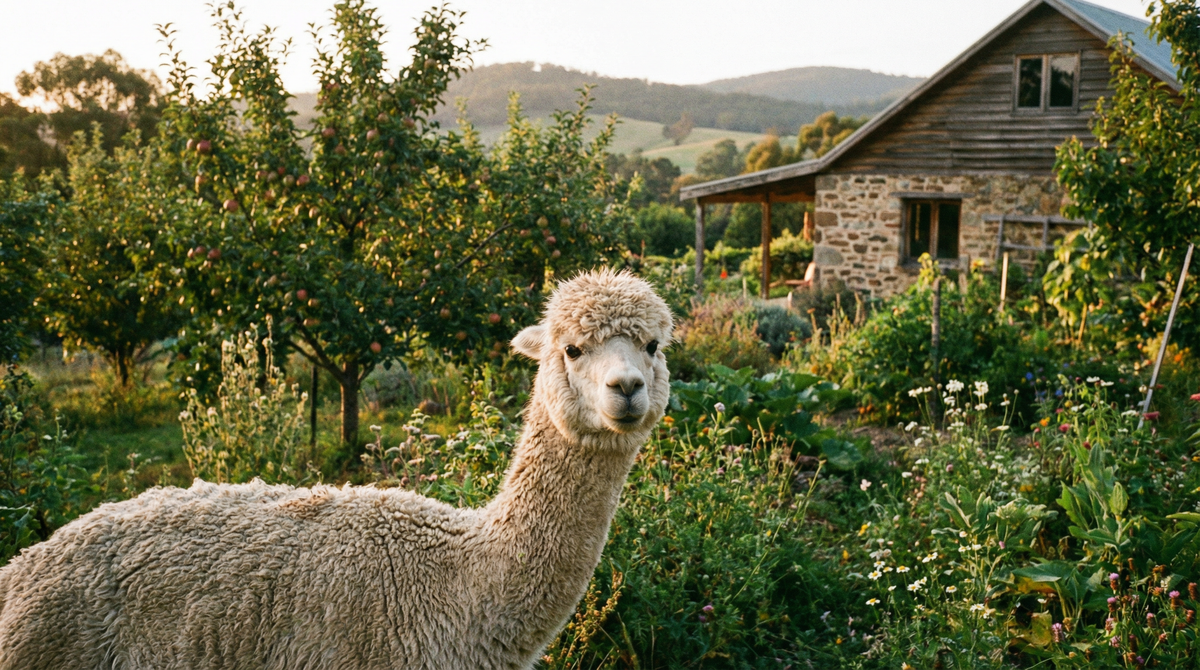
Overview & breed notes
The alpaca (Vicugna pacos) is a domesticated South American camelid bred for more than 6,000 years in the high Andes of Peru, Bolivia, and Chile [1]. They are the smallest of the four South American camelids and the only one bred primarily for fiber rather than wool, meat, or transport.
Two breed types are recognized:
- Huacaya — dense crimped fleece, teddy-bear silhouette; roughly 90% of registered animals worldwide.
- Suri — long lustrous fiber that hangs in pencil-locks; rarer and more sensitive to wet conditions.
Adults weigh 100–200 lb (45–90 kg) and stand 32–39 in (81–99 cm) at the shoulder, distinctly smaller than the related llama. Females breed at 12–18 months; males mature at 24–36 months. Gestation is 335–345 days — nearly a year — and almost always produces a single cria. Working lifespan on a well-managed farm is 15–20 years.
Three anatomical features matter for permaculture design: a three-compartment forestomach (technically pseudo-ruminants, not true ruminants), soft padded toes rather than hooves, and a habit of using communal latrines. Each of those drives the housing, grazing, and manure-handling decisions in the rest of this page.
Role in a permaculture system
Where alpacas fit well, they earn their keep through stacked functions: low-impact grazing, valuable fiber, garden-ready manure, light predator deterrence, and orchard-floor vegetation management. Where they fit poorly — hot humid climates — the cooling and parasite-management overhead can overwhelm the yields.
- Low-impact grazing. Soft, two-toed pads with a leathery sole exert roughly 8–12 psi of ground pressure versus 25–40 psi for cattle, dramatically reducing soil compaction and bank erosion on wet pastures [2].
- Fiber. 5–10 lb (2.3–4.5 kg) of fleece per annual shearing, with finer animals producing 18–24 micron fiber that is lanolin-free and hypoallergenic.
- Garden-ready manure. Pelletized, low-nitrogen (typically 1.5–2% N versus 3–5% in chicken manure), and applicable directly to vegetable beds without composting [3].
- Predator deterrent. A gelded male or pair of females will pursue foxes and free-roaming dogs, protecting chickens and sheep; not adequate against coyotes or larger predators.
- Vegetation management. Top-grazes grasses without pulling root crowns, leaving a clean sward suitable for orchard floors and silvopasture.
Best fit is USDA zones 3 through 7, in dry-cool to cool-temperate climates. Zones 8 and warmer require shade structures, summer shearing, and dedicated heat protocols; zones 9b and above (where I sit) require continuous active cooling through summer.
Shelter, fencing & space requirements
Alpacas are forgiving about housing but unforgiving about three things: heat, predators, and inadequate herd size.
Shelter
A three-sided shed open to the prevailing breeze (south in the Northern Hemisphere) is adequate for most temperate climates. Allow 40–60 sq ft (3.7–5.6 m²) of covered space per animal. Roof height of 7–8 ft (2.1–2.4 m) keeps the structure cool and lets you work without stooping. Earthen, sand, or rubber-mat floors are preferred over concrete; alpacas use a dung pile rather than soiling bedding, so deep bedding is unnecessary.
In subtropical zones add: roof vents or a 12 in (30 cm) ridge gap, two box fans rated for at least 4,000 CFM each on a thermostat that kicks on at 80°F (27°C), and an outdoor misting line on a timer.
Fencing
The fence’s job is to keep predators out, not alpacas in.
- Height 48–60 in (122–152 cm).
- 2×4 in (5×10 cm) woven wire (no-climb horse fence) is the gold standard.
- Avoid barbed wire — it catches and tears fleece.
- Avoid electric high-tensile as the primary fence; soft pads make alpacas poor candidates for electric training.
Space
Stocking rate on improved pasture is 4–8 alpacas per acre (10–20 per hectare) in zones 5–7 with adequate rainfall; halve that on dryland or in zones 3–4. Confinement minimums are 0.5 acre per animal with paddock rotation. Alpacas are obligate herd animals: a single alpaca will decline and is an animal-welfare concern. Plan for a minimum of three.
Feeding, foraging & integration with plants
Daily intake is roughly 1.5% of body weight in dry matter, or about 2–4 lb (0.9–1.8 kg) of forage per adult animal. They prefer to top-graze, eating the upper third of the sward and leaving the crown intact, which is one reason a well-rotated pasture maintains itself well under alpaca pressure.
Forage base
- Orchard grass and timothy hay as the calorie backbone.
- Modest inclusion of clover (10–20% of stand) for protein.
- Free-choice grass hay year-round; reserve alfalfa for pregnant or lactating females because of its high calcium and protein.
- Loose mineral mix formulated for camelids (selenium-supplemented in deficient regions, vitamin D in cloudy winters above 40°N).
Avoid these plants
- Fatal: oleander, yew, foxglove, water hemlock, wilted cherry leaves (cyanogenic glycosides).
- High toxicity: rhododendron, mountain laurel, larkspur, milkweed, nightshade.
- Moderate: oak (acorns and young leaves), lupine, rhubarb leaves.
Endophyte-infected tall fescue can cause subclinical reproductive issues in pregnant females; overseed with endophyte-free varieties or brome. In Florida and the Deep South, the dominant warm-season pastures (bahiagrass, bermudagrass) are lower-protein than ideal alpaca forage; planted cool-season annuals (rye, oats) are needed for winter quality.
Health, climate tolerance & welfare
Alpacas evolved at 12,000–15,000 ft (3,600–4,500 m) in the Andes, so they tolerate cold remarkably well but suffer in heat.
- Cold: healthy adults are comfortable to −20°F (−29°C) with windbreak and dry bedding.
- Heat stress begins above 80°F (27°C) combined with relative humidity over 50%, or when the temperature plus humidity index exceeds 120 [4]. THI above 150 is an emergency.
From the field (Lucas Summer, central Florida, USDA zone 9b): I evaluated a starter herd of three Huacayas for my site in 2024 and decided against it. Our July average is 91°F at 75% RH (THI roughly 165), our nighttime low rarely drops below 73°F, and a five-day power outage during a tropical storm would mean dead animals. A neighbor 40 miles north runs eight alpacas successfully but spends roughly $1,800/year on fans, mister-line water, and a backup generator dedicated to the barn. For most central and south Florida sites, miniature goats or hair sheep deliver more permaculture function with one-tenth the heat-management overhead. North Florida (zone 8b and cooler) is the southern edge where alpacas pencil out without extreme intervention.
Summer protocol where heat is a factor
- Shear annually in late spring before sustained heat.
- Provide deep shade, redundant fans, and shallow wading water; misters reduce body temperature within minutes.
- Check belly and groin skin daily during heat waves; pink, damp, or hot skin signals heat stress.
Parasites and routine care
Communal dung piles reduce parasite pressure but do not eliminate it. Haemonchus contortus (barber pole worm) is the dominant economic parasite in warm humid regions; use FAMACHA scoring rather than calendar drenching to slow resistance [5]. Toenail trimming every 3–6 months. Core vaccinations: CDT (Clostridium perfringens C and D + tetanus) annually, plus rabies in endemic regions.
Polyculture & rotational systems
Silvopasture and orchard understory
Mature fruit and nut orchards benefit from alpaca grazing between rows. Soft pads cause negligible compaction on irrigated drip lines, and they avoid bark stripping if browse and salt are adequate. Trunk-guard young trees up to 4 ft (1.2 m) until the bark thickens. Stocking rate in temperate orchards is roughly one alpaca per quarter acre when the orchard floor carries good forage. In subtropical orchards (citrus, mango, avocado), the orchard provides excellent shade but pasture protein is typically below alpaca needs without supplemental hay.
Multi-species rotational grazing
Run alpacas behind cattle or horses on a leader-follower rotation: they consume forage the larger animals refused and break parasite cycles by interrupting host specificity. With sheep, run together rather than sequentially — a 1:3 alpaca-to-sheep ratio provides predator protection without measurable forage competition. Avoid running with goats on the same pasture when browse is limited; the species compete more directly than the alpaca-sheep pairing.
Guardian deployment
One or two gelded males placed with a small flock will challenge foxes, raccoons, and free-roaming dogs. Guardian alpacas are not a substitute for fixed fencing against coyotes or larger predators; expect protection against the small-to-medium threat class only.
Manure rotation: collect from communal latrines twice weekly, age 30–60 days in a passive pile if applying near edible roots, and side-dress vegetables at roughly 1 lb per square foot (5 kg/m²).
Frequently asked questions
Can I keep just one alpaca?
No. Alpacas are obligate herd animals; a solo alpaca will exhibit stereotyped pacing, weight loss, and depression. The accepted minimum is three; two is workable only if both are well bonded and at least one other livestock companion (a llama or sheep) shares the paddock.
Are alpacas a good choice for Florida or the Deep South?
Honest answer: not without serious infrastructure. Zone 8a and cooler can work with strong shade and fans. Zone 8b through 10 means continuous active cooling, backup power, and elevated parasite-management costs. If your goal is permaculture function (grazing, manure, predator deterrence), goats and hair sheep deliver more for less labor in the Southeast.
Do alpacas spit?
Yes, but rarely at humans unless severely stressed. Spitting is herd communication, typically directed at other alpacas over food or breeding disputes. Calm, predictable handling reduces it.
How much fiber do they produce, and is it worth selling?
5–10 lb (2.3–4.5 kg) per shearing. Direct-to-consumer raw or processed fiber sales can yield $3–$15 per ounce. At wholesale fiber-pool rates the economics work only as part of a diversified offering (fiber + breeding + agritourism + manure).
Are alpacas hard on pasture?
Less than almost any other ruminant their size. Padded feet, top-grazing, and communal dung piles together result in soil-conservation outcomes recognized by USDA NRCS in several states for conservation cost-share programs.
References
- Penn State Extension. Llamas and Alpacas. The Pennsylvania State University.
- Oregon State University Extension Service. Alpacas and Llamas.
- Ohio State University Extension. Composting Livestock Manure.
- Merck Veterinary Manual. Llamas and Alpacas.
- American Consortium for Small Ruminant Parasite Control. FAMACHA system.
- ASPCA Animal Poison Control Center. Toxic and Non-Toxic Plants.
Field notes by Lucas Summer, central Florida (USDA zone 9b). The decision against running alpacas on this site is based on on-site climate measurement and conversations with three regional alpaca keepers; numbers without citations come from operational experience and should be treated as starting points, not published standards.
Foraging Behavior
Alpacas are efficient grazers that prefer grasses and hay, grazing for 57% of daylight hours. They have soft, padded feet that cause minimal soil compaction compared to hooved animals. They are selective browsers and will sample a variety of plants but primarily consume grasses.
Fencing Requirements
Alpacas require 4-5 foot fencing, though they rarely challenge fences. Woven wire or board fencing works well. They are prey animals and fencing is primarily to keep predators out rather than alpacas in.
Shelter Requirements
Three-sided shelters are adequate in most climates as alpacas are well-adapted to temperature extremes. They need shade in summer and wind protection in winter. Minimal bedding required as they use communal dung piles away from shelter.
Permaculture Notes
Alpacas are increasingly valued in permaculture systems for their low environmental impact and multiple yields. Their soft, padded feet cause significantly less soil compaction than hooved livestock, making them ideal for sensitive pastures and silvopasture systems. They are efficient grazers requiring less feed per pound of body weight than sheep or goats, and their three-compartment stomach allows them to thrive on lower-quality forage. One of the most valuable permaculture functions of alpacas is their manure management. They use communal dung piles, making collection easy and reducing parasite loads in pastures. Alpaca manure is lower in nitrogen than other livestock manures, meaning it can be applied directly to gardens without composting—a significant labor savings. This 'alpaca gold' is prized by gardeners for its balanced nutrient profile. Alpacas serve as effective guardian animals for chickens, sheep, and goats, using their alertness and intimidating size to deter foxes, dogs, and other predators. A single gelded male or a pair of females can protect a small flock. In silvopasture and orchard systems, alpacas provide weed control and fertilization while their browsing habits are gentle enough to avoid bark damage to trees. The fiber harvest provides a valuable annual yield, with each alpaca producing 5-10 pounds of fleece. This fiber is hypoallergenic, lanolin-free, and warmer than wool. For permaculture operations, alpacas also provide agritourism opportunities, as their gentle nature and appealing appearance attract visitors. Their 20-25 year lifespan means a long-term relationship and consistent yields from the same animals.