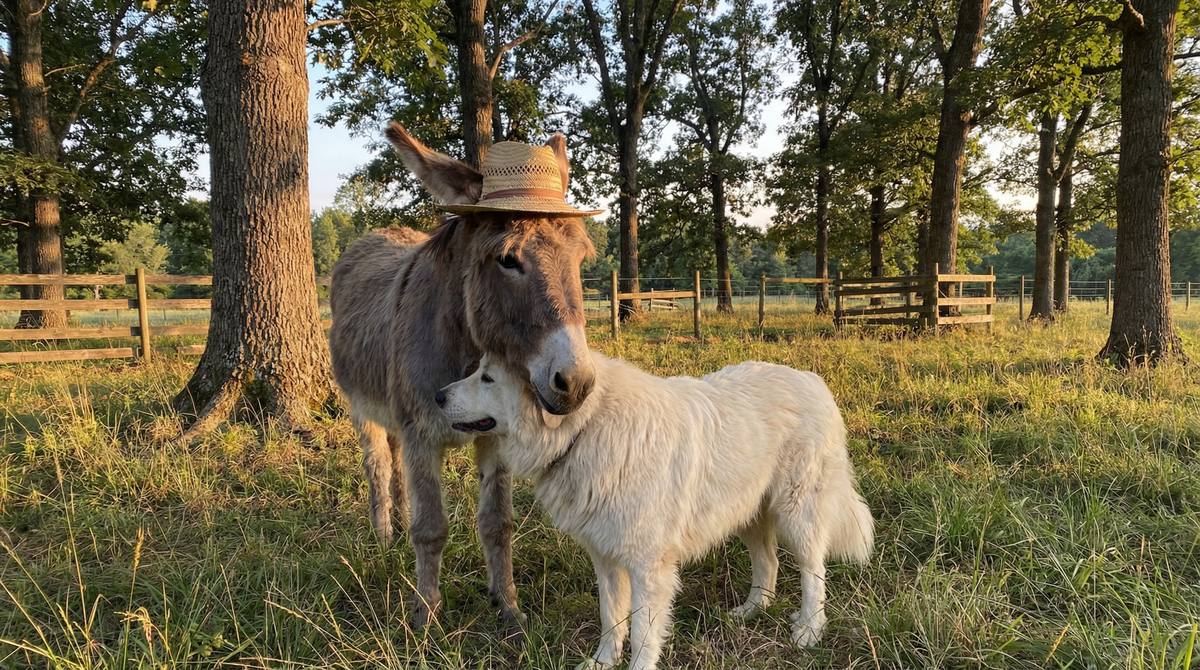
Overview
The donkey (Equus africanus asinus) is a domesticated equine descended from the African wild ass, kept by humans for at least 5,000 years as a pack and draft animal. Donkeys are smaller than horses, more heat-tolerant, and famously cautious rather than flighty under threat, which is why guardian-donkey use against coyotes and free-roaming dogs is now a documented practice in extension publications across the southern United States. On my central Florida site (USDA zone 9b), a standard-size donkey has earned her place not as a draft animal but as a calm sentinel and an unfussy weed-and-fence-line manager.
Compared with horses, donkeys eat roughly half the calories per pound of body weight, prefer coarser forage, and tolerate heat far better. Those three traits matter more in subtropical permaculture than any draft capacity, and they are the reason most small Gulf-coast homesteads that experimented with horses for fence and pasture work eventually downgraded to one or two donkeys instead.
Permaculture Role
Donkeys earn their keep in a designed system through four functions: livestock guarding, low-intensity pasture management, manure production, and light draft. None of them is exotic, but all four are reliable when the donkey is matched to the right paddock size and forage base.
Livestock guardian
A jenny (female) or gelded jack bonded to sheep, goats, or poultry will charge, bite, and kick predators rather than flee. University of Tennessee Extension and the USDA-APHIS National Wildlife Research Center both note that single donkeys raised with the herd are more effective guardians than pairs, which tend to bond with each other and ignore the livestock. Intact jacks are not recommended around small stock because they can injure animals during play or breeding behavior.
Pasture and weed manager
Donkeys browse and graze a wider range of plants than horses, including thistle, blackberry canes, and tough perennial weeds that cattle and horses reject. On my place they reliably knock back smilax (catbrier) and beautyberry sprouts along the fence line that I would otherwise have to brush-cut every six weeks in summer.
Manure and draft
One adult donkey produces roughly 8 to 10 pounds of manure per day, drier than horse manure and easier to compost without heavy bedding inputs. Traditional draft use (pulling a small cart or stoneboat, packing feed and fence posts) is still practical at the half-acre to ten-acre scale, where a tractor is overkill and a wheelbarrow is undersized.
Housing & Fencing
Donkey coats are not waterproof, despite the popular myth, and prolonged rain in cool weather is the fastest way to lose a donkey to pneumonia or rain rot. The Donkey Sanctuary (UK) and Penn State Extension agree on the housing baseline: every donkey needs free 24-hour access to a dry, draft-free shelter.
Shelter
A three-sided run-in shed with the open face turned away from prevailing wind is sufficient in USDA zones 8 and warmer. Allow at least 48 square feet per donkey, with 80 to 100 square feet preferred so two donkeys can lie down without crowding. In colder zones, an enclosed barn with passive ventilation is the safer build. My own shelter is a 10 by 12 ft open-front shed on the north side of a live-oak grove, which holds the air 6 to 8°F cooler than open pasture during July afternoons.
Fencing
Donkeys test fences with their chests and lips more than horses do, and they are notorious for lifting gate latches. Three-strand smooth high-tensile wire at 18, 32, and 48 inches works well when the bottom strand is electrified. Barbed wire is not appropriate. Woven-wire field fence with a hot top strand at 48 inches is the most predator-resistant option when the donkey is also expected to guard sheep or goats.
Footing
Hoof care is the single biggest housing issue on Gulf-coast sand. Wet sandy paddocks soften the hoof wall and invite white-line disease and thrush. A dry-lot area with crushed shell or screenings near the shelter, scraped clean weekly, gives the hooves time to harden between rain events.
Feeding & Forage
Donkeys are trickle feeders adapted to sparse, fibrous desert vegetation. The most common welfare problem in domestic donkeys is not starvation, it is obesity and laminitis from rich pasture and grain. The Donkey Sanctuary recommends a maintenance diet of 1.3 to 1.7 percent of body weight in dry-matter forage per day, with barley straw making up 50 to 75 percent of that ration for easy-keeping adults.
Pasture base
On the Gulf coast, low-sugar warm-season grasses are the right fit. Bermudagrass and bahiagrass pastures, kept short and never lush, are appropriate. Perennial peanut is too rich as a sole forage and is best used as a hay supplement at no more than 10 percent of the ration.
Hay and straw
Clean barley straw is the gold-standard chew-feed for adult donkeys without heavy work demands. Mature grass hay (coastal bermuda cut at full maturity, or timothy in cooler climates) is the next best option. Avoid alfalfa, clover-heavy hay, and any feed marketed as “horse sweet feed.”
Minerals and water
A free-choice horse-and-mule mineral block (no urea, no high copper) and clean water daily are non-negotiable. In central Florida summers a 300-lb donkey will drink 5 to 8 gallons of water per day; in winter that drops to 3 to 4 gallons.
Toxic plants
Donkeys will sample almost anything when bored or short on forage. Fatal or high-toxicity species to exclude from grazing areas include yew, oak acorns in quantity, red maple wilted leaves, foxglove, rhododendron, ragwort, hemlock, bracken, and privet. Pull or fence off these plants before turning donkeys onto new ground.
Health
A well-managed donkey on appropriate forage with good hoof care can live 30 to 50 years, far longer than a horse. Most health problems on small homesteads trace back to overfeeding, missed hoof trims, or untreated parasites.
Hooves
Hoof trims every 6 to 10 weeks by a farrier experienced with donkeys (the donkey hoof is taller and more upright than a horse hoof and is trimmed differently) is the single most important preventive task. On Florida sand, I move trims to the 6-week end of that range during the wet season and stretch to 10 weeks in the dry months.
Parasites
Florida and Gulf-coast pastures support a year-round parasite load. Rotational grazing across two or three paddocks, cross-grazing with poultry where possible, and a fecal-egg-count based deworming schedule (rather than blanket calendar deworming) are the current University of Florida IFAS Extension recommendations.
Laminitis and obesity
Donkeys are several times more prone to laminitis than horses on rich spring pasture. The clinical sign to watch for is a stiff, short-strided walk and reluctance to move, especially after a heavy rain that triggers grass regrowth.
Vaccines
Core equine vaccines (tetanus, Eastern and Western equine encephalitis, West Nile virus, and rabies) are recommended annually for donkeys in the southeastern United States. EEE and WNV pressure is high in Florida from May through November.
Field notes, central Florida. I keep a single jenny on roughly two acres of mixed bahiagrass and live-oak shade, paired with a small flock of sheep. She has never lost an animal to coyote or stray-dog pressure, and the only year I had a black-vulture lamb-loss issue ended the week she arrived. Hoof trims are every 7 weeks during our June to October wet season and every 9 to 10 weeks the rest of the year. EEE-WNV combination shots go in every March before mosquito season ramps up.
Integration
Donkeys integrate cleanly into three permaculture systems: silvopasture under shade-tree canopy, rotational grazing with small ruminants, and fence-line and trail brush management. They do not integrate well into actively managed food-forest plantings unless those plantings are mature and trunk-protected, because donkeys will strip bark from young fruit and nut trees within hours.
Silvopasture
Mature oak, hickory, and pecan canopy at 30 to 50 percent cover is ideal. Avoid pastures dominated by red maple, which is fatally toxic to equines when leaves wilt after a windstorm.
Sheep and goat guarding
One donkey per 50 to 75 head of sheep or goats, bonded from a young age, is the protection ratio most extension services use. Larger flocks or multi-paddock setups benefit from a livestock guardian dog instead of additional donkeys.
Poultry
Donkeys and chickens coexist well in the same paddock during daytime. Donkeys are not effective guardians against hawks or raccoons, so the chickens still need a secure overnight coop and overhead cover near the run.
Frequently Asked Questions
How much land do I need for one donkey?
One half-acre of decent pasture per donkey is the working minimum if you supplement with hay during drought and the wet season. One acre per donkey is more comfortable and reduces overgrazing.
Can a donkey live alone?
Donkeys are herd animals and prefer at least one companion, which can be a horse, mule, sheep, or goat. A solo donkey kept as a guardian must be bonded with the livestock it is protecting from the start.
Do donkeys really protect against coyotes?
Yes, when properly selected and bonded. A single jenny or gelding raised with sheep or goats will actively confront canid predators. Donkeys are not effective against bears, mountain lions, or packs of multiple coyotes.
Are donkeys louder than horses?
Yes. A braying jack carries roughly a mile in still air. Plan accordingly if you have close neighbors.
What is the difference between a donkey, a mule, and a hinny?
A mule is the offspring of a male donkey and a female horse. A hinny is the offspring of a male horse and a female donkey. Both are nearly always sterile.
References
- The Donkey Sanctuary. Feeding Your Donkey. thedonkeysanctuary.org.uk/for-owners/feeding
- University of Tennessee Extension. Guard Donkeys for Sheep and Goats. extension.tennessee.edu — PB1779
- University of Florida IFAS Extension. Parasite Control in Horses and Donkeys. edis.ifas.ufl.edu — VM097
- Penn State Extension. Donkey Care and Management. extension.psu.edu/donkey-care-and-management
- USDA-APHIS National Wildlife Research Center. Livestock Guardian Animals. aphis.usda.gov/wildlife-damage
Field notes and central-Florida observations in this article are from Lucas Summer’s permaculture site in USDA zone 9b. Hoof-trim intervals, water-intake figures, and pasture-grass selections reflect on-site practice; mortality rates, life-span ranges, and vaccine recommendations are drawn from the extension sources cited above.
Foraging Behavior
Donkeys are trickle feeders and enjoy feeding on highly fibrous feeds. They also have a natural browsing behavior and enjoy safe logs and branches.
Fencing Requirements
Fences should be sturdy and secure to keep donkeys in their safe space.
Shelter Requirements
Donkeys need access to a shelter or stable to hide from the elements, as their coats are not waterproof. A three-sided shed is sufficient in most climates, but a fully enclosed shelter is recommended for regions with frigid temperatures.
Permaculture Notes
Donkeys are a valuable addition to a permaculture system, primarily for their roles in weed management and fertilization. Their manure is an excellent addition to compost piles, enriching the soil with vital nutrients. They can be integrated into silvopasture and rotational grazing systems, where their grazing habits can help maintain pastures and control unwanted vegetation. Donkeys are also effective in controlling aggressive weeds that other livestock may avoid. In a food forest, donkeys can help manage the undergrowth, but care must be taken to protect young trees and desired plants, as donkeys will browse on a variety of vegetation. Their calm demeanor and manageable size make them a good choice for smaller homesteads. They are also excellent companion animals and can provide draft power for light farm work, reducing the need for fossil-fuel-powered machinery. When integrating donkeys, it is crucial to provide them with adequate shelter, as their coats are not waterproof. A simple three-sided structure is often sufficient, but in colder climates, a more substantial, enclosed shelter is necessary. Fencing must be strong and secure to ensure their safety and prevent them from wandering. With proper care and management, donkeys can be a sustainable and beneficial component of a permaculture design.