Overview
The llama (Lama glama) is a domesticated South American camelid descended from the wild guanaco of the Andes. Larger than its cousin the alpaca and bred for centuries primarily as a pack animal rather than a fiber animal, the llama is calm, intelligent, and remarkably easy to handle for its size. The Inca civilization moved goods across the Andes on llama trains for several hundred years, and the species remains the standard freight animal in much of the high Andes today.
Llamas are tougher and more heat-tolerant than alpacas, but both species evolved at 8,000 to 14,000 ft of elevation in cool, dry, low-oxygen conditions. That makes them a real but qualified fit for permaculture sites on the Gulf coast. On my central Florida site (USDA zone 9b), I weighed up a single guard llama for the sheep paddock several years ago and ultimately chose a donkey instead, because the donkey handles a 95°F afternoon without active cooling and the llama would have required midday misters or a wading pool through July and August. The decision was about climate fit, not about the species itself, which is genuinely excellent at guard duty in cooler climates.
Permaculture Role
Llamas fill four useful permaculture niches: livestock guarding, light pack and draft work, fiber production, and manure for compost. They are also commonly kept for agritourism and as companion animals because of their calm temperament.
Livestock guardian
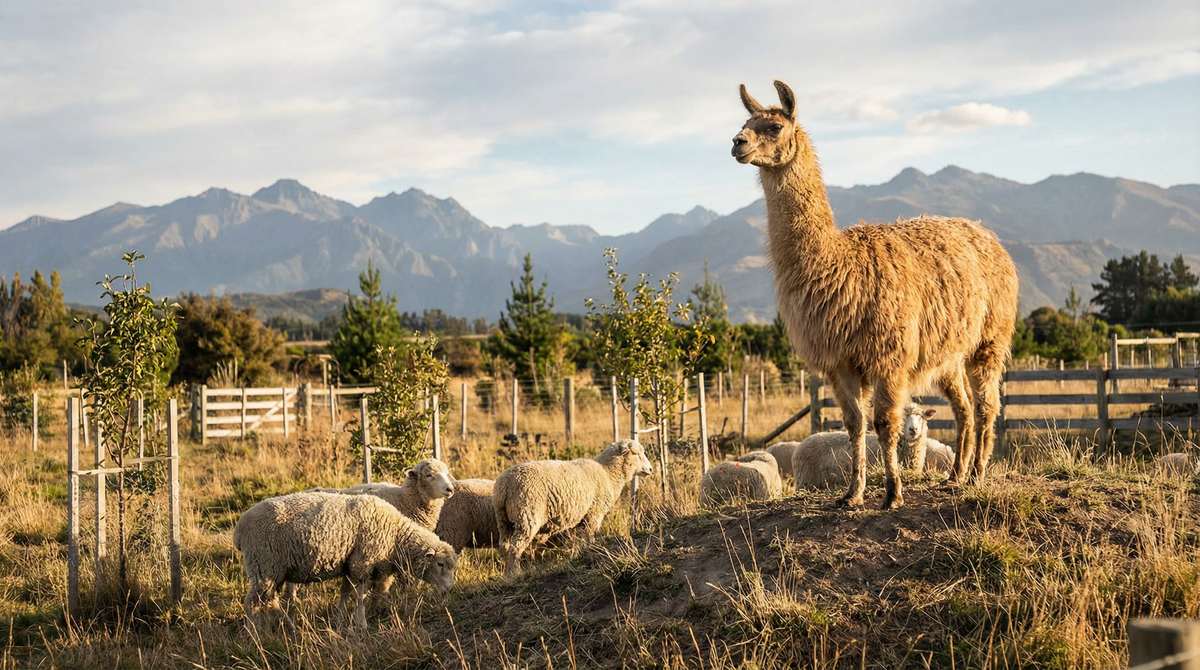
A single gelded male or female llama bonded with sheep or goats from young will charge, kick, and stand between predators and the flock. USDA-APHIS National Wildlife Research Center and Colorado State University Extension both document llamas as effective coyote and stray-dog deterrents when properly bonded and stocked at one guard llama per 50 to 200 head of sheep.
Pack animal
An adult llama can carry 50 to 90 pounds (roughly 20 percent of body weight) at 2 to 3 mph for 8 to 12 hours per day on appropriate trails. Pack-llama outfitters across the western US use them for wilderness trips because they leave a much lighter footprint than horses or mules.
Fiber
Llama fiber is coarser than alpaca and is shorn annually in spring. Yield is 3 to 6 lb per animal. It is suitable for ropes, rugs, and outerwear rather than fine garments.
Manure
Like alpacas, llamas use communal dung piles, which simplifies cleanup and reduces pasture parasite spread. The pelleted manure is low in nitrogen and can go directly onto garden beds without composting.
Housing & Fencing
Llamas tolerate cold well but struggle in sustained heat and humidity. On the Gulf coast, summer management is the entire housing problem.
Shelter
A three-sided run-in shed with the open face turned away from prevailing wind is sufficient in zones 7 and warmer. Allow 40 to 60 sq ft per animal under roof. In hot, humid climates, an open shed with a fan or natural cross-breeze, deep shade, and a wading pool or misters from May through September is the standard for adequate heat management. Camelid heat-stress thresholds are documented by the International Camelid Health Conference and Oregon State University Extension at ambient temperatures of 80°F with 50 percent humidity (a temperature-humidity index of about 120) or above.
Fencing
Llamas respect fences well and do not test them the way goats do. A 4 to 5 ft woven-wire field fence with a hot top strand is sufficient for adults. Intact males benefit from a 5.5 ft fence to discourage breeding-season interactions. Barbed wire is inappropriate. Predator-proofing the outside perimeter against coyotes and stray dogs matters more than containment of the llama itself.
Annual shearing
Annual shearing in early spring is non-negotiable in subtropical climates. An unshorn llama entering a Florida summer is at high risk of heat stroke even with shade and water.
Footing
Llama toenails grow continuously and need trimming every 4 to 6 months. Wet, soft sandy paddocks soften the foot pad and contribute to infection. A dry-lot area near the shelter helps.
Feeding & Forage
Llamas are pseudo-ruminants with three-chambered stomachs and are extraordinarily efficient at extracting nutrients from low-quality forage. The single most common feeding mistake among new owners is overfeeding rich pasture or grain to an animal that has evolved on sparse, fibrous, high-altitude vegetation.
Pasture
On the Gulf coast, mature warm-season grass pasture is the working forage base. Bermudagrass and bahiagrass at 4 to 6 inch grazing height in a rotational system support adult llamas at maintenance without supplementation. Perennial peanut is too rich as a sole forage and is best limited to a small portion of the daily ration.
Hay
Coastal bermudagrass or mature timothy at 8 to 12 percent crude protein is the gold-standard winter hay. Alfalfa is too rich and is reserved for pregnant or lactating females and very young or thin animals.
Minerals and water
A llama-and-alpaca-specific mineral supplement (not a sheep or cattle mineral) covers selenium, copper, and zinc requirements that are otherwise hard to meet on Florida forage. Fresh water always available, with daily intake doubling in summer.
Toxic plants
Fatal or high-toxicity species to exclude from pasture include yew, oleander, red maple (wilted leaves), black walnut, horse chestnut, Japanese honeysuckle, chokecherry, and black locust. Oak acorns in quantity are problematic; light access during mast years is usually tolerated.
Health
Llamas are remarkably healthy when housed and fed appropriately. The two recurring failure modes on Gulf-coast properties are heat stress and meningeal worm.
Heat stress
Open-mouth breathing, lethargy, and refusal to move are early warning signs. Above a temperature-humidity index of 120, an unshorn or older llama can deteriorate quickly. Daily rectal-temperature checks during summer heat waves are common in southeastern breeder herds. Normal is 99 to 102°F; above 104°F is a veterinary emergency.
Meningeal worm
Parelaphostrongylus tenuis is a parasitic nematode carried by white-tailed deer that causes neurological disease in camelids. Florida and the broader southeastern US carry high deer densities and meaningful exposure risk. Cornell University College of Veterinary Medicine and Oregon State Extension recommend monthly prophylactic ivermectin or moxidectin in high-risk regions.
Parasites
Internal parasites are managed with fecal-egg-count-based deworming and rotational grazing. Mineral imbalance (especially low selenium and copper) compounds parasite vulnerability.
Vaccines
CDT (Clostridium perfringens C and D plus tetanus) annually. Rabies depending on local incidence. Consult a camelid-experienced veterinarian, as the species has some drug sensitivities unlike small ruminants.
Field notes, central Florida. I priced out a single guard llama as part of the decision matrix when I first added sheep to my place. The bonded-from-young guard llama setup is genuinely effective against coyotes and stray dogs in the documentation, and a llama is a calmer, lower-maintenance animal than a guardian dog. What pushed me to a donkey instead was the summer heat-management overhead: a llama on my property would need daily attention from June through September (shaved coat, wading pool refresh, midday mister, body-temperature checks during heat waves), while my donkey jenny tolerates the same conditions with nothing more than live-oak shade and a clean trough. For a cooler-climate operation, I would not hesitate.
Integration
Llamas integrate well with silvopasture, sheep- and goat-guarding, rotational grazing, and agritourism. They integrate poorly with very-small-livestock operations (alpaca-sized fiber farms do better with alpacas) and require thoughtful summer management on the Gulf coast.
Sheep and goat guarding
One guard llama per 50 to 200 head of sheep or goats, bonded from young, is the working protection model. Multiple guard llamas typically bond with each other rather than the flock and lose guarding effectiveness.
Silvopasture
Mature live-oak, pecan, and slash-pine canopy at 30 to 50 percent cover gives essential summer shade. Avoid red maple in pasture.
Manure system
Communal dung piles can be raked into a single composting pile or wheelbarrowed directly to garden beds as a low-nitrogen amendment. The pellets are dry, almost odorless, and a favorite input for vegetable transplant mix.
Pack and trail use
Trained pack llamas open up wilderness areas that would be inaccessible to motorized transport. This is less relevant on a small homestead but matters in mountain or remote-terrain operations.
Frequently Asked Questions
What is the difference between a llama and an alpaca?
Llamas are larger (250 to 450 lb adults vs 100 to 200 lb for alpacas), have longer ears with a banana shape, and are bred primarily for pack and guard work. Alpacas are smaller, with shorter spear-shaped ears, and are bred for fine fiber.
Do llamas spit?
Yes, mostly at each other to establish hierarchy. A well-handled llama rarely spits at humans. Spitting at people usually indicates poor handling history or fear.
Can a llama live alone?
Llamas are herd animals and prefer a companion. A solo guard llama bonded with a flock of sheep or goats accepts the flock as its herd, which is why the single-guardian model works.
How much land per llama?
Roughly 1 acre of good pasture per animal in a rotational system, less if hay supplements the ration. Llamas overgraze less aggressively than horses or goats given the same stocking.
Are llamas dangerous?
Properly handled llamas are calm, gentle, and safe around children. An intact stallion (un-gelded male) can develop berserk-male syndrome from being raised without other llamas, which is dangerous; this is why most pet and working llamas are gelded.
References
- USDA-APHIS National Wildlife Research Center. Livestock Guardian Animals. aphis.usda.gov/wildlife-damage
- Colorado State University Extension. Llamas and Alpacas as Guard Animals. extension.colostate.edu — agriculture
- Oregon State University Extension. Camelid Heat Stress Management. extension.oregonstate.edu
- Cornell University College of Veterinary Medicine. Meningeal Worm in Camelids. vet.cornell.edu
- International Camelid Institute. Llama and Alpaca Production. icicamelid.org
Field notes and central-Florida observations in this article are from Lucas Summer’s permaculture site in USDA zone 9b. The honest comparison between llama and donkey guardian options and the climate-driven decision reflect on-site practice; heat-stress thresholds, meningeal-worm prophylaxis, and guardian-stocking ratios are drawn from the extension and veterinary sources cited above.
Foraging Behavior
Llamas are both grazers and browsers. They are efficient at extracting nutrients from low-quality, coarse vegetation and will eat taller grasses, forbs, shrubs, and tree leaves.
Fencing Requirements
Fences should be a minimum of 4-5 feet high, with 5.5 feet recommended for separating stud males. Woven wire, no-climb, or electric fencing are suitable, but barbed wire should be avoided. Dog-proof peripheral fences are also important for protection against predators.
Shelter Requirements
A three-sided shelter is often sufficient for protection from wind and rain. In colder climates, an enclosed barn with good ventilation and bedding is necessary. In warm climates, shade is essential, and misters or wading pools can help prevent heat stress.
Permaculture Notes
Llamas are intelligent and gentle animals that can be well-integrated into permaculture systems. They are larger than alpacas and are well-suited as pack animals for carrying loads in rugged terrain. Their soft-padded feet minimize soil compaction, making them ideal for grazing in various environments, including silvopasture and food forests. Rotational grazing is recommended to maintain healthy pastures and prevent overgrazing. Llamas are valuable for their fiber, though it is not as fine as alpaca fiber. Their manure is a nutrient-rich fertilizer that can be used to create "manure tea" for gardens, contributing to a closed-loop nutrient system. Llamas also serve as excellent guard animals, protecting other livestock from predators like coyotes and foxes. Their natural curiosity and calm demeanor also make them suitable for agritourism operations. When integrating llamas, it is important to provide them with companionship as they are herd animals. They require secure shelter and fencing for protection. With proper handling and care, llamas can be a versatile and beneficial addition to a permaculture farm or homestead, contributing to its overall resilience and productivity. Their ability to thrive on a variety of forage and their multi-purpose nature make them a valuable asset in a diverse and sustainable agricultural system.