Overview
The domestic rabbit (Oryctolagus cuniculus) is a small lagomorph domesticated from European wild rabbits roughly 1,500 years ago in French monasteries. Today rabbits are kept worldwide for meat, fiber, manure, and companionship, with global production estimated by the FAO at over 800,000 tonnes of meat per year. Among small-livestock options for a permaculture homestead, rabbits offer the lowest space requirement, the fastest reproduction rate, the leanest meat, and one of the best manures for direct garden application.
The biggest challenge of rabbit-keeping on the Gulf coast is the same one as for guinea pigs: heat. Rabbits are temperate-zone animals with poor heat tolerance and a tendency to die quietly during summer afternoons. On my central Florida site (USDA zone 9b), I raise New Zealand White and Californian crosses in raised-wire hutches under deep live-oak shade with frozen 2-liter bottles refilled twice daily through July and August. The setup works but it is the most labor-intensive small-livestock operation I run during the hottest weeks of summer.
Permaculture Role
Rabbits earn their keep in three niches: meat production at extraordinary feed-conversion efficiency, high-quality cold manure for the garden, and (less commonly) angora fiber.
Meat production
A doe (female) of a meat breed (New Zealand White, Californian, Champagne d’Argent, Florida White, Rex) produces 4 to 6 litters per year of 6 to 10 kits each, finishing to 4 to 5 lb live weight at 10 to 12 weeks. That is roughly 100 to 200 lb of meat from a single doe and buck plus a small hutch and 1 to 2 lb of pelleted feed per day. The University of Florida IFAS Extension publication on small-scale rabbit production documents this productivity in detail.
Cold manure
Rabbit droppings are dry, almost odorless pellets that can be applied directly to garden beds without composting. The nitrogen is in slow-release organic form, so there is no burn risk to seedlings. A single doe-and-litter unit produces enough manure in a year to enrich roughly 200 to 300 sq ft of intensive vegetable bed. Stacking a worm bin under wire-floor hutches captures the manure and converts it to vermicompost with no extra handling.
Angora fiber
Angora rabbits (English, French, Giant, Satin) produce 8 to 16 oz of fine wool per year, plucked or shorn every 90 days. Angora is too warm a fiber to be a primary commercial product in subtropical climates but works as a homestead niche.
Housing
Rabbit housing falls into three rough categories: raised wire hutches, ground colonies, and movable rabbit tractors. On the Gulf coast, raised wire hutches in deep shade are the practical default.
Raised wire hutches
A 30 by 36 in wire hutch with a resting board, a nest box for breeding does, and an automatic waterer holds one adult meat-breed doe with litter. Wire floors allow manure to fall through to a catch tray or worm bin. Mount hutches in stacks of 2 or 3 high under a shaded roof with at least 12 in of overhead clearance between tiers for airflow.
Ground colonies
A predator-proof enclosed run with deep bedding, multiple hides, and a buried-skirt perimeter fence (rabbits dig) houses 5 to 15 adults plus litters in a more natural arrangement. Disease and parasite management are harder than in cages. The American Rabbit Breeders Association and Cornell University publications both treat colonies as the high-skill option, not the beginner setup.
Movable tractors
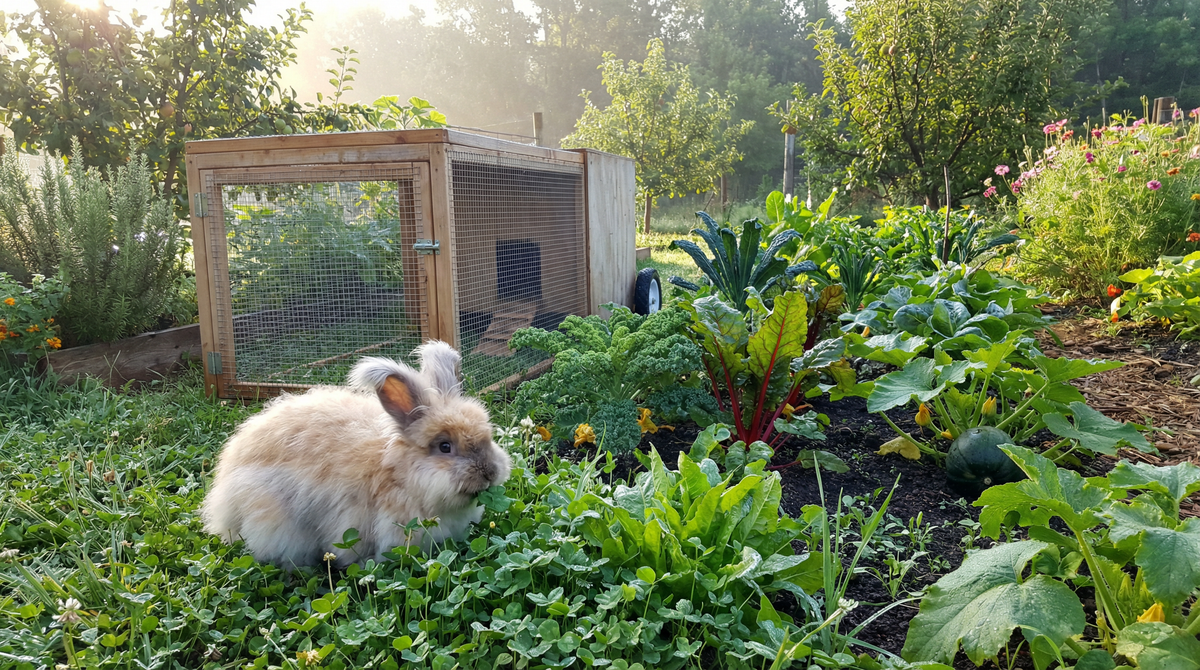
A bottomless wire pen on grass rotates rabbits across lawn or garden cover crops. Works well in cool weather but is heat-risky in central Florida summers; useful spring and fall only.
Heat management
Above 85°F, rabbits are at heat-stress risk. Above 90°F sustained, deaths begin. The standard Gulf-coast summer kit is: deep shade, fans on the hutch rack, frozen water bottles in the hutch refreshed twice daily, ceramic floor tiles for the rabbits to lie on, and morning-only handling to avoid afternoon stress.
Feeding
Rabbits are obligate herbivores with a hindgut-fermenting digestive system. The standard production diet is a 16 to 18 percent protein commercial pellet, free-choice grass hay, and limited fresh greens. Permaculture-leaning operations defray pellet costs with garden- and tree-fodder feeding.
Hay
Free-choice timothy or grass hay is the foundation. Alfalfa hay is appropriate for growing kits, pregnant or lactating does, and active bucks, but is too rich as a sole forage for sedentary adult stock.
Pellets
4 to 8 oz per adult per day of commercial pellet, scaled to body size and production stage.
Fresh fodder
Florida-friendly greens include comfrey (small amounts), dandelion, plantain, young mulberry leaves and shoots, moringa leaves, sweet potato vine, pigeon pea leaves, and carrot tops. Introduce one new fodder at a time over 5 to 7 days to avoid GI upset.
Water
Fresh water always available. A nursing doe drinks 1 to 2 quarts per day; in Florida summer heat, intake doubles.
Toxic plants
Avoid rhubarb, tomato leaves and stems, raw cassava, avocado, onion, garlic, and most ornamental bulb foliage.
Health
Rabbits hide illness well, and a sick rabbit can deteriorate from looking normal to dying within 12 to 24 hours. Daily handling and weight tracking is the standard early-detection practice.
Heat stress
Open-mouth breathing, lethargy, and ears that feel hot rather than warm are warning signs. Cool the rabbit by misting the ears (large surface area for heat exchange) and providing cool tile to lie on. Sustained ambient above 90°F can be lethal within hours.
GI stasis
The most common rabbit emergency. A rabbit that stops eating and producing droppings for 12 hours needs immediate veterinary care. Prevention is continuous hay, adequate fiber, no sudden diet changes, and stress reduction.
Pasteurellosis (snuffles)
A bacterial respiratory disease that becomes chronic in stressed or poorly ventilated colonies. Affected animals should not be kept as breeders; the pathogen spreads readily.
Fly strike
In hot wet weather, flies lay eggs on soiled fur (especially around the tail) and maggots can kill a rabbit within days. Daily inspection of the hindquarters during summer is non-negotiable.
Rabbit Hemorrhagic Disease (RHDV2)
An emerging viral disease in North America, fatal in most affected rabbits. Vaccines are now available from veterinarians. Consult a rabbit-experienced veterinarian on current local recommendations.
Field notes, central Florida. My production setup is 4 New Zealand White / Californian-cross does and one buck in 30 by 36 in wire hutches on a 3-tier rack under a shed roof framed up against the north side of a live-oak grove. Frozen 2-liter water bottles go in at 8 am and again at 1 pm from June through September, ceramic tiles year-round, a 20 in box fan on a timer running 11 am to 7 pm. With that setup I lose maybe 1 to 2 adults per year to summer heat events and average around 80 to 100 lb of dressed meat per doe per year. The catch tray under the rack feeds two adjacent worm towers that provide all the vermicompost the vegetable garden uses.
Integration
Rabbits integrate easily with vermicomposting, vegetable-bed fertility, and small-space homesteads. They integrate poorly with free-range outdoor systems on the Gulf coast for the temperature reasons above.
Vermicomposting under cages
A 12 in deep worm bin under wire-floor hutches converts droppings and bedding directly into vermicompost. The worms break down the manure faster than it accumulates and the system runs at near-zero maintenance.
Garden fertility
Fresh rabbit manure can be top-dressed directly on vegetable beds or steeped in water for 24 hours as a foliar feed. The slow-release nitrogen suits leafy greens and brassicas particularly well.
Pasture rotation
In cool weather (October through April in central Florida), a movable rabbit tractor on grass supplements pellet feeding and gives the animals natural foraging behavior. Skip the tractor in summer.
Co-location with poultry
Hutches built into the back of a chicken coop, with manure falling into the coop run, give the chickens fly-larva control and the rabbits some company. Direct contact between species should still be limited to avoid disease transmission.
Frequently Asked Questions
How many rabbits do I need to feed a family?
A two-doe and one-buck setup produces roughly 150 to 250 lb of dressed meat per year, enough to provide a family of four with rabbit twice a week year-round.
What is the best breed for meat?
New Zealand White, Californian, Champagne d’Argent, and Florida White are the major American meat breeds. New Zealand and Californian crosses are the production standard.
How long does a meat rabbit live?
Meat rabbits are typically harvested at 10 to 12 weeks (4 to 5 lb live weight). Breeding does and bucks live 5 to 8 years in production and can reach 10 to 12 years as pets.
Can I keep a rabbit alone?
Yes for meat production (single-doe hutches are the standard). Pet rabbits do better with a bonded same-sex or neutered-pair companion.
Are rabbits legal to raise for meat in urban areas?
Usually yes, but rules vary by jurisdiction. Check city ordinances on small-livestock keeping and on-property processing before scaling.
References
- University of Florida IFAS Extension. Small-Scale Rabbit Production. edis.ifas.ufl.edu — rabbits
- American Rabbit Breeders Association. Rabbit Husbandry Guide. arba.net
- Cornell University College of Veterinary Medicine. Rabbit Health and Care. vet.cornell.edu
- House Rabbit Society. Heat Safety for Rabbits. rabbit.org — heat stroke
- USDA-APHIS. Rabbit Hemorrhagic Disease. aphis.usda.gov — RHDV
Field notes and central-Florida observations in this article are from Lucas Summer’s permaculture site in USDA zone 9b. Rack-fan setup, frozen-bottle refresh schedule, ceramic-tile use, summer-loss rate, and per-doe meat yield reflect on-site practice; heat-stress thresholds, GI-stasis emergency care, and RHDV2 information are drawn from the UF/IFAS, House Rabbit Society, and USDA-APHIS sources cited above.
Foraging Behavior
Rabbits are herbivores with a natural instinct to forage. They will graze on a variety of grasses, herbs, and other plants. In a pasture or colony setting, they will nibble on available vegetation, and their foraging can help to control weeds. They are crepuscular, meaning they are most active at dawn and dusk.
Fencing Requirements
Rabbits are proficient diggers, so fencing must be secure. For ground-based enclosures, wire mesh should be laid on the ground and attached to the bottom of the vertical fence to prevent them from tunneling out. The fence should be high enough to prevent them from jumping over, typically at least 2-3 feet.
Shelter Requirements
Rabbits require a shelter that protects them from predators, wind, rain, and direct sunlight. This can be a hutch, a cage, or a well-designed colony with burrowing areas. The shelter should be well-ventilated to prevent respiratory issues and should provide a dry, clean area for the rabbits to rest.
Permaculture Notes
Rabbits are a valuable component of a permaculture system, offering a closed-loop cycle of nutrients and resources. Their primary contribution is their manure, which is an excellent 'cold' fertilizer that can be applied directly to garden beds without the need for composting. This enriches the soil with nitrogen, phosphorus, and other essential minerals, improving soil structure and fertility. Rabbit manure is also a fantastic feedstock for vermicomposting, further enhancing the nutrient content of the compost. In a permaculture design, rabbits can be integrated in several ways. A 'rabbit tractor,' a movable cage without a floor, allows the rabbits to graze on a specific area of lawn or garden bed, simultaneously fertilizing the soil and controlling weeds. This method is particularly useful for preparing new garden beds or for managing cover crops. Rabbits can also be integrated into orchard or food forest systems, where they can help to manage ground cover and provide fertilizer to the trees and shrubs. However, care must be taken to protect young trees and other valuable plants from being girdled or eaten by the rabbits. Raising rabbits in colonies, rather than individual cages, can be a more natural and humane approach. A well-designed colony provides rabbits with more space to exercise and socialize, and allows them to engage in natural behaviors like digging and burrowing. However, colony systems require careful management to prevent disease, parasites, and unwanted breeding. Providing a deep bedding of straw or wood chips in the colony can help to manage waste and create a rich compost material. One of the challenges of raising rabbits is their susceptibility to heat stress. It is crucial to provide them with adequate shade and ventilation, especially in warmer climates. Their housing should be designed to protect them from predators, extreme weather, and direct sunlight. Despite these challenges, the benefits of integrating rabbits into a permaculture system are numerous. They are a highly efficient source of protein, a valuable source of fertilizer, and a fascinating and rewarding animal to raise.