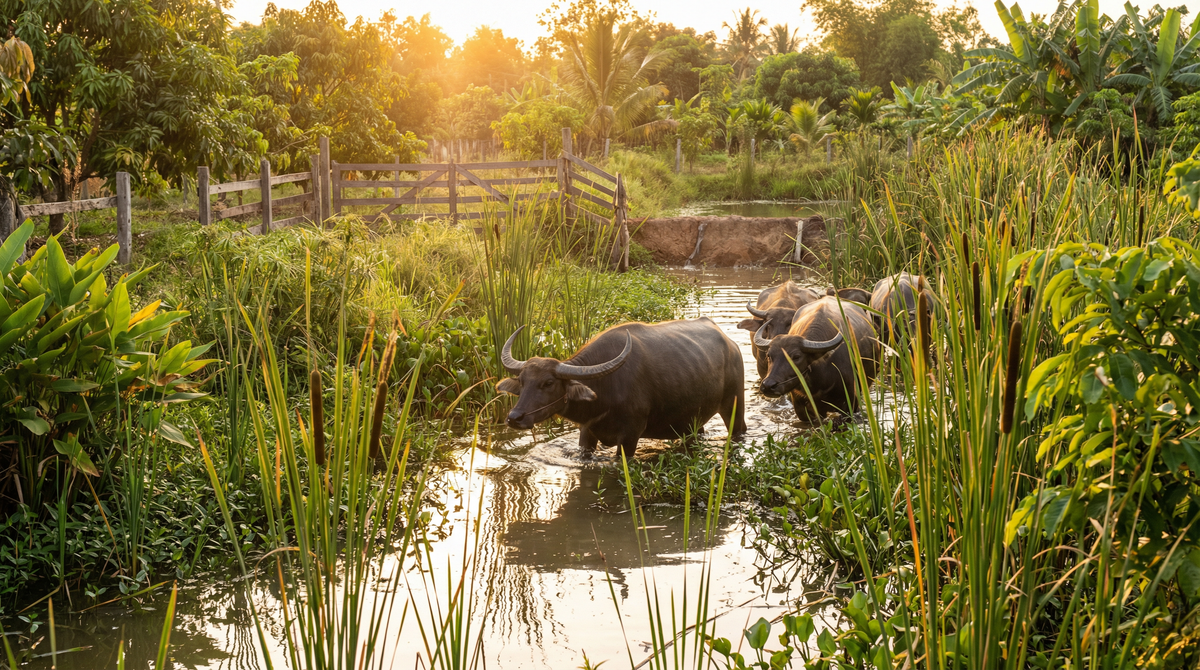
Overview
The water buffalo (Bubalus bubalis) is a large bovid domesticated in South Asia at least 5,000 years ago and now the foundation of dairy and draft agriculture across Pakistan, India, China, Egypt, Italy, and dozens of other countries. The species exists in two functionally distinct types: the river buffalo (Murrah, Nili-Ravi, Mediterranean, Jaffarabadi) selected for dairy production and the swamp buffalo (Carabao, Asian) selected for draft work in flooded rice culture.
Water buffalo are a real but uncommon livestock option on Gulf-coast permaculture sites. They thrive on wet, marginal pasture that defeats most cattle, they tolerate humidity and heat better than any European cattle breed, and their milk is rich enough to be the basis for genuine mozzarella di bufala. The constraints are imported genetics (no large US breeding population), specialized processing infrastructure for dairy buffalo milk, and a mandatory wallow that has to be designed into the paddock plan. On my central Florida site (USDA zone 9b), I have toured a small Murrah dairy in central Florida and was impressed; the species fits the climate well, but the entry cost and the processing question kept me at cattle and small ruminants for my own operation.
Permaculture Role
Water buffalo fill four niches: dairy production for specialty cheese, draft and pack work in wet-soil agriculture, wet-pasture and rough-forage management, and (less commonly) meat production.
Dairy and mozzarella di bufala
Murrah and Mediterranean buffalo produce 5 to 12 lb of milk per day at 7 to 9 percent butterfat, compared with 2 to 4 percent for dairy cattle. The high fat and casein content makes buffalo milk the only true mozzarella di bufala source under Italian protected-designation-of-origin rules. Small US dairies in Vermont, North Carolina, and Florida sell artisan buffalo mozzarella at premium prices.
Draft and rough-land work
Swamp-type buffalo remain the working draft animal in rice paddies and seasonally flooded fields across Southeast Asia. Their splayed hooves spread weight across soft mud, where cattle and horses would sink and tear up the soil.
Wet-pasture management
Buffalo tolerate seasonally wet, lower-quality pasture (bahiagrass, native grasses, sedges, reeds) that cattle find unpalatable or that bogs down their hooves. Florida flatwoods and prairie pasture is well-suited to buffalo on this basis.
Wallow as habitat
The mud wallow that buffalo create is also a microhabitat: a wet depression that attracts frogs, dragonflies, and shorebirds and that contributes a small but real biodiversity bump to a pasture system. Penn State Extension and several international agroecology publications note this as a documented co-benefit.
Housing & Fencing
Water buffalo housing is broadly similar to cattle housing with three significant differences: a wallow is required, the animals are stronger than cattle and need stronger fencing, and the species is more cold-sensitive than European cattle breeds.
Shelter
A simple three-sided run-in shed with the open face turned away from prevailing wind is sufficient in zones 8 and warmer. Allow 50 to 100 sq ft per adult animal under roof. In zones 7 and colder, an enclosed barn with passive ventilation is the safer build because buffalo are less cold-hardy than European cattle.
Wallow
A 10 by 15 ft mud wallow at least 1 ft deep in the lowest corner of the paddock is non-negotiable. The wallow regulates body temperature, deters biting insects (the mud coat blocks horn-fly access), and is part of the normal behavior of the species. Without a wallow, buffalo develop chronic stress, biting-fly mastitis, and heat stress.
Fencing
4 to 5 ft high-tensile wire (4 strands, two electrified) or woven-wire field fence at 48 inches with a hot top strand. Buffalo are stronger than cattle and will push through marginal fencing. Cattle panels and good corner posts are essential for working pens.
Water and shade
Buffalo drink 15 to 25 gallons per adult per day, doubling in summer heat. Mature live-oak or pole-barn shade through the hottest hours of the afternoon is essential.
Feeding & Forage
Water buffalo are non-selective grazers, well-adapted to coarse and low-protein forage. Their rumen extracts more nutrition from poor pasture than cattle rumens do, which is the main efficiency advantage on marginal Gulf-coast land.
Pasture
Bermudagrass, bahiagrass, paspalum, and native warm-season grasses all work as Gulf-coast forage. Buffalo will also graze cattails, sedges, and water grasses in wet margins that cattle avoid. Perennial peanut is too rich as a sole forage and is best limited to a portion of the pasture mix.
Hay and silage
Mature coastal bermudagrass or pearl-millet hay is the working winter feed. Buffalo accept silage of warmer-season forages better than cattle do.
Dairy supplementation
Lactating dairy buffalo benefit from a 14 to 16 percent protein dairy ration at 3 to 5 lb per 10 lb of milk produced. Cottonseed meal, brewer’s grains, and citrus pulp are regionally available supplements.
Minerals
A cattle mineral block is generally appropriate for buffalo; selenium supplementation matters in Florida soils. Calcium and phosphorus balance is critical for lactating animals.
Toxic plants
Avoid hemlock, oleander, rhododendron, lantana, and buffalo bur. Wilted red maple leaves are not safe. Light oak mast exposure is generally tolerated.
Health
Water buffalo are remarkably healthy on appropriate pasture and with a working wallow. They tolerate parasites and pathogens that affect cattle better and live 25 to 30 productive years on average.
Parasites
Florida supports a year-round parasite load. Gastrointestinal nematodes, liver flukes (Fasciola hepatica) on wet pasture, and external parasites (horn flies, ticks) are all manageable with rotational grazing, fecal-egg-count-based deworming, and the wallow itself, which reduces fly load.
Hooves
Buffalo hooves grow more slowly than cattle hooves and rarely need trimming. Foot rot is uncommon if the wallow is well-positioned and a dry resting area is available.
Vaccines
Cattle vaccines (blackleg, malignant edema, IBR-PI3-BVD-BRSV, leptospirosis) generally apply. Brucellosis surveillance under USDA-APHIS rules applies to all bovid livestock including buffalo.
Heat stress
Despite excellent heat tolerance, buffalo without a working wallow on a 95°F afternoon will show panting and reduced milk yield. The wallow is the primary mitigation; shade and water are secondary.
Calving
Buffalo cows calve every 14 to 18 months on a slightly longer gestation than cattle. Dystocia is uncommon in well-grown heifers.
Field notes, central Florida. I toured a small Mediterranean / Murrah dairy in central Florida (roughly 25 milking cows on 40 acres of seasonally wet pasture) and came away with two clear impressions. First, the buffalo thrived on ground that would have left a Holstein knee-deep in mud and parasites; the wallow was working as designed and the herd looked excellent. Second, the constraint that kept me from following the same plan on my own place was not the animals, it was the processing pipeline: making and selling mozzarella di bufala under FDA and Florida Department of Agriculture rules is a separate, regulated business in addition to the dairy itself. For a permaculturist with a dairy build-out in mind, the buffalo question is more about the cheese-making infrastructure than the animal.
Integration
Water buffalo integrate well with wet-pasture rotational grazing, with rice and aquaculture operations, and with silvopasture in warm humid climates. They integrate poorly with intensive food-forest plantings (they are too large and too strong) and with regions that lack imported buffalo dairy processing infrastructure.
Wet-pasture rotation
Seasonally flooded Florida flatwoods pasture, marsh margins, and cypress-bottom edges are buffalo territory. Cattle on the same ground need careful drainage management; buffalo do not.
Rice integration
Swamp-type buffalo in rice-and-buffalo systems work the field between rice plantings, eating stubble and weeds and providing manure. This is the classic Southeast Asian integration and is being trialed at the small commercial scale in Louisiana and east Texas.
Silvopasture
Mature canopy at 30 to 50 percent cover provides shade. Avoid red maple in pasture.
Co-grazing with cattle
Buffalo and cattle generally co-graze well, though buffalo will dominate the wallow and the shaded resting area. Separate water sources reduce conflict.
Frequently Asked Questions
Are water buffalo legal in the US?
Yes, but importation is regulated by USDA-APHIS and requires significant paperwork. Most US buffalo come from established domestic breeding herds rather than direct imports.
How much land per buffalo?
1 to 2 acres of warm-season pasture per adult buffalo with rotational management, plus access to a wallow.
Is buffalo milk the same as cow milk?
No. Buffalo milk is roughly twice as high in butterfat, higher in calcium, and lacks beta-carotene (it is whiter than cow milk). It is the traditional base for mozzarella di bufala, ricotta, and several South Asian dairy products.
Can buffalo be kept without a wallow?
Not well. The wallow is part of the species’ thermoregulation and parasite-control behavior. A sprinkler system or stream access can substitute on a smaller scale, but a dedicated wallow is the standard approach.
Are buffalo dangerous?
Properly handled buffalo are calmer than most cattle breeds. Intact bulls are dangerous and require dedicated handling facilities. Wild African buffalo (Syncerus caffer) is a different and unrelated species and should not be confused with domestic Asian water buffalo.
References
- FAO. Water Buffalo: An Asset Undervalued. fao.org/animal-production
- University of Florida IFAS Extension. Forage Management for Tropical Bovids. edis.ifas.ufl.edu — forage
- American Water Buffalo Association. Husbandry and Production Guides. americanwaterbuffalo.org
- Louisiana State University AgCenter. Buffalo in Rice-Based Agriculture. lsuagcenter.com
- USDA-APHIS. Importation of Ruminants. aphis.usda.gov — imports
Field notes and central-Florida observations in this article are from Lucas Summer’s permaculture site in USDA zone 9b. The Mediterranean/Murrah dairy tour and the conclusion that the real constraint is processing infrastructure rather than the animal reflect on-site decision-making; milk composition, vaccine schedules, and importation requirements are drawn from the FAO, UF/IFAS, and USDA-APHIS sources cited above.
Foraging Behavior
Water buffalo are non-selective grazers with a broad mouth, allowing them to consume a wide variety of vegetation, including coarse and nutritionally poor plants. They are well-adapted to foraging in wet and swampy areas and will create wallows to cool down and protect themselves from insects.
Fencing Requirements
Standard cattle fencing is generally adequate, but it should be strong and well-maintained. Electric fencing can also be effective. Due to their size and strength, a more robust fencing solution may be required in areas with high predator pressure or near sensitive habitats.
Shelter Requirements
A simple, three-sided shelter is sufficient to protect water buffalo from extreme weather conditions. They need a dry, comfortable place to rest. Access to shade is also important, especially in hot climates. In colder climates, a more substantial shelter may be necessary to protect them from wind and snow.
Permaculture Notes
Water buffalo are a valuable asset in permaculture systems, particularly those with a water element. Their ability to thrive on marginal forage and their role as 'living tractors' make them ideal for land regeneration and management. They can be integrated into silvopasture systems, where they graze under trees, and their manure enriches the soil. In rotational grazing systems, they can be used to manage pasture and control weeds. Their wallows create microhabitats that increase biodiversity, attracting frogs, insects, and birds. In a food forest, water buffalo can be used to clear undergrowth and create pathways. Their manure is a rich source of nutrients for the system. They can also be integrated with aquaponics, with their waste providing nutrients for the aquatic plants. The challenges of integrating water buffalo include their need for water or mud to wallow in and their potential to damage sensitive ecosystems if not managed properly. However, with careful planning and management, they can be a powerful tool for creating a resilient and productive permaculture system.