Nobody warned me that a coconut isn't actually a nut. Not legally, not botanically, not in any way that matters to the plant itself. It's a drupe, a massive fibrous drupe, the same fruit category as a peach or a cherry, except this one can survive months adrift in the open ocean, wash ashore on a foreign beach, and just... start growing. I've stood on a Florida shoreline and watched one do exactly that, waterlogged and half-buried in sand, already pushing a pale shoot toward the light. No soil amendment. No irrigation. No help from me whatsoever.
That self-sufficiency is the thing about coconuts that keeps catching me off guard even after years of working with them. We tend to think of them as a tropical commodity, something that arrives shrink-wrapped or canned, but the palm behind that product evolved to cross entire ocean basins on its own terms.[1] And the genetics tell a genuinely strange story: there appear to be two distinct wild lineages, one from the Pacific, one from the Indian Ocean region, which means coconuts may have made that leap independently, twice, before humans ever got involved.[2] Once you know that, it changes how you see every palm you pass.
Coconut Origin, History, and Cultural Significance
Few plants have traveled as far or woven themselves as deeply into human life across the globe as the coconut palm. Classified botanically as Cocos nucifera, it belongs to the Arecaceae family and is the sole species in its genus.[3] What we casually call a "coconut" is technically a drupe, built from a thick fibrous husk (mesocarp) wrapped around a hard shell (endocarp) that protects a large, liquid-filled endosperm and the embryo within.[3][4] The whole structure functions as a seed for planting, but botanically it's the inner kernel doing that work. This is a polycarpic perennial, meaning it flowers and fruits repeatedly over decades without dying after reproduction, which helps explain why a well-sited coconut can remain productive for 40 to 60 years after first bearing fruit, with peak yields typically between ages 15 and 30.[5][6] The full lifespan commonly runs 60 to 100 years, and some specimens exceed that under ideal management.[7]
Botanical Background and Physical Characteristics of Cocos nucifera
Getting a coconut to that productive peak requires patience. Under favorable tropical conditions, it takes 6 to 10 years from germination just to reach first fruit.[5][8] Those favorable conditions are specific: tropical temperatures in the 25 to 30°C range, annual rainfall between 1,000 and 3,000 mm, well-drained sandy loam soils with a pH of 5.5 to 7.0, and consistent warmth year-round.[3] Frost, heavy clay, drought, and compacted ground all chip away at both longevity and yield. Coastal soils with good aeration are where these palms really thrive. Serious threats to lifespan include the coconut rhinoceros beetle, Ganoderma butt rot, and lethal yellowing phytoplasma, the last of which can kill a palm within 6 to 12 months of infection.[9] I'll get into variety resistance and integrated management later in this article, but knowing those threats exist is part of understanding why the origin story of this plant is so tied to human selection and care.
The genetic story of where coconuts actually came from took years of molecular work to untangle. Cocos nucifera is native to the tropical Indo-Pacific, encompassing Southeast Asia, the Pacific Islands, parts of India, and Melanesia, with wild populations dating back approximately 50,000 years.[10][11] Genetic analysis reveals two primary lineages: Pacific coconuts, which represent the older wild populations, and Indo-Atlantic coconuts, which arose from human transport and secondary domestication of those Pacific ancestors.[12] Domestication itself appears to have occurred around 2,500 to 3,000 years ago in Southeast Asia, with archaeological evidence from cultivated specimens in the Philippines and southern India reaching back to 2500 to 1500 BCE.[13][11] While the coconut's buoyant husk can keep a fruit viable for months adrift at sea, enabling some natural dispersal, the research is clear that human activity drove the plant's pantropical reach far more than ocean currents alone.[12]
Visual Identification Features of the Coconut Palm
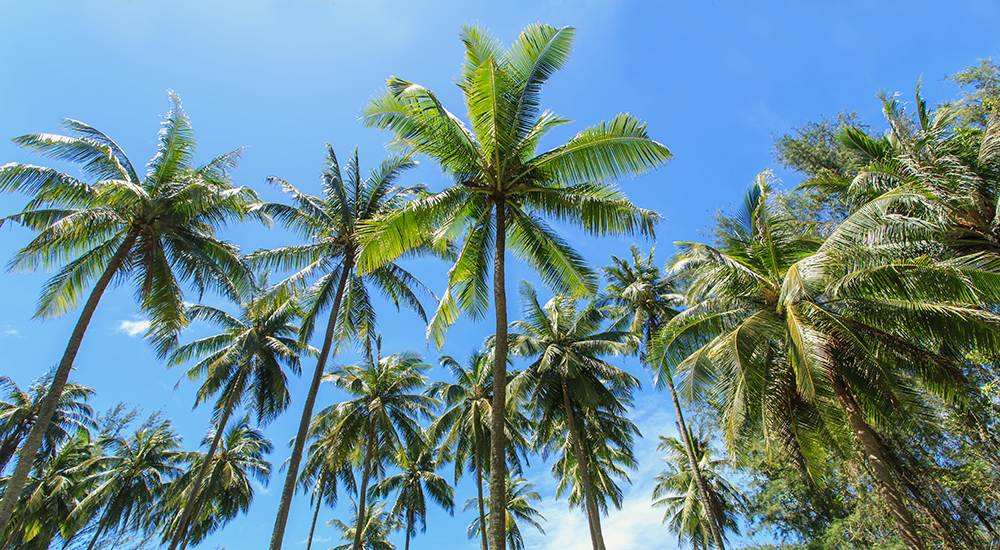
The solitary, unbranched trunk is smooth and grayish-brown, marked with horizontal leaf scars that stack up over decades, and it lacks true wood in the botanical sense since the internal structure is fibrous, a monocot trait.[14] Mature specimens typically reach 15 to 30 meters tall, with trunks 30 to 60 cm in diameter at the base and a feathery canopy spread of 6 to 9 meters.[15][7] In my landscape designs, that silhouette is unmistakable and I use it deliberately as a vertical focal point in coastal subtropical plantings. Nothing else quite matches it.
The pinnate leaves are enormous, averaging 4 meters long with 200 to 250 linear leaflets per frond, arranged in a spiraling, arching crown that casts dappled shade rather than deep shadow.[16] The root system deserves particular attention: it's shallow and adventitious, spreading horizontally up to 10 meters but penetrating only 1 to 2 meters deep.[17] I've stood next to mature specimens in high-wind events and felt genuinely nervous on their behalf. That extraordinary height combined with a shallow root mat makes them more vulnerable to windthrow than you'd expect from something so imposing. It's a good reminder that impressive stature doesn't always mean structural anchoring.
Flowers are small, creamy white to pale yellow, and carried on large pendulous spadices up to 1.5 meters long, enclosed initially in a fibrous spathe. Male flowers are numerous; female flowers are fewer and larger. In the tropics, flowering can happen year-round.[18][19] The resulting fruit is 25 to 30 cm long and 15 to 20 cm in diameter, with the three germination pores at the base giving the fresh nut that distinctive face-like look that gardeners find easy to remember.[7][20] I've propagated a lot of large drupes over the years, and those three pores are always the first thing I orient toward when placing a nut for germination. Morphology shifts noticeably with conditions: wet seasons push larger leaves and heavier fruits, while drier or saline environments produce denser husk fiber and reduce overall size.[21] Tall cultivars produce larger leaves and fruits overall; dwarf varieties stay under 10 meters and are a different beast entirely, which I'll cover in the varieties section.
Traditional and Cultural Uses Across the World
Ancient Sanskrit and Tamil texts mention coconuts as early as 500 BCE, and by the time Pliny the Elder was writing his Natural History in 77 CE and the Periplus of the Erythraean Sea was documenting Indian Ocean trade routes in the 1st century CE, the "Indian nut" was already a recognized export commodity from the Malabar Coast.[22][23][24] The spread from that Indo-Pacific origin followed human ambition and ingenuity. Austronesian navigators carried the palm throughout the Pacific roughly 3,500 years ago; Arab traders extended its reach across the Indian Ocean, with evidence of cultivation in Zanzibar around 500 BCE; and Portuguese and Spanish colonizers deliberately planted it across the Americas, Africa, and the Caribbean in the 16th and 17th centuries, including keeping nuts aboard ships as a source of fresh water on long voyages.[12][25]
The "tree of life" label given to it by Pacific Island cultures isn't hyperbole. At Lapita archaeological sites dating to around 1500 BCE, and throughout Fiji, Hawaii, and Polynesia, the coconut supplied food, water, shelter, tools, fuel, and fiber, and it appeared in ceremonies, funerals, and voyaging rituals as a symbol of abundance and community continuity.[26][27] Southeast Asian cultures drew on it just as completely: husks for coir ropes and mats, leaves for thatching and weaving, fruit for water, meat, and oil, with the palm woven into hospitality, village festivals, and funeral rites across the Philippines, Indonesia, Thailand, and Vietnam.[28][29] In Hindu traditions, particularly in Tamil Nadu, the coconut symbolizes purity and prosperity, offered to deities during puja and yajna ceremonies and broken in wedding rituals to ward off evil; the Charaka Samhita, dating to approximately 300 BCE to 200 CE, recorded uses of coconut water as a coolant and diuretic and the oil for skin ailments and massage.[30][22]
Today, global production sits at approximately 62 million metric tons annually, with Indonesia, the Philippines, and India collectively accounting for over 80% of that output.[31][19] The scale is staggering, and so are some of the ethical dimensions. Exploitative labor practices including child labor and low wages in the Philippines and Indonesia, deforestation and biodiversity loss from monoculture plantations, and the appropriation of traditional Pacific and Asian knowledge by Western wellness and cosmetic industries without fair acknowledgment or benefit-sharing are all documented concerns.[32][33] I make a point of seeking out smallholder-sourced or certified-sustainable coconut products for my own use and in any design work where I'm recommending inputs, and I'd encourage anyone reading this to do the same. The plant has an extraordinary, multimillennial relationship with the communities who cultivated it. That deserves more than a discount jar of oil from a faceless industrial supply chain.
Fun Facts About Coconuts
The coconut produces one of the largest single-seeded fruits of any angiosperm on Earth, typically 25 to 30 cm long and 15 to 20 cm across, from a tree that can clear 30 meters in height, with the tallest recorded specimens approaching 35 meters in optimal conditions.[3][7] That combination of scale and the fruit's buoyant fibrous husk means a coconut can survive months adrift at sea and still germinate on a distant shore, a natural dispersal strategy so effective it helped seed shorelines across the tropics long before humans ever picked one up.[12] When you consider that those same fruits have also been carried by Austronesian voyagers, Arab traders, and European colonizers across every ocean on the planet, it's hard not to feel a certain reverence for a plant that essentially built its own distribution network, partly through sheer physical resilience, and partly by becoming indispensable to anyone who encountered it.
Coconut Varieties and Sourcing
Tall vs. Dwarf Coconuts: Key Differences and Named Varieties
Every practical decision about growing a coconut palm starts with one fundamental split: Tall (typica) or Dwarf (nana).[34][15] Before you think about soil or spacing or water, this classification tells you how long you'll wait for fruit, how high you'll have to climb to harvest it, and whether your tree will survive the disease pressures in your region. Whatever variety you land on, you're working with a monocot palm capable of reaching 70 to 100 feet with a canopy spread of 20 to 30 feet, producing those familiar fibrous drupes six to nine inches across with their creamy white meat and sweet-to-nutty liquid center.[35][36]
Tall varieties live up to their name in almost every dimension. They take 6 to 10 years to bear fruit, mainly cross-pollinate with neighboring trees, and push out 50 to 100 nuts per year once they hit their stride.[34][37] Their large nuts are what the copra and oil industries want, and they're genuinely better at tolerating salt spray and drought than their shorter relatives. King coconut, a Tall type from Sri Lanka growing 15 to 25 meters, produces 80 to 120 distinctive orange nuts per year loaded with sweet water prized in Ayurvedic tradition.[38][39] Beautiful tree, but plan for a long wait and a tall ladder.
Dwarfs are a different proposition. They top out around 6 to 10 meters (15 meters at the absolute maximum), self-pollinate, and can start fruiting in just 3 to 5 years.[34][40] Their yields are actually higher by count, running 100 to 250 nuts per year, though individual nuts are smaller.[9] I've found young dwarf seedlings easy to identify at a good nursery: they tend to look more compact with noticeably broader leaf bases compared to the lankier profile of tall seedlings. Malayan Dwarf is the one I'd point Florida growers toward first, producing 100 to 200 nuts per year with solid copra content and, critically, meaningful resistance to Lethal Yellowing disease.[9][41] I've watched Lethal Yellowing move through older tall plantings on the Florida coast and take them out completely while nearby Malayan Dwarfs kept producing. Disease resistance isn't a nice-to-have in South Florida; it's the whole conversation.
Hybrids like Maypan split the difference. Cross a Malayan Dwarf with a Panama Tall and you get trees bearing in 3 to 4 years, yielding 150 to 300 nuts, with disease resistance built in and enough vigor for the subtropical edge cases where zone 10b gardeners are trying to push the limits.[42][43] Hybridization programs have produced over 100 named crosses since the 20th century, most prioritizing those dwarf traits for easier harvesting and improved resistance to both Lethal Yellowing and red palm weevil.[44] All of them, regardless of height class or parentage, require USDA zones 10 to 11 and struggle when temperatures drop below 40°F for any stretch, with real damage setting in below freezing.[45][43] My advice for anyone in zone 10b: site selection and microclimate matter as much as variety. The south side of a building or near a masonry wall can mean the difference between a palm that survives a cold snap and one that doesn't.
Sourcing Coconut Palms in the US: Regulations, Nurseries, and Prices
Coconut palms are commercially available in the US essentially only in southern Florida (concentrated around Miami-Dade and the coast) and Hawaii (especially Oahu and Maui).[46][47] If you're not in one of those places, your options narrow fast. There's no meaningful mainland cultivation outside those pockets, and that geographic reality shapes everything about where you buy and what you can legally bring in.
USDA APHIS maintains strict import rules to keep coconut rhinoceros beetle and red palm weevil out of the country, which means whole fresh coconuts from most countries are prohibited at the border, while processed products like oil or desiccated coconut require phytosanitary certificates.[48][49] Florida and Hawaii layer their own state quarantines on top of that, requiring that any coconut palm seedling you plant come from a nursery certified by USDA APHIS and approved by state plant health programs as free of Lethal Yellowing and other regulated diseases.[50][51][52] I only buy from nurseries that hand over the certification paperwork with the plant. It feels like extra bureaucracy until you've seen what an uncertified palm can introduce into a landscape or a neighborhood planting.
On price, expect to pay $20 to $100 for a seedling or sapling, with mature specimens running above $200.[53] Prices shift 10 to 30 percent year to year depending on weather events, export dynamics, and demand, so what you paid last season may not be what you pay this one.[54] For a single backyard palm, buy certified, buy local to your state if possible, and always confirm the nursery's current compliance status with USDA and your state department of agriculture before you bring anything home.
Coconut Propagation and Planting Guide
Understanding the Coconut Seed (Drupe)
Every coconut palm starts with what is technically not a seed at all, but a drupe: a three-layered fruit with an outer green exocarp, a thick fibrous coir layer (the mesocarp), and a hard woody endocarp enclosing the actual seed inside.[55][15] When you crack open a germinating nut, you find something unexpected: a strange white spongy mass called the haustorium, slowly absorbing the liquid and solid endosperm to fuel the embryo. I've opened dozens of sprouting nuts over the years, and that sponge still catches me off guard every time. It looks like something between a marshmallow and a mushroom, packed with the energy the seedling needs before its first true root can reach soil.
That fibrous mesocarp is also what makes the coconut such a remarkable long-distance traveler. It traps air beautifully, keeping the whole drupe buoyant for up to 110 days in seawater -- enough to cross substantial stretches of ocean while the embryo inside stays viable.[56][57] Think of it as a message in a bottle that evolved over millions of years. But that same ocean-going resilience masks a critical vulnerability: coconut seeds are recalcitrant, meaning they absolutely cannot be dried or stored at low temperatures without losing viability.[58] I learned this the hard way. I once tried storing a few husked nuts in the fridge the way I'd store other large seeds. Lost the whole batch. Now I plant fresh, every time, in the warm rainy season, no exceptions. If you need to hold them briefly, keep them in moist sand or vermiculite at 25-30°C and high humidity; viability under ambient conditions lasts roughly 2-6 months before it declines sharply.[59]
Seed Propagation Methods and Germination
For the home grower, seed is the only practical route. Plant a mature, husked (or lightly husked) coconut horizontally, about 1-2 inches deep, with the pointed end angled upward in a well-draining sandy loam mix.[5][60] Germination requires sustained warmth (27-32°C, or roughly 80-90°F) and humidity around 80-90%.[5] Even under ideal conditions, expect a germination rate of 50-70%, so starting with several nuts gives you better odds.[61] The biggest killer at this stage is waterlogging; just 48 hours of saturated soil can trigger root rot before you even have a seedling to lose.[62] Because coconut seeds are monoembryonic and highly outcrossing, open-pollinated seedlings vary considerably in their traits, so don't expect two nuts from the same tree to produce identical palms.[63]
Advanced Propagation Techniques
Tissue culture via somatic embryogenesis achieves 60-90% success in laboratory settings and is how commercial nurseries produce certified, disease-free elite varieties that may fruit in as few as 3-4 years.[64][65] It's not something you can replicate at home. Cuttings succeed less than 20% of the time and aren't commercially viable, and grafting is essentially a dead end because coconut is a monocot with vascular tissue that just doesn't cooperate.[66] If you're in Florida or Hawaii, buying a certified seedling from a reputable nursery that specializes in disease-resistant cultivars often beats growing from scratch, especially given Lethal Yellowing pressure in the Southeast.
Soil, Site Selection, and Sunlight Needs
Coconut palms evolved on coastal sands, and their fibrous shallow root system (most roots live in the top 50-100 cm) reflects that heritage.[62] They want well-drained sandy loam with a pH between 5.5 and 7.5, ideally around 6.0-7.0, and they're surprisingly tolerant of moderate salinity.[67][60] Compacted clay is essentially a death sentence for young roots. I test my sandy Florida beds twice a year because heavy summer rainfall leaches nutrients and gradually drops pH; if you're planting in similar conditions, that testing habit pays for itself. When pH drifts below 5.5, phosphorus and calcium become unavailable and aluminum toxicity creeps in; high pH locks out iron, manganese, and zinc, causing chlorosis you'll see as yellowing newer fronds.[62][68]
Full sun is non-negotiable -- a minimum of 6-8 hours of direct light daily, with less than 4-6 hours causing leggy, unproductive growth.[69] In the continental United States, productive outdoor cultivation is realistically limited to frost-free coastal zones in South Florida and Hawaii, USDA zones 10-11.[70] For containers, a mix of equal parts coarse sand, perlite, and coir or peat drains well and mimics coastal sandy loam closely enough to get a young palm established.[69]
Planting Spacing, Technique, and Timeline to Fruit
Mature coconut palms reach 65-100 feet tall with a crown spread averaging 20 feet, and that scale has to inform your spacing decisions from day one.[71] The standard recommendation is 20-30 feet (6-9 meters) between trees, with triangular patterns at 7.5 meters allowing roughly 175-200 trees per hectare for commercial plantings.[72] In a home landscape, I've seen people plant too close because the seedlings look small and lonely. By year fifteen those same trees are dropping 10-pound nuts from 50 feet up with overlapping canopies, and harvesting becomes genuinely dangerous. Wider spacing also reduces fungal disease pressure and improves wind resistance during storms -- both real considerations in coastal South Florida.[5]
When planting, set seedlings with the soil line slightly above grade and keep the base of the trunk and any adventitious roots exposed; burying them invites rot.[73] Plant into soil that's already above 70°F (21°C), timed with the warm, rainy season for the best establishment.[38]
Germination and Early Growth Timeline
Patience is the honest price of growing a coconut palm from seed. Germination takes 3-6 months under warm, moist conditions, occasionally stretching to 12 months if conditions fluctuate.[15] After that, a tall-type seedling grown from seed will require nearly a decade of maturity before beginning production.[74] I've grown both tall seedlings and dwarf varieties side-by-side, and the difference in bearing age is unmistakable -- the dwarfs were forming flower spikes noticeably earlier, typically fruiting within 3-5 years from planting.[46] Consistent fertilization and irrigation can shave 1-2 years off that wait, but no method reliably gets you below the 3-year mark.[75] If you plant a coconut today and tend it well, you're making a promise to your future self -- and that future self will be very glad you did.
Coconut Palm Care Guide
Caring for a coconut palm comes down to a simple truth: this tree is a true tropical, and every care decision either supports that reality or fights it. Get the water, light, and feeding right, and you'll have a palm that produces continuously for decades. Push it outside its comfort zone and the fronds will tell you immediately.
Water Requirements for Coconut Palms
These tropical trees have deep roots that prefer infrequent, thorough soakings rather than frequent shallow watering. In well-draining soils, watering every two to three weeks and getting moisture down to 30–60 cm depth is usually plenty.[73][76] Mature palms can tolerate four to eight weeks without rain,[77] but prolonged drought stretching beyond two to three months will show up as wilting fronds, browning leaf tips, and reduced nut production.[78] The flip side is overwatering, which causes lower-frond yellowing, root rot, and in bad cases, crown rot.[79] In Central Florida I've watched palms that looked perfectly fine all dry season develop those same yellowing fronds almost overnight once summer rains turned sandy soil into a soggy sponge. The transition from drought stress to overwatering damage can happen fast. For water quality, rainwater is ideal; coconut palms, especially dwarf cultivars, are sensitive to salinity, and irrigation water should stay below 2.0–4.0 dS/m EC with a pH of 5.5–7.5.[80][81] I collect rainwater specifically for my container coconuts because my municipal supply sits right at that upper tolerance edge.
Sunlight Needs and Light Stress Symptoms
Coconuts want full, unobstructed sun, ideally six to eight hours of direct light daily. Too much sudden intense light, especially combined with drought or poor soil, can cause photoinhibition: the photosynthetic machinery gets overwhelmed, chlorophyll breaks down, and you see white or brown bleached patches on the sun-exposed sides of fronds.[82][83] I've seen something similar on citrus moved abruptly from a shaded greenhouse into a Florida summer. On the other end, too little light produces etiolated, spindly growth with smaller fronds and chlorosis that starts in the lower canopy first.[84] Site selection matters enormously here; there's no correcting a shady spot once the palm is in the ground.
Feeding and Nutrient Management
The coconut palm is a genuinely heavy feeder, with high demands for both macronutrients and micronutrients throughout its life.[85][86] The gold-standard method is leaf tissue analysis from the 14th frond, with optimal targets of 2.0–2.5% nitrogen, 0.15–0.20% phosphorus, 0.8–1.0% potassium, and 0.3–0.4% magnesium, among others.[85] I take that frond sample every spring before I order fertilizer, a habit I picked up after watching a neighbor's palm develop manganese frizzle-top because he'd only ever used lawn fertilizer. The NPK ratio should shift with the plant's stage: a higher-nitrogen blend like 12-6-12 drives vegetative growth and trunk development, while a potassium-forward formula like 8-3-24 supports flowering and fruiting.[87] In Florida, three applications per year (late spring, summer, early fall) with roughly 1.5 pounds of actual nitrogen per mature tree annually is the standard recommendation.[88] The deficiency list is long and visually specific: nitrogen shows as yellowing older leaves; potassium as frond necrosis and "bunch firing"; magnesium as orange-yellow striping on leaflets; boron as button nuts and transverse leaf cracking; manganese as frizzle-top.[85][89] Base every decision on soil and tissue tests rather than guessing; over-fertilization causes its own problems and contributes to runoff.[85]
Frost Tolerance and Cold Protection
The coconut palm's cold limit is around 28°F (-2°C), and even brief dips below 32°F can cause damage; prolonged exposure below 40°F suppresses growth significantly.[90][5] This is a USDA zones 10b–11 plant, full stop.[90][91] Frost damage shows as browning from the leaf tips and margins inward, drooping fronds, and in severe cases, blackened necrotic tissue or crown death.[46] I lost a young seedling to an unexpected January freeze before I learned to treat microclimate selection as non-negotiable. Planting on the south side of a masonry wall buys a reliable 4–6°F on cold nights, something that separates success from failure in zone 10a. Horticultural fleece during cold snaps helps, and keeping young palms near the thermal mass of a structure during their first two winters can be the difference between survival and loss.[92] For container palms in cooler climates, moving them indoors to a bright location above 59°F (15°C) is the only reliable option.[93]
Heat Tolerance and High-Temperature Management
Coconut palms belong in AHS Heat Zones 9–11, needing at least 120 days per year above 86°F for optimal growth.[94] That said, extreme heat without adequate moisture will stress the tree: fronds scorch at the margins, curl to reduce surface area, and fruit production drops with smaller nuts or premature drop.[95] Mulching 5–10 cm deep around the base, maintaining irrigation at 40–50 liters per tree every two to three days during peak heat, and establishing windbreaks of six to ten feet all help significantly.[96][88] In Central Florida's hot, dry springs, I treat mulch and windbreaks as non-negotiable, not optional extras. If you're selecting a variety for a particularly hot, exposed site, Malayan Dwarf hybrids and King Coconut show better heat resilience than many Tall types.[97]
Pruning and Maintenance
The rule for pruning a coconut palm is simple: brown comes off, green stays on. Remove only dead, dying, or diseased fronds to improve air circulation and reduce pest pressure; leave every living frond, even the drooping lower ones.[98][73] Early in my career I made the mistake of cleaning up a palm that looked a bit ragged by removing several still-green lower fronds. Nut count dropped noticeably the following year, and I haven't touched a living frond since. The palm knows what it needs; our job is to get out of the way and only remove what's genuinely dead or diseased.
Seasonal Growth and Flowering Rhythm
In true tropical conditions, coconut palms never really stop growing and producing. A healthy palm produces a new inflorescence every four to six weeks year-round, and from pollination to a mature nut takes eleven to thirteen months.[99] Flower initiation to anthesis alone takes four to six months,[99] which means a single palm can carry young flowers, developing nuts, and nearly mature fruit simultaneously. In Central Florida the rhythm slows during dry-season cold spells, but a well-cared-for tree bounces back quickly. Manage the water, feed it properly, and protect it from cold, and a coconut palm will reward you with continuous production for decades.
Harvesting Coconuts: Timing, Technique, Yield, and Flavor
A coconut doesn't happen fast. From the moment a flower opens to the day you pull a mature brown nut from the bunch, roughly 11 to 12 months have passed.[100][101] Knowing that timeline changes how you think about the harvest entirely, because there are actually two very different windows worth planning for.
When to Harvest Coconuts: Maturity Indicators and Regional Seasons
Young green coconuts for drinking come off the palm at 5 to 7 months, when they're still bright and full of water. Mature nuts for meat, oil, or copra need the full 11 to 12 months, by which point the husk has shifted from green to yellow-brown and turned dry and fibrous.[102] The sensory cues are your best guide: watch for the husk color change, feel for a hardened shell, and listen when you tap. Young nuts slosh; mature ones ring with a clear metallic sound.[103][104] That tapping test is the one I rely on most. I've harvested both green drinking nuts at six months and fully mature ones at nearly a year in my own garden, and that shift from a dull thud to a ring is unmistakable once you've heard it.
In consistently warm, humid tropical climates, coconut tree harvesting can happen year-round, though flowering often peaks in spring and mature nut abundance tends to follow in late summer through fall.[105][106] Dwarf cultivars generally mature a bit faster than tall types, but calendar dates are always secondary to what the fruit is actually telling you.[102]
How to Harvest and Handle Coconuts
For most home gardeners, climbing a 60-foot palm is not a realistic or safe option. Long poles fitted with curved cutters work well and keep your feet on the ground.[102] If you have a tall palm and no professional training or equipment, please do not climb it. The risk of a serious fall is real, and pole harvesting gets the job done. Morning is the preferred time, before midday heat sets in.[102]
Once the nuts are down, the whole fruit is worth something: water, meat, oil, husk fiber, and dried copra for oil extraction.[102] Post-harvest handling splits along those two harvest windows: young nuts get husked, cleaned, and refrigerated for prompt use; mature nuts can be dried into copra.[102] I learned the hard way once that leaving husked mature nuts in humid conditions too long pushes them toward off-flavors fast. Prompt drying matters.
Yields, Storage, and Flavor Profiles at Different Stages
A healthy mature palm yields 50 to 100 nuts per year, and harvesting on a 45 to 60 day cycle prevents over-maturity and keeps quality consistent.[107] Mature nuts store 4 to 6 weeks at 0 to 10°C with moderate humidity; young green coconuts are far more perishable and need refrigeration with use within days to a couple of weeks; properly dried copra keeps for months in cool, dry conditions.[108][102]
Flavor shifts dramatically with maturity. Young coconut water is sweet, mildly fruity, occasionally with a hint of salinity, driven by volatiles like hexanol and ethyl acetate.[109][110] The water from my own trees at six months is noticeably sweeter and more fragrant than anything I've bought at a store, which tells me most commercial green coconuts are harvested a little late or have simply sat too long. Mature meat turns creamy and rich, its aroma coming from δ-octalactone and aldehydes, while coconut milk develops vanilla-like depth from methyl ketones and lactones.[111][112] Palms grown with consistent moisture in humid coastal conditions tend to produce milder, sweeter meat; drier or inland sites push the flavor toward something nuttier and more concentrated.[113][114] Variety plays into this too, with oil content under optimal conditions reaching 60 to 70 percent and yields dropping 20 to 50 percent in drier or saline-stressed growing conditions.[115] Pick at the right moment and handle it well, and the quality takes care of itself.
Coconut Preparation, Culinary Uses, and Non-Food Applications
Edible Parts: Coconut Water, Meat, Milk, Oil, and Sap
Crack open a young green coconut and you're holding one of the most refreshing drinks a garden can produce. That clear liquid inside is the liquid endosperm, packed with potassium and electrolytes that Pacific Island communities have relied on for generations as a rehydration staple.[116][117][118] The meat that follows, especially from a mature nut, opens into a whole second world of products. Grate it, press it with warm water, and strain it through cloth: you've got coconut milk, the dairy-free base of countless Southeast Asian and Indian curries.[119][120] Dry that same meat to copra and you can cold-press or expeller-press it into oil.[121][122] And if you tap the flower stalks before they open, the sap that weeps out can be drunk fresh, fermented, or reduced down into palm sugar and jaggery.[122] One palm, this many directions. I've always found that a bit astonishing.
Safe Home Processing and Storage Techniques
Freshness and hygiene are everything here, and I mean that in a very practical sense. Coconut water should be consumed right off the palm or pasteurized by heating to 72°C for 15 seconds if you want it to keep longer; if you're ever uncertain about cleanliness, just boil it.[123] Bacterial contamination, including Vibrio cholerae and E. coli, has caused real outbreaks from improperly handled coconut water, including a documented 2010 incident in Singapore.[124][123] In my years processing tropical staples, I've never had an issue because I follow the same FAO hygiene rules I apply to any harvest: potable water, clean equipment, temperature control throughout.[122][125]
Coconut milk spoils quickly. Make it fresh, store it in glass (skip the metal utensils, which can affect flavor), refrigerate immediately, and use it within two to three days.[122] I label every batch with the date, the same habit I developed making fresh almond milk. For copra, moisture is the enemy: drying must bring the meat below 7% moisture to block aflatoxin formation, and kiln or sun-drying at temperatures above 60°C in clean conditions is the reliable path there.[122] One humid Florida summer I skipped the final moisture check on a home-dried batch and ended up with off-flavors that no amount of pressing could fix. That mistake taught me to take that threshold seriously. And if you're pickling coconut meat, maintain acidity below pH 4.6 with 5% acetic acid and process jars in a boiling-water bath for ten minutes.[122]
Traditional and Modern Culinary Applications
Fresh meat from crack-free, mold-free nuts is safe eaten raw; cooking reduces microbial risk and also deactivates trypsin inhibitors naturally present in the flesh, which is a quiet bonus most people don't know about.[123] The flavor you get from home-processed oil is something worth experiencing: pressing from fresh meat yields a sweeter, cleaner aroma than even quality store-bought virgin oil, exactly what the research on processing methods predicts when sun-drying preserves aroma compounds better than artificial heat.[126] That oil folds beautifully into coconut cream pie recipes, enriches a simple coconut rice recipe, and makes a surprisingly good base for a coconut-infused tea alongside other antimicrobial botanicals.[127][128] Coconut milk carries curries in ways no substitute quite replicates, and the palm sap, reduced slowly, produces a sugar with a warm, complex sweetness that's become a staple in my kitchen.
Non-Food Uses of the Coconut Palm
The palm gives far beyond the kitchen. Husks and fronds chopped as mulch suppress weeds, lock in soil moisture, and feed microbial life as they break down.[129] I've found coir mulch breaks down more slowly than most tropical materials, which makes it particularly useful in sandy soils that drain fast and dry out faster. The coir fiber itself is remarkably tough: rot-resistant, water-resistant, and woven into ropes, mats, and geotextile rolls for erosion control on slopes and coastlines.[127] The trunk, dense and straight-grained, becomes timber for framing and furniture in traditional building traditions across the tropics.[127] The oil turns up in cosmetics and biodiesel alongside its culinary life, which speaks to how thoroughly this plant gets used.[127][128] And in the garden itself, the tall canopy serves as both landscape anchor and structural layer in a food forest, the kind of living architecture I've watched define the character of every tropical client planting I've designed.[130]
Coconut Health Benefits and Medicinal Uses
Across tropical cultures for thousands of years, nearly every part of the coconut palm has served a medicinal purpose. Coconut husk ash was applied to wounds as an antimicrobial dressing, the water was used to soothe digestive complaints, and the oil treated infections and inflammation long before anyone had isolated a single active compound.[131][132] Modern research has started catching up to what those traditions seemed to know intuitively, though the picture it paints is nuanced rather than miraculous.
Traditional and Modern Medicinal Research on Coconut
The strongest evidence base centers on lauric acid, which makes up 45 to 52 percent of coconut oil's fatty acids.[133] Lauric acid disrupts microbial cell membranes and interferes with viral entry, giving coconut oil its well-documented antimicrobial action.[134][135] When I press virgin coconut oil myself from freshly grated meat, the scent is clean and almost floral; commercial versions processed at high heat smell noticeably flatter, and I suspect that freshness and minimal processing genuinely preserve more of the bioactive potency, even if the research on that specific comparison is still thin.
While traditional knowledge highlights general inflammation relief, clinical anti-inflammatory effects are real but more modest. Coconut extracts appear to inhibit NF-κB translocation and reduce pro-inflammatory cytokines, and small pilot studies on healthy adults showed reductions in IL-6 with virgin coconut oil supplementation.[136][137] Promising, yes. Proven by large human trials, not yet. The antioxidant profile of coconut water is better documented, with free radical scavenging confirmed through DPPH and FRAP assays and bioactive components shown to activate the Nrf2 pathway.[138][139] For hydration, the evidence is solid: coconut water performs comparably to commercial sports drinks for electrolyte replacement, with a mild diuretic effect to boot.[140][141] After a long July afternoon in my Central Florida garden, I reach for a young green nut before I reach for anything with an artificial color. The water from nuts picked right after summer rains tastes noticeably sweeter and more satisfying than anything from a shelf-stable carton.
Early-stage research also shows alpha-glucosidase inhibition comparable to acarbose, suggesting potential for blood sugar modulation,[142] and phenolic compounds have demonstrated acetylcholinesterase inhibition with possible neuroprotective implications.[143] Anticancer mechanisms involving Wnt/beta-catenin inhibition and caspase-dependent apoptosis have been identified in vitro as well.[144] These are genuinely interesting findings, but they're in-vitro and animal studies; I always flag that distinction clearly when clients ask me whether coconut can treat a specific condition.
Key Phytochemicals in Coconut
What gives coconut such a broad traditional reputation is the sheer diversity of bioactive compounds distributed across its parts. Leaves, husk, fruit, water, roots, bark, flowers, and oil each carry distinct chemical profiles, including flavonoids like catechin, epicatechin, and quercetin; phenolic acids like ferulic, gallic, and p-coumaric acids; saponins, terpenoids, coumarins, and sterols like beta-sitosterol and stigmasterol.[145][146] Ferulic acid shows high DPPH radical scavenging activity, while quercetin inhibits COX-2 inflammatory pathways.[147][148] Lauric acid contributes both antimicrobial and antioxidant activity by reducing oxidative stress in addition to its membrane-disrupting mechanisms.[149]
Phytochemical concentrations aren't fixed; they shift with geography, season, soil conditions, and cultivar. Production peaks in the wet season, sandy soils tend to push higher saturated fat content, and the King coconut variety is notably richer in catechins and water-soluble phenolics than most commercial types.[150][151] Coconuts grown along tropical coasts under high UV and salt stress produce more defense compounds as a result of those ecological pressures,[152] which tracks with my own observation that coastal-grown fruit tends to have a more pungent, complex aroma than inland-grown equivalents. It's a reminder that where and how a plant lives shapes what it offers.
Nutritional Profile of Coconut Meat and Water
The edible parts of Cocos nucifera break into two very different nutritional packages depending on fruit maturity. Young green fruit yields the clear, electrolyte-rich water; mature fruit provides the dense white meat and the oil pressed from dried copra.[153] Raw coconut meat clocks in at 354 kcal per 100g with 33.5g of total fat, 9g of dietary fiber, and 3.33g of protein, along with meaningful amounts of potassium, phosphorus, magnesium, manganese, and copper, plus B vitamins and vitamin C.[154] Coconut water is a completely different story: only 19 kcal per 100g, approximately 250mg of potassium per 100g, a useful dose of B vitamins, and 2 to 4mg of vitamin C per 100mL.[116] I drink it after gardening in Florida heat because it genuinely replaces what I lose, and I don't need a sports drink's ingredient list to do it.
Beyond the macros, coconut carries cytokinins like kinetin in the water, plus polyphenols, tocopherol, and beta-sitosterol in the meat, all of which add functional value beyond basic calories.[133] One practical note: raw forms retain significantly more vitamin C than dried or heat-processed products, with losses reaching up to 50 percent,[155] which is a good reason to enjoy fresh meat and water when you can. The high lauric acid content comes with genuine antimicrobial benefits, but coconut oil's roughly 90 percent saturated fat composition means it can raise LDL cholesterol when consumed in excess.[156][157] I use it in my kitchen, just not by the tablespoon every day.
Safety Considerations When Using Coconut
The edible parts of coconut, including the fruit, water, meat, and oil, are free from major toxins and recognized as safe by the FDA for both culinary and topical use.[158][159] No clinically significant poisoning from edible coconut parts has been documented.[160] Non-edible parts like the husk, shell, and leaves contain tannins that can cause mild gastrointestinal irritation only if ingested in unusually large quantities, and the plant's latex may cause contact dermatitis in sensitive individuals.[161][162]
Two dietary cautions deserve real attention. Coconut water's potassium content, roughly 250 to 600mg per serving, can create hyperkalemia risk for anyone with kidney impairment or taking potassium-sparing medications.[163] Coconut oil's high saturated fat content can elevate LDL and cardiovascular risk with excess consumption.[164] I tell clients with kidney concerns or relevant prescriptions to check with their doctor before making coconut water a daily habit; the potassium is genuinely beneficial for most people, but that qualifier matters. Coconut allergy is uncommon, affecting roughly 0.39 percent of the US population, but reactions can range from hives to anaphylaxis, and there's 20 to 40 percent cross-reactivity with tree-nut allergies worth knowing about.[165][166] High fat and fiber intake can also cause digestive upset if portions get out of hand.
The most urgent safety issue is misidentification. Coconut palms are sometimes confused with the highly toxic sago palm (Cycas revoluta), which can cause severe liver failure if ingested.[167][168] A client of mine once planted what she thought was a decorative coconut palm; I caught the mistake during a site visit and the plant turned out to be a sago. That experience stuck with me, and I never assume correct identification based on a casual glance at a feathery palm in a nursery.[169] Fresh coconut water also ferments quickly and should be consumed promptly or properly pasteurized to avoid bacterial contamination.[170]
Coconut Pests and Diseases
Coconut palms are generally low in inherent resistance to most insect pests and diseases,[171][172] which means that what keeps a coconut palm healthy over decades is less about the plant's own defenses and more about how well you manage its environment. That said, the palm isn't completely unarmed. The tough, leathery fronds carry high lignin content and calcium oxalate crystals that can physically damage insect mouthparts, backed by tannins that discourage feeding.[3][173] Crush a leaflet and you feel the resistance immediately. It's not enough to stop a determined pest, but it does raise the threshold.
Major Insect Pests of Coconut Palms
The five insects every coconut grower needs to know are the rhinoceros beetle (Oryctes rhinoceros), red palm weevil (Rhynchophorus ferrugineus), coconut leaf beetle (Brontispa longissima), coconut scale (Aspidiotus destructor), and coconut mite (Aceria guerreronis).[171][174] The rhinoceros beetle is the one I'd watch most carefully on young palms. It bores into the crown, causing severe structural damage before you realize anything is wrong.[175][176] Biological control using Oryctes virus, combined with pheromone traps, is the most effective non-chemical approach.[177] The red palm weevil is sneakier; by the time you see wilting fronds and notice the trunk cavities, the infestation is already advanced.[178][171] I've learned to look for frond wilting on the younger spears first, because that's the tell. Resistance to this weevil tracks more with trunk morphology than cultivar,[179] though some Pacific hybrids show partial tolerance.
The coconut leaf beetle causes leaf skeletonization, with outbreaks in Southeast Asia frequently spiking during monsoon seasons.[180][181] Coconut scale is managed primarily through biological controls, while the coconut mite is the quietly expensive one, responsible for up to 30% yield loss from nut deformation.[171][182] Pest interactions compound that number further.[183] Varietal selection helps: Malayan Dwarf shows meaningful resistance to rhinoceros beetle and red palm weevil, and dwarf-tall hybrids often gain additional protection through heterosis.[172][184] In the mixed edible landscapes I design, pairing that varietal foundation with pheromone traps, encouraged parasitoid populations, and good sanitation reduces chemical inputs significantly.[185][186] Regional pressures matter too: rhinoceros beetle is the bigger story in the Pacific Islands, leaf beetle outbreaks follow monsoon timing in Southeast Asia.[187][188]
Key Diseases and Their Management
No coconut cultivar is immune to disease, but resistance levels vary enough that variety choice is one of the most consequential decisions you'll make.[189] Lethal Yellowing, a phytoplasma spread by leafhopper vectors, has no cure. Infected palms must be removed immediately to reduce vector pressure, and prevention depends entirely on planting resistant cultivars and controlling the insect vector.[190][191][192] Malayan Dwarf varieties, including Red and Green Dwarf, show significant resistance; the Maypan hybrid (Malayan Dwarf × Panama Tall) was specifically bred for this threat and performs well in affected regions.[193][194] In humid subtropical plantings I've designed in Florida, Malayan Dwarfs outperformed susceptible Talls I eventually had to replace following outbreaks. Atlantic Tall has shown field tolerance in Jamaica, though performance varies by location.
Phytophthora bud rot is a different threat entirely, fueled by humidity above 80% and persistently wet conditions.[195] Green Dwarf varieties show tolerance; West African Tall does not.[196] Ganoderma butt rot is harder to manage genetically since most cultivars show low resistance,[197][198] so the strategy shifts almost entirely to cultural practices: removing stumps to at least four feet deep, avoiding trunk wounds, maintaining drainage, and applying preventive phosphonates early.[199][200] In fifteen years of specifying coconuts in landscape designs, preventing trunk wounds during installation does more than any fungicide after the fact. The research on sanitation backs this completely. Across all diseases, integrated management combines resistant cultivar selection, copper-based fungicides for bud rot prevention, drainage improvements, canopy management to reduce humidity, and vector control where appropriate.[201][202][203] Always use clean tools between palms during pruning; disease transmission on contaminated blades is a real and preventable risk.[73]
Coconut in Permaculture Design
Every design decision you make with coconut flows from a single non-negotiable reality: this palm lives or dies by its climate. Get the siting wrong, and no amount of clever guild design or soil prep will save it. Get it right, and you have one of the most productive canopy trees in the tropical food forest toolkit.
Climate Requirements and Growing Zones
Coconut thrives between the tropics, roughly 23.5°N and 23.5°S latitude, in the warm, humid Af and Am climate zones where rainfall, heat, and humidity align consistently.[18][19] Sweet spot temperatures run 25 to 32°C (77 to 90°F), with mature trees tolerating brief dips near 0°C, but anything below 5 to 10°C held for more than a short spell causes real damage and stops growth outright.[204][205] Rainfall needs run a minimum of 30 to 40 inches annually just to survive, with 50 to 75 inches being the productive sweet spot, and humidity ideally holding at 70 to 80 percent or better.[206][3]
In the US, reliable performance means USDA zones 10 to 11: coastal south Florida, Hawaii's lower elevations, Puerto Rico, and the US Virgin Islands.[205][207] I've seen them do beautifully in protected Miami-area yards where buildings, water bodies, and dense planting create true zone 10b microclimates. Push farther north into zone 9b along the Texas Gulf Coast or coastal California and you're gambling, especially with young trees, which are dramatically more cold-sensitive than established ones.[208] Coastal elevation also matters; below 600 meters is optimal, and the palm's exceptional salt spray and wind tolerance (mature trees can handle gusts above 100 km/h) makes it a natural fit for shoreline sites where other canopy trees struggle.[55][209] That said, I always install temporary windbreaks around young transplants on coastal projects. The mature tree's resilience is earned slowly, not given at planting.
Forest Layer and Guild Placement
Coconut sits firmly in the canopy layer, reaching 15 to 30 meters at maturity.[210][211] Its fronds create dappled rather than dense shade, which is genuinely useful for the understory species planted beneath it. Orchids and ferns colonize the trunk naturally in humid conditions, adding biodiversity without competing for soil resources.[212] Below ground, the root system is fibrous and adventitious, spreading horizontally within roughly a meter of the surface rather than driving deep, which means it competes laterally rather than vertically with companions.[213] It reminds me of banana in this way: both are fast-growing tropicals with shallow, spreading roots and heavy litter accumulation that genuinely improves soil structure over time, but both can also muscle out companions if you let density get ahead of design.
The FAO documents coconut's natural integration into multi-layered agroforestry with legumes, bananas, pineapples, and sweet potatoes, and that combination tracks with what I've observed in well-designed tropical food forests.[9][55] Legumes fix nitrogen into the rhizosphere, the coconut canopy raises humidity for moisture-sensitive understory crops, and the leaf litter feeds everything from the soil food web outward. The key design constraint is density. High canopy coverage suppresses understory diversity and can create allelopathic effects from decomposing husks and leaves that deter some insects and competing plants.[214][215] Space the canopy generously, and that same allelopathic tendency shifts from a liability into a natural weed suppression tool at the guild edges.
Ecosystem Functions and Services
On coastal sites, the coconut's ecological contributions stack up quickly. Its fibrous roots bind sand and stabilize dunes against erosion, and dense plantings reduce wind velocity by up to 50 percent, creating a sheltered microclimate for the entire food forest system behind them.[216][129] The same structure that shelters crops also provides nesting and foraging habitat for birds, bats, and beneficial insects, including pollinators that service the rest of your food forest.[217]
Leaf litter is one of coconut's most underrated design assets. As it decomposes, it releases potassium, nitrogen, calcium, and magnesium back into the soil, and the husks contribute allelopathic compounds that suppress weedy competition around the palm's base.[129][218] It's often described as a dynamic accumulator, drawing up calcium and magnesium from deeper soil horizons through its extensive lateral root network. I wouldn't stake everything on that label since the published citations are thinner than I'd like, but the nutrient cycling I've observed in established coconut systems is genuinely impressive.
Pollination is primarily wind-driven, with bees and beetles playing a supplementary but meaningful role.[219][220] In ideal conditions (25 to 30°C, 70 to 90 percent humidity, and light winds of 5 to 15 mph), natural fruit set still only reaches 10 to 20 percent.[221][222] I've noticed noticeably more insect activity around flowering palms when I interplant with nectar-rich companions, and it tracks with the research: diverse floral resources in the guild support the same insect visitors that improve coconut fruit set. Coconut is well-behaved in Florida's managed landscapes, but in some Pacific island ecosystems it has displaced native vegetation at scale. If you're designing large plantings outside the palm's native Indo-Pacific range, assess local ecology carefully before committing to high density.
The Palm That Taught Me to Think in Decades
I planted my first coconut in a coastal garden in Florida knowing I'd probably never harvest enough fruit to justify it on paper. But there's something that rearranges your whole relationship with time when you're tending a plant that crossed oceans before anyone thought to write anything down. It grew. It fruited, eventually. And every time I cracked one open, I thought about all the hands that had done the same thing for thousands of years before me.
Sources 222
- Genomic insights into the origin of coconut palm - Nature Plants ↩
- Origin and Dispersal of Coconut: New Insights from Population Genetics - PLOS ONE ↩
- Cocos nucifera ↩
- Coconut Palm (Cocos nucifera) ↩
- Coconut Palm - University of Florida IFAS Extension ↩
- The Coconut Palm - FAO ↩
- Coconut - Wikipedia ↩
- Cocos nucifera: The Coconut Tree ↩
- Coconut Diseases and Pests ↩
- The origin and distribution of coconuts ↩
- Domestication and Origins of the Coconut ↩
- Human-mediated dispersal explains the wide distribution of coconuts ↩
- Archaeological Evidence for Coconut Cultivation ↩
- Cocos nucifera - Missouri Botanical Garden ↩
- Cocos nucifera - Royal Botanic Gardens, Kew ↩
- Cocos nucifera - Missouri Botanical Garden ↩
- Root System of Coconut Palm - Agroforestry Resources ↩
- Cocos nucifera - Kew Science ↩
- Coconut Palm Flower Description - Britannica ↩
- Fruit Morphology of Cocos nucifera ↩
- Environmental Influences on Coconut Phenology ↩
- Ayurveda and the Coconut ↩
- Pliny the Elder: Natural History ↩
- Periplus of the Erythraean Sea ↩
- The Role of Coconuts in Polynesian Voyaging ↩
- Archaeology of Coconut in Polynesia ↩
- Coconut: The Tree of Life ↩
- Cultural and Economic Significance of Coconut ↩
- Ethnobotany of the Coconut Palm ↩
- Coconut in Hindu Rituals and Traditions ↩
- FAOSTAT - Crops and livestock products ↩
- Behind the Label: Coconut Oil ↩
- Sustainability Assessment of Coconut Production ↩
- Coconut Germplasm and Cultivars ↩
- Missouri Botanical Garden Plant Finder ↩
- University of Florida IFAS Extension ↩
- Coconut Production Manual ↩
- Coconut Production and Uses - FAO ↩
- King Coconut Characteristics - Ceylon Coconut Research Institute ↩
- Dwarf Coconut Varieties - International Coconut Community ↩
- Cocos nucifera Malayan Dwarf - UF IFAS ↩
- Maypan Hybrid Coconut Yield ↩
- Coconut Cultivation in Florida - University of Florida IFAS ↩
- Breeding and Genetics of Coconut Palms - USDA ARS ↩
- USDA PLANTS Database ↩
- Coconut Palm Growing in the Florida Landscape ↩
- Growing Coconut Palms in Florida ↩
- Coconut Rhinoceros Beetle Quarantine ↩
- Red Palm Weevil ↩
- Florida Plant Quarantine Regulations ↩
- Hawaii Plant Quarantine Branch ↩
- Florida Coconut Nursery Regulations ↩
- Coconut Market Review ↩
- Seasonal Price Variations in Tropical Crops ↩
- Missouri Botanical Garden - Cocos nucifera ↩
- Coconut Palm: Morphology and Seed Dispersal ↩
- Hydrochory in Cocos nucifera: Buoyancy and Viability Studies ↩
- Seed Dormancy and Germination in Coconut (Cocos nucifera L.) ↩
- Coconut Seed Storage Guidelines - IPGRI ↩
- Coconut (Cocos nucifera) in Florida ↩
- Coconut Propagation Methods ↩
- Coconut Palm - University of Florida IFAS Extension ↩
- Coconut Genetic Resources ↩
- Micropropagation of Coconut: Protocols and Challenges ↩
- Coconut Micropropagation Techniques ↩
- Vegetative Propagation Challenges in Palms ↩
- FAO - Coconut Cultivation Guidelines ↩
- Soil Management for Coconut Plantations ↩
- Growing Palms in Containers - University of Florida IFAS Extension ↩
- Coconut Palm Growing in the Florida Landscape ↩
- Food and Agriculture Organization (FAO) Guide to Coconut Cultivation ↩
- Effect of plant spacing on the growth and productivity of coconut palm ↩
- Coconut Palm Care Guide ↩
- Coconut Palm Cultivation ↩
- Propagation of Coconut Palm ↩
- Missouri Botanical Garden Plant Finder ↩
- Coconut Palm Water Relations and Drought Tolerance ↩
- FAO Guidelines on Coconut Water Stress Management ↩
- Diseases of the Coconut Palm ↩
- Coconut Handbook ↩
- Irrigation Water Quality Guidelines for Coconut ↩
- Coconut Palm Disorders: Sunburn and Photoinhibition ↩
- Managing Sunscald in Tropical Palms ↩
- Light Requirements for Tropical Palms ↩
- Coconut Palm Nutrition and Fertilization - University of Florida IFAS Extension ↩
- Nutrient Management for Coconut - FAO Soils Bulletin ↩
- Coconut Palm Nutrient Requirements - University of Florida IFAS Extension ↩
- Fertilization Recommendations for Coconut Palms in Florida ↩
- Coconut Nutrient Deficiencies - University of Florida IFAS Extension ↩
- Coconut Palm Growing in the Florida Landscape ↩
- USDA Plant Hardiness Zone Map ↩
- Frost Protection for Palms - University of Florida Extension ↩
- University of Florida IFAS Extension: Coconut Palm in Florida ↩
- Understanding AHS Heat Zones ↩
- Coconut Palm: Horticultural Guidelines ↩
- Coconut Production in the Context of Climate Change ↩
- Varietal Improvement for Heat Tolerance in Coconut ↩
- Coconut Palm Pruning and Maintenance ↩
- Coconut Palm Phenology and Reproductive Biology ↩
- Coconut: Post-harvest Operations ↩
- Coconut Production Guidelines ↩
- Cocos nucifera - Coconut Palm ↩
- Coconut Water and Maturity Stages ↩
- Physiological Maturity Indicators in Cocos nucifera ↩
- Coconut Water and Production Guidelines ↩
- Coconut Farming in India ↩
- Postharvest Handling of Coconut ↩
- Coconut Palm Cultivation ↩
- Coconut Water: An Unexpected Source of Urinary Citrate ↩
- Volatile Compounds and Sensory Characteristics of Coconut Water ↩
- USDA FoodData Central - Coconut Meat ↩
- Aroma-Active Compounds in Coconut Meat ↩
- Coconut Handbook ↩
- FAO: Coconut Production and Uses ↩
- Coconut Production and Climate Impacts ↩
- Coconut water, raw - USDA FoodData Central ↩
- Coconut Water: An Overview of Health Benefits and Flavor ↩
- Traditional Coconut Processing in Pacific Islands ↩
- USDA Coconut Milk in Savory Dishes ↩
- Culinary Uses of Coconut - International Coconut Community ↩
- Coconut Oil Extraction Methods ↩
- FAO Coconut Processing Guidelines ↩
- Coconut Safety and Processing - NCBI ↩
- Bacterial Contamination of Coconut Water ↩
- WHO Guidelines on Safe Street Food ↩
- Effect of Processing on Coconut Flavor Compounds ↩
- FAO - Coconut Production and Uses ↩
- Medicinal Properties of Coconut Oil ↩
- FAO: Coconut Production and Coastal Protection ↩
- Cocos nucifera (Coconut Palm) Plant Profile ↩
- Traditional Medicinal Uses of Coconut: A Systematic Review ↩
- Antimicrobial Properties of Coconut Husk Ash ↩
- Antioxidant Activity of Lauric Acid from Cocos nucifera ↩
- Lauric Acid: A Versatile Antimicrobial Agent from Coconut Oil ↩
- Antibacterial Activity of Lauric Acid from Coconut Oil ↩
- Anti-inflammatory and Analgesic Effects of Cocos nucifera in Animal Models ↩
- Effects of virgin coconut oil on inflammatory markers: a pilot study ↩
- Antioxidant Properties of Coconut Water and Derivatives ↩
- Antioxidant Activity of Coconut Water Using DPPH and FRAP Methods ↩
- Clinical Trials on Coconut Water: Hydration and Diuretic Effects ↩
- Coconut water as a rehydration beverage: diuretic effects trial ↩
- Cocos nucifera Phenolics: Inhibition of α-Glucosidase and ACE ↩
- Coconut Ethanolic Leaf Extract Reduces Amyloid-beta Aggregation ↩
- Anticancer Mechanisms of Coconut Extracts: NF-κB, Wnt, and Apoptosis ↩
- Secondary Metabolites from Cocos nucifera: A Review ↩
- Phytochemical Investigation of the Defatted Seeds of Cocos nucifera ↩
- Phenolic Compounds in Coconut Water: Ferulic Acid and Antioxidant Effects ↩
- Quercetin and Flavonoids from Coconut Kernel: Anti-Inflammatory Study ↩
- Antimicrobial Activity of Coconut Bioactive Compounds ↩
- Bioactive Compounds in Coconut (Cocos nucifera) Water and Pulp ↩
- King Coconut: Nutritional and Phytochemical Analysis ↩
- Kew Science: Cocos nucifera ↩
- USDA FoodData Central: Coconuts, raw ↩
- Coconut meat, raw - USDA FoodData Central ↩
- FAO Nutritional Profile - Coconut ↩
- Coconut Oil - The Nutrition Source ↩
- Health Effects of Coconut Consumption - NIH Review ↩
- ASPCA - Coconut ↩
- Cocos nucifera (L.) (Arecaceae): A phytochemical and pharmacological review ↩
- Toxicity of Coconut (Cocos nucifera) and Its Components: A Review ↩
- Antinutritional Factors in Coconut Husk and Their Effects ↩
- Contact Dermatitis from Coconut Products ↩
- Coconut Water: Health Benefits and Risks ↩
- Coconut Oil and Cardiovascular Disease Risk - PMC ↩
- Coconut allergy: Characteristics of reactions and diagnostic predictors ↩
- Prevalence and Burden of Coconut Allergy in the United States ↩
- Cycas revoluta - Sago Palm ↩
- Toxic Plants: Sago Palm ↩
- Identification of Palms ↩
- USDA FoodKeeper app ↩
- Coconut Insect Pests and Their Management ↩
- Breeding for Resistance in Coconut Palm ↩
- Missouri Botanical Garden: Plant Finder - Cocos nucifera ↩
- USDA ARS: Coconut Insect Pests and Management ↩
- Coconut Rhinoceros Beetle Field Trials - ACIAR Report ↩
- Management of the Coconut Rhinoceros Beetle ↩
- Coconut Palm Pests and Diseases ↩
- Red Palm Weevil on Palms: Symptoms and Control ↩
- Resistance in Coconut to Red Palm Weevil ↩
- Brontispa longissima on Coconut Palms ↩
- Brontispa longissima Damage Assessment in Coconut ↩
- Eriophyid Mites on Coconut: Field and Greenhouse Studies ↩
- Pest Interactions in Coconut Plantations: Observational Insights ↩
- Peer-Reviewed Study: 'Pest Resistance in Coconut Palm Varieties', Journal of Horticultural Science ↩
- Integrated Pest Management for Coconut ↩
- Biological Control of Coconut Pests ↩
- Regional Variations in Coconut Pests and Climate Influence ↩
- Brontispa longissima: A Serious Pest of Coconut ↩
- Lethal Yellowing Disease of Palms ↩
- Lethal Yellowing of Palms ↩
- Lethal Yellowing of Coconut Palms ↩
- Lethal Yellowing of Palms: Research and Practical Aspects ↩
- Resistant Coconut Varieties in the Caribbean ↩
- Sources of Resistance to Lethal Yellowing in Cocos nucifera ↩
- Management of Phytophthora Bud Rot in Coconut Palms ↩
- Bud Rot of Palms ↩
- Ganoderma Diseases of Palms ↩
- Ganoderma Butt Rot of Palms ↩
- Resistance to Ganoderma boninense in oil palm and coconut ↩
- Philippine Coconut Authority Disease Resistance Research ↩
- Coconut Disease Management Guidelines ↩
- FAO Coconut Disease Management Guidelines ↩
- Phytophthora Bud Rot of Coconut Palms ↩
- Royal Horticultural Society - Coconut Palm Growing Guide ↩
- Coconut Palm Growing Guide - University of Florida IFAS Extension ↩
- Missouri Botanical Garden Plant Finder ↩
- Growing Coconuts in Hawaii ↩
- Coconut Palm - Gardening Solutions, UF/IFAS Extension ↩
- USDA PLANTS Database - Cocos nucifera ↩
- Cocos nucifera - Missouri Botanical Garden Plant Finder ↩
- Cocos nucifera - Kew Science Plants of the World Online ↩
- Epiphyte Diversity on Cocos nucifera in Pacific Islands ↩
- Missouri Botanical Garden Plant Finder: Cocos nucifera ↩
- Shading Effects of Coconut Canopy on Understory Vegetation ↩
- Plant-Plant Interactions in Coconut Plantations ↩
- Ecological Role of Coconut Palms in Coastal Ecosystems ↩
- Agroforestry Benefits of Coconut Palms ↩
- Ecological Importance of Coconut Palms in Coastal Areas ↩
- The Coconut Palm - FAO ↩
- Pollination in Coconut Palm (Cocos nucifera L.): A Review ↩
- Environmental Factors Affecting Coconut Pollination ↩
- Pollination Biology of Coconut Palm ↩
About the Author
After ten years of living on Ometepe, Rachael is passionate about the connection between nature, food, and homes. She believes in returning to living in homes made from local materials and eating food grown close by.