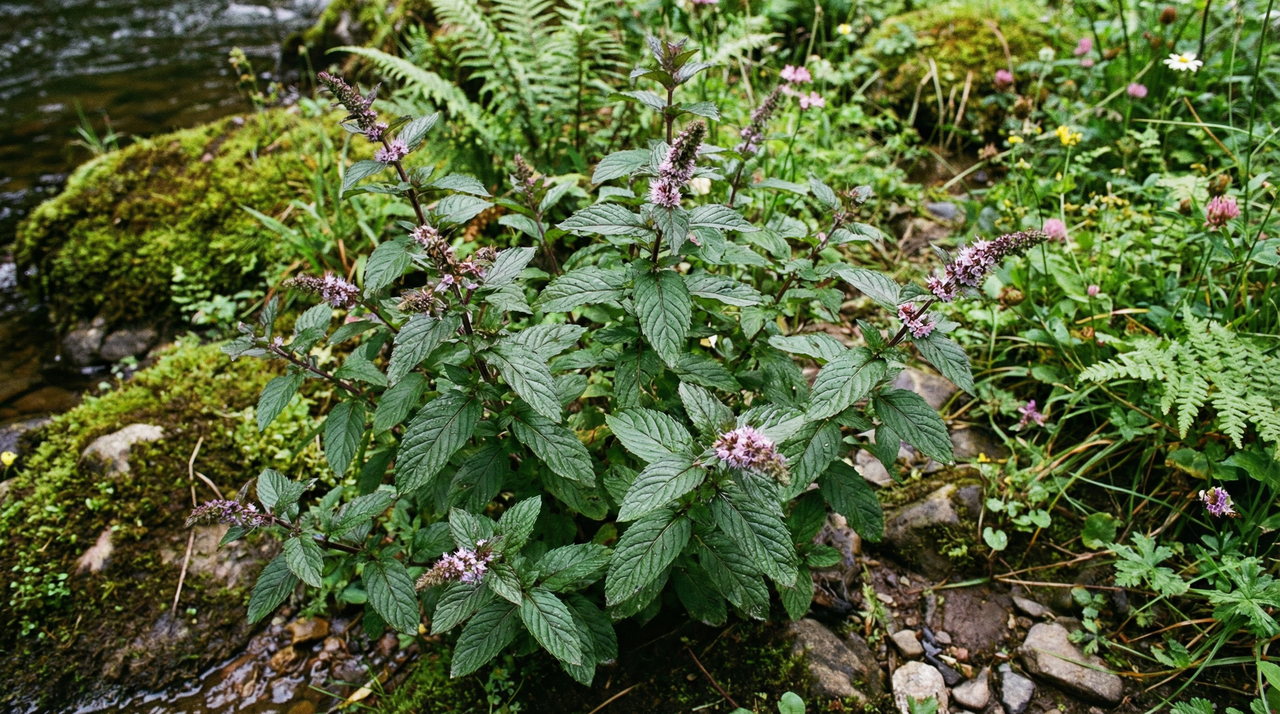
Most gardeners think mint's invasiveness is the thing nobody warns you about. But I'd argue the real surprise is that peppermint, the one filling those pots on everyone's porch, the one in your tea, your toothpaste, your medicine cabinet, is a plant that technically shouldn't exist. It's a sterile hybrid, a spontaneous cross between watermint and spearmint first documented in an English garden in 1696, and it can't reproduce from seed.[1] Every peppermint plant alive today is a clone, passed hand to hand, divided and re-divided, for over three centuries. That's not a metaphor. That is literally what's happening when your neighbor hands you a sprig to tuck into a pot.
What that biological quirk explains about mint's behavior in your garden, why it spreads the way it does, why you can't just sow seeds and call it done, and why a single rooted cutting can carpet a bed in one season, is something most growing guides bury in a footnote. It shouldn't be. Once you understand what peppermint actually is, the whole plant starts to make sense: the aggressive rhizomes, the short individual lifespan, the wild variation in flavor between varieties. It's not an unruly herb. It's a human-made organism doing exactly what it was shaped to do.
Origin and History of Peppermint (Mentha × piperita)
Botanical Background and Hybrid Origins
Peppermint is not a plant that evolved anywhere in the wild. It's a sterile hybrid, the result of watermint (Mentha aquatica) and spearmint (Mentha spicata) crossing, almost certainly in cultivation, and the fact that it can't set viable seed shapes everything about how it behaves in the garden.[2][3][4] Its genetic roots trace to western and southern Europe, the Mediterranean Basin, and western Asia, where both parent species are native,[5][6] and from there it has naturalized across North America, Asia, Africa, Australia, and New Zealand wherever cultivation brought it close to damp meadows and stream banks.[2][7]
Because it can't reproduce by seed, peppermint spreads exclusively through underground rhizomes and stolons, and it does so with genuine enthusiasm.[4] Individual plants are short-lived, typically declining after 3-5 years as disease pressure accumulates, though well-managed patches can persist considerably longer.[4][8] I've found that dividing patches every two to three years in my more humid growing conditions keeps them vigorous and staves off the fungal problems that eventually drag older clumps down. The colony outlives the individual, which is a useful thing to understand before you plant it near anything you want to keep.
Visual Characteristics of Peppermint and the Mentha Genus
Peppermint grows 30 to 90 cm tall on square, often purplish stems with opposite, sharply serrated leaves 3-9 cm long.[9] The square stem is the Lamiaceae family hallmark, and once you know to look for it, identification gets much easier. My personal field test is simpler still: crush a leaf. The immediate, almost aggressive menthol hit is unmistakable, and it's how I confidently tell peppermint from spearmint when seedlings are young and similar-looking. Come midsummer, the lilac-purple flower spikes appear in dense whorls,[10][3] and that's usually when I notice the plant has been quietly creeping a foot or two past where I left it. The rhizomatous root system is responsible for those dense colonies the genus is known for across all its species.[4] Genus relatives like horse mint (Mentha longifolia) share the opposite leaves and serrated margins but carry distinctly hairy, almost felted foliage,[11] a contrast that makes them easy to separate once you've handled both.
Traditional and Cultural Uses Across Civilizations
Mints have been in human hands for a long time. The Ebers Papyrus, dating to around 1550 BCE, records mint's use for digestive complaints and funerary preparations in Egypt, and Greek writers including Hippocrates, Theophrastus, and Dioscorides described it for stomach ailments, breath, and general tonic use.[12][13] Pliny the Elder wrote about mint's virtues with the sort of enthusiasm that suggests he'd had strong opinions on the subject for years.[14]
Behind all of this runs the myth of Minthe, the nymph transformed into the plant by Persephone. This mythological origin links the genus from its very beginning to transformation, purification, passion, and hospitality.[15] I find that story weirdly apt for a plant that spreads the way peppermint does, always reaching, always claiming new ground. That symbolic thread of welcome and cleansing continued through Middle Eastern tea traditions, European folklore, Hindu ritual, and Native American practice.[16] There's something genuinely moving about offering peppermint tea from the garden and participating in that unbroken chain. Carl Linnaeus formally described peppermint in 1753,[17] but the plant was already woven into the fabric of cooking and medicine across most of the world. Across the genus, shared uses for digestion, respiratory complaints, headaches, and cooling appear in Traditional Chinese Medicine's 'Bo He' (field mint), Ayurvedic 'Pudina', and numerous indigenous North American traditions.[13] Where the historical record says 'mint' without specifying species, I take that breadth as a reminder that the whole genus was in service, not just peppermint. On sustainability: I only harvest from plants I've grown myself, and I'd encourage anyone working with traditionally significant mints to do the same rather than pulling from wild populations.[18]
Fun Facts and Historical Cultivation
Despite its historical depth across the broader Mentha genus, peppermint itself is younger than it feels given how thoroughly it has colonized kitchens and medicine chests.[19] It moved through European monastic gardens, entered commercial production in England during the 18th century, and reached the United States around 1820, first in New England and eventually spreading to the Midwest and Pacific Northwest.[20][21] As a sterile hybrid, the plant is also genetically unstable, producing variation in morphology and chemistry across cultivars. Menthol makes up 30-50% of the essential oil, with menthone at 10-30%, and both shift depending on cultivar, soil, climate, and when you harvest.[22] That variability explains why my home-grown peppermint sometimes has a noticeably sharper bite than anything from a grocery store. 'Mitcham' is the cultivar historically prized for higher menthol content.[23]
The genus-wide pattern of aggressive rhizomatous spread and 3-5 year individual lifespans means all mints require thoughtful siting,[24][25] a lesson I learned the messy way before I started using sunken pots and root barriers. Field mint's oil runs 70-90% menthol, higher than peppermint itself, and carries centuries of use in TCM and Native American herbalism.[26] Horse mint adds pollinator value and Mediterranean culinary tradition alongside that distinctive woolly leaf.[27] The commercial hospitality of the 19th century mint trade and the ancient hospitality of offering mint to a guest at the door are separated by millennia but point to the same impulse, which is the kind of continuity that makes growing this plant feel like more than just gardening.
Mint Varieties and Cultivars
The sheer number of mints on the market can feel paralyzing until you understand that almost all of them trace back to a handful of parent species, with peppermint at the center of most gardeners' interest. Since all cultivated peppermint must be propagated vegetatively, which clone you choose to plant actually matters.
Popular Peppermint Cultivars for Garden and Commercial Use
Peppermint arose from a cross between watermint (Mentha aquatica) and spearmint (Mentha spicata), almost certainly in late 17th-century England, with commercial cultivation following in the 18th century.[28][19] Plants typically run 2 to 3 feet tall, spreading enthusiastically via rhizomes to a similar width, with dark ovate leaves and those familiar whorled lavender-pink flowers that appear mid-summer.[29][30]
For commercial oil production, 'Black Mitcham' is the gold standard, a traditional English cultivar prized for its high menthol content. 'Todd's 77' dominates US production, particularly in the Pacific Northwest, while 'Williams' is common in that same region and 'Mulberry' was specifically bred for Verticillium wilt resistance.[31][32] I lost a beautiful 'Black Mitcham' patch early in my gardening life to wilt creeping in from a neighboring infected bed. Now I reach for 'Mulberry' any time I'm planting near susceptible perennials. The menthol intensity is slightly lower, but not losing the colony is worth it.
On the more playful end of the spectrum, 'Chocolate' peppermint is genuinely one of my favorite plants to grow near a garden path. Rub a leaf and you get this unmistakable hot-cocoa scent that stops visitors mid-sentence. It's a specialty cultivar prized for teas and confections rather than essential oil.[33][34] The variegated form ('Variegata') is striking in the garden with its cream-splashed leaves, though the flavor is noticeably milder and the plants seem to need more shade to look their best.
A point of regular confusion: cornmint, also called Japanese mint (Mentha arvensis var. piperascens), is not peppermint, even though most of the world's commercial menthol comes from it. This species, cultivated heavily in India and Asia, can yield essential oil with 70 to 85% menthol, rising above 90% after crystallization.[35][36] Indian cultivars like 'Himalaya', 'Gomati', and 'Kosi' were bred specifically for high menthol yields and disease resistance.[36] When I want maximum menthol for homemade salves, I source these from specialty US importers who carry CIMAP-derived stock rather than settling for generic "field mint" of unknown provenance.
Other Mentha Species and Their Notable Forms
Spearmint, the other parent species, is what most of us grew up chewing as gum. 'Mitcham' spearmint holds an RHS award and is valued for its high carvone content; 'Kentucky' is the workhorse for culinary use; and 'Scotch' stays compact with up to 1.5% essential oil.[37][38] The spearmint vs peppermint plant distinction really comes down to that carvone-versus-menthol difference: spearmint is sweeter, lighter, and friendlier in savory cooking, while peppermint hits harder and colder. Among the specialty spearmints, 'Mojito Mint' has a lime brightness that makes perfect sense in a glass, and 'Apple Mint' has a soft, almost fuzzy quality both in its leaves and its aroma.[39]
Watermint (Mentha aquatica) deserves more attention from permaculture gardeners working with wet edges. The 'Variegata' form, with cream-edged leaves, has won awards for damp-area planting, and 'Compacta' keeps things tidy in container water gardens.[40][41] Horse mint (Mentha longifolia) is the tall, silver-leaved species that tolerates drier conditions better than most, with 'Brookmint' being one of the more widely available compact selections.[42][43]
What connects all of these species is the rhizome. Every single one spreads aggressively, and all are hardy across USDA zones 3 to 9 depending on species.[4][44][45] I always grow mints in large bottomless pots sunk into the bed; it's saved me from several near-takeovers and lets me move the colony when I redesign a guild.
Sourcing Mint Plants and Seeds Responsibly
Peppermint holds over 70% of US commercial production in the Pacific Northwest and is eligible for USDA organic certification.[46][47] For home gardeners, that means organic-certified starts and seed are genuinely accessible. Spearmint is the easiest mint to find, naturalized across all 50 states and available at almost every garden center in spring.[48] Reputable mail-order sources for named peppermint cultivars include Johnny's Selected Seeds, Richters Herbs, Strictly Medicinal Seeds, and Territorial Seed Company, with starter plants typically running $3 to $15 and seed packets $2 to $20.[49][50]
For less common species, matching your intent to the right supplier matters. Field mint and water mint are best sourced from native-plant or wetland specialists like Prairie Moon Nursery or Ion Exchange, while horse mint is more accessible through perennial herb nurseries such as Plant Delights.[51][52][53] And before any mint touches your soil, please check your state regulations. Peppermint isn't federally listed as invasive, but it's documented as problematic in California wetlands and riparian areas, and other states have their own watchlists.[54] Because most mints are sterile or run wildly off-type from seed, named cultivars from a reputable nursery (or divisions from a trusted gardening friend) are almost always the smarter starting point than generic seed packets anyway.
Mint Propagation and Planting Guide
Peppermint is, botanically speaking, a dead end. As a sterile triploid hybrid of water mint and spearmint, it carries 3n=66 chromosomes and produces no viable seed.[4][3] That single biological fact shapes everything about how you grow it. There is no seed packet, no starting tray in February under grow lights. Because of this genetic dead-end, vegetative propagation is the only reliable way to start or expand a patch. Once I understood that, growing mint clicked into a kind of satisfying simplicity.
Why Peppermint Is Almost Never Grown from Seed
Occasionally you will find "peppermint seed" for sale, and I have tried it exactly once. Mentha seeds need light to germinate and want soil temperatures between 65 and 75°F; even under ideal conditions, germination for peppermint sits somewhere below 20-50% and takes 7-16 days.[55][56] The seedlings that do emerge are genetically variable, meaning the flavor and menthol intensity you want are not guaranteed. Mine were mostly bland and slightly spearmint-adjacent. I now tell every workshop participant the same thing: skip seed entirely and start with cuttings or divisions. You will have harvestable plants in one season rather than wondering if you accidentally grew something else.
Vegetative Propagation Methods That Actually Work
Stem cuttings are the easiest entry point, and they root faster than almost any herb I grow. Take a 4-6 inch cutting from a healthy, non-flowering stem in late spring or summer, strip the lower leaves, and drop it in a glass of water at room temperature. Roots appear in 7-14 days with 90-100% success.[57][55] Compare that to basil, which roots reluctantly in cooler weeks, or rosemary, which can take six weeks and still sulk. Mint practically wants to become a new plant. If you are propagating in fall or in a cooler space, a dilute rooting hormone at 1000-3000 ppm IBA speeds things along, but honestly I rarely bother in summer.
For established clumps, rhizome division in spring or fall is the method commercial growers in the Pacific Northwest rely on, and there is good reason for that: success rates run 85-95%.[58][55] Dig up the clump, pull or cut apart sections that each have roots and a few shoots, and replant immediately. Division also serves double duty as maintenance; doing it every 2-3 years keeps the planting from collapsing into a woody, overcrowded tangle.[57]
Layering is the low-effort option I reach for when I want to expand a patch without digging anything up. Pin an actively growing stem to moist soil nearby in summer, keep it watered, and it roots in 4-6 weeks with 80-90% success.[57][55] Sever it once it has established and transplant it wherever you need it. Commercial tissue culture achieves over 95% success and produces disease-free stock,[59] but that requires a sterile lab setup that has no practical application at home. Whatever method you choose, start with certified disease-free material and make sure cuttings or divisions get good air circulation during rooting to avoid the rust and root rot that are perfectly happy to move in early.[60]
Soil, Site, and Spacing Requirements
I lost my first serious mint patch to root rot in heavy Florida clay, and that lesson has shaped every mint planting I have done since. Peppermint wants fertile, well-drained loamy soil with around 3-5% organic matter, consistent moisture, and a pH of 6.0-7.0, though it will tolerate anywhere from 5.5 to 7.5.[4][57] What it absolutely cannot handle is waterlogging. If your mint suddenly wilts despite the soil being wet, pull a root: black, mushy, foul-smelling roots mean rot has already set in.[33] I now always amend heavy ground with perlite or plant in raised beds. I also test soil pH every spring before refreshing my container mints, because drifting pH is one of those slow problems that shows up as mystery yellowing before anything else.
For containers, a mix of 60-70% potting soil, 20-30% perlite or coarse sand, and about 10% compost in a pot at least 12 inches wide gives roots enough room without staying soggy between waterings.[55][61] Sun-wise, 6-8 hours of direct light daily produces the most vigorous plants and the highest essential-oil yield; partial shade is tolerated but the leaves tend to be less pungent.[62][57]
On containment: I learned the hard way that one mint plant can colonize a 4×4 bed in two seasons. Every mint I grow now lives in a buried pot or a bed edged with a root barrier sunk at least 10 inches deep.[63][64] It is not a suggestion; it is the thing you do before you plant, not after.
Planting Technique and Timeline to First Harvest
Plant in spring after the last frost date or in early fall, spacing plants 12-18 inches apart with rows about 2-3 feet between them for airflow.[65][66] Vegetative starts need 60-120 days to reach harvestable size, with most home gardeners seeing their first proper flush at 90-120 days once plants hit 6-8 inches with multiple branching stems.[67][68] A cutting I started in mid-spring was going into my first batch of iced tea by midsummer of the same year. That kind of turnaround is genuinely satisfying, especially for a perennial that then comes back year after year with very little encouragement.
Peppermint Care Guide: Growing and Maintaining Mentha × piperita
Caring for a mint plant is, at its core, a moisture-management exercise. Get that right and almost everything else follows. Get it wrong and you'll end up with either a crispy, low-yielding stand or a bed full of rotting roots, both of which I've experienced personally in my early years of growing this plant. The good news is that once you understand where peppermint comes from (cool, moist European lowlands), its preferences start to feel less like a checklist and more like common sense.
Sunlight Requirements and Light Management
Peppermint wants 6-8 hours of direct sun per day, and that's not just for growth — it's for flavor.[67][4] Insufficient light can cut essential-oil yield by up to 50%, which means pale, stretchy stems translate directly to weak-tasting leaves.[34][69] If your peppermint is reaching and etiolating, it's telling you it needs more light. If the leaf margins are crisping in midsummer, it's asking for afternoon shade. In hot climates, that shade protection is worth providing without hesitation — scorching and bleaching are the other extreme, and heat-stressed leaves smell flat regardless of how often you water.
Watering Needs and Moisture Management
Consistent moisture is the single biggest factor separating thriving mint from disappointing, sparse stands. Aim for about 1-2 inches per week, allowing the top inch or two to dry slightly between waterings rather than letting the soil get fully dry.[57][70] Established plants can handle a week or two of drought without dying, but oil yield and vigor both drop noticeably.[4] After losing more than one stand to root rot early in my gardening career, I now grow nearly all my mint in raised beds or containers with genuinely excellent drainage. Overwatering causes chlorosis, wilting, and eventually root rot that can take out the whole plant quickly.[71][30] It's a plant that wants its roots moist, not submerged. Water mint (Mentha aquatica) is the exception — it genuinely wants saturated or even flooded conditions — but for peppermint and spearmint, good drainage is non-negotiable.[72]
Soil Fertility and Feeding
Peppermint is a moderate feeder that prefers fertile, loamy soil with a pH between 6.0 and 7.0.[73][74] I always soil-test before the season starts, because too much nitrogen produces lush, leafy growth with almost no menthol — elongated internodes, reduced oil content, and ironically more pest pressure as a bonus.[75] A balanced fertilizer (10-10-10 or equivalent) applied lightly in spring and again mid-season if needed is plenty for home gardens; composted manure is my preference because it won't spike salt levels the way synthetic formulations can.[76] Watch older leaves for diagnostic clues: yellowing signals nitrogen shortage, purplish tones point to phosphorus deficiency, and the tell-tale marginal scorch I watch for every July on my older peppermint plants usually means potassium is running low — a light compost top-dressing sorts it out quickly.[77][75]
Frost Tolerance and Winter Protection
This is where peppermint genuinely impresses. It's hardy to USDA zone 3, surviving temperatures as low as -40 °F when given proper mulch protection, and even without mulch it's fully rated to -20 °C by the RHS.[30][4][78] The top growth dies back to the ground in colder regions, but the rhizomes overwinter reliably and push new shoots in spring. Young growth and tender new leaves are the most vulnerable part — I always wait until after the last expected frost to uncover my beds rather than rushing.[79] Apply 2-4 inches of organic mulch after the ground freezes, choose a sheltered site away from cold-air pockets, and make sure drainage is good because wet, frozen soil is far more damaging than cold air alone.[80] Heavy snow cover actually works in your favor in northern gardens, acting as natural insulation over the root zone.
Heat Tolerance and Summer Care
Peppermint evolved in cool, moist lowland habitats and grows best between 59-77 °F (15-25 °C). Once temperatures push past 86 °F (30 °C) for extended periods, you'll see leaf scorch, wilting, chlorosis, and meaningful drops in both biomass and essential-oil content — somewhere in the range of 15-30% oil loss and 20-40% less growth.[81][30] Seedlings and flowering plants are hit hardest. In my beds, I've watched peppermint wilt noticeably on 95 °F afternoons while the horse mint growing nearby barely flinched — its Mediterranean heritage gives it thicker cuticles and more trichomes that buy it a bit more resilience, up to around 38 °C when moisture is adequate.[82][83] For peppermint in hot summers, afternoon shade and consistent soil moisture are the two most effective levers. A 2-3 inch mulch layer helps enormously, and deep watering in the late afternoon beats a quick surface sprinkle every time.[84]
Pruning, Maintenance, and Containing Spread
I grow almost all of my mint in pots now. Once you've spent a season chasing rhizomes across a vegetable bed, the lesson sticks. Peppermint spreads aggressively underground and needs either containers, raised beds with barriers, or 18-inch-deep root barriers sunk into the soil to stay in its lane.[69][76] Spearmint, field mint, and horse mint share the same rhizomatous drive, so containment applies across the genus.
For pruning a mint plant, the practice is simple: pinch growing tips regularly and cut stems back by one-third to one-half in late spring or early summer to encourage bushy, leafy growth and delay flowering.[85] Once plants flower, energy redirects away from the aromatic foliage you actually want, so deadheading flower spikes promptly is worth the effort. Divide clumps every 2-3 years in spring or fall to keep vigor high and prevent the center of the colony from becoming woody and unproductive.[69] Always use clean tools when cutting — disease spreads easily through pruning, and a wipe with diluted bleach between plants takes seconds. Layer 2-4 inches of organic mulch around the base to retain moisture, suppress weeds, and insulate roots through winter.[86]
Seasonal Rhythm and Lifecycle
Watching peppermint cycle through the year has taught me more about harvest timing and division windows than any single reference ever could. In temperate climates, new shoots emerge in March or April, growth accelerates through spring, flowering happens somewhere between June and August, and then the plant gradually retreats into dormancy as temperatures fall below 40 °F.[33][4] Individual plants live 3-10 years, but the colony persists indefinitely through its rhizomes, which is why peppermint beds planted decades ago are often still thriving.[87] I mark my calendar for early spring when new shoots are 4-6 inches tall — that's the window I've found consistently delivers the strongest regrowth and the best oil yields in the season ahead. In warmer zones, plants may stay semi-evergreen through winter with afternoon shade; in northern gardens, heavy snow is genuinely your friend, providing natural insulation over the root system all winter long. The whole rhythm, from cautious spring emergence to quiet autumn retreat, connects directly to that signature menthol intensity that makes this plant worth caring for carefully.
Harvesting Mint: Timing, Technique, and Preserving Peak Flavor
When to Harvest Peppermint for Maximum Essential Oil and Flavor
After several seasons of growing peppermint, I stopped relying on a calendar and started relying on my tongue. Each morning I pinch a leaf and taste it. When the cooling sensation is unmistakably sharp, almost electric, that's my signal. What I'm chasing is the bud stage: that window just before or right at the onset of flowering, when essential oil content peaks at 1.5-2.5% of leaf dry weight and menthol levels hit their highest concentration.[88][81] Studies confirm oil yields run 20-30% higher at the bud stage compared to full flower or pure vegetative growth, and once the plant pushes past flowering, the leaves toughen and lose aroma fast.[89][90]
Visually, you're looking for vibrant green stems around 18-24 inches tall, with roughly half the stems showing buds, and leaves that are firm, slightly glossy, and strongly aromatic.[91][92] First-year plants typically hit that benchmark 90-120 days after planting, but expect lighter yields until year two or three, when established perennials really hit their stride.[90][67] A healthy patch in mid-to-late summer (July and August are the sweet spot in temperate climates) can deliver two to four harvests per season, with regrowth taking roughly four to six weeks between cuts.[93] Timing your cut in the morning, after dew dries but before the midday heat builds, keeps essential oils intact and cuts down on microbial risk in the harvested material.[94][95]
How to Harvest Mint Stems and Leaves Without Harming the Plant
I use sharp, clean scissors or pruners every time. Cut stems two to four inches above the soil, just above a leaf node, and aim for the growing tips where oil concentration is highest.[95][94] My personal rule is never to take more than a third of the plant at once, and I've found that sticking to cuts no lower than three inches from the ground keeps my patch giving three strong harvests each summer without flagging. Tearing or crushing stems bruises the tissue and accelerates flavor loss before the leaves ever make it to your kitchen.
Post-Harvest Handling, Drying, and Storage for Freshness and Potency
I learned the hard way that harvesting after a rain leads to musty dried leaves. Wet plant material plus imperfect air circulation is a recipe for mold, not medicine. Wait for dry, sunny mornings, and get your cuttings out of direct sun immediately after picking. For drying, I keep my dehydrator at 105°F because university trials and my own taste tests confirm it preserves the brightest menthol without scorching; the research-backed range is 95-110°F for two to four hours.[96][97][98] Shade air-drying over three to seven days also works well if you have good airflow. Either way, store dried leaves at below 10% moisture in airtight containers away from heat and light; they'll stay potent for one to two years.[99] Fresh-cut stems keep seven to fourteen days in the refrigerator, either upright in a glass of water or wrapped in a damp paper towel inside a loose bag.[100]
Peppermint Flavor Profile and Yield Compared to Related Mints
What you're tasting in a fresh peppermint leaf is that dominant combination of menthol and menthone, which together create that signature cooling bite followed by a clean, slightly sweet bitterness.[101] Drying is always a tradeoff: expect to lose 20-40% of those volatiles compared to fresh leaves,[102] which is why proper low-temperature drying and sealed storage matter so much. I grow spearmint alongside my peppermint and use them differently: spearmint's carvone-forward, sweeter profile is perfect for fresh salads and drinks, while peppermint's deeper menthol punch is what I reach for in teas and chocolate desserts.[103] Field mint tips even further toward intensity, with menthol reaching 70-90% of its oil,[104] while horse mint runs more bitter and pungent from higher pulegone.[105] Knowing which mint you're harvesting tells you a lot about what it's good for before you even dry it.
Mint Preparation and Uses
Culinary Uses and Flavor Profiles of Mint
Across the entire Mentha genus, it's the leaves and flowers you're after. Stems are edible when young but turn woody and fibrous fast, and roots or seeds don't have a place on the plate.[4][106] That said, which leaves you pick matters enormously. Peppermint's cooling intensity comes from its dense concentration of menthol and menthone.[107] Field mint pushes that menthol fraction all the way to 70-92%, giving it a sharper, almost medicinal edge.[108] Spearmint, by contrast, is softer and citrus-tinged, driven by carvone rather than menthol.[109] I reach for peppermint when I want to cut through rich chocolate or fatty lamb, but spearmint for cucumber salads or fruit desserts where that cool blast would overwhelm everything else.
Those flavor differences explain why peppermint dominates teas, chocolate pairings, and confections while spearmint and water mint turn up more often in sauces, dressings, and drinks alongside honey, berries, and yogurt.[30][110] Keep heat gentle no matter which species you're using. High temperatures drive off volatile oils fast, and even a long steep shifts the chemistry: infusions hydrolyze menthol esters over time, gradually nudging the menthol-to-menthone ratio as the tea sits.[111] Five to ten minutes in hot water is plenty. For syrups I bring sugar and water just to a simmer, pull the pan off the heat, then steep the leaves in the residual warmth rather than boiling the aromatics away.[112]
One thing I tell everyone who grows mint: know what's in your soil before you harvest it for food. All Mentha species bioaccumulate heavy metals and other contaminants readily, and plants growing near roads or old industrial ground can carry those residues straight into your tea.[4] I grow mine in dedicated raised beds and test the soil periodically. Identification also matters more than people think. Pennyroyal relatives can look convincingly mint-like, and pennyroyal is genuinely toxic.[113] When in doubt, smell it and check it against a reliable key before eating it.
Medicinal Preparations and Dosages
Tea is the most practical starting point for most home growers, and it genuinely delivers. Steep 1-2 teaspoons of dried peppermint leaves in hot water for 5-10 minutes, up to two cups a day for everyday digestive support.[114] The same basic protocol applies to spearmint, field mint, water mint, and horse mint: roughly 1-2 grams of dried herb per cup, up to three cups daily.[115] I find that a simple home-dried peppermint steep gives reliable relief after heavy meals without the intensity of commercial capsules, and because I harvested it myself just before bloom, I know the menthol content is at its peak.
For a more concentrated preparation, tinctures work well: macerate leaves in alcohol at a 1:5 ratio for two to four weeks, then dose at 1-2 mL up to three times daily. For topical or aromatic applications, peppermint essential oil needs to be diluted to 1-2% before it touches skin. The clinical benchmark for IBS is enteric-coated peppermint oil capsules at 0.2-0.4 mL taken three times daily, a protocol backed by both randomized trials and meta-analysis.[116][117] Internal essential oil use in any form is adult-only territory; dilution and dosage are non-negotiable.
Traditional and Non-Food Applications
The same leaves that steep into a mint tea for bloating or get muddled into a mint julep have been seasoning European chocolates, Middle-Eastern beverages, Indian chutneys, and Southeast Asian dishes for centuries.[118][33] Field mint is the backbone of much of South and Southeast Asian cooking; water mint flavored European ales and sauces long before commercial peppermint existed.[119] Once gardeners get comfortable with tea and simple syrups, I've found they naturally start experimenting further: mint-infused vinegar for salad dressings, rough pestos with spearmint and walnuts, or a mint-oil spray that does double duty as both kitchen fragrance and a gentle deterrent around doorways. The plant rewards that kind of curiosity.
Mint Health Benefits and Medicinal Uses
There's a reason mint has been a medicine-cabinet staple for thousands of years. The pharmacology is genuinely compelling, and much of it traces back to a handful of volatile compounds that you can smell the moment you brush a leaf. Knowing what those compounds are, and how they differ across the genus, makes you a smarter grower and a more confident herbalist.
Key Phytochemicals in Mint: Menthol, Menthone, Rosmarinic Acid, and Carvone
Peppermint essential oil is built around menthol (30-55%) and menthone (14-32%), with smaller fractions of menthofuran and pulegone.[120][121] Field mint, by contrast, possesses a dramatically higher menthol profile.[122] Spearmint is a different creature entirely: its dominant compound is carvone (50-70%), which produces that sweeter, rounder aroma, with almost no menthol to speak of.[123] Water mint features a mix of menthone, limonene, and moderate menthol, while horse mint leans heavily on 1,8-cineole.[124] Same genus, very different chemistry.
Running through all of them is rosmarinic acid, which can account for up to 5-10% of leaf dry weight, alongside flavonoids like luteolin, eriocitrin, and apigenin. Total phenolic content typically falls in the range of 50-100 mg GAE per gram dry weight.[125][126] These are the antioxidant and anti-inflammatory workhorses of the plant, distinct from the volatile oils but equally important medicinally.
Where you harvest matters as much as what you harvest. Essential oil concentration is highest in the leaves (1-3% dry weight) and drops significantly in stems and flowers; menthol follows the same gradient.[23] Potency peaks around full flowering. I've noticed this firsthand: leaves picked from plants just hitting bloom have a noticeably sharper, more penetrating menthol hit than foliage harvested early in the season. If I'm growing for tea or medicine rather than just fresh garnish, I pay close attention to that window. Post-harvest, shade drying at 30-35°C preserves up to 95% of volatiles, which is why I dry my mint slowly rather than rushing it through a warm oven.[127]
Medicinal Research and Clinical Evidence for Mint
The strongest clinical evidence for any Mentha species sits squarely in digestive health. Peppermint oil works as an antispasmodic by blocking calcium channels in gastrointestinal smooth muscle, and the results from multiple meta-analyses and a Cochrane review are consistent: it significantly reduces abdominal pain and global IBS symptoms compared to placebo.[128][129][130] This is one of the better-supported herbal interventions in modern gastroenterology. These clinical trials use enteric-coated oil capsules at standardized doses, which is quite different from sipping a cup of peppermint tea. The tea still has real antispasmodic value for milder discomfort, but I don't want anyone expecting clinical-trial results from their afternoon brew.
Topical peppermint oil also holds up in randomized trials for tension headaches, with efficacy comparable to acetaminophen. The mechanism is menthol activating TRPM8 cold receptors, which modulates pain pathways and produces that familiar cooling sensation.[131][132] Beyond those headline uses, the genus shows broad antimicrobial activity against Staphylococcus aureus, E. coli, and Candida albicans in vitro, and anti-inflammatory actions via NF-κB inhibition with reduced TNF-α and IL-6.[133][134]
Traditional uses across Ayurveda, TCM, and European folk medicine have long reached for mint for indigestion, flatulence, nausea, and respiratory complaints, and the WHO formally recognizes peppermint leaf and oil for symptomatic treatment of digestive disorders.[135][136] The respiratory claims, though, remain largely traditional and anecdotal. When a client tells me mint tea helped their congestion, I believe them; I just can't point to controlled trials the way I can with IBS. Spearmint adds some interesting preliminary signals around anti-androgenic effects and cholinesterase inhibition, while water mint and horse mint show hepatoprotective and antidiabetic potential in preclinical work.[137][138] Interesting leads, but high-quality human trials are still thin outside the IBS and headache territory.
Nutritional Profile of Fresh Mint Leaves
Nobody eats mint by the bowlful, and a typical serving is somewhere between 1-5 grams of fresh leaf. At culinary amounts, mint contributes relatively modest nutrients in absolute terms, but the per-100 g numbers are genuinely impressive for a leafy herb: around 70 kcal, with 8 g fiber, 243 mg calcium, 5-8 mg iron, 569 mg potassium, and substantial amounts of vitamin A (4051 µg RAE), vitamin C (31.8 mg), vitamin K (495 µg), and folate (114 µg).[139] Spearmint tracks closely with a similarly nutrient-dense, low-calorie profile, with minor variation depending on soil conditions and growing environment.[140]
Fresh leaves are your best bet for retaining water-soluble vitamins; drying can reduce vitamin C by 20-50% if temperatures exceed 40°C, though minerals concentrate and essential oils and phenolics hold well at lower temperatures.[141] Brewing into tea causes a modest additional vitamin C loss of 10-20%.[142] When I want the full nutritional picture, I throw a generous handful of fresh garden leaves into a smoothie or tear them into a salad before the volatile oils have had any chance to off-gas.
Safety Considerations and Potential Side Effects
Culinary mint, used as culinary mint, is very safe. Leaf tea at 1-2 g dried leaf per cup, two or three cups daily, is GRAS status for most adults, and that covers the vast majority of how people actually use this plant.[143] The risk profile shifts sharply with concentrated essential oils. Peppermint oil relaxes the lower esophageal sphincter, which is exactly what you don't want if you have GERD. I always tell clients with reflux to enjoy mint freely in cooking but skip the oil capsules entirely unless their doctor has specifically approved them.[144] Pulegone, found in higher concentrations in some species, is regulated because it metabolizes to the hepatotoxic menthofuran.[145] Spearmint's pulegone content is under 1%, which is part of why I reach for it in culinary applications where I'm serving anyone pregnant or trying to minimize risk.[146]
Clear contraindications: avoid concentrated mint essential oils during pregnancy due to potential uterine stimulation, keep them away from children under 6-8 years (menthol can cause respiratory or neurological effects), and never use undiluted oil on skin.[147] For pet owners, this is non-negotiable: mint essential oils are toxic to dogs and cats even through inhalation or skin contact during grooming.[148] The fresh plant in the garden is a different matter than a diffuser or topical concentrate, but it's still worth knowing. Mint oils also inhibit CYP3A4 enzymes and can interact with statins, benzodiazepines, and warfarin, so anyone on those medications should check with their prescriber before moving beyond culinary amounts.[149]
One identification note I take seriously: always confirm you have culinary mint (square stems, immediate sharp aroma when crushed) before using any wild-harvested material. Pennyroyal carries dangerously high pulegone levels and is hepatotoxic in concentrated form, and water hemlock can be fatal.[113][150] Growing your own removes all the ambiguity.
Mint Pests and Diseases
Mint occupies an interesting middle ground in the garden: a plant with genuine chemical armor that still manages to attract its share of trouble. The menthol, menthone, and menthyl acetate packed into peppermint's glandular trichomes interfere with insect nervous systems, disrupt feeding, and even signal nearby beneficial insects when a leaf gets damaged.[135][151] I think of it like basil or rosemary, where stress and damage actually ramp up that pungency. Mint does the same thing, recruiting predatory insects to its own defense. Deer and rabbits largely leave it alone for exactly this reason.[152]
Natural Defenses and Insect Pests of Peppermint
That chemical defense doesn't make mint bulletproof. Aphids, spider mites, flea beetles, cutworms, mint root borers, thrips, leafminers, and slugs all show up in mint patches, particularly on plants that are stressed, overcrowded, or sitting in poor drainage.[153][154][155] Aphids and spider mites are the ones I see most often in home gardens, usually during summer heat when plants dry out between waterings. Symptoms range from leaf curling and stippling to general wilting, and those same aphids can vector viral diseases while they're at it. One season I accidentally mislabeled two rows of what I thought was the same peppermint cultivar, and come July one row was crawling with aphids while the other stayed virtually clean. Turns out cultivar matters. Horse mint in particular shows notably higher natural resistance to aphids, spider mites, and whiteflies, with its essential oils reducing feeding by up to 70-90% in some trials.[156][157] Cultivars like Brookmint and Fillymint are worth seeking out if pest pressure is a consistent problem on your site.
Major Diseases Affecting Peppermint and Related Mints
The disease picture is where mint can really humble you. Verticillium wilt, caused by Verticillium dahliae, is the biggest threat in commercial peppermint production and a serious problem for home growers too.[158] Once that fungus is in your soil, it can persist for years. I now test any suspect bed before planting mint into it, and if there's any doubt I grow mint in containers instead. Peppermint has limited natural resistance; spearmint and water mint fare somewhat better, while field mint's vigorous root system gives it reasonable tolerance.[159]
Rust (Puccinia menthae) is the other major production constraint, particularly in the Pacific Northwest and Midwest, where cool and humid conditions give it exactly what it wants.[160] Downy and powdery mildews follow a similar pattern, thriving wherever leaves stay wet and airflow is poor.[161] Root rots from Pythium, Fusarium, and Rhizoctonia finish the list, all of them linked to waterlogged soil.[162] A dying mint plant that's yellowing from the base up in a wet season is almost always a root rot situation. Cultivar selection genuinely helps here. Black Mitcham, Murray Mitcham, and Willamette offer improved rust resistance in peppermint; for spearmint, Prigo was specifically bred for Verticillium resistance; field mint cultivars like Kosi and Himalaya bring combined resistance to rust and mildew.[163][164]
Integrated Pest and Disease Management Strategies
Cultural practices do most of the heavy lifting. Well-drained soil, proper spacing (12-24 inches) for airflow, base watering rather than overhead irrigation, and removing infected debris at season's end will prevent the majority of problems you'd otherwise treat.[165][166] I moved a crowded mint planting into a raised bed with morning sun and better drainage a few years ago, and the powdery mildew that used to coat the leaves every August has not come back since. Rotating mint out of the same ground every 3-5 years keeps soil-borne pathogens from building up.[167]
From there, biological controls are the next line of defense. I release lacewings early in the season and maintain flowering habitat for parasitic wasps and predatory mites year-round, which means I rarely need to reach for anything else. When I do, neem oil handles most insect and early fungal issues, insecticidal soap works well on aphid flare-ups, and sulfur or copper fungicides are there as a last resort for persistent rust or mildew.[165] For water mint and horse mint, published management data is thinner and recommendations are often extrapolated from peppermint research, so checking with your local extension office is genuinely worth the effort.[162] Good drainage, air circulation, resistant varieties, and a healthy predator community will take you most of the way there regardless of which mint you grow.
Mint in Permaculture Design
Because peppermint cannot seed itself, it relies entirely on taking over through underground rhizomes if you let it.[30] That biological reality shapes every design decision. In my experience, gardeners who skip the containment conversation end up with mint everywhere they didn't want it and nowhere they did. Start with that understanding, and the rest follows naturally.
Climate Adaptability and Hardiness Zones
Peppermint is impressively cold-hardy, surviving winter lows down to -40°F with mulch protection and performing reliably across USDA zones 3 through 11, with the sweet spot in zones 5-9.[67][168] What it genuinely loves, though, is cool and moist: daytime temperatures of 60-80°F, annual rainfall around 30-40 inches, and humidity in the 50-70% range.[169] There's a reason commercial production concentrates in the Pacific Northwest, where Washington, Oregon, and Idaho deliver exactly that combination of cool temperatures and well-drained soils.[170] Above 85°F the plant starts to struggle, and above 90-95°F oil quality drops noticeably.[171] In hotter climates I rely on afternoon shade and consistent mulching to extend the season.
The genus as a whole has more range than peppermint alone suggests. Spearmint and field mint push cold hardiness to zone 3 at -40°F, while spearmint and horse mint handle heat up to 100°F when moisture is adequate.[172][173] Water mint sits at the other end of the spectrum entirely, thriving in consistently wet soils and wetland margins where peppermint would rot.[172] Knowing which species fits your site is half the design work done before you even dig a hole.
Ecosystem Functions and Roles
The pest-deterrence case for peppermint as a companion plant is one of the better-documented claims in companion planting literature. The menthol and monoterpenes in its essential oils repel aphids, ants, cabbage moths, flea beetles, and spider mites, with field trials showing reductions in pest infestation up to 50%.[174] In my own beds, interplanting peppermint near brassicas has consistently reduced cabbage moth pressure compared to unplanted control rows, which matches those numbers well. Good spearmint companion planting delivers similar results, and both work well alongside tomatoes, roses, peas, and beets.[175]
Here's what surprises most people: despite being a sterile hybrid, peppermint is a genuinely excellent pollinator plant. Those small lilac-purple flowers attract bees, hoverflies, butterflies, moths, and beetles.[176][177] I deliberately let certain patches flower in my designs specifically to boost hoverfly populations near brassicas and tomatoes. The beneficial insect activity around those beds is noticeably higher when mint is blooming nearby.
Beyond pest management, peppermint functions as a dynamic accumulator of potassium and phosphorus, cycling those minerals back through leaf litter and cuttings.[178] Its allelopathic root exudates suppress competing weeds, making it a practical living mulch, though that same trait is part of why it spreads so aggressively.[179] It does not fix nitrogen, so don't plan around that. Water mint takes these soil functions further in wetland contexts, absorbing excess nitrogen and phosphorus to improve water quality and providing habitat for invertebrates, amphibians, and birds.[180] All Mentha species carry the same invasive potential: dense rhizomatous spread that can crowd out native plants if left unchecked.[181] That's not a footnote; it's a design constraint.
Forest Layer Placement and Guild Design
Peppermint sits in the herbaceous and groundcover layer of a food forest, reaching 60-90 cm tall and preferring the moist, well-drained loamy soils (pH 6.0-7.5) found at forest edges, stream banks, and dappled understories.[30][4] Those are exactly the conditions common around fruit trees, which is why peppermint and comfrey often appear together in the same guild, with strawberries filling the lower groundcover tier.[34] For pond edges or rain garden plantings, I swap in water mint instead: it doubles as a nutrient sponge in those wetter spots where peppermint's roots would struggle.[182]
In my designs, I always give mint its own contained guild pocket so it can do its job without stealing the show. The mechanics matter: bury large containers or install root barriers at least 12 inches deep before planting.[69][30] Early in my career I installed a bed of unconfined peppermint alongside strawberries. Within two seasons it had colonized the pathways on both sides and was threading under the strawberry crowns. Digging it out took most of an afternoon and still wasn't complete. Don't skip the barriers. Check rhizome margins every spring, and monitor any contained patch for runners that have found a gap. Done right, the combination of pest deterrence, pollinator support, weed suppression, and mineral cycling makes mint one of the most productive square feet in the guild. Done carelessly, it becomes the problem you spend years managing instead.[183]
The Plant I Keep Trying to Contain (and Keep Forgiving)
I've pulled mint out of places it had no business being more times than I can count, cursing those rhizomes under my breath. And every single time, without fail, I brush against a stem, get that smell on my hands, and completely forget I was annoyed. It's hard to stay mad at a plant that smells like that.
Sources 183
- Taxonomic and nomenclatural notes on Mentha (Lamiaceae), JSTOR ↩
- Mentha × piperita - Plants of the World Online (Kew Science) ↩
- Peppermint (Mentha × piperita) - Kew Royal Botanic Gardens ↩
- Mentha × piperita L. - USDA PLANTS Database ↩
- Mentha aquatica L. | Plants of the World Online | Kew Science ↩
- Mentha spicata - Plants of the World Online | Kew Science ↩
- Distribution of Mentha piperita - Flora of North America ↩
- Mentha x piperita - Missouri Botanical Garden Plant Finder ↩
- Mentha x piperita - Missouri Botanical Garden Plant Finder ↩
- Mentha × piperita - Missouri Botanical Garden Plant Finder ↩
- Mentha longifolia - Flora of North America ↩
- The Ebers Papyrus ↩
- Mint in Ancient Medicine ↩
- Natural History by Pliny the Elder ↩
- Mint (plant) - Mythology ↩
- Cultural Significance of Mint in the Middle East ↩
- Species Plantarum by Carl Linnaeus ↩
- Sustainable Harvesting of Medicinal Plants ↩
- Peppermint ↩
- Peppermint Production ↩
- The History of Peppermint ↩
- Chemical Composition and Antioxidant Properties of Essential Oils from Peppermint (Mentha piperita L.) Cultivars ↩
- Variability in Essential Oil Composition of Mentha piperita L. Cultivars ↩
- Mentha aquatica (Water Mint) ↩
- Mentha spicata (Spearmint) ↩
- Chemical Composition of Mentha arvensis Essential Oil ↩
- Mentha longifolia: A Review of Its Traditional Uses, Phytochemistry, and Pharmacology ↩
- Mentha piperita - Missouri Botanical Garden ↩
- Mentha x piperita - Kew Science ↩
- Peppermint - Mentha x piperita | Missouri Botanical Garden ↩
- Oregon State University Extension - Peppermint Production ↩
- Black Mitcham Peppermint ↩
- Mentha × piperita Cultivars - RHS Gardening ↩
- Mint Varieties - University of Minnesota Extension ↩
- Cornmint (Mentha arvensis) - Essential Oil Profile ↩
- Japanese Mint (Mentha arvensis) - CIMAP ↩
- Spearmint 'Mitcham' AGM ↩
- Cultivars of Mentha spicata: Agronomic Performance and Essential Oil Variability ↩
- Mentha spicata Cultivars - RHS Gardening ↩
- Mentha aquatica ↩
- Mentha aquatica 'Variegata' ↩
- Mentha longifolia - RHS Plants ↩
- Mentha longifolia 'Brookmint' - Plant Profile ↩
- Mentha arvensis L. ↩
- Mentha aquatica L. water mint ↩
- Peppermint Production in the United States ↩
- Noxious Weed List ↩
- USDA PLANTS Database: Mentha spicata ↩
- Growing Spearmint - Mentha spicata ↩
- Mentha longifolia Seeds ↩
- Water Mint (Mentha aquatica) ↩
- Mentha longifolia - Horse Mint ↩
- Mentha arvensis ↩
- Invasive Plants of California ↩
- Royal Horticultural Society - Growing Mint ↩
- Missouri Botanical Garden - Mentha × piperita ↩
- Growing Peppermint - University of Minnesota Extension ↩
- Peppermint and Spearmint Production in the Pacific Northwest ↩
- Tissue Culture of Peppermint ↩
- University of Minnesota Extension - Mint Rust ↩
- Growing herbs in containers - Cornell University Extension ↩
- Effect of light intensity on essential oil yield in peppermint ↩
- Missouri Botanical Garden - Mentha × piperita ↩
- Invasive Plant Atlas - Mentha species ↩
- Growing mint in home gardens - University of Minnesota Extension ↩
- Peppermint Production - Oregon State University Extension ↩
- Peppermint Growing Guide - University of Minnesota Extension ↩
- Mint Production Handbook - USDA ARS ↩
- Royal Horticultural Society - Growing Mint ↩
- Royal Horticultural Society - Peppermint ↩
- University of Minnesota Extension - Root Rot ↩
- USDA PLANTS Database - Mentha aquatica ↩
- Nutrient Management for Mint - MSU ↩
- Peppermint Production in Ohio ↩
- Soil Fertility and Nutrient Management for Peppermint - WSU ↩
- University of Minnesota Extension - Mint in the Garden ↩
- Nutrient Deficiencies in Herbs: Mint - UMD ↩
- Royal Horticultural Society - Mentha × piperita ↩
- University of Minnesota Extension - Frost Damage in Mint ↩
- Royal Horticultural Society - Peppermint Care Guide ↩
- Temperature Effects on Mentha Species ↩
- Heat Stress in Herb Crops ↩
- Mentha longifolia Heat Stress Adaptation ↩
- Abiotic Stress in Mint Species ↩
- Oregon State University - Growing Peppermint ↩
- Royal Horticultural Society - Mentha aquatica ↩
- Oregon State University Mint Production Guide ↩
- Peppermint Production Guide ↩
- Essential Oil Yield and Composition of Peppermint at Different Growth Stages ↩
- Mint Production in Illinois ↩
- Harvesting and Storing Herbs ↩
- Mint Production in the Pacific Northwest ↩
- Herb Gardening: Mint Production ↩
- Peppermint Cultivation Guide ↩
- Royal Horticultural Society - Growing Mint ↩
- Postharvest Handling of Herbs ↩
- Peppermint Production in California ↩
- Drying Techniques for Mint Leaves: Effects on Essential Oil Quality ↩
- Dried Herb Storage Guidelines ↩
- Storing Fresh Herbs ↩
- Volatile Composition and Sensory Properties of Peppermint (Mentha piperita L.) ↩
- Effect of Drying on Peppermint Volatile Compounds ↩
- Spearmint (Mentha spicata) Flavor and Aroma Profile ↩
- Chemical Composition and Antioxidant Activity of Essential Oils from Mentha arvensis ↩
- Phytochemical Composition and Biological Activities of Mentha longifolia L. ↩
- Mentha arvensis - Wikipedia ↩
- Peppermint Essential Oil Composition and Yield as Affected by Harvest Time ↩
- Field Mint (Mentha arvensis) Essential Oil Composition ↩
- USDA Plants Database - Mentha spicata ↩
- Missouri Botanical Garden Plant Finder: Mentha aquatica ↩
- Composition of Peppermint Essential Oils from Different Cultivars ↩
- University of Minnesota Extension: Peppermint Production ↩
- Pennyroyal Toxicity ↩
- Herbal Medicine: Expanded Commission E Monographs ↩
- Mentha aquatica - Water Mint ↩
- Enteric-coated peppermint-oil capsules in the treatment of IBS ↩
- Impact of peppermint oil on IBS: meta-analysis ↩
- Culinary and Ritual Uses of Mint in Indigenous Cultures ↩
- Royal Horticultural Society Plant Selector: Mentha aquatica ↩
- Chemical Composition of Peppermint Essential Oil - USDA ↩
- Bioactivity of Menthol and Menthone: A Review - PubMed ↩
- Chemical composition and bioactivity of Mentha arvensis essential oil ↩
- Chemical composition of spearmint essential oil ↩
- Chemical Composition and Antioxidant Activity of Essential Oil from Mentha aquatica L. ↩
- Phytochemical Profile of the Leaves of Mentha piperita ↩
- Rosmarinic Acid Content in Mentha Species ↩
- Post-Harvest Drying Effects on Menthol Content in Mentha piperita ↩
- Peppermint oil for the treatment of irritable bowel syndrome: a systematic review and meta-analysis ↩
- Cochrane Review: Peppermint oil ↩
- Peppermint oil for the treatment of irritable bowel syndrome: a systematic review and meta-analysis ↩
- Topical peppermint oil for tension headache: A randomized clinical trial ↩
- Menthol and TRPM8: The Cold and Hot Story of a Cool Anesthetic ↩
- Antimicrobial Activity of Peppermint Oil ↩
- Anti-Inflammatory Effects of Mentha piperita Essential Oil ↩
- Ethnopharmacological Review of Mentha piperita: Traditional Uses and Phytochemical Constituents ↩
- WHO Monographs on Selected Medicinal Plants ↩
- Pharmacological activities of Mentha spicata: a comprehensive review ↩
- Pharmacological Properties of Mentha aquatica L. ↩
- USDA FoodData Central - Peppermint, fresh ↩
- USDA FoodData Central - Spearmint, fresh ↩
- Effect of drying methods on essential oil and phenolic compounds of peppermint ↩
- Nutrient retention in herbal teas: Impact of brewing conditions ↩
- Review: Physiologic effects and safety of Peppermint Oil ↩
- Peppermint - MedlinePlus Supplements ↩
- Pulegone and Hepatotoxicity ↩
- Spearmint: Safety and Side Effects ↩
- Peppermint Oil - NCCIH ↩
- ASPCA - Peppermint Toxicity in Dogs and Cats ↩
- Peppermint Oil ↩
- Toxicity Profile of Mentha Species Essential Oils ↩
- Role of Trichomes in Volatile-Mediated Plant Defense ↩
- Missouri Botanical Garden Plant Finder: Mentha spicata ↩
- Peppermint Insect Pests - Oregon State University Extension ↩
- Insect Pests of Mint - Washington State University Extension ↩
- Pests and Diseases of Mint ↩
- Essential Oils of Mentha longifolia L. as a Source of Active Compounds against Stored Product Insects ↩
- Chemical Composition and Anti-Insect Properties of Mentha longifolia ↩
- Verticillium Wilt of Mint ↩
- Comparative Susceptibility of Mint Species to Verticillium ↩
- Rust Diseases of Mint - Pacific Northwest Pest Management Handbooks ↩
- Foliar Diseases of Mint - Powdery and Downy Mildew ↩
- Pacific Northwest Plant Disease Management Handbook - Mint Diseases ↩
- Breeding for Disease Resistance in Peppermint ↩
- Release of Prigo Spearmint ↩
- Integrated Pest Management for Mint ↩
- University of Minnesota Extension - Managing Insects & Mites on Mint ↩
- Verticillium Wilt Management in Mint ↩
- USDA Plant Hardiness Zone Map ↩
- Peppermint Production Guidelines - FAO ↩
- Peppermint Production in the United States - Washington State University Extension ↩
- Mentha piperita - North Carolina Extension Gardener Plant Toolbox ↩
- Mentha arvensis - North Carolina Extension Gardener Plant Toolbox ↩
- Mentha longifolia - North Carolina Extension Gardener Plant Toolbox ↩
- Peer-Reviewed Study on Mint as Companion Plant ↩
- University of California Agriculture - Peppermint Growing Guide ↩
- Floral Ecology of Mentha Species ↩
- Pollination Biology of Mentha piperita ↩
- The role of aquatic plants in nutrient cycling ↩
- Allelopathic Potential of Peppermint (Mentha piperita L.) Essential Oil on Weed Species ↩
- Mentha aquatica (Water-mint) ↩
- Invasive Plant Factsheet - Mentha spp. - USDA ↩
- Water Mint in Permaculture Systems ↩
- Invasive Plant Atlas: Mentha arvensis ↩