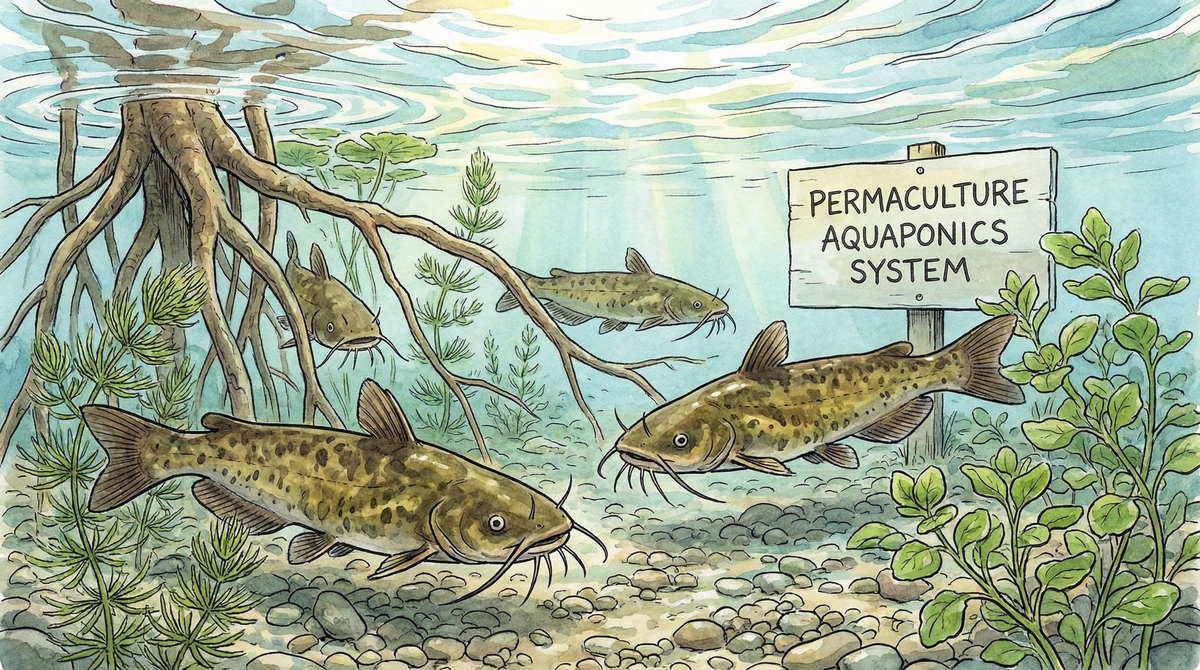
Overview & breed notes
The channel catfish (Ictalurus punctatus) is the most-farmed freshwater fish in the United States and the workhorse of North American backyard aquaculture [1]. They are slender, scaleless, and unmistakable: eight whisker-like barbels arranged around the mouth, a deeply forked tail, and a slate-gray to bluish back fading to a near-white belly. Young fish often show dark spots that fade in adults.
Adult fish in pond conditions typically reach 12–24 in (30–60 cm) and 1–5 lb (0.5–2.3 kg). Wild trophy specimens exceed 40 lb (18 kg), but for food production a 1.5–2 lb (0.7–0.9 kg) fish at 12–18 months is the practical target. Lifespan in a well-managed pond is 10–15 years.
Two cultivated strains are worth knowing:
- Standard (wild-type) channel cats — the default for most fingerling suppliers; thrive 65–90°F (18–32°C).
- Albino channel cats — same species, lacking melanin; sometimes preferred for visual appeal in display ponds. Identical husbandry.
Do not confuse with the closely related blue catfish (Ictalurus furcatus), which grows larger and is regulated as a non-native in some southeastern states. If you order fingerlings, ask the hatchery to confirm species and origin.
Role in a permaculture system
Catfish are the fish I default to when a client in the Florida heartland asks “what fish for the pond?” They tolerate the warm, low-oxygen, sometimes turbid water that a backyard system will throw at them better than trout, salmon, or most native sport fish. The stacked functions in a permaculture design are:
- Protein production. 1.5–2 lb (0.7–0.9 kg) of fillet-ready fish in roughly 14 months on a mix of commercial pellets and on-site grubs.
- Aquaponics nutrient driver. Ammonia from fish waste, converted by nitrifying bacteria to nitrate, drives plant growth in a coupled grow bed [2].
- Fertigation water. Pond water siphoned at season's end is mild liquid fertilizer (typically 5–20 ppm nitrate and 1–5 ppm phosphate) for fruit trees and annual beds.
- Mosquito control. Catfish fry will consume mosquito larvae in shallow margins; for stronger control, pair with Gambusia mosquitofish.
- Educational and agritourism value. A stocked pond doubles as a teaching tool and a low-effort recreational feature.
From the field (Lucas Summer, central Florida, USDA zone 9b): I ran trout fingerlings in a buried 250-gallon stock tank one cool season and lost the whole batch in a single early-April warm spell when the water passed 70°F for three days. Channel cats survived a 92°F shallow-pond summer the next year with nothing more than a $40 aquarium air pump on a timer. For anyone south of zone 7b, this is the realistic backyard fish.
Pond, tank & space requirements
Earth ponds
For dedicated food production, a 0.1–0.5 acre pond 4–8 ft (1.2–2.4 m) at its deepest point is the long-term goal. Stocking rate is roughly 1,000–1,500 fingerlings per surface acre without supplemental aeration, or up to 3,000 with aeration. Smaller backyard impoundments work fine at proportional density.
Soil dictates whether you can hold water at all. On clay or marl, a properly compacted basin will seal. On the deep sands typical of Florida flatwoods and most of the southeastern Coastal Plain, you will need a 30–45 mil EPDM or RPE liner, or a bentonite seal applied at 1–2 lb per square foot (5–10 kg/m²) and rototilled in. A handful of native sand is not enough; assume any pond on sand without engineering will leak.
Tanks and IBC totes
For aquaponics, common formats are:
- 275-gallon (1,040 L) IBC totes — hold 5–10 grow-out fish.
- 500–1,000 gallon (1,900–3,800 L) round poly tanks — hold 25–50 fish.
Plan 7–10 gallons (27–38 L) per pound of fish at harvest. Provide hide structures (perforated cinder block, ceramic flowerpot on its side) for stress reduction.
Predator exclusion
Great blue heron, anhinga, river otter, and (in the Southeast) alligator will all visit a stocked pond. Standard defenses: monofilament line strung in a grid 12–18 in (30–46 cm) above the water for wading birds, 4 ft (1.2 m) wildlife fence set back from the bank for otters, and a clear sightline to detect alligators before they take up residence.
Feeding, foraging & integration with plants
Channel catfish are opportunistic omnivores. They will eat almost anything organic that fits in their mouth, which is convenient and a hazard in equal measure.
The pellet base
Commercial floating catfish pellets at 32–36% protein are the most reliable nutrition base. Feed 2–3% of body weight per day during the growing season, divided into one or two feedings, and stop feeding when water drops below 60°F (16°C). Floating pellets let you watch the response — if fish leave food on the surface, cut the next feeding by a third [1].
On-site supplements that actually work
- Black soldier fly larvae (see black soldier fly): a 5-gallon bucket bin produces enough larvae to supplement 20–30 fish through summer. Larvae are 40–44% protein and 30–35% fat.
- Earthworms and red wigglers from a vermicompost bin: gradually substitute up to 25% of the pellet ration.
- Surplus garden produce in moderation: squash, melon rinds, sweet potato (see sweet potato) tubers cooked and chopped.
- Floating duckweed grown on the pond surface — 25–40% protein, self-replenishing.
What not to feed or grow in the pond
- Toxic blue-green algae blooms. Cyanobacteria can release hepatotoxins fatal to fish; if you see thick green or blue-green scum on a hot still day, do not feed and aerate aggressively.
- Solanaceous foliage. Trimmings from tomato, pepper, and eggplant carry glycoalkaloids; keep them out of the pond.
- Eucalyptus and lilly pilly leaves (eucalyptus) leach oils and tannins that stress fish; do not plant directly over a pond.
Health, water quality & welfare
Channel cats are forgiving of most parameters but unforgiving of two failures: oxygen crashes and ammonia spikes. Both can wipe out a stocked pond in a single morning.
Target water parameters
- Dissolved oxygen (DO): > 5 mg/L preferred; stress begins below 3 mg/L; mortality at 2 mg/L sustained [1].
- Temperature: optimum 80–85°F (27–29°C); growth essentially stops below 65°F (18°C).
- pH: 6.5–8.5; aim for 7.0–7.5.
- Total ammonia nitrogen (TAN): < 0.5 mg/L; un-ionized ammonia < 0.05 mg/L.
- Salinity: tolerates up to 11 ppt; prefers < 4 ppt.
The dawn-DO problem in warm climates
In subtropical ponds, the most dangerous moment is 4–7 AM after a still, cloudy summer night, when algae have respired oxygen all night with no photosynthesis to replace it. On my Florida site I run a 1/4 hp paddlewheel aerator from 11 PM to 9 AM all summer; on extreme heat advisories I add a small surface fountain through the heat of the day. A $30 dissolved-oxygen meter pays for itself the first time it tells you to flip the aerator on at 3 AM.
Common diseases
- Ich (Ichthyophthirius multifiliis): white spots on body and fins; treat with salt at 0.3% (3 g/L) for 7 days at 75°F+ or follow vet-supervised copper sulfate protocols.
- Columnaris (Flavobacterium columnare): saddle-shaped lesions and frayed fins, especially after handling stress; reduce handling, improve oxygenation, treat with potassium permanganate per Extension protocol.
- Enteric Septicemia of Catfish (ESC): bacterial disease causing “hole-in-the-head” lesions; manage with diet, oxygen, and stress reduction; treat under veterinary direction with approved antibiotics observing the full PHI.
Polyculture & rotational systems
Single-species catfish ponds work, but a polyculture catches niches the catfish leave open and dramatically improves system resilience.
The classic southeastern combination
Channel catfish + tilapia + bluegill is a triple stack: catfish work the bottom, tilapia eat algae and detritus mid-column, bluegill clean up insect larvae and small invertebrates near the surface. Stocking ratio for a backyard 1/8 acre pond: roughly 80 catfish, 40 tilapia, 100 bluegill fingerlings.
Aquaponic loops
Catfish are excellent aquaponic protein producers. A typical media-bed ratio is 1 sq ft (0.09 m²) of grow bed per 5–7 gallons (19–27 L) of fish tank. The plants most reliably grown on catfish effluent in central Florida are leafy greens (lettuce, kale, mustard), herbs (basil, mint), and Asian aquatic crops like watercress and taro in deep media beds.
Native edge plantings, with one important warning
Beneficial pond-edge species in warmwater climates include cattail, arrowhead, pickerelweed, and elephant ear (the Asian variety Colocasia, not the invasive Alocasia).
Regulatory note from central Florida: water hyacinth and water lettuce are Florida Prohibited Aquatic Plants. Possessing them without a permit is illegal under FDACS rule 5B-64. They are wonderfully productive everywhere they are not catastrophic invaders, and Florida is not one of those places. Use duckweed and azolla on your pond surface instead.
Frequently asked questions
How fast do they grow?
Fingerlings stocked at 4–6 in (10–15 cm) in spring reach 1.5–2 lb (0.7–0.9 kg) by the following autumn in warm-climate ponds with full feeding. Cooler climates add 6–12 months. Stunting in overstocked ponds is common; lighter densities grow larger fish faster.
Do I need a permit?
State rules vary. In Florida, channel catfish from licensed in-state hatcheries can be stocked in private ponds without an individual permit, but ponds with public outflow or interstate fish movement trigger additional regulation. Check your state Wildlife Resources or Fish & Wildlife agency before ordering; on my site I have used Florida-based hatcheries with delivery confirmation and a transfer receipt, which has been sufficient.
Can I raise them in a stock tank?
Yes, with caveats. A 300-gallon (1,140 L) above-ground tank will grow 10–15 fish to plate size in a summer, but only with continuous aeration and either an aquaponic biofilter or frequent partial water changes (10–20% weekly). Without biofiltration, ammonia will overwhelm the tank by mid-summer.
What happens in a cold snap?
Channel cats stop feeding below 60°F (16°C) and become torpid. They survive ice cover on ponds 6 ft (1.8 m) deep or greater. In hard freezes, they retreat to deepest water and wait it out. Aquaponic tank fish need supplemental heating below 55°F (13°C) to avoid prolonged immune suppression.
Are they native to Florida?
Yes. Channel catfish are native to the Mississippi drainage and much of the eastern U.S. including northern Florida, and they are widely established statewide. This is part of why they integrate cleanly with native pond ecology in the Southeast.
References
- Hill, J.E. & Yanong, R.P.E. (UF/IFAS). Freshwater Ornamental Fish Commonly Cultured in Florida. University of Florida Institute of Food and Agricultural Sciences.
- University of Arkansas Cooperative Extension. Channel Catfish Production in Ponds.
- USDA ARS. Warmwater Aquaculture Research Unit, Stoneville, MS.
- Florida Fish and Wildlife Conservation Commission. Private Pond Fish Stocking Regulations.
- Florida Department of Agriculture and Consumer Services. Prohibited Aquatic Plants (Rule 5B-64).
- Merck Veterinary Manual. Aquaculture — Catfish.
Field notes by Lucas Summer, central Florida (USDA zone 9b). Where this page reports specific operating numbers without a citation, they come from on-site experience and are presented as a working starting point rather than a published standard.
Foraging Behavior
Channel catfish are opportunistic omnivores and bottom feeders, foraging on a wide variety of available plant and animal matter.
Fencing Requirements
Containment within a pond, tank, or other aquaculture system is the primary requirement. No traditional fencing is necessary.
Shelter Requirements
As bottom dwellers, they require shelter such as submerged logs, rocks, or artificial structures to hide in.
Permaculture Notes
Channel Catfish are an excellent species for integration into permaculture systems, particularly in aquaponics. Their nutrient-rich waste provides a natural fertilizer for plants, creating a closed-loop system that minimizes waste and maximizes resource efficiency. They are hardy and adaptable, tolerating a wide range of water conditions, which makes them a forgiving choice for those new to aquaculture. In a polyculture system, they can be raised with other fish species like tilapia and bluegill, further diversifying the outputs of the aquatic system. When designing a system for Channel Catfish, it is important to provide adequate space and shelter. As bottom-dwellers, they appreciate structures like submerged logs or rocks where they can hide. While they are tolerant of a range of temperatures, maintaining optimal conditions will ensure the best growth rates. Their diet is varied, and they can be fed a combination of commercial pellets and natural food sources like worms and insects, which can be cultivated on-site in a permaculture design. The primary outputs from Channel Catfish in a permaculture system are high-quality protein in the form of meat and nutrient-dense water that can be used to irrigate and fertilize gardens. This integration of aquaculture and horticulture is a hallmark of permaculture design, demonstrating the principle of stacking functions and creating beneficial relationships between elements. The challenges are minimal but include managing water quality and preventing the introduction of toxic plants or algae into the system.