Overview
The common earthworm (Lumbricus terrestris), also called the nightcrawler or dew worm, is a large temperate-zone lumbricid worm native to Europe and now found wherever European agriculture has spread. It is the species most North American gardeners imagine when they hear the word “earthworm,” but it is not the only earthworm at work in a garden, and on Gulf-coast sand it is often not even the dominant one.
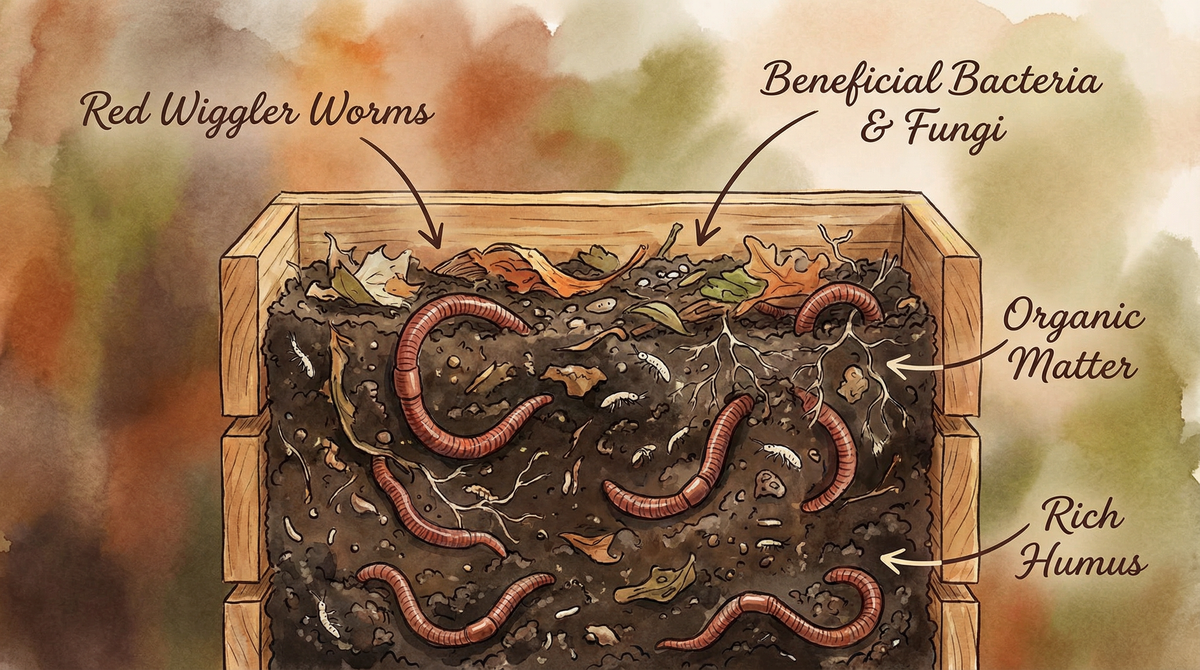
Earthworms are detritivores: they pull leaves, mulch, manure, and other dead organic matter down into their burrows, digest it through a mineral-rich gut, and excrete the residue as castings. Those castings are higher in available nitrogen, phosphorus, potassium, calcium, and magnesium than the surrounding soil, which is why a healthy worm population is the single most reliable visual indicator of a functioning permaculture soil system. On my central Florida site (USDA zone 9b), the earthworm story has two characters: cool-season Lumbricus activity in the surface mulch from November through March, and a warmer-season community of red wigglers (Eisenia fetida) confined to shaded bins and in-ground worm towers from April through October.
Permaculture Role
Earthworms are not livestock in the conventional sense. They are infrastructure. The four functions they perform, all simultaneously and at no cost, would otherwise require a tiller, a fertilizer spreader, an irrigation engineer, and a bag of soluble micronutrients.
Biological tillage
A single mature Lumbricus terrestris moves several pounds of soil per year through its gut and builds vertical burrows up to 6 feet deep. USDA Natural Resources Conservation Service publications credit worm channels with the bulk of the macro-pore network that lets water infiltrate undisturbed soils, and field studies cited by Cornell University Soil Health Lab show infiltration rates 4 to 10 times higher in worm-active plots than in worm-poor plots of the same texture.
Nutrient cycling
Worm castings carry roughly 5 times more available nitrogen, 7 times more phosphorus, and 11 times more potassium than the soil they came from. The shift is not magic, it is the result of acid digestion plus microbial inoculation in the gut. Vermicompost is a slow-release fertilizer that does not burn roots and does not leach nitrate the way synthetic fertilizers do.
Soil structure
Casting-rich soils form crumb aggregates that resist compaction. On the Florida sand I started with, five years of mulch-and-cover-crop management has lifted aggregate stability enough that the same beds now drain in a heavy rain in minutes rather than ponding for hours.
Indicator species
If you cannot find 5 to 10 worms in a shovelful of soil from a permanent bed, something upstream is wrong: not enough organic matter, too dry, too acidic, or too disturbed. The worms are the dashboard warning light.
Housing & Habitat
Earthworms have three non-negotiable habitat requirements: consistent moisture, consistent temperature, and a steady supply of fresh organic matter. Lose any one of them and the population collapses within weeks.
Surface mulch
A 3 to 5 inch layer of carbon-rich mulch (wood chips, leaf litter, straw, pine needles) is the simplest way to support a field population. Mulch moderates soil temperature, holds moisture, and feeds the worms directly as it decomposes from the bottom up.
Vermicomposting bins
For active vermicomposting, a 4 by 2 ft wooden or plastic bin 12 to 18 inches deep, kept in shade with a vented lid, will hold 1 to 2 pounds of red wigglers and process 2 to 4 pounds of kitchen scraps per week. Bedding starts as moist shredded cardboard or aged leaves; food scraps are buried, not surface-applied, to deter fruit flies and rodents.
In-ground worm towers
A 4-inch PVC pipe drilled with quarter-inch holes, sunk 18 inches into a garden bed with a lid on top, lets worms migrate freely between the tower and the surrounding soil while you feed kitchen scraps directly into the root zone. On my place these are the workhorse vermicomposting unit from April through October because the buried portion stays 10 to 15°F cooler than an above-ground bin.
Temperature
Red wigglers tolerate 55 to 85°F. Lumbricus terrestris retreats deep when soil exceeds 70°F at the surface. Above 95°F sustained, both species die. On the Gulf coast, that is the controlling design constraint: shade and depth, always.
Feeding
Earthworms eat decaying organic matter, not living tissue. The general rule is that anything that came from a plant or animal and is not chemically preserved, oily, or salty is acceptable.
Good inputs
- Vegetable and fruit scraps (banana peel, apple cores, lettuce trim)
- Coffee grounds and tea leaves
- Crushed eggshells (calcium plus grit)
- Aged manure from herbivores (cattle, horse, rabbit, goat)
- Shredded cardboard, paper bags, newsprint (no glossy ink)
- Tropical biomass: banana leaves, papaya stems, moringa trimmings, comfrey leaves chopped fine
Limit or exclude
- Meat, dairy, oils (anaerobic, odorous, draws pests)
- Citrus peel in volume (acidic, can drop bin pH)
- Onion and garlic skins in volume (worms avoid them)
- Fresh oak leaves (high tannins; age them 6 months first)
- Salted or pickled food waste
Field application
For the field worm population, the “feeding” lever is mulch quality. Mix carbon sources (wood chips, dried leaves) with nitrogen sources (grass clippings, manure, fresh prunings) at roughly 3 parts carbon to 1 part nitrogen by volume to keep the surface food supply moving steadily without going anaerobic.
Health & Population Management
Worms do not get diseases the way livestock do, but they collapse fast under bad conditions. The five failure modes are dehydration, overheating, acidification, anaerobic conditions, and toxic inputs.
Dehydration
Worms breathe through moist skin. A bin or mulch layer that dries out kills them within hours. Bedding should feel like a wrung-out sponge: damp, not dripping. In a Florida dry spell (April to early June, typically) I water the worm towers weekly along with the garden beds.
Overheating
Sustained bin temperatures above 90°F are lethal. A simple thermometer probe in the bedding center is the cheapest insurance. Shade cloth, north-side placement, and burying the bin partially into the ground all help.
Acidification
Citrus peel, coffee grounds in volume, and pine bark mulch all drive pH down. Worms prefer a pH of 6.0 to 7.5. Crushed eggshells or a tablespoon of agricultural lime per square foot of bin surface corrects mild acidification.
Anaerobic conditions
Waterlogged bins go sour and smell like sulfur. Fix by adding dry shredded cardboard, lifting and fluffing the bedding, and reducing wet inputs for a week.
Toxic inputs
Manure from animals recently treated with avermectin family wormers (ivermectin, eprinomectin) is toxic to earthworms for several weeks after dosing. The same applies to grass clippings from lawns treated with persistent herbicides like aminopyralid. When in doubt, compost questionable inputs in a separate pile for six months before feeding worms.
Field notes, central Florida. I lost my first vermicompost bin to August heat the year I started, parked in afternoon sun against the workshop south wall. The fix was two-fold: move the bin to the north side of the workshop under live-oak shade, and supplement it with three in-ground PVC worm towers spaced through the garden. The towers run year-round and feed worms directly into the root zone of sweet potato and cassava beds without ever needing temperature management. I top them up with kitchen scraps about once a week.
Integration
Earthworms are the easiest livestock to integrate with the rest of a permaculture site, because they need no fencing, no daily attention, and no separate feed budget. The integration challenge is simply giving them the conditions they want everywhere you want healthy soil.
Food forest
Deep chop-and-drop mulch under canopy species (mulberry, moringa, pigeon pea) creates an ideal worm habitat. Mulberry and pigeon pea are particularly useful because their leaf litter is high in nitrogen and breaks down quickly.
Market garden
No-till or low-till systems with permanent mulch outproduce tilled beds on worm population within two seasons. The worms in turn outperform synthetic fertilizer for total yield over a 5-year horizon in most published trials.
Livestock integration
Rabbit and goat manure can be added directly under cages or in catchment trays. Cattle and horse manure should be aged 4 to 6 weeks before feeding worms to avoid heat damage and to ensure any worming-drug residue has degraded.
Vermicompost as fertilizer
Finished vermicompost at 1/2 inch top-dressing per quarter for established beds, or 10 to 20 percent by volume blended into transplant soil, is the standard application. A 10-gallon batch made into “worm tea” (1:10 dilution, aerated 24 hours) is enough foliar feed for a 1,000 sq ft market garden.
Frequently Asked Questions
What is the best worm species for a backyard system?
For an outdoor bin or in-ground tower in zones 8 and warmer, red wigglers (Eisenia fetida) are the standard. They reproduce quickly, tolerate a wide temperature range, and process surface food. Lumbricus terrestris is a field-soil species that does not thrive in bins.
Are jumping worms a problem?
Yes. Amynthas species (Asian jumping worms) are invasive in the eastern US, consume leaf litter at destructive rates, and degrade soil structure. Do not move soil or compost from infested sites. The University of Wisconsin Extension and University of Minnesota Extension both publish current identification guides.
How many worms do I need to start?
One pound (roughly 1,000 worms) is enough to seed a 4 by 2 ft bin. They double every 60 to 90 days under good conditions.
Can I just dig worms out of my yard?
The worms in most yards are field species that will not thrive in a confined bin. Buy red wigglers from a vermicompost supplier instead.
Will worms survive Florida summers outdoors?
In shaded in-ground systems with consistent moisture, yes. In above-ground bins in direct sun, no. On my place the field population becomes invisible from mid-July through September, then rebounds with the first cool rain.
References
- USDA Natural Resources Conservation Service. Soil Biology Primer — Earthworms. nrcs.usda.gov/soil-health
- Cornell University Soil Health Lab. Comprehensive Assessment of Soil Health. soilhealth.cals.cornell.edu
- University of Wisconsin-Madison Extension. Jumping Worms. hort.extension.wisc.edu — jumping worms
- University of Minnesota Extension. Earthworms. extension.umn.edu/earthworms
- NC State Extension. Vermicomposting for Households. composting.ces.ncsu.edu — vermicomposting
Field notes and central-Florida observations in this article are from Lucas Summer’s permaculture site in USDA zone 9b. Bin temperature failures, worm-tower depth specifics, and field-population seasonality reflect on-site practice; nutrient ratios in castings, jumping-worm invasion ecology, and infiltration rate figures are drawn from the extension and research sources cited above.
Foraging Behavior
Earthworms are detritivores that forage by consuming decaying organic matter from the soil and the surface. They pull leaves and other plant debris down into their burrows, mixing it with the soil and excreting nutrient-rich castings.
Fencing Requirements
Fencing is not applicable for earthworms as they are soil-dwelling organisms. Containment is managed by providing a suitable habitat and food source within the desired area.
Shelter Requirements
Earthworms require a cool, dark, and consistently moist environment to thrive. In a garden setting, this is achieved by maintaining a thick layer of mulch on the soil surface. For vermicomposting, they can be housed in dedicated bins or in-garden worm towers that protect them from temperature extremes and predators.
Permaculture Notes
In permaculture systems, earthworms are considered keystone species, acting as 'soil engineers' that are fundamental to building and maintaining healthy, fertile soil. Their extensive burrowing aerates the soil, creating channels for water to penetrate and for plant roots to grow with ease. This natural tillage reduces compaction and improves soil structure without the need for mechanical intervention. The constant processing of organic matter into nutrient-dense castings provides a slow-release fertilizer that is readily available to plants, enhancing their growth and resilience. Integrating earthworms into a permaculture design can be achieved through both passive and active methods. Passively, creating a healthy soil environment with ample organic matter, consistent moisture, and a thick layer of mulch will naturally attract and support a thriving earthworm population. Actively, vermicomposting systems can be established to process kitchen scraps and other organic waste into high-quality compost and 'worm tea' fertilizer. These can be either stationary bins or in-garden 'worm towers' that deliver nutrients directly to the root zone of plants. A healthy earthworm population is a clear indicator of a well-functioning permaculture system. Their presence signifies a balanced soil food web, good soil structure, and high fertility. By supporting earthworms, permaculturists can close nutrient loops, reduce waste, and build resilient, self-sustaining ecosystems.