Overview
The domestic pig (Sus scrofa domesticus) is an omnivorous, even-toed ungulate domesticated from the Eurasian wild boar at least 9,000 years ago. Pigs are arguably the most useful single animal on a permaculture site that has the space and the fencing to keep them: they convert kitchen scraps, spoiled fruit, weeds, mast, and pasture forage into meat and manure at conversion ratios that no other livestock species matches, and they perform a unique earth-moving function (biological tillage) that is awkward to replicate with any other tool.
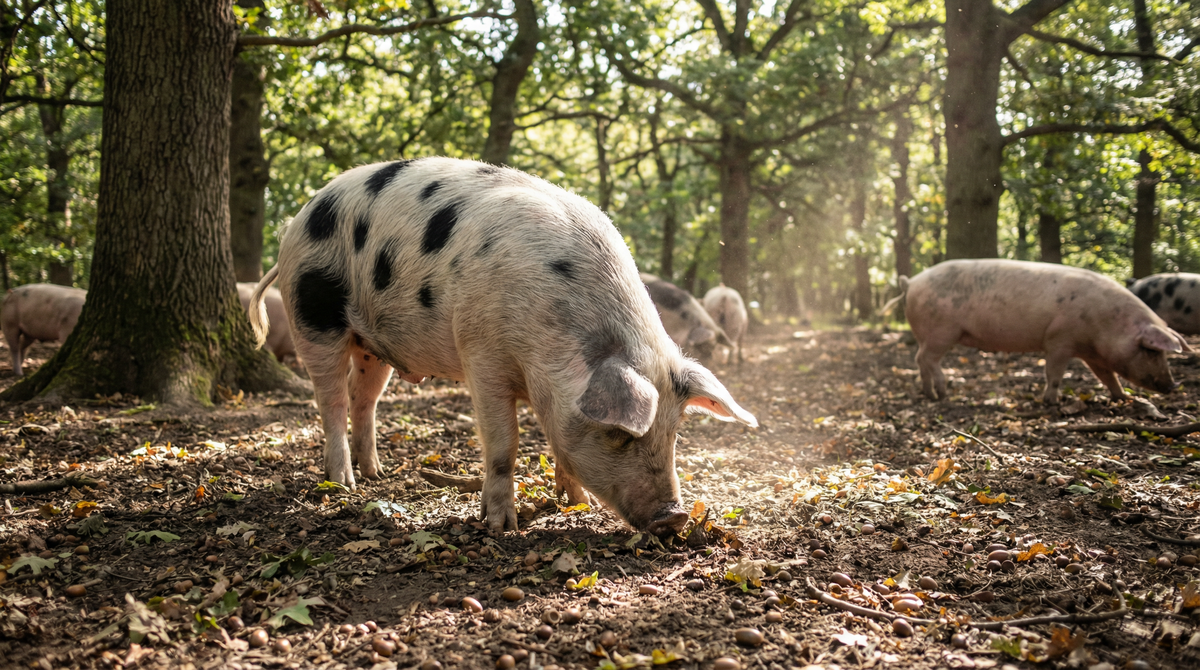
On my central Florida site (USDA zone 9b), I have run a small annual pig project for several years using two American Guinea Hogs from spring through fall on a moveable woodland paddock under the live-oak and pecan canopy. The breed choice (small, lard-type, heat-tolerant, calm) and the seasonality (release in March, harvest before December cold snaps) are both deliberate accommodations to the Gulf coast climate.
Permaculture Role
Pigs fill four primary niches: biological tillage and land clearing, meat production, manure for fertility, and scrap and waste utilization.
Biological tillage and land clearing
A 200 lb pig in a 1,000 sq ft paddock will root the area to a depth of 6 to 12 inches in 7 to 14 days, eating roots, grubs, and weed crowns as it goes. This is the standard preparation for breaking in a new garden bed or clearing an overgrown patch without herbicide. ATTRA and several Cornell Cooperative Extension publications document the practice in detail.
Meat production
Heritage breeds suited to pasture-based and woodland systems include American Guinea Hog (small, lard-type, calm, heat-tolerant), Mangalitsa (lard-type, hardy), Tamworth (long-bodied bacon type, good foragers), Berkshire (medium-sized, premium pork market), and Kune Kune (very small, gentle, non-rooting). Industrial confinement breeds (commercial Yorkshire, Duroc) are bred for indoor production and do less well outdoors.
Manure
Pig manure is high in nitrogen, phosphorus, and potassium, but it is also high in pathogens (E. coli, Salmonella, parasites). The standard advice from UF/IFAS and USDA NRCS is to compost pig manure at proper temperatures (140°F for at least 3 days, turned twice) before applying to vegetable beds, or apply to fields at least 120 days before harvesting any crop that contacts the soil.
Scrap utilization
A small homestead pig can productively eat dairy whey, vegetable trim, garden waste, fallen fruit, and acorn mast in season. Feeding meat scraps or animal-product waste is regulated in most US states because of disease-transmission risk; check local rules before scaling.
Housing & Fencing
Housing pigs has two non-negotiable requirements: a shelter that stays dry and cool, and fencing that contains rooting and pushing animals that quickly learn to test infrastructure.
Shelter
A simple wooden A-frame or hoop-style hut with deep straw bedding, large enough for the pig to lie down stretched out, is sufficient in zones 8 and warmer. Allow 60 to 100 sq ft of shaded resting space per finishing pig. In cold-winter regions, an enclosed, well-bedded shed is the safer build. Pigs do not sweat and rely entirely on shade, wallows, and breeze for cooling.
Wallow
A shallow mud wallow (a 4 by 6 ft scrape in the lowest corner of the paddock, topped off with the garden hose on hot days) is the single most important Gulf-coast pig management tool. Pigs without a wallow on a 95°F day are at high heatstroke risk.
Fencing
The working pig fence in the southeast is two strands of electric high-tensile wire at 6 and 12 inches off the ground inside a perimeter of 4 ft woven-wire or hog panels. Train pigs to electric in a small training pen before turning them onto pasture. Once a pig respects hot wire, the electric alone is sufficient containment. Burying or skirting the perimeter prevents under-fence rooting. Barbed wire is inappropriate.
Movable paddocks
Step-in posts and polywire let you build movable paddocks for rotational grazing, tillage, and stump and brush removal. A 1,000 sq ft paddock holds 2 to 3 finishing pigs for 7 to 14 days before rotation.
Feeding
Pigs are omnivores and will eat almost anything. The question on a working homestead is how much of their feed you can defray with pasture, mast, and farm waste rather than purchased grain.
Pasture and mast
An adult pig on good Bahiagrass pasture with access to oak acorn mast in fall, pecan drops, mulberry fruit drop in late spring, and papaya windfalls can defray 30 to 50 percent of its caloric needs depending on the year. Mast years vary; my best fall reduced grain by half, lean years gave back almost none.
Grain
A 16 to 18 percent hog grower or finisher ration covers the rest. Whole shelled corn or barley soaked in water for 24 hours is an acceptable substitute on small operations. A finishing pig eats 4 to 8 lb of grain per day, scaled to weight and growth target.
Garden and kitchen waste
Pigs will eat sweet potato vine and tubers, cassava roots (must be cooked or fully wilted to denature cyanogenic glycosides), pigeon pea pods, banana fruit and stems, comfrey leaves, and most kitchen scraps. Feeding raw meat or animal-derived waste is regulated in most jurisdictions; check before scaling.
Water
Fresh water always available. A 200 lb pig drinks 3 to 6 gallons per day, doubling in hot weather.
Toxic plants
Avoid hemlock, nightshade family green parts, foxglove, lantana, and angel trumpet. Pigs are smarter about toxic plants than ruminants but will eat them when bored or short on forage.
Health
Pasture-based pigs in small numbers are typically very healthy. The recurring failure modes are heat stress, parasites, and (less often) infectious disease.
Heat stress
Above 85°F, pigs need shade and a working wallow. Above 95°F sustained, panting becomes constant and weight gain stops. Above 100°F, mortality climbs. Active cooling (overhead misters, frozen water bottles in the bedding, refrigerator-water-bucket dump) bridges peak afternoons in central Florida summers.
Parasites
Roundworm (Ascaris suum) and whipworm are the most common pig parasites on Gulf-coast pasture. Rotational paddocks, fecal-egg-count testing, and prompt treatment with ivermectin or fenbendazole based on actual load (not calendar) are the working approach.
Lameness
Mineral-deficient diets, hard wet ground, and overgrown hooves contribute. Address with a balanced ration and dry resting areas.
Reportable diseases
African Swine Fever, Classical Swine Fever, and Foot and Mouth Disease are reportable in the US. Pseudorabies and brucellosis are managed by USDA-APHIS surveillance programs. Buy stock from a reputable breeder with current herd health paperwork.
Castration and weaning
Boar taint in intact males harvested over 200 lb is the standard reason for castration at 1 to 2 weeks of age. Wean piglets at 6 to 8 weeks for sow welfare and piglet growth.
Field notes, central Florida. I run two American Guinea Hog finishers each year on a moveable paddock under live-oak shade from March (typically 30 to 50 lb feeder weight) through early December (180 to 220 lb finish weight). The wallow goes in on day one, refilled weekly through July and August. Acorn drop in October and November consistently saves me roughly a third of the grain budget in the last 8 weeks of the finish. The two hardest weeks are always the second and third weeks of August; the pigs go off feed in the afternoon heat and I run a portable shop fan into the shelter to keep them eating.
Integration
Pigs integrate well with established food forests (mast cleanup), market-garden bed preparation (rotational tillage), and rotational woodland grazing. They integrate poorly with active vegetable beds and young perennial plantings, both of which they will destroy.
Food forest mast cleanup
An oak, pecan, mulberry, or chestnut food-forest block dropped to ground level by autumn mast is an excellent finishing paddock for one or two pigs from October through early winter. The pigs eat fallen nuts that would otherwise feed deer, rats, and weevils, and they convert that mast directly to meat with no grain cost.
Garden bed preparation
A movable pig paddock parked on a future garden bed for 10 to 14 days rotates that bed from weed-and grass-covered to bare, tilled, fertilized ground. Plant cover crops or transplants immediately after the pigs move off.
Manure management
Compost piles built from soiled pig bedding, weed-and-mast paddock scrapings, and carbon (wood chips, dry leaves) reach 140 to 150°F in summer and produce safe, finished compost in 4 to 6 months.
Legal considerations
Many Florida counties regulate hog keeping under nuisance and feral-swine rules; check local ordinances before starting. The US has a national feral swine eradication program and pigs that escape and breed wild are a serious agricultural and ecological problem.
Frequently Asked Questions
What is the best pig breed for a small homestead?
For the Gulf coast, American Guinea Hog (small, calm, heat-tolerant, lard-type) and Kune Kune (very small, non-rooting, gentle) are the easiest to manage. For larger meat production, Tamworth and Berkshire are good pasture breeds.
How long does it take to raise a pig to harvest?
7 to 9 months from weaning to 200 to 250 lb finish weight for commercial breeds. Heritage breeds take longer (10 to 14 months) but produce richer, fattier meat.
How much land per pig?
For rotational paddock pasture, plan on 1/4 to 1/2 acre per finishing pig with 7 to 14 day rotations across 4 to 8 cells. Smaller spaces work with daily paddock moves.
Can pigs and chickens live together?
Yes, in mixed-species pasture systems. Chickens scratch through pig manure for fly larvae, interrupting the parasite cycle. Pigs will eat chickens if cornered and hungry, so the system needs secure chicken roosting at night.
Are escaped pigs really that big a deal?
Yes. Florida and the southeast already have major feral-hog problems that damage crops, native ecosystems, and ground-nesting birds. Containment is a legal, ethical, and ecological responsibility.
References
- ATTRA Sustainable Agriculture. Pork on Pasture. attra.ncat.org
- University of Florida IFAS Extension. Small Farm Swine Production. edis.ifas.ufl.edu — swine
- Cornell Cooperative Extension. Pasture-Based Pig Production. smallfarms.cornell.edu
- USDA-APHIS. Feral Swine Damage Management. aphis.usda.gov — feral swine
- USDA Natural Resources Conservation Service. Manure Management for Small Livestock Operations. nrcs.usda.gov
Field notes and central-Florida observations in this article are from Lucas Summer’s permaculture site in USDA zone 9b. The American Guinea Hog finisher schedule, wallow management, August heat-stress fan use, and acorn-mast feed savings reflect on-site practice; parasite, disease, and manure-management guidelines are drawn from the ATTRA, UF/IFAS, and USDA sources cited above.
Foraging Behavior
Pigs have a natural tendency to dig, turn over sod, and uproot weeds and small trees. As they forage and root through the soil, they aerate the ground, break up hard-packed or clay-heavy areas, and create a weed-free, nutrient-rich seedbed.
Fencing Requirements
Fences should be at least 4 feet high and buried 1 foot deep. Wire mesh, high-tensile wire, panels, and wood are suitable materials. Electric fencing can be used within a perimeter fence to prevent rooting, but is not recommended as the sole fencing type.
Shelter Requirements
Pigs require a solid, four-sided structure for protection from the elements. The shelter should provide adequate space, proper ventilation, and be constructed with durable materials. Packed dirt floors are recommended, and abundant straw bedding should be provided for comfort and nesting.
Permaculture Notes
Pigs are highly effective biological plows, using their natural rooting and foraging behaviors to prepare land for planting, eliminate weeds, and improve soil health. Pig tractors, which are movable pens, allow for targeted land clearing and soil preparation. The manure produced by pigs is a valuable, nutrient-rich fertilizer that can be composted or applied directly to the land, contributing to a closed-loop, regenerative system. Integrating pigs into a crop rotation system can further enhance soil fertility and suppress weeds. Heritage breeds like Mangalitsa, Meishan, and Kune Kune are well-suited for permaculture systems due to their hardiness and foraging abilities.