
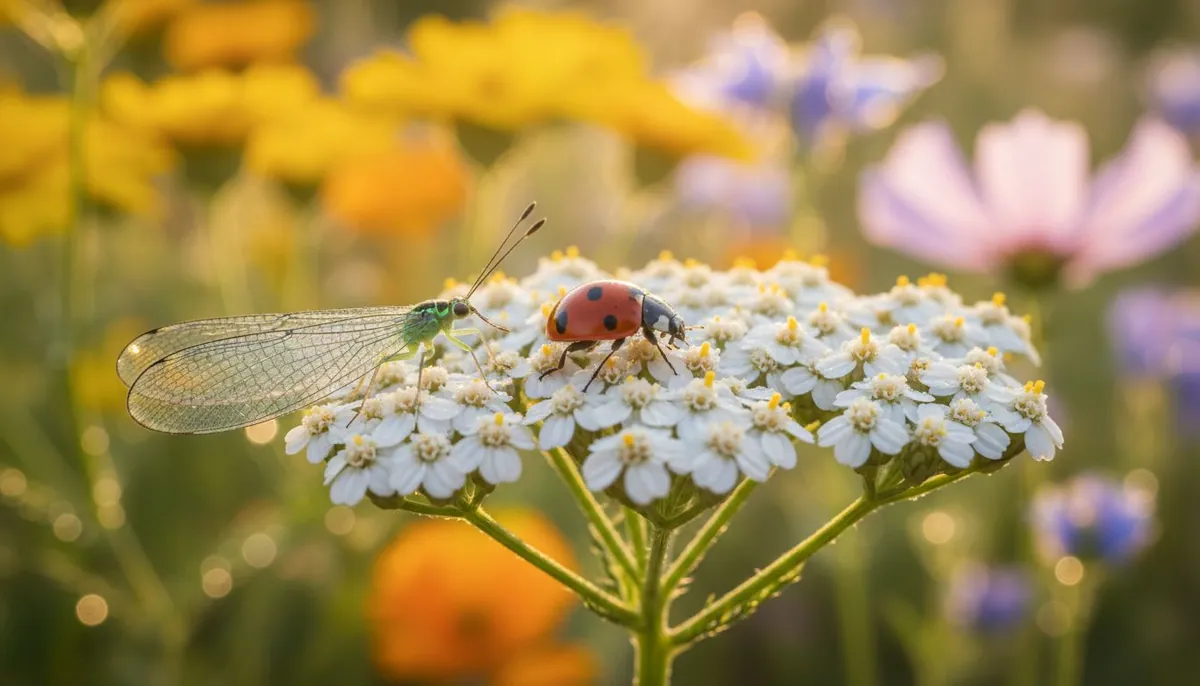
The single best pest-control decision I ever made was to stop reaching for the spray bottle and start planting flowers instead. Once I understood that beneficial insects for the garden were doing the work I had been trying to do with chemicals, my whole approach changed. These "good bugs" are the predatory and parasitic insects that hunt, sting, and devour the aphids, mites, and caterpillars chewing through your vegetables. Attract enough of them and they become a standing army that patrols your beds around the clock, for free, with no side effects. This guide is about how to invite them in and keep them: the nectar plants, the water, the shelter, and the sprays you need to put down. For the biology of any particular species, I'll point you to our individual pest-control profiles as we go.
What Beneficial Insects Actually Do
Entomologists sort the good bugs into two working categories, and it helps to know which is which because they hunt very differently.
Predators are the ones most people picture. They actively stalk and eat their prey, often devouring hundreds of pests over a lifetime. The lady beetle is the poster child, but its larvae, those spiky little alligator-shaped things people squash by mistake, are even hungrier than the adults. The green lacewing is another heavyweight; a single lacewing larva can devour up to 200 aphids in a week before it pupates. Add the hoverfly, whose maggot-like larvae mow through aphid colonies, the ground-dwelling ground beetle that ambushes cutworms and slugs at night, the soldier beetle, the ferocious assassin bug, and the tiny big-eyed bug that specializes in spider mites and insect eggs. The praying mantis gets all the attention, but honestly it's an indiscriminate hunter that eats good bugs as readily as bad ones, so I don't count on it as a workhorse.
Parasitoids are the quieter, arguably more effective half of the crew. Instead of eating pests outright, they lay eggs on or inside them, and the developing larvae consume the host from within. The parasitic wasp group is enormous and almost entirely harmless to humans, these are not the wasps that sting you at a picnic. The Aphidius wasp turns aphids into papery brown "mummies"; the microscopic Trichogramma wasp destroys the eggs of moths and caterpillars before they ever hatch; and the bristly tachinid fly parasitizes caterpillars, beetles, and squash bugs. The first summer I noticed those mummified aphids on my kale, I nearly panicked and reached for a spray, until I realized they meant the Aphidius wasps had already won the battle for me.
Attracting Beneficial Insects for the Garden Starts With Nectar
Here is the fact that reorganized my entire garden: the adults of most predatory and parasitic insects don't eat pests at all. They eat nectar and pollen. The larvae are the hunters; the adults are pollinators that need flowers to fuel egg-laying. Penn State Extension and UC IPM both make the same point, that even when pests are abundant, your natural enemies will be fewer, shorter-lived, and less fertile unless nectar and pollen are on the menu. Plant those food sources and you're providing biological pest control the way a permaculturist should, by designing the system rather than reacting to it.
Plants grown specifically to feed and shelter these good bugs are called insectary plants, and a few plant families do the heavy lifting.
The Carrot Family (Apiaceae)
If you plant nothing else, plant these. The tiny flowers clustered into flat umbels are perfectly sized for the short mouthparts of small parasitic wasps and hoverflies. I let a few dill and fennel plants bolt every year specifically for this, and the umbels swarm with tiny wasps I can barely see. Coriander (cilantro), lovage, angelica, parsley left to flower in its second year, and caraway all belong to this indispensable group.
The Aster Family (Asteraceae)
The daisy-shaped flowers here draw the larger predators, lady beetles, soldier beetles, and lacewings. Yarrow is my number-one recommendation; its flat flower heads bloom for weeks and every gardening extension I trust puts it near the top of the list. Round it out with purple coneflower, coneflower, sunflowers, calendula (pot marigold), marigold, chamomile, and chicory.
Legumes, Mints, and the Rest
Legumes like clover and vetch feed beneficials while fixing nitrogen, which is exactly the kind of stacked function I look for. The mint family pulls its weight too, catmint and flowering mint are magnets for hoverflies. I also keep borage and nasturtium tucked among the vegetables; the nasturtium doubles as a trap crop that lures aphids away from my beans and concentrates them for the lady beetles to find.
Design for a Season-Long Buffet
One flush of bloom in June isn't enough. The core principle, straight out of the UC IPM guidance, is sequential flowering: something in bloom from the first warm days of spring through the last of fall, so nectar never runs dry. A hungry adult lacewing that finds nothing to eat in August simply leaves, and it takes next year's pest control with it.
A few design rules I follow:
- Favor many small flowers over a few big showy ones. A single umbel of dill offers hundreds of tiny nectar cups sized for tiny mouths; one giant dahlia bloom offers almost nothing a parasitic wasp can use.
- Plant in drifts, not singles. A clump of a dozen yarrow plants is far easier for insects to find than one lonely plant across the yard.
- Vary the height and layering. Xerces recommends a mix of heights in sun and shade so different species and life stages all find a niche, which is really just permaculture layering applied to bugs.
- Tuck flowers into the vegetable beds themselves. Interplanting, rather than banishing flowers to a separate border, puts the predators right where the pests are. Our guide to polycultures and companion planting goes deeper on this.
Water and Shelter: The Overlooked Half
Nectar gets all the attention, but like any creature, natural enemies need water and a place to hide. Both are easy to provide and both are routinely forgotten.
For water, insects can't land in a birdbath without drowning. Penn State's fix is the one I use: a shallow saucer filled with pebbles or gravel, topped up so the water just reaches the stone tops. The bugs perch on the dry stones and drink from the film of water between them. I keep a couple of these clay-saucer stations at bed level and refill them whenever I water.
For shelter, the ground-dwelling predators, ground beetles, rove beetles, and spiders, need cover to hide from the midday heat and their own predators. A layer of coarse organic mulch gives them exactly that; UC IPM specifically recommends groundcovers and coarse mulches so non-flying predators have somewhere to shelter. On a larger scale, a "beetle bank," a permanent strip of bunch grasses, and a permanent perennial hedgerow give beneficials a year-round home base to overwinter and breed. In my own garden, the scruffiest, least-tidied corner, the one with leaf litter and a rotting log I never got around to moving, is reliably where I find the most ground beetles come spring. A garden that's too clean is a garden with nowhere for your allies to live.
The One Rule That Ties It All Together: Ease Off the Sprays
You can plant every flower on this list and still fail if you're spraying broad-spectrum insecticides. This is the part I feel most strongly about. As Xerces puts it, pesticides don't discriminate between the bugs you want and the ones you don't, and that includes the organic ones. A broad-spectrum spray wipes out your natural enemies right alongside the pests, and because predators reproduce more slowly than the aphids and mites they eat, the pests always rebound first, into a garden now empty of the very insects that were keeping them in check. You end up on a chemical treadmill, spraying more and more to fix a problem the spraying created.
Breaking that cycle is the whole point. When I do need to intervene on a bad outbreak, I follow a few principles:
- Tolerate a low level of pests. Zero aphids means zero food for lady beetles. You need a few pests around to keep the predators fed and resident. I aim for balance, not sterility.
- Spot-treat, don't blanket-spray. Knock aphids off with a hard jet of water or squash a colony by hand before you reach for anything stronger.
- Choose the most selective product and time it carefully. If you must spray, Penn State recommends products with minimal residual activity, applied in the evening when many beneficials and pollinators are less active. Even then, use them as a last resort, our guides to organic pest control and neem oil cover how to do this with the least collateral damage.
Putting It Together
Attracting beneficial insects isn't complicated, but it is a shift in mindset, from fighting pests to building a habitat that fights them for you. Start with a backbone of insectary plants from the carrot and aster families, yarrow and dill are the two I'd never garden without. Stagger your bloom so there's nectar from spring to frost. Set out a pebble water dish, lay down coarse mulch, and leave one wild, untidy corner as a refuge. Then put the broad-spectrum sprays away for good. Do those things and the lady beetles, lacewings, hoverflies, and parasitic wasps will find you, usually faster than you'd expect. The first year I committed to it, I did far less spraying and, oddly, had far fewer pest problems. That's not a coincidence. That's the garden doing what a well-designed garden is supposed to do: taking care of itself.
Sources
- UC Statewide IPM Program (UC IPM) — Insectary Plants
- Penn State Extension — Attracting Beneficial Insects
- Xerces Society — Planting for Helpful Predators: How "Natural Enemies" Can Control Garden Pests for You
- Wisconsin Horticulture (UW–Madison Extension) — Plant Flowers to Encourage Beneficial Insects
About the Author
Lucas is a writer and researcher focused on sustainable agriculture and permaculture practices.