
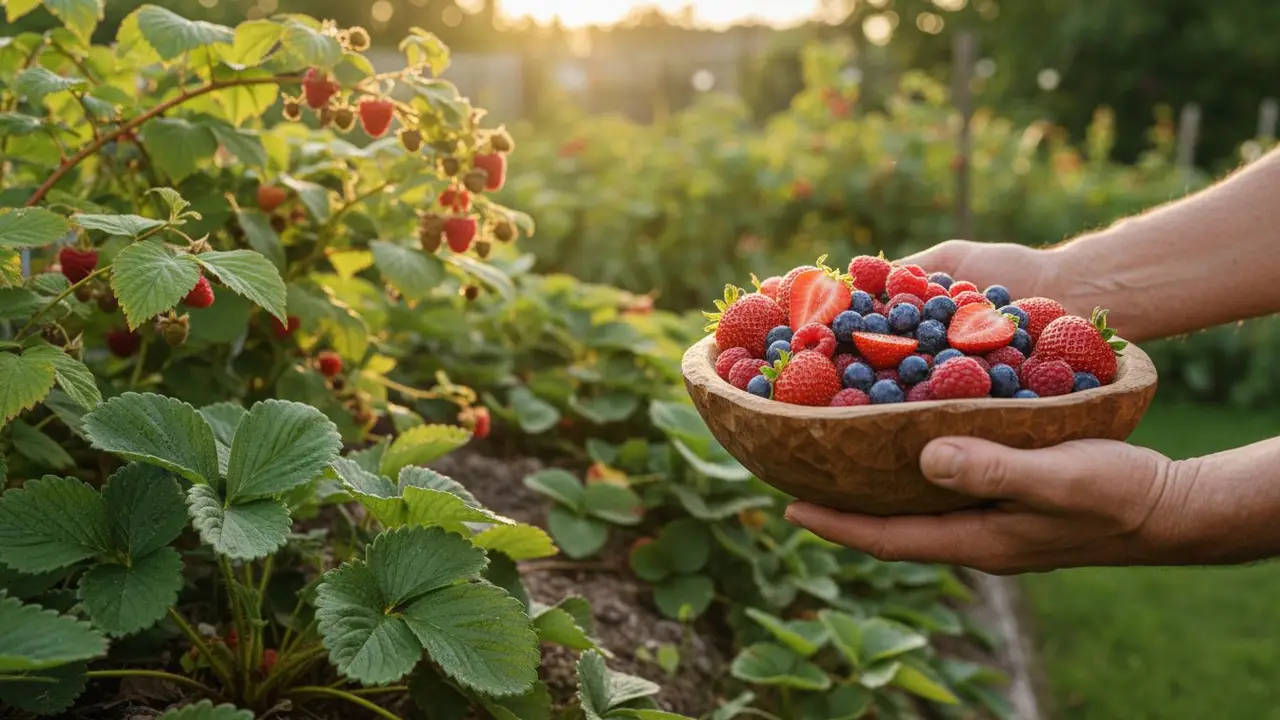
If you want to grow your own fruit and are not sure where to begin, begin with berries. Growing berries is the fastest, easiest, and most rewarding way into home fruit growing, and it is where I always tell new gardeners to start. Where a fruit tree can make you wait years for a harvest, a strawberry plant will hand you ripe fruit its very first summer, and a few berry plants tucked into a corner will feed you for years to come. Berries are compact enough for the smallest yard, several of them thrive in containers, and once established they mostly look after themselves. This guide introduces the four easiest berries to grow and exactly how to succeed with each.
Why Berries Are the Best First Fruit
Berries earn their place as the beginner's fruit for several reasons. They are fast: strawberries fruit within a single season, and brambles and blueberries within a year or three, compared to the many years a fruit tree can take to bear. They are compact and forgiving of small spaces, fitting into a corner bed, along a fence, or in a pot on a patio. And because they are perennials, you plant them once and harvest for many years, which makes them a natural first layer of a perennial, food-forest-style garden. On top of all that, berries are expensive and fragile to buy, so a homegrown supply is one of the highest-value crops you can grow, and the flavor of a sun-warm berry picked at perfect ripeness is simply not something you can buy.
Here is the quick version if you are deciding where to start: strawberries give you fruit fastest and are the most beginner-proof, blueberries are the most demanding about soil but the most low-maintenance once established, and brambles are the most productive but the most vigorous and space-hungry. Most gardeners end up growing all three, and there is no wrong order in which to add them.
Strawberries: The Fastest Reward
Strawberries are the gateway berry, because they fruit the same year you plant them. My own love of growing fruit started with a small strawberry patch that was covered in berries by its first June, and I was hooked on the spot. There are two broad types to know: June-bearing strawberries deliver one big flush of fruit in early summer, while everbearing or day-neutral types produce smaller amounts spread across the whole season.
Give strawberries full sun and rich, well-drained soil, and set the plants at the right depth, with the crown right at the soil surface, since a buried crown rots and an exposed one dries out. As the University of Minnesota Extension notes in its guide to growing strawberries, a straw mulch keeps the fruit clean and off the damp soil, which is exactly how the berry got its name. Water consistently as the fruit swells, and expect to renew a bed every three or four years as the plants tire, propagating new plants for free from the runners they throw out. Strawberries also excel in containers, hanging baskets, and vertical towers, making them perfect for a balcony. Their one reliable enemy is birds, so be ready to net the ripening fruit. Our strawberry profile covers variety choices in more detail.
Blueberries: Worth Getting the Soil Right
Blueberries are wonderfully low-maintenance and long-lived once established, but they come with one non-negotiable demand that trips up more gardeners than any other: they require acidic soil, a pH of roughly 4.5 to 5.5. Plant them in ordinary soil and they will yellow, sulk, and slowly fade, which is exactly what happened to my first bushes until I tested the soil, discovered the pH was far too high, and corrected it. Michigan State University Extension's guidance on growing blueberries stresses this acidity above all else.
If your soil is neutral or alkaline, you have two good options: lower the pH over time with elemental sulfur, or, far easier, grow blueberries in large containers filled with an acidic potting mix, which sidesteps the problem entirely. Beyond pH, give them full sun, consistently moist but well-drained soil rich in organic matter, and an acidic mulch such as pine needles or bark. Plant at least two different varieties for cross-pollination and heavier crops, choosing types suited to your climate. Blueberries take a couple of years to hit their stride but then produce for decades, and they too need netting against birds. See our blueberry profile for variety and climate guidance.
Raspberries and Blackberries: Generous and Vigorous
The bramble fruits, raspberries and blackberries, are the most generous berries of all, capable of burying you in fruit from just a few plants. That vigor is also their catch: they spread by suckering and send up long canes, so they need a dedicated bed and some support. Grow them along a fence or a simple trellis, which keeps the canes tidy and the fruit easy to pick, and give them full sun and rich, mulched soil.
The one thing you must know is your type, because it dictates pruning. Summer-bearing brambles fruit on two-year-old canes: the cane grows one year, fruits the next, then dies and should be cut out. Everbearing or fall-bearing raspberries fruit on first-year canes in autumn and can simply be mowed to the ground each winter, which is far simpler. The University of Minnesota Extension's guide to growing raspberries is a clear reference for matching pruning to type. Thornless blackberry varieties make picking a pleasure, and once you have tasted a warm, just-picked raspberry, you will forgive the brambles their spreading ways.
Getting Any Berry Off to a Good Start
Whichever berries you choose, a few shared basics set them up to thrive for years.
- Full sun. Nearly all berries want six or more hours of direct sun for the sweetest, heaviest crops.
- Good soil. Berries reward rich, well-drained soil high in organic matter, so test it first, work to improve heavy clay, and build fertility the no-dig way with compost.
- Consistent water and mulch. Keep the soil evenly moist as fruit develops, and mulch heavily to hold moisture, suppress weeds, and, for strawberries, keep the fruit clean.
- Good plants and the right varieties. Start with healthy, certified disease-free plants, and choose varieties suited to your climate and hardiness zone.
- Netting. Birds love ripe berries as much as you do, so plan to drape bird netting over the crop as it colors up; I lost most of a strawberry harvest to birds one year before I learned this the hard way, and a few dollars of netting has protected every crop since.
Because berries are a long-term planting, site them thoughtfully and feed them each spring with compost or a balanced organic fertilizer. Plant most berries in spring, or in fall in mild climates, and fold them into your seasonal garden routine.
Berries for Small Spaces and Containers
You do not need an orchard, or even a yard, to grow berries. Strawberries may be the single best fruit for a balcony, spilling out of hanging baskets, stacked towers, and window boxes, and I keep a strawberry pot going right by my back door purely for the pleasure of grazing on it as I pass. Compact blueberry varieties grow happily in large containers of acidic mix, which neatly solves the soil-pH problem in one move. Even the brambles have caught up: modern thornless, compact raspberry and blackberry varieties are bred specifically for pots and patios. Trained up a vertical support or tucked into a container, berries put homegrown fruit within reach of nearly every gardener, no matter how little ground they have.
Beyond the Easy Four
Once the first berries have won you over, a whole world of home fruit opens up. Vigorous, easygoing plants like grapes, gooseberries, elderberries, and mulberries all reward a home grower, and a warm-climate fig is one of the great pleasures of a backyard. Together they form the productive shrub and vine layer of a diverse, perennial garden.
And when your berry plants start producing more than you can eat fresh, which they will, the surplus preserves beautifully: freeze berries on a tray for winter smoothies and baking, or turn them into jam through water-bath canning. My honest advice is to start this spring with a few strawberry plants, add a couple of blueberry bushes in pots and a raspberry or two along a fence, and let the harvests build from there. Few things in gardening pay off as quickly, or as deliciously, as a berry patch, and unlike an annual vegetable bed, it keeps giving back for years on the strength of a single planting. For more on growing food of every kind, our food forests library has a guide for each step.
Sources
- University of Minnesota Extension — Growing strawberries in the home garden
- Michigan State University Extension — Growing blueberries in the garden
- University of Minnesota Extension — Growing raspberries in the home garden
- Clemson Cooperative Extension (Home & Garden Information Center) — Strawberry
About the Author
Lucas is a writer and researcher focused on sustainable agriculture and permaculture practices.