
When people ask me for the secret to organic pest control, they usually want the name of a spray. I understand the impulse, but after years of growing food I've learned the spray is almost never the answer, and it's certainly never the first move. The gardens that stay healthiest through a long, buggy summer aren't the ones with the best chemical arsenal. They're the ones built as a system, where the soil is alive, the plants are diverse, and a whole crew of predators is doing the work I used to think was mine to do. Organic pest control is that system, and this guide is the map to it.
What I'm describing has a formal name: integrated pest management, or IPM. University Extension services and the US EPA have used the framework for decades on farms, and its logic scales down beautifully to a backyard. The idea is a layered hierarchy. You start with the cheapest, safest, most durable tactics, and you only climb to stronger interventions when the lower rungs aren't holding. Reaching for a bottle of anything, even an organic one, means the earlier layers had a gap. So let's build those layers from the ground up.
Start With the Soil and Plant Diversity
The most effective natural pest control for a garden happens before a single pest arrives. A stressed plant is a beacon. Aphids and mites in particular home in on soft, nitrogen-flushed, water-stressed growth, and a plant fighting for its life in poor soil simply can't defend itself the way a robust one can. So my first line of defense is dirt. I feed my beds with finished compost every season, and if you're not already making your own, my guide to composting at home is the single highest-return habit I can recommend for pest resistance. Living soil grows plants with the resources to produce their own defensive compounds and to shrug off the damage that would cripple a weaker neighbor.
The University of Maryland Extension puts it plainly: plant diversity reduces plant problems. A monoculture is a buffet with a neon sign. When you plant a solid block of one crop, a pest that finds it hits the jackpot and breeds without limit. Break that block up and you slow the pest down, confuse its search, and give predators a reason to stick around. This is the whole premise behind polycultures and companion planting, and it's why I never plant a long unbroken row of anything anymore. I interplant, I tuck herbs and flowers between vegetables, and I keep something blooming from spring through fall.
Rotation is the diversity principle stretched across time. Many of the worst offenders, from the Colorado potato beetle to root-dwelling grubs and soilborne diseases, overwinter in the ground right where their host grew. Plant the same family in the same spot next year and you've handed them breakfast in bed. Moving crops around each season, as I lay out in my piece on crop rotation, breaks those life cycles without any product at all. In my own garden, the first year I got serious about rotating my nightshades, my early-season potato beetle pressure dropped so noticeably that I stopped hand-picking by mid-June.
Identify the Pest Before You Do Anything
This is the step most gardeners skip, and it's the one the EPA puts near the very front of the IPM framework for good reason: many organisms in your garden are harmless, and some are actively helping you. Sighting a single bug does not mean control is needed. If you spray on sight, you will inevitably kill the predators that were about to solve your problem for free, and you'll be back out there next week fighting a worse outbreak because you cleared the field for the pests.
So I identify first, every time. I want to know exactly what I'm dealing with, because the correct response is completely different from one pest to the next. Chewed, ragged leaf edges point one way; stippled, silvery speckling from spider mites points another; the tiny shot-hole punctures of flea beetles point somewhere else entirely. Clustered, sap-sucking aphids call for a different playbook than the shield-shaped squash bugs hiding under my zucchini leaves, and the slimy trails of a slug problem have nothing in common with either. This overview is a map to the method; when you need to pin down exactly who is eating your plants and how to respond, follow the links to each specific pest page, where the identification cues and species-specific tactics live.
The same discipline applies to diseases, which people constantly mistake for insect damage. The white dusting of powdery mildew, the concentric brown target-spots of early blight, and the fast, greasy collapse of late blight are all fungal problems that no insecticide will touch. Spraying neem at a fungus wastes your time and money. Correct identification tells you whether you even have a pest problem to begin with, and it's the fork in the road that determines everything downstream.
Accept a Little Damage as Normal
Before we go further, a mindset shift that took me years to accept. The goal of organic pest control is not a spotless, insect-free garden. That garden doesn't exist, and chasing it will drive you to overspray and wreck your own ecosystem. The goal is to keep pest numbers below the level where they cause damage you actually care about. Maryland Extension notes that most healthy herbaceous and woody plants can tolerate 20 to 30 percent leaf loss without any long-term harm. A few holes in the outer leaves of my kale are not an emergency; they're the price of admission. I keep a rough action threshold in my head for each crop, and I don't intervene until a pest crosses it. Some chewed leaves also keep a resident predator population fed and on patrol, which is exactly what I want.
Prevention and Physical Barriers
Once I know what I'm dealing with and I've decided it's crossed the line, my next layer is physical, not chemical. The most reliable tool in this category is the floating row cover: lightweight fabric laid over the crop that simply denies the pest access. It's my go-to for anything that arrives predictably. I cover young brassicas against cabbage moths and my squash and cucumbers early in the season against squash bugs and cucumber beetles. Timing is the whole game, and I walk through it in detail in my guide to using row covers. The one rule you cannot forget: any crop that needs pollination has to be uncovered once it flowers, or you've traded a pest problem for an empty harvest.
Physical control also means using your hands. Hand-picking is unglamorous and genuinely effective for larger, slower pests. I drop potato beetles and squash bugs into a jar of soapy water during my morning walk-through, crush the neat little rows of bronze eggs I find on leaf undersides, and set out simple traps for slugs. Ten minutes of this a few times a week, early in an infestation, does more than any spray I own. Good sanitation belongs here too: I clear out heavily infested debris and, as I cover in my piece on preventing plant disease, I never compost material showing signs of blight or mildew, because that's how you seed next year's outbreak.
Invite the Predators to Do the Work
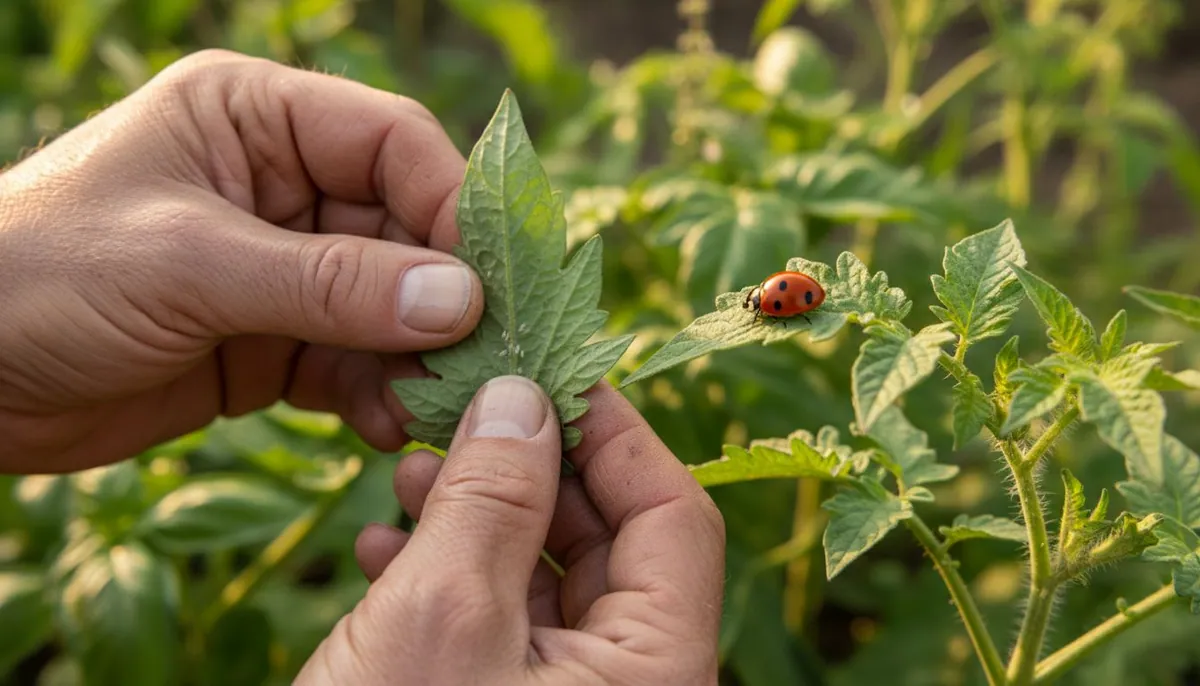
This is my favorite layer, because once it's established it runs itself. Every pest in your garden has natural enemies, and a well-designed organic garden is really just a place that keeps those enemies fed, housed, and reproducing. Lady beetles and their alligator-like larvae, lacewings, hoverflies whose maggots devour aphids by the hundred, tiny parasitic wasps, ground beetles that patrol the soil at night for slugs and cutworms, and predatory mites are the real pest control crew. My job is simply not to get in their way and to give them what they need.
What they need, mostly, is nectar, pollen, and shelter. Adult hoverflies and parasitic wasps feed on small flowers even though their offspring are voracious predators, so I keep a steady supply of umbrella-shaped and tiny-flowered blooms going all season: dill, fennel, cilantro left to bolt, yarrow, sweet alyssum. I leave a few messy corners and some undisturbed ground for beetles to overwinter. I explain how to build this standing army in my guide to beneficial insects, and it connects directly back to that diversity principle from the start. The reason I refuse to reach for a broad-spectrum spray at the first sign of trouble is right here: those sprays are indiscriminate, and they kill your allies faster than your enemies. In my experience, the aphid colonies that look alarming in late spring are usually crawling with lady beetle larvae within a week or two if I just leave them alone and let the cavalry arrive.
Targeted Organic Pest Control: The Last Resort
Only now, at the top of the ladder, do we talk about actually spraying something, and even here the watchword is targeted. The whole point of climbing through prevention, identification, barriers, and predators first is that by the time you reach for a product, you're using the narrowest possible tool for a specific, correctly-identified problem, not carpet-bombing your ecosystem. According to Clemson's Home and Garden Information Center, these lower-toxicity materials are effective while posing relatively low risk to people and, used carefully, to many beneficial insects.
- Insecticidal soap. Fatty acids that break down the outer coating of soft-bodied pests, causing them to dehydrate. It's my choice for heavy aphid, mite, thrip, and whitefly infestations. It only works on direct contact, so thorough coverage, including leaf undersides, is everything. It has no lasting residue, which is good for predators and means you may need to repeat it.
- Horticultural oil. Works by smothering insects and their eggs. Effective on the same soft-bodied crowd. Clemson advises against applying it in extreme heat, roughly above 90°F, to avoid scorching foliage.
- Neem oil. Derived from the neem tree, it acts as both a contact insecticide and a growth disruptor against aphids, whiteflies, mites, thrips, and scale crawlers, and it has some suppressive effect on fungal issues too. I cover its proper use and limits in my guide to neem oil.
- Bt (Bacillus thuringiensis). A naturally occurring soil bacterium that is toxic only to caterpillars when they eat treated leaves, with essentially no effect on other insects, birds, or mammals. This is the precision tool. When a cabbage looper or hornworm is stripping a plant, Bt targets it and leaves everything else, including my bees and lady beetles, untouched. It must be eaten to work, so coverage on the leaves the caterpillars are chewing matters.
- Spinosad. Another soil-bacteria product, effective on caterpillars, leaf miners, thrips, and some beetles. One critical caution from Clemson: spinosad is toxic to bees, so never apply it to plants in bloom, and spray only in the evening after pollinators have gone home.
That last warning applies to every product on this list, even the gentle ones. Spray at dusk, spot-treat the affected plant rather than the whole garden, never spray open flowers, and always read and follow the label. The organic label on a bottle does not mean harmless. It means you've reached the top of a ladder you should have been reluctant to climb, and the discipline that got you there, healthy soil, real diversity, honest identification, physical barriers, and a thriving crew of predators, is what makes the rare trip to the sprayer so effective when you finally take it. Build the system, and the pests become a manageable background hum rather than a crisis. For the specific bug or blight in front of you right now, follow the links throughout this guide to the pest and disease pages, where the detailed identification and species-by-species tactics live.
Sources
- US EPA — Integrated Pest Management (IPM) Principles
- University of Maryland Extension — IPM: Prevent, Identify, and Manage Plant Problems
- Clemson Cooperative Extension HGIC — Less Toxic Insecticides for Garden and Landscape Pest Control
- University of California Statewide IPM Program — What Is Integrated Pest Management?
About the Author
Lucas is a writer and researcher focused on sustainable agriculture and permaculture practices.