
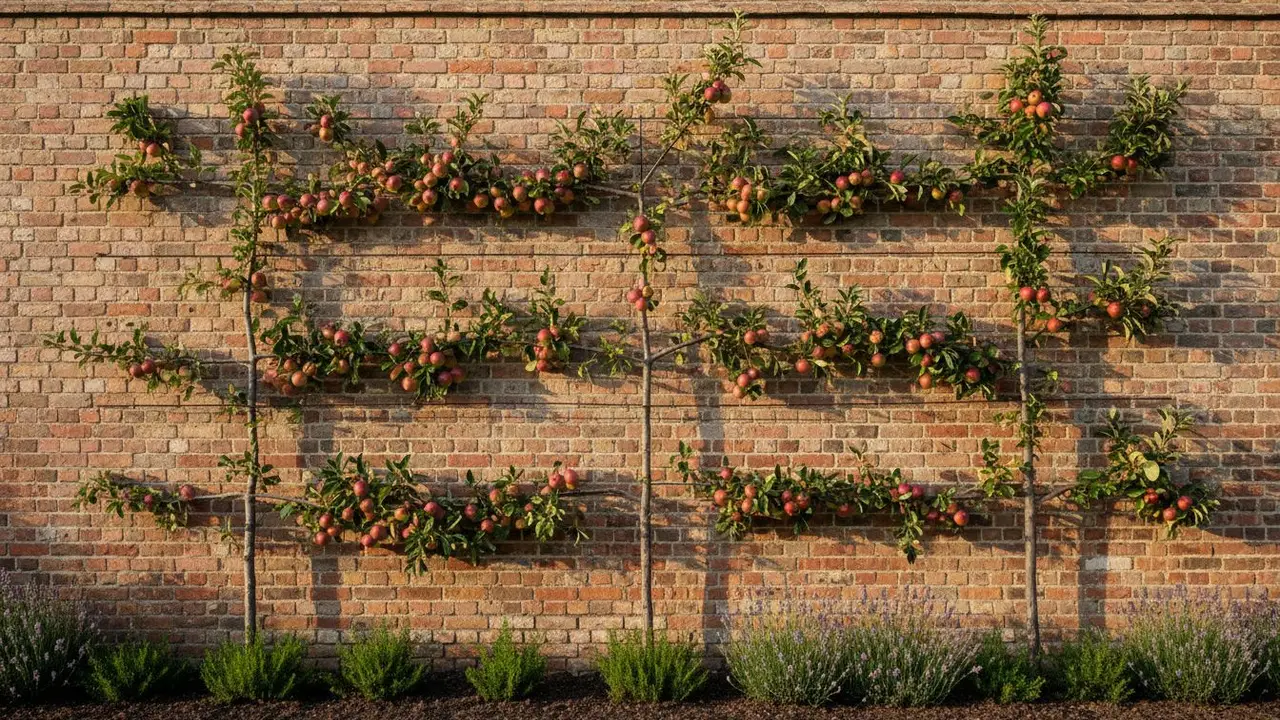
Espalier, pronounced ess-PAL-yay, is the centuries-old art of training a fruit tree to grow flat, in a single plane, against a wall, fence, or trellis. It is one of the most elegant and space-saving ways to grow fruit that exists: a full crop of apples or pears from a tree just inches deep, spread along a wall where an ordinary tree could never fit. I grew my first espalier along a sunny fence out of pure necessity, in a strip too narrow for anything else, and it became not only productive but the most beautiful feature in the whole garden. Beyond the beauty and the space savings, a warm wall gives the tree a microclimate that ripens fruit earlier and better. Espalier asks for patience and a yearly touch of pruning, but the reward is living architecture that feeds you for decades. This guide covers what espalier is, the best plants and patterns, and how to start and maintain one.
What Is Espalier, and Why Do It?
To espalier a tree is to train it two-dimensionally against a support, using pruning and tying to hold its branches in a flat, often formal pattern. The technique is ancient, refined in medieval monastery gardens and grand European estates, and it delivers several real advantages to a modern home gardener, as Michigan State University Extension notes in its guide to espalier as a space-saving way to grow fruit.
- Space. An espalier grows in a strip a foot or less deep, so you can raise fruit along a wall, a fence, a path edge, or as a living divider, in gardens far too small for a standard tree. It is a superb fit for urban and small-space growing.
- Warmth. A south- or west-facing wall soaks up the sun and radiates that heat back, creating a warm microclimate that ripens fruit earlier and can let you grow marginal, heat-loving fruits like figs in a cooler climate. The wall also shelters early blossom from a late frost. My wall-trained apple ripens a solid week or two ahead of the same variety out in the open garden, purely on the strength of that stored heat.
- Access and health. With every branch held flat and at arm's reach, an espalier is wonderfully easy to prune, thin, net, and pick, and its open, evenly lit form grows clean, high-quality fruit.
- Beauty. An espalier is living sculpture, its blossom and fruit displayed along a graceful framework. It is as much a garden ornament as a crop.
The Best Plants and Patterns
Not every fruit takes to espalier equally. The classic and most forgiving subjects are apples and pears, because they fruit on long-lived short spurs along their older wood and tolerate the regular training cuts. Choose a dwarf or semi-dwarf rootstock so the tree stays in scale. Stone fruits such as cherries and plums, along with figs and even persimmons, can be trained too, usually as a fan rather than a tiered form, and grapevines are natural wall subjects on wires.
Espalier patterns range from simple to spectacular:
- Cordon: a single straight stem, often planted at an oblique 45-degree angle, hung with fruiting spurs. It is the simplest form and lets you fit many varieties into a short run of fence.
- Horizontal tiered: the iconic espalier, a central stem with pairs of horizontal arms at even intervals, like the rungs of a ladder. This is the best pattern for a beginner working with apples or pears.
- Fan: branches radiating out like the ribs of a fan from a short trunk, the traditional choice for stone fruit and figs.
- Ornate forms like the candelabra, palmette, and the interwoven Belgian fence reward the ambitious with true living lattice.
How to Start an Espalier
Begin with a sturdy support and a young tree. Run strong horizontal wires along your wall or a freestanding post-and-wire frame, spacing them roughly fifteen to eighteen inches apart for a tiered form, and, on a solid wall, hold the wires a few inches off the surface so air can circulate behind the tree. Start with an unbranched young "whip," which you will train from scratch, or buy a partly trained espalier to get a head start.
One siting detail matters especially: plant the tree six to eight inches out from the base of a wall rather than right against it, because the ground hard against a wall sits in a dry "rain shadow." I ignored this with my first tree, tucking it too close under the eaves, and it struggled with drought until I moved my watering out and mulched well. Otherwise, plant it like any fruit tree, in full sun and well-drained soil.
Training a tiered espalier then follows a simple yearly rhythm. In the first winter, cut the whip back to just above the lowest wire, leaving buds to form the first tier. As growth begins, train the topmost shoot vertically up toward the next wire and tie the two shoots below it out along the first wire, starting them at a gentle angle and lowering them to horizontal by season's end to slow them and encourage fruiting spurs. Each year you repeat the process at the next wire up, building one new tier at a time until the framework is complete, which typically takes three to five years. Throughout, tie the growing shoots to the wires with soft ties and bend them gently; never force a branch, or it will snap.
Maintaining an Espalier
Once the framework is built, an espalier is kept in shape mainly by summer pruning, and this is the key that unlocks the whole technique. Because the goal is to restrain growth into a flat plane and coax the tree into forming fruiting spurs rather than long shoots, most espalier pruning happens in mid-to-late summer, when, as I cover in my guide to pruning fruit trees, cutting has a calming, growth-slowing effect. Shorten the new shoots growing off the arms back to a few leaves each summer, and over time they build the short, productive spurs that carry your fruit. I spent my first couple of years trying to shape my espalier in winter and getting nothing but leggy regrowth for my trouble; switching to summer pruning was the moment it finally settled into a tidy, fruitful frame.
In winter, do only light structural work, removing anything growing straight out from or behind the flat plane and tidying the framework. Beyond that, care for an espalier as you would any fruit tree: keep it watered, especially in that wall-side rain shadow, feed it lightly, thin a heavy fruit set, and net it against birds. It is a long game, but a patient one, and once established it produces for decades.
How Much Fruit, and How Long?
It is fair to ask what all that patience actually buys you. An established tiered apple or pear espalier of four or five tiers can produce a genuinely useful crop, often a bushel or more from a single wall-trained tree, and because the fruit is so evenly lit and so easy to tend, its quality tends to be excellent. The trade-off is time: expect three to five years to build the framework and reach full production, though starting with a partly trained tree from a specialty nursery shortens that considerably. It helps to think of an espalier the way you would any fruit tree or a berry patch, as a long-term planting that, once established, repays a modest yearly effort with decades of fruit. The years spent training are not a delay so much as the price of admission to one of the most productive square yards in the whole garden.
Espalier in the Small-Space Garden
Espalier is, above all, the small-space gardener's secret weapon for growing fruit. A productive apple or pear trained along a boundary wall or run as a living fence takes almost no ground at all, which makes it a natural companion to container growing and other vertical techniques for wringing a real harvest from a tiny plot. A Belgian-fence espalier can even serve as an edible garden divider, beautiful from both sides and dripping with fruit. It pairs perfectly with a bed of berries to give even the smallest garden a genuine mix of home fruit.
My honest advice is to start simple and start now. Pick a sunny wall or fence, run two or three wires, and set a young apple or pear whip against it to train as a basic horizontal tier. The framework will look sparse for a season or two, and then it will fill in and become the thing visitors ask about first. Few projects in a garden combine beauty, productivity, and clever use of space quite like an espalier. For more on growing food of every kind, our food forests library has a guide for each step.
Sources
- Michigan State University Extension — Espalier, a space-saving way to grow fruit
- Utah State University Extension — Espalier
- Iowa State University Extension and Outreach — Espalier fruit trees
- Royal Horticultural Society (RHS) — Espalier fruit trees
About the Author
Lucas is a writer and researcher focused on sustainable agriculture and permaculture practices.