
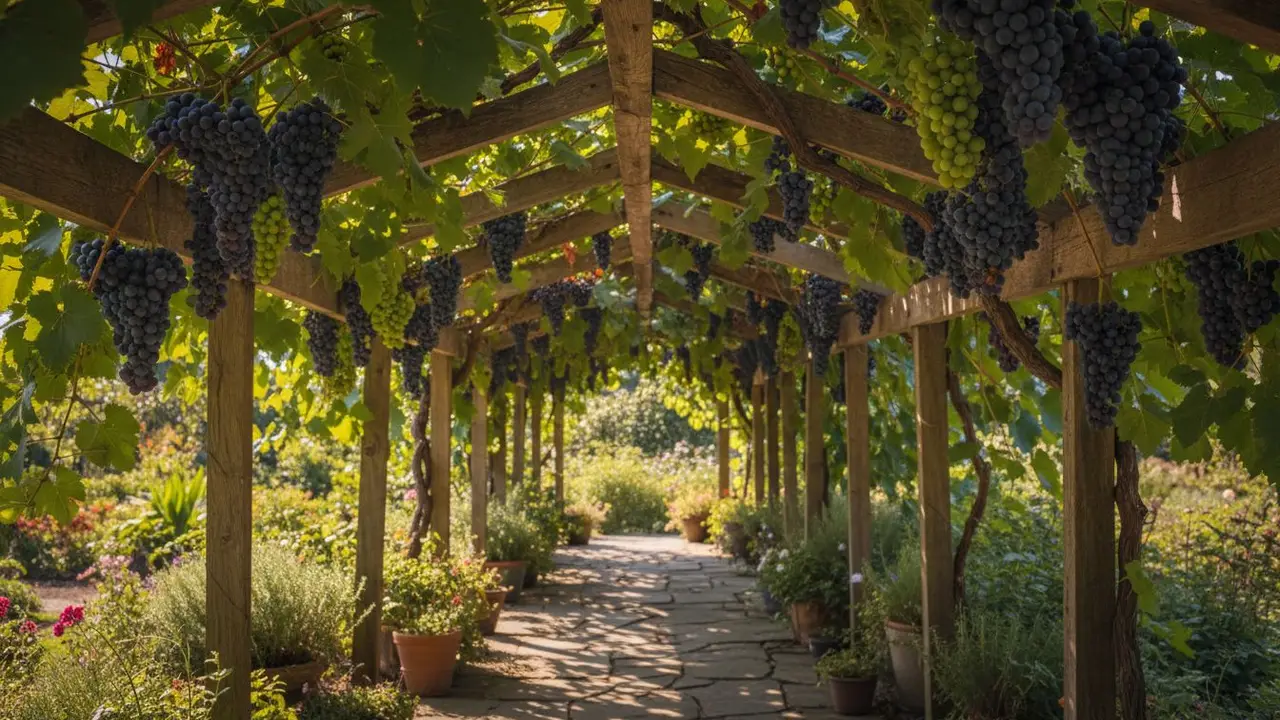
Few plants give a garden as much as a grapevine. Growing grapes at home rewards you with one of the most productive and long-lived fruits there is: a single well-tended vine can drape an arbor, throw welcome shade over a seating area, and hand you pounds of fruit every year for decades. My own grape arbor is the most multi-functional plant I grow, shading the patio through summer while dripping with clusters by September, and I would not garden without one. Grapes ask for full sun, a sturdy support, and one firm annual pruning, but beyond that they are tough, drought-tolerant, and generous. This guide covers choosing the right grapes, planting and supporting them, the all-important pruning that so many beginners get wrong, and keeping the vines healthy.
Choosing the Right Grapes
Success with grapes starts with matching the type to your climate, because grapes fall into a few distinct groups with very different needs. American grapes (the Concord type) are cold-hardy, disease-tolerant, and slip-skinned with a bold, foxy flavor that makes superb juice and jelly, which makes them the easiest and best choice for cold climates and for beginners anywhere. European or vinifera grapes are the classic wine and fine table grapes, but they are less cold-hardy and far more prone to disease. French-American hybrids split the difference, offering good flavor with more toughness, and muscadines are the grape of the hot, humid Southern United States, adapted to conditions that would defeat the others.
So choose by where you live: American grapes and hybrids for cold regions, muscadines for the humid South, and vinifera only where summers are warm and dry or you are willing to fuss. Most table grapes are self-fertile, so a single vine will crop, though a few muscadines need a pollinator partner. Our grape profile covers variety choices in more detail.
Planting and Support
Grapes are not fussy about soil, tolerating poor and rocky ground that would stunt other fruit, but they are absolute about two things: sun and drainage. Give them the sunniest spot you have, ideally seven or eight hours a day, because sun is what ripens the fruit and builds its sugar, and never plant them in soggy ground, since grapes will not abide wet feet. Good air circulation matters too, as it keeps the foliage dry and disease at bay, so a south-facing slope or wall is close to ideal. It is worth a quick soil test before planting.
Because grapevines are vigorous, they need a strong, permanent support built before or at planting. The options are the fun part: a simple two-wire trellis on sturdy posts is the workhorse; an arbor or pergola turns the vine into living architecture and summer shade; and a wall or fence puts the same vertical space to work, much like an espaliered fruit tree. Plant dormant, bare-root vines in early spring, spacing them six to eight feet apart, and cut each one back hard to just two or three buds so it pours its first year into building strong roots rather than top growth. Water through that establishment year, then ease off, since grapes are quite drought-tolerant once settled. A mulch helps, but go easy on nitrogen fertilizer, which pushes a jungle of leaves at the expense of fruit. Be patient with a young vine, too: you sacrifice fruit in the early years to build the framework, and a new vine usually gives its first real crop in its third year and reaches full production by year four or five.
Pruning Grapes: The Make-or-Break Skill
If there is one thing that separates a productive grapevine from a barren tangle, it is pruning, and grapes demand the hardest pruning of any common fruit. Here is the key fact that explains it: grapes bear fruit only on the new shoots that grow from one-year-old wood, that is, last season's canes. Wood any older than that will not fruit. So every winter you must cut the vine back drastically to renew that supply of young fruiting wood, typically removing around ninety percent of the previous year's growth. As the University of Minnesota Extension stresses in its guide to growing grapes, this severe annual pruning is essential; without it, a vine becomes a shady thicket of old wood that produces plenty of leaves and almost no grapes.
Prune while the vine is fully dormant in late winter. A vine pruned late will "bleed" sap from the cuts, which looks alarming but does little harm. The two common approaches are cane pruning, where you keep a few long fruiting canes from last year plus short renewal spurs for next year, and spur pruning, where you train permanent horizontal arms (cordons) along a wire and cut the side growth back to short two- or three-bud spurs each winter. Either way, the principle from my guide to pruning fruit trees applies in the extreme here: be bold. Under-pruning is the single most common grape-growing mistake, and I made it for years, too timid to cut hard and forever disappointed by the meager crop hiding in all those leaves. The season I finally pruned my vine the way the books insisted, hacking away most of it, the harvest multiplied.
Keeping Grapes Healthy
Grapes are vigorous but not invincible, and two challenges deserve attention. The first is fungal disease, since grapes are prone to powdery mildew, downy mildew, and black rot, especially in humid climates. Your best defenses are cultural: plenty of airflow through good spacing and hard pruning, thinning some leaves around the fruit clusters so sun and wind reach them, cleaning up fallen leaves and shriveled "mummy" fruit that harbor spores, and, above all, choosing disease-resistant American or hybrid varieties. These same principles run through my guide to preventing plant disease, and leaning on resistant varieties can spare you almost all spraying. The Concord-type vine on my arbor sails through our humid summers with barely a blemish, while a vinifera I once tried in the same spot was a mildew magnet by July; the choice of variety made all the difference.
The second challenge is competition for your ripe fruit. Birds will strip a vine the moment the grapes color up, and wasps and yellowjackets soon follow, so netting the clusters as they ripen is the reliable answer; I learned that the hard way after losing an entire crop to birds one September before I started netting. On young or overloaded vines, thinning some of the clusters early also improves the size and quality of those that remain.
Common Grape-Growing Mistakes
Most grape disappointments trace back to a short list of avoidable errors.
- Under-pruning. By far the most common. A timidly pruned vine is all leaf and little fruit, so be ruthless each winter.
- Too little sun. Grapes grown in part shade ripen poorly and stay sour; give them the sunniest spot you have.
- Overfeeding. Rich soil and heavy nitrogen grow rampant vines that refuse to fruit, since grapes actually crop best in lean ground.
- A flimsy support. A mature vine is heavy and long-lived, so build the trellis or arbor strong enough to hold it for decades from the very start.
- Forgetting the birds. An unnetted crop can vanish almost overnight the moment it ripens, so have the netting ready before the grapes color up rather than scrambling for it after the damage is done.
Harvesting and Using Your Grapes
One thing to know at harvest is that grapes do not ripen further once picked, so you cannot pull them early and hope. Judge ripeness by taste, backed up by full color, plump berries, and browned seeds, which usually comes in late summer or fall, and then cut the clusters whole. What you do with them is the happy part: eat them fresh, press them for juice, cook the classic jelly and preserve it by water-bath canning, dry them into raisins, or, if you are ambitious, make wine. The fresh clusters even keep for a few weeks in cool cellar storage.
A grapevine is one of the most rewarding and beautiful things you can grow, a plant that feeds you, shades you, and only grows more valuable with age. It slots naturally into the wider fruit garden alongside your berries and fruit trees, and a vine-draped arbor is a centerpiece worth building a garden around, giving you dappled shade to sit under and a canopy of fruit hanging within arm's reach overhead. My honest advice is to start with a single cold-hardy, disease-resistant variety on a good, strong support, commit to that hard yearly pruning, and be patient; within a few years you will be harvesting your own grapes from a plant that may well outlive you. For more on growing food of every kind, our food forests library has a guide for each step.
Sources
About the Author
Lucas is a writer and researcher focused on sustainable agriculture and permaculture practices.