
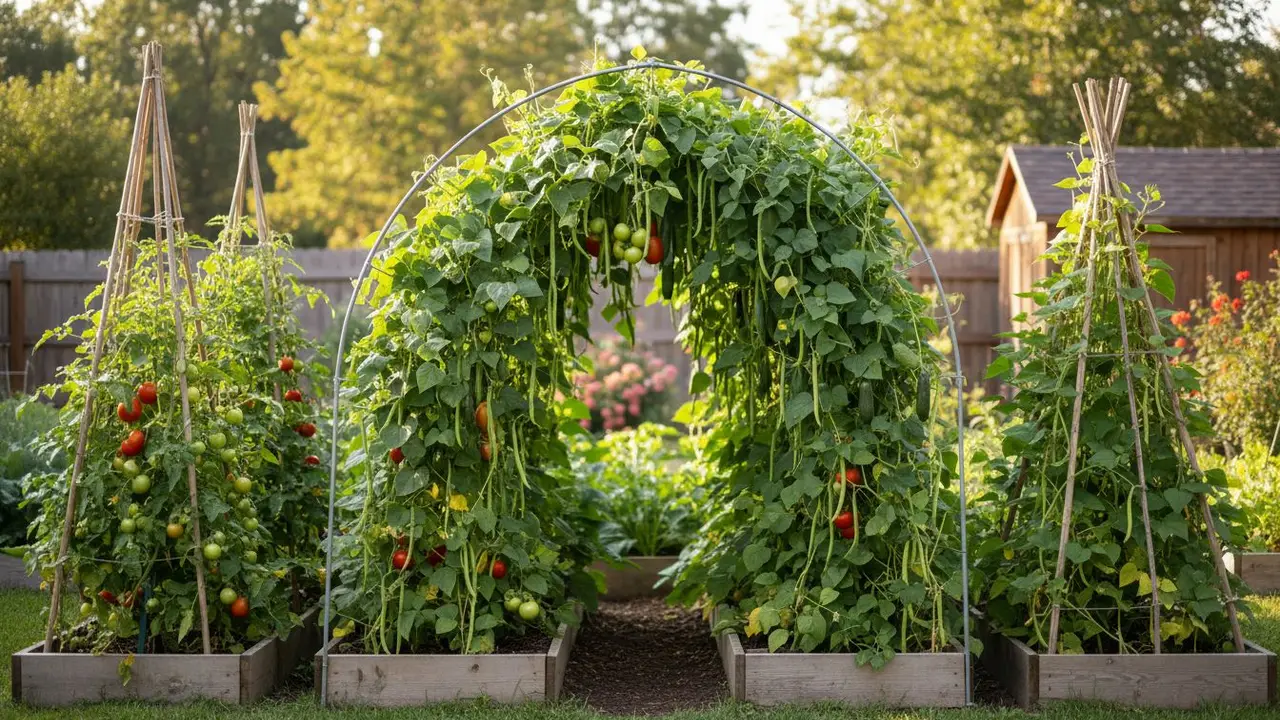
When you run out of ground, the answer is to grow up. Vertical gardening, training plants onto trellises, arches, towers, walls, and hanging baskets, is the single most powerful way to multiply the productivity of a small garden, balcony, or patio. A square foot of soil that would grow one sprawling squash plant flat on the ground can instead support a cucumber vine climbing eight feet into the air, yielding far more from the same footprint. But saving space is only part of the appeal. Growing vertically also makes for healthier plants and a cleaner, easier harvest, which is why I now trellis something in nearly every bed I plant. This guide covers why vertical gardening works so well, what to grow, the structures to grow it on, and how to do it successfully.
Why Grow Vertically?
The headline reason is space. By lifting crops off the ground and into the air, you dramatically increase the yield you can wring from a small plot, which is exactly why Michigan State University Extension frames vertical gardening as a way of maximizing small spaces. For anyone gardening in a tight yard, a container garden, or a balcony, it is the difference between a token harvest and a real one.
The benefits go well beyond square footage, though.
- Healthier plants. Lifting foliage off the ground and opening it to the breeze dramatically improves air circulation, which dries leaves faster and cuts down on the fungal diseases like powdery mildew that plague sprawling vines. The summer I trellised half my cucumbers and let the other half sprawl, the climbers stayed clean while the ground-level vines were coated in mildew by August; the difference was impossible to miss.
- A cleaner, easier harvest. Fruit that hangs in the open is easy to spot and pick, stays off the damp soil where it would rot, and is far less accessible to slugs. Harvesting a trellis at eye level also saves your back.
- More sun. A vertical plant presents more of its leaves to the light instead of shading itself in a tangle on the ground.
- Beauty and function. A living wall of beans or a grape-draped arch is gorgeous, and it can double as a screen for privacy or shade.
To put numbers on it, a teepee of pole beans occupying barely two square feet of ground will out-yield a whole long row of bush beans, and it keeps producing for months rather than in one flush. Even greedy, heavy crops can go up: I grow small melons on a sturdy trellis and cradle each ripening fruit in a sling made from an old mesh onion bag tied to the frame, so the vine carries the weight and the melon never touches the soil to rot. Once you start thinking in three dimensions, a small garden suddenly holds far more room than you ever thought it did.
What to Grow Vertically
Many crops are natural climbers, and a few need a little help, but the vertical garden is surprisingly full.
- Self-climbing crops grab onto a support with tendrils or twining stems and need almost no help: pole beans, peas, cucumbers, small melons, grapes, and cheerful nasturtiums.
- Crops you tie up do not climb on their own but grow tall and are easily trained onto a support, above all indeterminate tomatoes, which produce far more, and cleaner fruit, up a stake or string than in a cage.
- Heavy-fruited vines like larger melons and squash can grow up too, but their fruit needs a sling of netting or cloth tied to the frame to bear the weight.
- Trailing crops flip the idea and spill downward beautifully from hanging baskets and towers: strawberries, cherry tomatoes, trailing herbs, and ornamental sweet potato vines.
Vertical Structures, From Simple to Ambitious
The structure can be as humble or as grand as you like, and half of them can be built from things you already own.
- Trellises and netting. A flat panel, an A-frame, a section of lattice, or trellis netting strung between posts gives climbers something to grab. My favorite of all is a cattle-panel arch: a single livestock panel bent between two beds into a walk-through tunnel, which becomes a shaded archway dripping with beans and cucumbers you pick from both sides. It is the best structure I have ever built.
- Teepees and tripods. Three or more bamboo poles or straight branches lashed together at the top make a classic, sturdy support for beans and peas, and they fit neatly into a bed or a large pot.
- Stakes and cages. Simple stakes with soft ties, or sturdy cages, hold up tomatoes and peppers.
- Arches and arbors. A permanent arch carries grapes, hardy vines, or gourds and turns a path into a feature.
- Walls, fences, and hanging systems. Put existing vertical surfaces to work with wall pockets, a repurposed pallet stood on end, stacked planters, a strawberry tower, or hanging baskets. These are the heart of balcony and urban growing, where every wall is potential garden.
Build It From What You Have
One of the most satisfying things about vertical gardening is how little it needs to cost, which fits the permaculture habit of putting what is already at hand back to work. Some of my most productive supports were free. A salvaged wooden pallet stood on end against a fence and planted through its slats grows strawberries and greens. An old wooden ladder makes a charming frame for squash vines, and a discarded metal headboard becomes an instant trellis for peas. Sturdy branches pruned from a tree lash into bean poles, and a length of cast-off fencing or cattle panel does the work of a store-bought trellis for nothing. Before you buy a single thing, look around your yard, garage, and the curb on trash day, because a vertical garden is really just plants plus something to climb, and that something is very often already lying around unused.
How to Garden Vertically Successfully
Growing up asks for a little forethought, and a few habits make the difference between a thriving vertical garden and a collapsed one.
- Anchor everything firmly. A mature trellis loaded with vines is heavy and catches the wind like a sail. I once lost a beautiful bean teepee to a summer storm because I had barely pushed the poles into the soil; now I sink posts deep and brace them well. Build for the weight and wind of a full-grown, fruit-laden plant, not the bare frame.
- Put supports in at planting. Install the trellis or stake when you sow or transplant, so you do not tear through roots adding it later.
- Guide and tie gently. Some climbers need a nudge to find their support; weave young stems in, and tie trained crops loosely with soft material in a figure-eight so you never strangle a growing stem.
- Mind the shadow. Tall structures cast shade, so place them on the north side of a bed to avoid shading shorter crops, or use that shade deliberately to grow cool-season greens through the heat of summer.
- Water and feed well. Vertical and container-grown plants work hard and dry out fast, so keep them well watered, ideally with drip irrigation, and fed to support all that growth.
Vertical gardening also stacks beautifully with other space-saving techniques. The ground beneath a trellis is often lightly shaded, so it makes a perfect spot to tuck a quick, shade-tolerant crop through succession planting, wringing two harvests from a single square foot.
Growing Up in Small Spaces
Vertical gardening is what turns a cramped space into a genuinely productive one. A balcony railing hung with trellised cucumbers, a tower of strawberries in a corner, a wall of pocket-planted herbs, these are how urban and small-space gardeners grow real food where there seems to be no room at all. And the technique is just as valuable in a large garden or a raised bed, where growing up keeps sprawling crops tidy, healthy, and easy to pick, and frees the ground you save for another crop entirely. Vertical space is the one dimension most gardens leave completely empty, and claiming it is like discovering a second garden you did not know you had.
My honest advice is to start with one structure and let it sell you on the idea. Bend a cattle panel into an arch over a path, or lash together a simple bean teepee in a sunny corner, and plant it thickly with beans or cucumbers. By midsummer you will be walking through a green tunnel picking dinner, and you will start looking at every fence, wall, and railing as one more place to grow. For more on growing food in any space, our gardening library has a guide for every step.
Sources
- Michigan State University Extension — Vertical gardening: maximizing small spaces
- Michigan State University Extension — Gardening vertically
- Utah State University Extension — Vertical Gardening
- University of Illinois Extension — Vertical Gardening
About the Author
Lucas is a writer and researcher focused on sustainable agriculture and permaculture practices.