
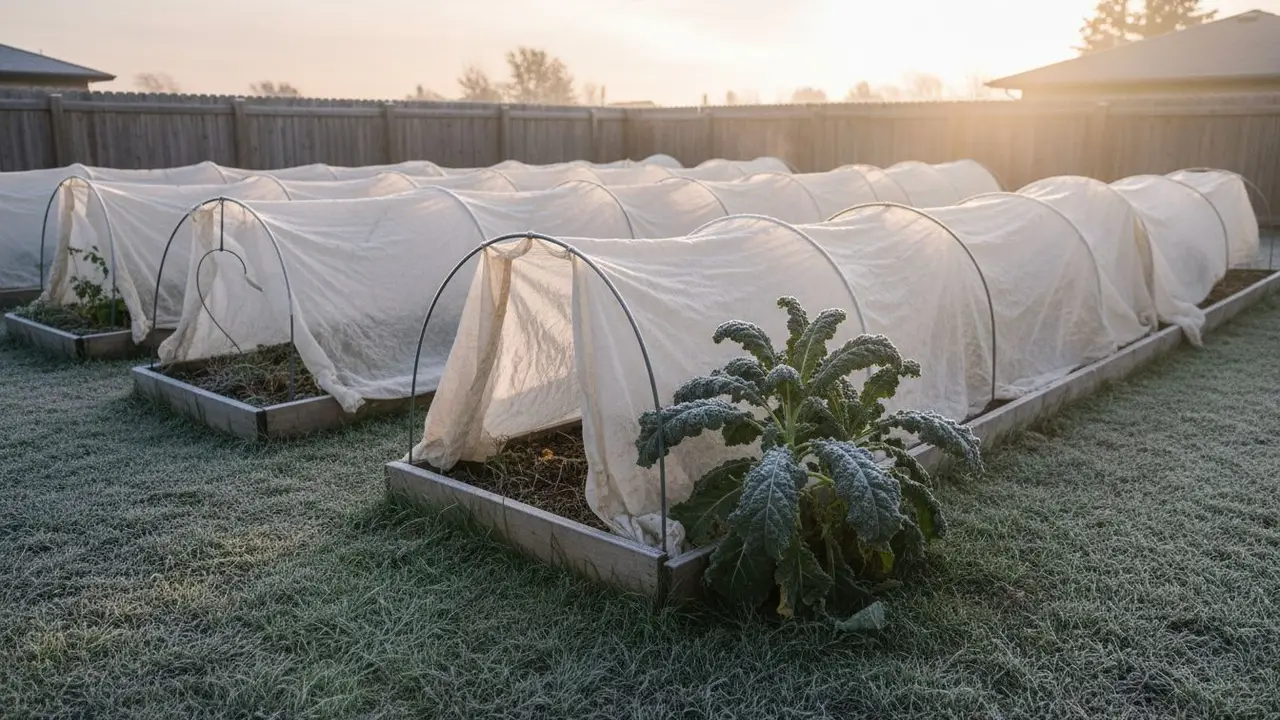
Two dates quietly rule a gardener's entire year: the average last frost of spring and the average first frost of fall. Everything in between is your growing season, and knowing those frost dates, along with how to shield plants when a frost threatens, is one of the most useful skills you can learn. I found that out the hard way when an early autumn frost I never saw coming flattened a whole bed of tomatoes and basil overnight. Since then I have made friends with frost, and it has stopped being a threat and become a tool. This guide covers the difference between frost and a freeze, how to find and use your frost dates, and exactly how to protect your plants when the temperature drops.
Frost vs. Freeze, and Why It Matters
People use the words interchangeably, but they are not quite the same. A frost is the ice you see form on surfaces when they cool to freezing, which often happens on clear, calm nights even when the air a few feet up is a degree or two above 32°F. A freeze is when the air temperature itself drops below freezing, and it is the more damaging of the two, because ice forming inside plant cells ruptures them.
It also helps to know that most damaging frosts are what meteorologists call radiation frosts: they happen on still, cloudless nights when the day's heat radiates away from the ground into a clear sky. Those are the nights you can do the most to protect against, because trapping that escaping ground heat makes a real difference. A windy freeze driven by a cold air mass is far harder to fight. Michigan State University Extension's guidance on protecting plants from frost and freezing temperatures is a good primer on the distinction.
What a frost means for your garden depends entirely on the crop. Frost-tender plants like tomatoes, peppers, basil, cucumbers, and squash are killed by the first touch of frost. Cold-hardy crops like spinach, cabbage, and carrots shrug it off, and some even improve, which I will come back to.
How cold is too cold?
Not all frosts are equal, and the temperature tells you how worried to be. A light frost, roughly 29 to 32°F, will kill tender summer crops but leaves hardy vegetables untouched. A hard or killing freeze, around 25 to 28°F, damages or ends many semi-hardy crops and pushes even the tough ones toward the end of their run. Below about 24°F, a severe freeze takes all but the most cold-adapted plants and anything that is well protected. This is why the same forecast of "frost tonight" can be a shrug or an emergency depending on what you are growing and exactly how low the temperature dips. When in doubt, protect: it is far easier to cover a bed you turned out not to need to than to replace a crop you lost.
Know Your Frost Dates
Your average last spring frost and average first fall frost bracket your frost-free growing season, and they are the anchor for nearly every planting decision you make. You can look yours up by ZIP code through NOAA's National Centers for Environmental Information freeze-and-frost data, your local Extension office, or an online frost-date calculator.
One crucial caveat: these dates are averages and probabilities, not guarantees. A "last frost date" usually marks the point after which there is only a small chance of frost, which means frost can and sometimes will fall on the wrong side of it. So treat your dates as a planning guide and always watch the actual forecast in the risky weeks.
It is also worth clearing up a common confusion between frost dates and your USDA hardiness zone. The USDA Plant Hardiness Zone Map is based on the average coldest winter temperature, and it tells you which perennials will survive your winters. Frost dates are a different measurement entirely, describing the length of your frost-free season for annual crops. You need both: the zone for "will this shrub live through winter," and the frost dates for "when can I plant tomatoes."
Mind your microclimates
Frost is not uniform across a yard, and this is something every gardener should map. Cold air is heavy and flows downhill like water, pooling in low spots to create "frost pockets" that freeze weeks before the rest of the garden. Meanwhile, ground near a south-facing wall or under a tree canopy stays warmer. On my own place there is a low back corner that frosts long before anywhere else; once I stopped planting tender crops there, my losses dropped sharply. Learn where your garden's cold and warm spots are and plant accordingly.
Using Your Frost Dates to Plan
Once you know your two dates, the whole season falls into place. In spring, you count backward from the last frost to time your indoor seed starting, and you wait until after that date, when the soil has also warmed, to set tender crops outside. Through the season, the first fall frost is the target you count back from for fall and succession plantings. And the first frost marks the hinge of the year, the moment tender crops end and cold-hardy winter gardening begins, with anything you cannot protect getting harvested and stored instead.
How to Protect Plants from Frost
When a frost is in the forecast and you have tender plants still out, a few simple tactics can save them, especially on those still, clear radiation-frost nights.
- Cover before dusk. The goal is to trap the day's heat that is stored in the soil, so cover plants in the late afternoon, before that heat escapes. Row-cover fabric, old bedsheets, blankets, cardboard boxes, or upturned buckets all work. The cover must reach all the way to the ground to hold the warmth in, and ideally it should be held off the foliage on stakes or hoops, since leaves touching a frozen cover can still be damaged. Uncover in the morning once temperatures climb.
- Water the soil beforehand. Moist soil absorbs and releases far more heat than dry soil, so watering the ground the day before a frost, while the sun is on it, helps radiate warmth back up overnight. Well-hydrated plants also resist cold better than drought-stressed ones. The evening I first tried this before a surprise late frost, the watered, covered beds came through untouched.
- Mulch the roots. A layer of mulch insulates the soil and the crowns of your plants against the cold.
- Choose the cover wisely. Breathable fabric like a row cover or a cotton sheet is more forgiving than plastic, which conducts cold straight to any leaf it touches and can trap damaging heat if the sun comes out before you remove it. If plastic is all you have, keep it off the foliage on hoops and pull it back first thing in the morning.
- Move what you can. Bring container plants into a garage or indoors for the night.
- Use your warm microclimates. Tender plants tucked against a south-facing wall, under a tree canopy, or out of a frost pocket may escape a light frost entirely, since a wall radiates stored heat and an overhead canopy slows the loss of ground warmth to the sky.
An old bedsheet thrown over hoops has personally rescued my peppers through more than one surprise frost. For protection that lasts all season rather than a single night, this is exactly where the season-extension structures come in: a row cover, a cold frame, or a low tunnel provides ongoing frost defense, and Utah State University Extension's overview of frost protection covers the range of options in more depth.
Frost as a Friend
For all the worry it causes, frost is not purely an enemy. Many cold-hardy vegetables respond to a freeze by converting their starches into sugars as a natural antifreeze, which is why carrots, kale, and cabbage taste noticeably sweeter after the first hard frost. A frost is also your signal to shift gears, pulling the last tender crops, letting the hardy ones sweeten in place, and settling into the slower rhythm of the cold-season garden. Even your fall cleanup, from your fall garden preparation to planting garlic for next year, keys off that first frost.
Understanding frost is really about trading surprise for control. Look up your two dates and mark them on the calendar, learn your garden's cold corners, keep an eye on the forecast, and have a few old sheets ready for a surprise cold night. Do that and a frost stops being the thing that ends your season and becomes just another tool for shaping it. For more on stretching the garden through every season, our gardening library has a guide for each step.
Sources
- Michigan State University Extension — Protecting plants from frost and freezing temperatures
- Utah State University Extension — Frost Protection
- USDA — Plant Hardiness Zone Map
- NOAA National Centers for Environmental Information — Freeze/Frost Data
About the Author
Lucas is a writer and researcher focused on sustainable agriculture and permaculture practices.