
After years of growing food and medicine, I've come to believe that plant disease prevention is the single highest-leverage skill a gardener can develop. Not spraying. Not diagnosing. Preventing. Once a fungal or bacterial disease has taken hold of a plant, most of what we can do is damage control, and by then the pathogen is usually shedding spores onto everything nearby. The gardeners I know with the healthiest plots are not the ones with the biggest arsenal of sprays. They are the ones who quietly stacked the deck in their plants' favor months before any symptom could appear.
That is what this guide is about. Rather than walking you through how to treat a specific problem, I want to hand you the cultural playbook I actually use to stop disease before it starts. When you do need to identify something on a leaf, follow the links to our specific disease pages for diagnosis and treatment. Here, we stay upstream.
Why plant disease prevention beats treatment
Every plant disease needs three things to line up at once: a susceptible host, a pathogen capable of infecting it, and an environment that favors infection. Plant pathologists call this the disease triangle. Remove any one side and the disease cannot develop. That is genuinely good news, because as a gardener I have real control over at least two of those three sides. I choose the host. I shape the environment. The pathogen is often the only variable I can't fully eliminate, and even then I can starve it of the conditions it needs.
Cooperative Extension pathologists put it plainly: healthy, vigorous plants simply do not succumb to disease as readily as stressed ones. Most of what follows is about growing unstressed plants and denying pathogens the damp, crowded, dirty conditions they love. None of it is glamorous. All of it works.
Start with resistant varieties
The easiest disease to manage is the one your plant shrugs off. University of Missouri Extension calls resistant varieties "one of the best ways to manage plant disease in the garden," and I agree completely. When you read a seed catalog and see a string of letters after a tomato name, those codes tell you which diseases that variety was bred to withstand. A "VFN" tomato, for instance, carries resistance to fusarium wilt, verticillium, and nematodes.
One important caveat that trips up new gardeners: resistance is not immunity. A resistant variety is less likely to show symptoms and less likely to be knocked flat, but under heavy pressure it can still get sick. Think of it as a strong immune system rather than a force field. I still choose resistant varieties every chance I get, especially for diseases that are effectively incurable in a home garden, like late blight on tomatoes and potatoes. When you know a particular disease is common in your area, seek out varieties bred to resist it. It is the cheapest insurance in gardening.
Alongside genetics, start clean. Inspect transplants carefully above and below the soil line before you buy, and reject anything with suspicious spotting, wilting, or odd growth. If you start your own seedlings, use fresh sterile mix and clean containers so you don't invite damping off and gray mold into the seed tray before the season even begins.
Give plants room to breathe
If I had to name the one mistake that causes the most preventable disease, it would be crowding. Fungal and bacterial pathogens thrive when leaves stay wet, and leaves stay wet when air can't move through the canopy. Proper spacing is not wasted garden real estate; it is a disease-control tool.
In my own garden, the first summer I truly gave my tomatoes the spacing the seed packet asked for instead of cramming in two extra plants, my septoria leaf spot problem quietly shrank to almost nothing. The plants dried out by mid-morning instead of staying damp until noon, and that difference of a few hours is often the whole ballgame for foliar disease.
- Follow spacing recommendations so mature plants don't form one continuous wet mass of foliage.
- Trellis vining and sprawling crops. University of Minnesota Extension notes that trellises "provide better airflow through the canopy." Getting tomatoes, cucumbers, and pole beans up off the ground dramatically lowers powdery mildew and downy mildew pressure.
- Prune for airflow. Removing the lowest tomato leaves and thinning dense interior growth lets light and wind reach the middle of the plant.
- Weed diligently. Weeds crowd the canopy and can harbor the same pathogens and insect vectors that attack your crops.
Water the soil, not the leaves, and do it in the morning
How you water may be the most underrated lever in preventing fungal disease. Nearly every foliar pathogen I fight needs a film of surface moisture to germinate and infect. Overhead sprinklers give it exactly that, and they do it right on the leaf surface where the spores land.
So I keep water at the soil line. Drip irrigation and soaker hoses deliver moisture to the roots without wetting the foliage, and they're the backbone of my beds; if you're setting up a system, our guide to drip irrigation walks through the basics. When I do hand water, I aim the wand at the base of the plant rather than showering the canopy.
Timing matters just as much as method. I water early in the morning so that any moisture that does land on foliage burns off quickly in the sun. Watering in the evening leaves plants damp all night, which is an open invitation to black spot on roses and to gray mold everywhere. A second reason to keep the soil evenly moist rather than swinging between drought and flood: erratic watering is a direct cause of blossom end rot in tomatoes and peppers, which is really a calcium-uptake disorder driven by inconsistent moisture. And avoid waterlogging entirely, because saturated soil suffocates roots and feeds the root-rotting fungi that no spray can reach.
Mulch to stop soil splash
A lot of the worst tomato and potato diseases don't blow in on the wind. They overwinter in the soil and get splashed up onto the lowest leaves by rain and irrigation. That first splash is often the beginning of an early blight outbreak that then marches up the plant.
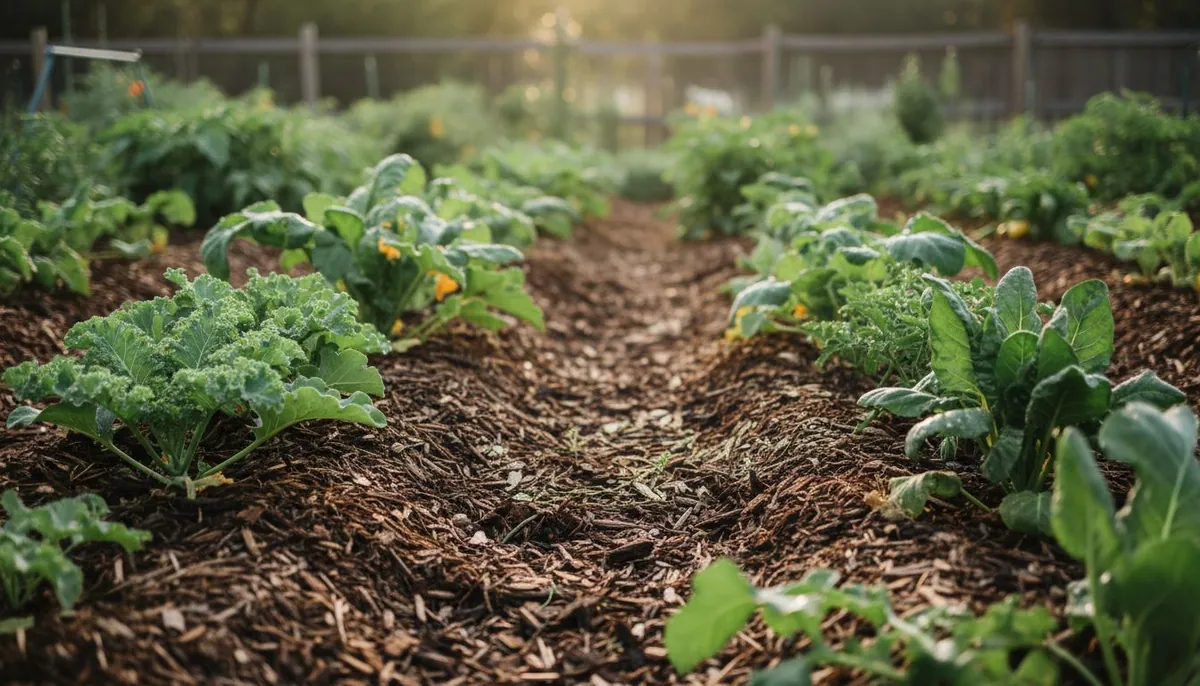
A layer of mulch breaks that cycle. University of Minnesota Extension is direct about it: mulch "prevents pathogens from splashing up from the soil." I keep a two- to three-inch blanket of straw or shredded leaves under my tomatoes, peppers, and squash, and it does double duty by holding soil moisture steady, which circles back to preventing blossom end rot. Our article on mulching the vegetable garden covers material choices and depth in more detail. The key is simply to put a physical barrier between contaminated soil and vulnerable foliage.
Sanitation: clean up, clean tools, clean hands
Pathogens are patient. Many of them survive the winter perfectly well in the debris of last year's diseased plants, waiting to reinfect this year's crop. Good garden disease control means denying them that refuge.
I keep a strict end-of-season habit: I remove and destroy diseased plant material rather than composting it. A hot, well-managed compost pile can kill many pathogens, but a lukewarm backyard pile often can't, and I'd rather not gamble by returning blight-laden vines to the very soil I'll plant in next spring. Healthy, disease-free trimmings are another matter and go straight into the pile; if you're building that system, here's how I compost at home. During the season I pull infected leaves promptly, and I do it when the plants are dry and no rain is coming, so I'm not spreading spores on wet hands as I work.
- Remove diseased tissue quickly and get it out of the garden entirely.
- Clean up at season's end. Extension services consistently rank removing crop residue and volunteers as one of the most effective ways to reduce next year's disease.
- Disinfect tools. I wipe down pruners between plants when I'm cutting out disease, and I wash shovels, cages, and stakes before storing them. Contaminated tools are a superb way to inoculate a whole bed.
- Mind your hands and shoes. Working wet, diseased plants and then moving to healthy ones spreads bacteria and fungi as surely as any insect does.
Rotate your crops
Crop rotation is prevention that plays out over years rather than weeks. The logic is simple: if a soilborne pathogen builds up under this year's tomatoes and I plant tomatoes in the same spot next year, I've served it a fresh host on schedule. Move the family somewhere else and I starve the pathogen of what it needs to survive.
SARE frames rotation as growing "non-host plants until the pathogen in the soil dies or its population is reduced." How long that takes depends entirely on the disease. University of Minnesota and Missouri Extension both recommend waiting about three years before returning solanaceous crops (tomatoes, peppers, potatoes, eggplant) to the same ground. Some pathogens are far more stubborn, though. SARE notes that fusarium wilts often need rotations of five to seven years, and verticillium can persist in the soil for over a decade thanks to durable resting structures. An honest reality check: rotation works beautifully against pathogens that live in crop debris, but true soil inhabitants like fusarium are hard to fully eliminate by rotation alone, which is exactly why it pairs so well with resistant varieties.
For a home garden, I keep it practical by grouping crops into families and never planting the same family in the same bed two years running. Our dedicated guide to crop rotation lays out a simple multi-year plan you can adapt to any layout.
Feed the soil, not just the plant
Underneath all of these tactics sits the foundation: living, healthy soil. A plant grown in biologically active soil with balanced nutrition and good drainage is a plant with a working immune system. It closes wounds faster, resists infection better, and recovers from stress that would tip a weaker plant into disease.
I keep a compost habit going year-round because organic matter is what feeds the soil food web, that vast community of bacteria, fungi, and other organisms that outcompete and suppress pathogens in the root zone. Well-structured soil also drains well, and drainage matters enormously; waterlogged soil is the single most reliable way to invite root rot. Where my drainage is marginal, I build up rather than fight it, using raised beds and generous amendment. I lean on compost and balanced organic inputs rather than heavy doses of quick synthetic nitrogen, which can push soft, sappy growth that sucking insects and fungi both love.
How prevention fits with pest control
Disease prevention and pest prevention are two halves of the same job. Many plant diseases, especially viruses, are carried plant to plant by insects like aphids, thrips, and leafhoppers, so keeping pest populations in check is also disease control. That's why I treat this prevention-first approach as the disease companion to my broader organic pest control strategy, both of which start with healthy plants and a balanced garden ecosystem rather than reaching for a bottle.
When I do need a targeted intervention on early-stage fungal issues, I'll sometimes reach for a horticultural oil; our overview of neem oil covers where it helps and where it doesn't. But I want to be clear that no spray substitutes for the cultural foundation above. Sprays are the exception I use when prevention has slipped, not the plan.
My prevention-first checklist
If you remember nothing else, remember that plant disease prevention is a stack of small, boring habits that compound. Here is the short version I run through every season:
- Choose disease-resistant varieties and start with clean seed and healthy transplants.
- Space and trellis for airflow so foliage dries fast.
- Water at the soil line, in the morning, and never leave plants soggy.
- Mulch to stop soil-borne pathogens from splashing onto leaves.
- Sanitize ruthlessly: remove diseased tissue, clean up in fall, disinfect tools.
- Rotate crop families on a multi-year cycle.
- Build living soil with compost, balanced nutrition, and good drainage.
Do these things and you will spend far less time diagnosing problems, because most of them will never appear. And when something does slip through, as it occasionally will in every real garden, head to our specific disease pages to identify it and decide on the right response. Prevention buys you a garden where those visits are rare.
Sources
- University of Minnesota Extension — Preventing plant diseases in the garden
- University of Missouri Extension — Disease Prevention in Home Vegetable Gardens (G6202)
- SARE — Managing Plant Diseases With Crop Rotation
- University of New Hampshire Extension — 10 Easy Steps to Prevent Common Garden Diseases
About the Author
Lucas is a writer and researcher focused on sustainable agriculture and permaculture practices.