
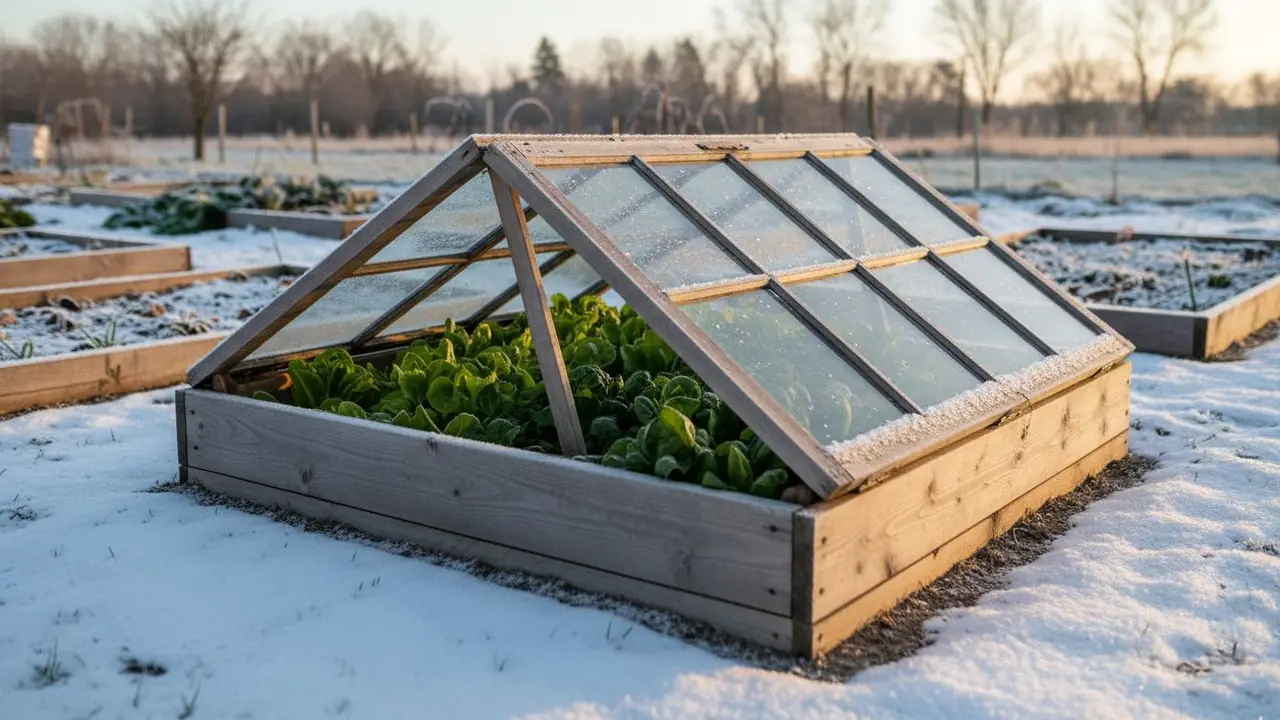
If I could give a new gardener just one tool for growing more food in more of the year, it would be a cold frame. This humble box, a bottomless frame topped with a clear lid, is the single most useful season-extension device I own, and it costs almost nothing to build. On a sunny winter day I can lift the lid and cut a bowl of fresh spinach while snow sits on the ground a few feet away. In spring it lets me start hardy crops weeks before the open garden is even workable. A cold frame is nothing more than a miniature passive-solar greenhouse, and once you have one, you will wonder how you gardened without it.
In this guide I will explain how a cold frame works, the three jobs it does for you, how to build a simple one, the single skill that makes the difference between success and cooked plants, and what to grow inside.
What Is a Cold Frame, and How Does It Work?
A cold frame is a low, bottomless box that sits directly on the soil, topped with a transparent, hinged lid, often a salvaged window, a sheet of polycarbonate, or plastic stretched over a frame. That is the whole design. The magic is in the physics: sunlight passes through the clear lid and warms the soil and air inside, and the lid traps that heat instead of letting it escape. The result is a protected microclimate several degrees warmer than the world outside, sheltered from frost, wind, and cold. As Michigan State University Extension describes it in its guide to how cold frames extend the growing season, the frame captures solar energy by day and buffers plants against the cold, stretching the harvest at both ends of the year.
A cold frame relies entirely on the sun for warmth, which is what makes it "cold." Its close cousin, the hotbed, is simply a cold frame with an added gentle heat source underneath, traditionally a layer of fresh, decomposing manure, or a modern soil-heating cable. For most gardeners, the unheated cold frame does everything they need.
The Three Jobs a Cold Frame Does
A cold frame earns its keep by doing three distinct things across the year.
- It extends the fall and winter harvest. Tuck cold-hardy greens under a cold frame and you can keep harvesting spinach, lettuce, and arugula deep into winter, or right through it in milder regions, long after the open garden has given up.
- It gives you a head start in spring. The frame warms the soil weeks ahead of the surrounding ground, so you can sow early radishes, greens, and other hardy crops well before the main garden is workable.
- It hardens off transplants. A cold frame is the perfect halfway house for seedlings you started indoors, letting them adjust gradually to outdoor sun and temperature swings before you plant them out.
How much season does it buy you?
It helps to have realistic expectations. A single cold frame effectively shifts the climate inside by roughly one to two USDA hardiness zones, as though you had picked up your garden and moved it a few hundred miles south. Add a second layer of protection, a floating row cover draped over the plants inside the frame, and you can gain the equivalent of another zone or so. That is enough to keep cold-hardy greens and roots alive and harvestable through most winters, and to start the spring garden well ahead of your neighbors. What it will not do is grow summer crops in January; a cold frame protects and extends, but it does not turn winter into July. Match it with hardy plants and it rarely disappoints.
How to Build a Simple Cold Frame
You can buy a cold frame, but building one is easy and cheap, and mine was nearly free. My first frame was a salvaged storm window laid over a box of scrap lumber, and it worked beautifully. Here is what matters.
Face it toward the sun. In the Northern Hemisphere, orient the clear lid to the south to catch the most light. Build the lid on a slope, higher at the back than the front, so it faces the low winter sun and sheds rain and snow. Placing the frame against a south-facing wall is ideal, since the wall blocks wind and radiates stored heat back into the frame.
Use whatever you have for the box. The frame can be rot-resistant lumber, bricks, cinder blocks, or even stacked straw bales, which add wonderful insulation. A common size is about 18 inches tall at the back sloping to 12 inches at the front, and no more than three feet from front to back so you can comfortably reach every plant. Keep it narrow, seal the gaps to hold heat, and set it over good garden soil or a bed of compost.
Glaze it with anything clear. An old window or glass door, a sheet of twin-wall polycarbonate, or heavy clear plastic over a wooden frame all work as the lid. Hinge it at the back so you can prop it open, which, as you are about to learn, is the most important thing you will do.
The One Skill That Matters Most: Ventilation
Here is the lesson that separates a thriving cold frame from a tray of wilted casualties, and I learned it the hard way. One bright February afternoon I left my frame shut tight, assuming that on a cold day the plants needed all the warmth they could get. I came home to scorched, collapsed seedlings. Even in winter, a closed cold frame in direct sun can heat up astonishingly fast and literally cook whatever is inside.
So the golden rule is vent on sunny days. Whenever the sun is out and the interior warms much above roughly 40 to 50°F, prop the lid open to let the hot air escape, then close it again in the late afternoon to trap the day's warmth before the cold night sets in. On mild, sunny days you may need it wide open; on grey, frigid days it stays shut. Because you will not always be home to manage it, an automatic vent opener, a simple wax-piston device that pushes the lid open as it warms and lets it close as it cools, is one of the best small investments you can make.
Two more management notes. Plants need far less water in cool weather, and the closed lid holds moisture, so water sparingly and only on mild mornings. And on nights of extreme cold, throw an old blanket or a straw mat over the closed lid for extra insulation, then remove it in the morning so light gets back in.
The Best Crops for a Cold Frame
A cold frame is happiest full of cold-hardy plants that shrug off a light freeze. My winter frames are packed with leafy greens, spinach, lettuce, arugula, mache, and other salad greens, which are the real stars of cold-frame growing. Root crops like carrots, radishes, and beets also hold and even sweeten under cover, and hardy overwintering plants like scallions and parsley come through well. In spring the same frame becomes a nursery for early greens and cabbage-family seedlings. Utah State University Extension's overview of season extension is a good reference for matching hardy crops to your climate.
Cold Frames in the Bigger Season-Extension Picture
A cold frame is one piece of a larger toolkit for beating the calendar, and it works even better in combination. Layer a floating row cover over the plants inside the frame and you add another zone of warmth, a trick that can push a cold frame's protection remarkably far. A deep mulch around and inside the frame buffers the soil temperature, and a raised bed makes an excellent, well-drained base to build a frame over. Of course, none of it works without good ground underneath, so the same fundamentals apply: build living soil the no-dig way and keep it fed.
Season extension also connects directly to keeping a harvest. Growing food later into the year, then storing what you grow, is how a garden feeds you through the cold months, which is the heart of self-reliant winter homesteading. My honest advice is to start this season: hunt down an old window, knock together a simple box, and set it over a bed of hardy greens. The first time you brush snow off the lid and lift out a fresh winter salad, you will understand why the cold frame has been a gardener's secret for centuries. For more on growing more food in every season, our gardening library has a guide for each step.
Sources
- Michigan State University Extension — Cold frames extend the growing season
- Michigan State University Extension — Season extension using cold frames
- Utah State University Extension — Season Extension
- Royal Horticultural Society (RHS) — Cold frames
About the Author
Lucas is a writer and researcher focused on sustainable agriculture and permaculture practices.