
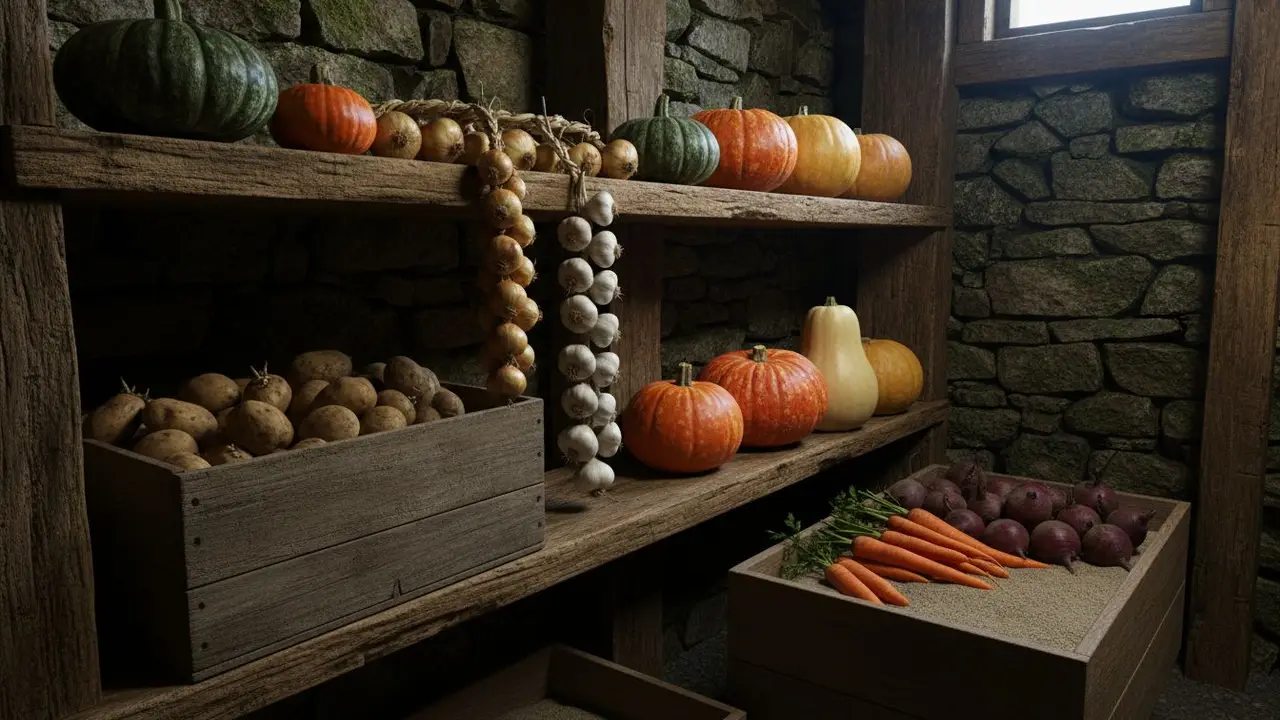
Growing a garden is only half of the permaculture cycle. The other half is keeping what you grew, so that a summer of abundance carries you through the lean months. Long before refrigerators, people ate homegrown vegetables all winter by mastering cold storage, and you can too. Learning how to store vegetables for winter using simple root cellar principles is one of the most satisfying skills a food gardener can develop: no canning jars, no freezer space, and often no electricity at all, just the right temperature, the right humidity, and a little know-how. A well-managed store of potatoes, onions, squash, and roots can feed you for months on produce that tastes like the day you pulled it.
In this guide I will cover the conditions that keep produce fresh, the two storage groups every crop falls into, the curing step most people skip, how to improvise a root cellar in a modern home, and the golden rules that separate a full larder from a bin of rot.
The Conditions That Keep Produce Fresh
A harvested vegetable is still alive and slowly respiring, and storage is simply the art of slowing that process to a crawl without killing the crop. Four conditions do the work: temperature, humidity, ventilation, and darkness. Get them right and a carrot that would go limp in a week on the counter will stay crisp for months.
Temperature is the big lever, because cold slows respiration and the growth of spoilage organisms. Most storage crops want it cold but not freezing. According to the University of Maine Cooperative Extension's guidance on storage conditions, the useful range for storing fruits and vegetables runs roughly from 32 to 55°F with relative humidity between 80 and 95 percent, depending on the crop. A traditional root cellar, a cool, dark, humid, ventilated space dug into the earth, hits those numbers naturally because the ground below the frost line stays cold and damp year-round. That is the target we are trying to recreate, whether we have a real cellar or not.
Ventilation and darkness round out the picture. Stored produce keeps respiring, giving off moisture, carbon dioxide, and, from fruits, the ripening gas ethylene, so a little fresh air movement prevents the stale, musty pockets where rot takes hold. That is why real root cellars are built with both a low intake vent and a high exhaust vent. Darkness matters most for potatoes, which turn green and produce bitter, mildly toxic solanine when exposed to light. I keep a cheap thermometer in every storage space, because guessing at temperature is the fastest way to lose a crop to freezing or premature sprouting.
The Two Storage Groups
Here is the single most important concept, and the one that trips up most beginners: not all crops want the same conditions. Storage crops sort into two broad groups, and mixing them up is why so much stored produce spoils early. Utah State University Extension and other root-cellaring guides organize crops along exactly these lines.
Cold and moist (about 32 to 40°F, 90 to 95% humidity)
This is the group most people picture, and it includes nearly all the root crops and hardy brassicas: carrots, beets, parsnips, turnips, cabbage, and leeks. These crops shrivel in dry air, so the challenge is holding humidity high. I pack my carrots and beets in boxes of damp sand or sawdust, which keeps them turgid for months, or use perforated plastic bags to trap moisture. Potatoes belong here too but prefer the slightly warmer end, around 40 to 45°F, and absolute darkness so they do not turn green or sprout.
Cool and dry (about 50 to 60°F, 60 to 70% humidity)
The second group wants it warmer and drier, and packing these crops into a cold, damp cellar will rot them. It includes onions, garlic, winter squash, pumpkins, and sweet potatoes (sweet potatoes and squash like the warm end, closer to 55 to 60°F). Store these with good air circulation: onions and garlic braided or in mesh bags, squash spaced out on a shelf so they are not touching. A spare bedroom closet or a cool pantry often suits them better than a cellar.
Curing: The Step Most People Skip
Several crops need a curing period before they go into storage, and skipping it is the difference between produce that keeps for weeks and produce that keeps for the whole winter. Curing dries and toughens the skin, seals wounds, and prepares the crop for the long haul. Michigan State University Extension notes that proper curing markedly extends storage life.
- Onions and garlic: cure in a warm, airy, shaded spot for two to three weeks until the necks are papery and dry.
- Winter squash and pumpkins: cure warm, around 80°F, for a week or two to harden the rind before storing them cool.
- Potatoes: cure about a week in the dark at 45 to 60°F so minor digging wounds heal over, then move them to cold, dark storage.
- Sweet potatoes: cure warm and humid for a week or so, which also improves their sweetness.
The first year I cured my garlic properly, hanging it in an airy shed until the necks were bone dry, it kept firm and fragrant clear into spring; the uncured bulbs I had stored the year before had gone soft by November. It converted me to curing for good.
A Root Cellar Without a Root Cellar
You do not need to dig a cellar into a hillside to store food this way. The goal is simply to find, or create, a space that stays cold but above freezing, with the right humidity. Here are the improvised options I and other gardeners rely on:
- An unheated basement, garage, or mudroom. A cool corner of a basement is often close to ideal; just watch that a garage does not dip below freezing on the coldest nights.
- A second refrigerator set warm makes a compact, reliable cold-moist store for roots.
- A buried bin or trash can. Sink an insulated tote or a clean metal can into the ground, fill it with roots layered in damp sand or straw, and cap it with a mulched lid, a classic outdoor "clamp."
- The garden itself. Many hardy roots store best right where they grew. I leave carrots and parsnips in the ground under a thick blanket of mulch and dig them through winter as needed; parsnips actually turn sweeter after a hard frost.
Whatever space you use, manage the humidity to match the crop group. For the cold-moist crops, a bucket of damp sand or an open pan of water raises humidity; for the cool-dry crops, good airflow keeps it down.
Golden Rules for Long Storage
Once you have the conditions sorted, a handful of habits make the difference between a larder that lasts and one that spoils. The National Center for Home Food Preservation and Extension storage guides echo these same points.
- Store only your best. Any vegetable that is bruised, cut, or diseased will rot and take its neighbors with it, so those go straight to the kitchen or the compost pile. Sound storage starts with careful disease prevention in the garden and gentle handling at harvest.
- Do not wash before storing. Water invites rot. Brush off loose soil and leave the rest; a little dirt on your carrots is a preservative, not a problem.
- Keep apples and pears away from your vegetables. Apples and pears give off ethylene gas, which sprouts potatoes and turns carrots bitter. I learned this the hard way the winter I stored apples next to my potato bin and found the spuds sprouting by December.
- Check often. Look through your stores every week or two and pull anything starting to soften. One bad vegetable really can spoil the barrel.
- Choose storage varieties. Some cultivars are bred to keep; storage onions outlast sweet onions, and "keeper" apples hold for months while summer varieties do not.
Where Winter Storage Fits in a Self-Reliant Garden
Cold storage is one pillar of preserving a harvest, and it pairs naturally with the others. What does not store well fresh can be dried in a solar dehydrator, canned, or fermented, and the seeds you save through traditional seed saving start next year's cycle. Storing your own food is a cornerstone of winter homesteading and a genuinely frugal way to eat well through the cold months.
My honest experience is that few garden skills pay off as richly as this one. There is a deep satisfaction in opening a bin of sand in February, brushing off a handful of carrots as sweet and crisp as autumn, and knowing they cost nothing to keep. Plan a few good storage crops into your garden this year, give them the temperature, humidity, and curing they ask for, and you will be eating your own harvest long after the first snow. For more on growing and keeping a resilient food garden, our homesteading library has a guide for every season.
Sources
About the Author
Lucas is a writer and researcher focused on sustainable agriculture and permaculture practices.