
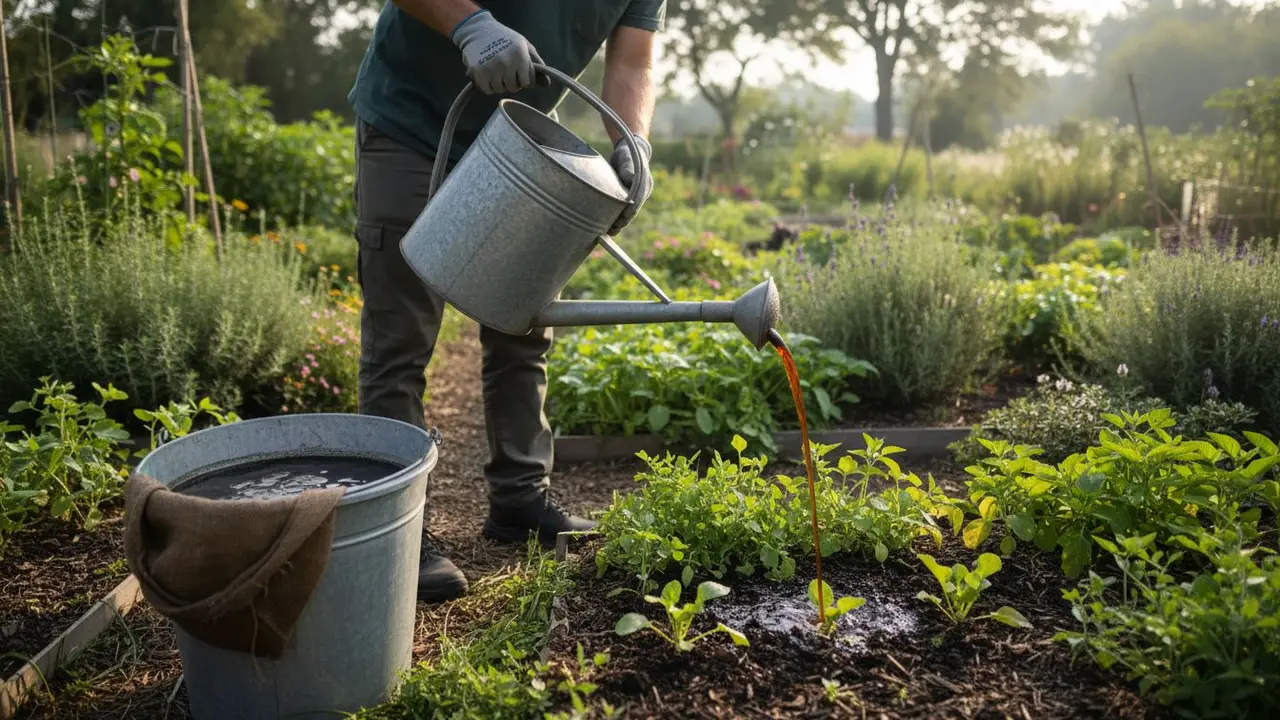
Few garden topics generate more breathless enthusiasm than compost tea. Steep some finished compost in water, the story goes, and you brew a living elixir that fertilizes your plants, inoculates your soil with beneficial microbes, and fends off disease. I was captivated by that promise years ago and built myself an elaborate bubbling brewer to chase it. Since then I have read the research, simplified my approach, and arrived at a more honest and, I think, more useful view. Compost tea is a genuinely handy tool when you understand what it actually is: a mild liquid feed. It is not the miracle it is often sold as, and treating it as one leads gardeners to neglect the practice that really builds soil. Let me walk you through what compost tea can and cannot do, the safety rules that genuinely matter, and how I make a simple, worthwhile batch.
What Is Compost Tea?
Compost tea is a liquid made by steeping finished compost in water to extract soluble nutrients and microorganisms, then applying that liquid to your plants as a soil drench or, sometimes, a foliar spray. There are two broad styles. A simple steeped tea (a passive extract) is just compost soaked in water for a day or two. An aerated compost tea, or ACT, is brewed with an aquarium-style air pump and often a splash of molasses or other food, the idea being to multiply the microbes from the compost into a much larger population before you apply it.
The appeal is easy to understand. Finished compost is full of plant nutrients and teeming with life, so capturing some of that in a liquid you can pour around your plants sounds like a shortcut to everything compost offers. As Michigan State University Extension describes it, compost tea is essentially a homemade liquid fertilizer you can brew from material you already have. That part is true, and it is where the real value lies.
What Compost Tea Can and Cannot Do
Here is where I want to be straight with you, because this is exactly the kind of claim that deserves an evidence check rather than hype. Compost tea's honest strengths are modest and real; its grander reputation is not well supported.
What it can do: compost tea is a gentle, mild, quick-acting liquid fertilizer. It delivers a small dose of readily available, water-soluble nutrients to plant roots, which makes it a nice pick-me-up for seedlings, transplants, and container plants that benefit from a light feed. In my own garden I use a dilute worm-casting tea as a gentle tonic for young transplants, and they take to it well. Think of it as a light snack for your plants, not a full meal.
What it probably cannot do: the dramatic claims, that spraying compost tea reliably suppresses plant diseases or meaningfully "inoculates" your soil with a lasting new microbial community, do not hold up well under scrutiny. Reviewing the research, Washington State University Extension horticulturist Linda Chalker-Scott, in her fact sheet "The Myth of Compost Tea," concludes that the evidence for consistent disease control is weak and inconsistent, and that the reliable, well-documented benefits come from applying the compost itself to the soil rather than brewing it into a tea. That squares with my experience. The single best thing I do for my beds is spread finished compost on them; the tea is a minor bonus on the side, never a substitute.
So keep compost tea in perspective. It is a supplement, not a soil-building program. If you only have so much finished compost, it does far more good spread on your beds as a no-dig top-dressing than steeped into a bucket.
Is the Bubbling Brewer Worth It?
Walk into the compost-tea corner of the internet and you will quickly meet aerated compost tea, the version brewed with an air pump running around the clock and a dose of molasses to "feed the microbes." The theory is that constant oxygen and a sugar source explode the beneficial microbial population into the millions before you apply it. I owned exactly this setup, and I no longer use it.
My reasoning is a cost-benefit one. The elaborate brewing adds equipment, electricity, careful timing, and a real food-safety hazard, all in pursuit of a benefit that the research has never reliably demonstrated over a simple steeped extract. A brew also has to be used within hours of finishing or the microbial community crashes and can turn anaerobic and foul. For the home gardener, the effort-to-payoff ratio simply does not add up. A plain steeped tea captures the soluble nutrients that provide compost tea's honest value, with none of the pump, the sugar, or the elevated risk. If you enjoy tinkering, by all means experiment, but do not feel you are missing out by keeping it simple. I certainly am not.
The Food-Safety Caveat You Must Know
This is the part most breezy compost-tea tutorials skip, and it is the one I care about most. Brewing changes the microbial picture, and not always for the better.
When you add molasses or sugar to a tea and aerate it, you are not only multiplying beneficial organisms; you are creating ideal conditions to multiply any microbe present, including human pathogens like E. coli and Salmonella if they exist in the compost or the added ingredients. This is a documented food-safety concern, and it is why the USDA National Organic Program places restrictions on compost teas made with supplemental nutrient sources when they are used on edible crops. The risk is highest exactly when you spray tea onto the parts of a plant you are going to eat.
My rules are simple and cautious, and I would urge you to adopt them:
- Use only fully finished, properly composted material. Well-made compost that has gone through a hot phase is your safest starting point; questionable or immature compost is not.
- Skip the sugar and molasses, especially for anything touching food crops. A plain steeped tea avoids the pathogen-blooming problem.
- Drench the soil rather than spray edible leaves, and never apply tea to the harvestable parts of a crop close to harvest.
How to Make a Simple Compost Tea
If you want to try it, the passive steeped method is easy, low-risk, and all I bother with anymore. Skip the pumps and additives.
- Fill a porous sack (a burlap bag, an old pillowcase, or a paint strainer bag) with a few shovelfuls of finished compost or, my favorite, worm castings.
- Steep it in water. Suspend the sack like a giant tea bag in a five-gallon bucket of water and let it sit for about 24 to 48 hours, stirring or squeezing the bag a few times.
- Use dechlorinated water. Chlorine in treated tap water can kill the very microbes you are trying to extract, so let tap water sit out overnight first, or use collected rainwater.
- Dilute and use it fresh. Dilute the finished tea to the color of weak tea and apply it the same day as a soil drench around the base of your plants. Do not store it; use it promptly and rinse your equipment.
Plant Teas: A Permaculture Cousin
Worth mentioning alongside compost tea are the plant-based liquid feeds many permaculture gardeners swear by, because they work on a similar principle but are really about nutrients rather than microbes. The classic is comfrey tea: pack a barrel with comfrey leaves, add water, and let it ferment into a potent, potassium-rich liquid feed that tomatoes and fruiting crops love. Stinging nettle makes a similar nitrogen-rich brew. I keep a comfrey barrel going every summer, and while it smells genuinely awful, a diluted cupful gives my tomatoes a real boost. These teas are a wonderfully frugal way to turn a corner of fast-growing plants into free fertilizer.
Where Compost Tea Fits in Your Garden
My honest, years-later conclusion is this: compost tea is a pleasant supplement and a fun project, but it is the garnish, not the meal. The foundation of a healthy, productive garden is living soil, and you build that by making and spreading real compost, keeping the ground mulched, and feeding it steadily. If a bed is genuinely struggling, a soil drench of tea will not fix it; you are far better served by testing your soil to find the real problem, working in the right organic amendments, and, if you garden on heavy ground, following a plan to improve your clay soil. Healthy soil grown this way also does more to support disease prevention than any spray ever could.
Brew a simple compost tea if you enjoy it and want a gentle liquid feed for your seedlings and containers. Just keep it simple, keep it safe, and never let the bucket distract you from the compost pile. For more on building living soil the low-input way, our soil and gardening library has a guide for every step.
Sources
- Washington State University Extension (Linda Chalker-Scott) — The Myth of Compost Tea
- Michigan State University Extension — Compost tea
- Clemson Cooperative Extension (Home & Garden Information Center) — Composting
- USDA National Organic Program — Guidance on compost and compost teas
About the Author
Lucas is a writer and researcher focused on sustainable agriculture and permaculture practices.