
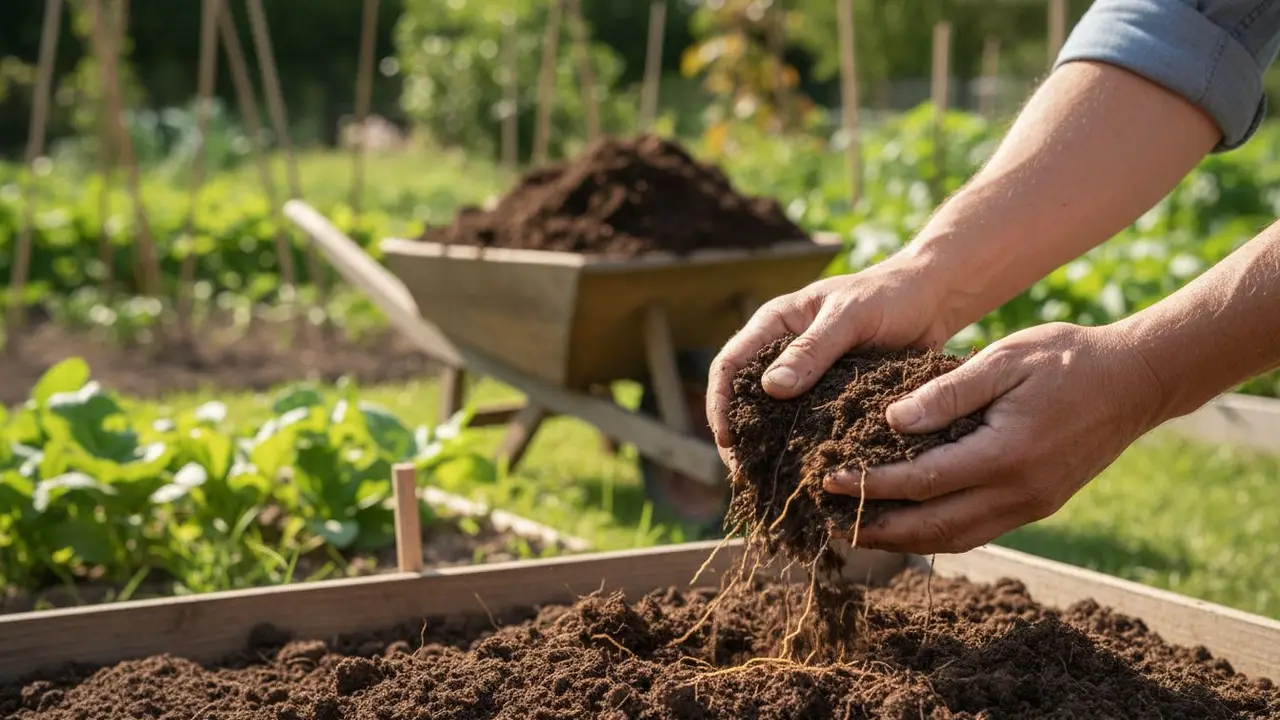
When I moved to a property with heavy clay, my first spring was a rude education. In April the beds were a sticky gumbo that clung to my boots in five-pound clods; by July the same ground had baked into something you could have built a wall with. If you garden on clay, you know the feeling. But here is the good news I wish someone had told me sooner: learning how to improve clay soil is one of the most rewarding projects in gardening, because clay is not a poor soil at all. It is a rich soil with a structure problem, and structure is something you can fix. A few years of the right approach turned my brick-hard beds into some of the most productive ground I have ever grown in.
In this guide I will explain what makes clay behave the way it does, the single amendment that actually works, the two popular "fixes" you should avoid, and the practical, patient method I use to build clay into beautiful garden soil.
Why Clay Soil Behaves the Way It Does
Soil is a mix of three particle sizes: sand (large), silt (medium), and clay (tiny). Clay particles are microscopically small and flat, so they pack together tightly with very little pore space between them. That single fact explains every clay-soil frustration. Water moves through slowly, so the ground stays waterlogged and drains poorly. Air struggles to reach roots. The soil is slow to warm in spring, compacts under the lightest footstep, and swings between sticky-when-wet and rock-hard-when-dry.
But those same tiny particles have an enormous amount of surface area, and that surface holds onto water and nutrients extremely well. As the Royal Horticultural Society points out, clay soils are typically high in nutrients and, once properly managed, can be among the most fertile and productive soils you can garden on. The goal, then, is not to get rid of the clay. It is to open up its structure so that air, water, and roots can move through it while keeping all that natural fertility. If you are not certain how much clay you actually have, a simple jar test, which I cover in my guide to testing your garden soil, will show you the sand, silt, and clay bands in an afternoon.
The One Amendment That Actually Works: Organic Matter
If you take away just one thing from this article, let it be this: the answer to clay soil is organic matter, applied generously and repeatedly. Nothing else comes close. Compost, aged manure, leaf mold, and other decomposed organic materials are what transform a heavy soil.
The mechanism is elegant. Organic matter and the soil life it feeds act like a glue, binding those tiny clay particles together into larger crumbs called aggregates. Those crumbs create the pore spaces that clay naturally lacks, and suddenly water drains, air enters, and roots run freely. Michigan State University Extension notes that adding organic matter improves the structure, drainage, and aeration of heavy clay soils while also feeding the microbial life that keeps building that structure over time. In other words, compost does not just sit there; it kick-starts a biological process that keeps improving the soil long after you apply it.
My workhorse amendment is homemade compost, and I use a lot of it. When I am establishing a new bed on clay, I spread several inches of compost and, that first time only, fork it into the top layer. After that I switch to a no-dig approach and simply top-dress with an inch or two of compost every year, letting the earthworms carry it down. The worm population in my clay beds exploded once I started feeding them this way, and their tunnels and castings do more to aerate the soil than any tool I own.
The Two "Fixes" to Avoid
Clay soil attracts bad advice, and two suggestions in particular can waste your money or actively make things worse.
Never add sand to clay
This is the big one. It seems logical: clay is dense, sand is loose, so mix them and get something in between. In reality you get the opposite. Unless you add a truly enormous quantity, mixing sand into clay fills the few remaining pore spaces and produces something with the consistency of concrete. Extension horticulturists warn against it repeatedly; Clemson Cooperative Extension is explicit that adding sand to a clay soil can create a brick-like, cement-hard condition rather than improving it. I was tempted to truck in a load of sand my first year, and I am grateful I read the warning first. Compost, not sand, is the fix.
Gypsum is not a magic bullet
Gypsum (calcium sulfate) is often marketed as a clay-buster, and it does have a genuine use, but a narrow one. As Colorado State University Extension explains in its guidance on choosing a soil amendment, gypsum only meaningfully improves structure in specific high-sodium (sodic) soils, which occur mainly in arid regions. For the vast majority of home gardeners on ordinary clay, gypsum does little that compost would not do better. Save your money and buy more organic matter instead.
Building Clay Soil the Practical Way
Improving clay is less a one-time project than an ongoing habit. Here is the full toolkit I use, beyond the compost that does most of the heavy lifting.
Grow your amendments with cover crops. One of the most powerful ways to break up clay is biological. Deep-rooted cover crops like daikon radish and clover drive roots straight down through compacted layers; when those roots die and decompose, they leave behind channels for water and air. A permanent planting of deep-taprooted comfrey does the same job while mining nutrients from the subsoil. This is clay improvement that happens while you sleep.
Mulch the surface, always. Bare clay crusts over and compacts under rain. A permanent blanket of mulch protects the surface, keeps it from drying to concrete, moderates moisture, and slowly rots down to feed the soil life below. On clay, exposed soil is the enemy.
Protect structure by staying off wet clay. This one I learned the hard way. Early on I dug a clay bed while it was still wet from spring rain, and I destroyed its structure for the whole season, smearing it into dense, airless clods. Clay is fragile when wet. Now I use the squeeze test: grab a handful and squeeze, and if it forms a sticky, shiny ball, it is too wet to work and I wait. I also keep permanent beds and paths so I never compact the growing areas by walking on them.
Build up when you cannot dig down. Sometimes the fastest route to good drainage over heavy clay is to garden above it. Building a raised bed or a hugelkultur mound on top of clay gives roots immediate depth and drainage while the clay below slowly improves from all the organic matter and biological activity above it. Sheet mulching, or lasagna gardening, is another excellent way to start a bed directly on top of unworkable clay.
Watering and Planting on Clay
Once its structure improves, clay's water-holding becomes a real asset, but you have to water it correctly. Clay accepts water slowly, so a fast blast runs off before it soaks in. I water deeply and slowly, which is exactly what drip irrigation does best, letting moisture percolate in rather than pool on top. And because poor drainage is the classic setup for root rot, improving clay is also a quiet form of disease prevention: better structure means fewer waterlogged roots.
Some crops are fussier about clay than others. Root vegetables like carrots tend to fork and stunt in dense clay, so I grow them in the loosest, most compost-rich beds or in raised beds; potatoes, on the other hand, are more forgiving. As the soil improves, the list of what thrives keeps growing. Pair your amendment plan with a fertility plan from my guide to the best organic fertilizers, and rotate crops through your improving beds to keep the soil balanced.
Patience Pays Off
The honest truth about clay is that there is no overnight fix, and anyone selling you one is selling snake oil. But there is a reliable, permanent one: add organic matter, keep the surface covered, keep living roots in the ground, and stop compacting it. Do that year after year and the transformation is remarkable. My worst clay bed took about three seasons to go from a boot-sucking swamp to a dark, crumbly, worm-filled soil that drains after rain and holds moisture through a dry spell, the best of both worlds. Clay rewards patience like no other soil, because once you have fixed its structure, you are left with a naturally rich, deep, fertile ground that most gardeners would envy. For more on building living soil the low-input way, our soil and gardening library has a guide for every step.
Sources
About the Author
Lucas is a writer and researcher focused on sustainable agriculture and permaculture practices.