
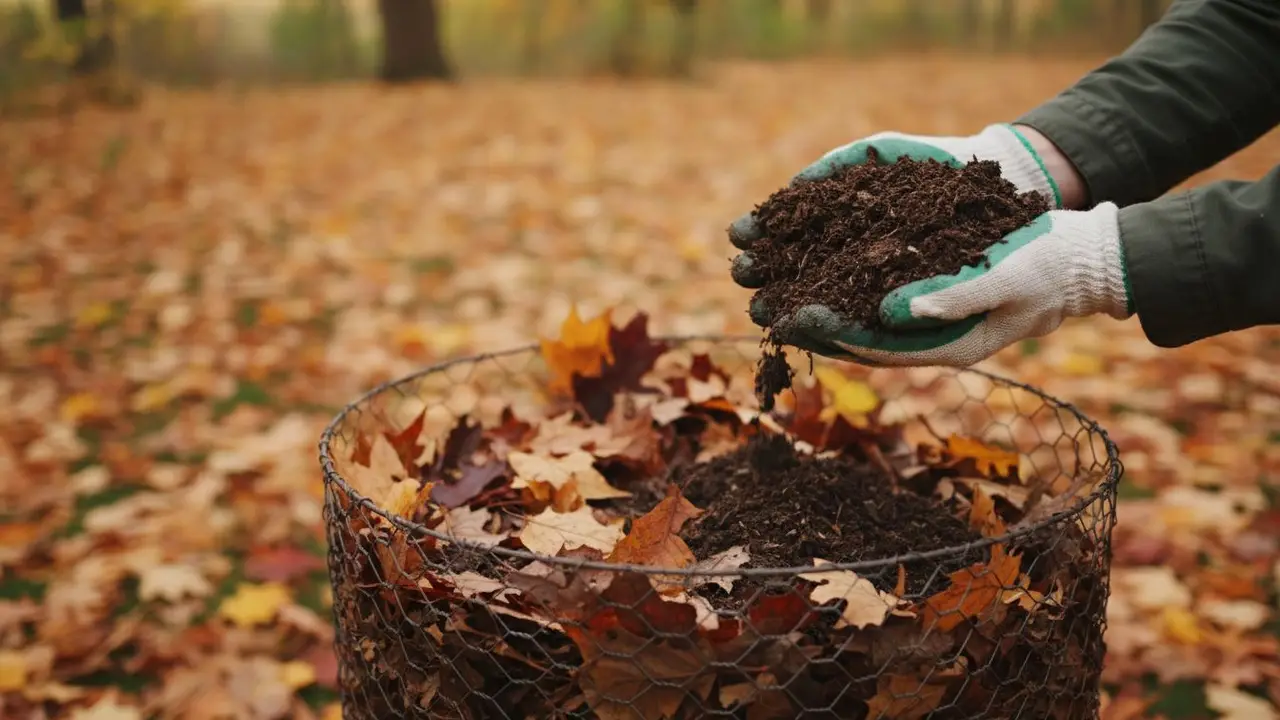
Every autumn I watch my neighbors do something that makes me quietly wince: they rake up their fallen leaves, stuff them into bags, and set them out for the trash. They are throwing away one of the finest soil amendments in gardening, and it is completely free. Those leaves, left to rot down, become leaf mold, a dark, crumbly, sweet-smelling material that gardeners have prized for generations as a soil conditioner. It costs nothing but a little patience, it asks almost no work, and it does things for your soil that a bag of anything from the garden center cannot. Learning to make leaf mold changed how I see fall cleanup entirely. Now I hoard leaves, my own and, with permission, my neighbors' too.
In this guide I will explain what leaf mold is and how it differs from compost, why it is worth making, the two simple methods for making it, and how to put the finished product to work in your garden.
What Is Leaf Mold, and How Is It Different from Compost?
Leaf mold is simply decomposed leaves, and nothing else. What makes it distinct from ordinary compost is the biology behind the breakdown. A compost pile is a hot, fast, bacterial process fueled by a mix of nitrogen-rich "greens" and carbon-rich "browns." Leaves, on the other hand, are almost pure carbon and low in nitrogen, so they do not heat up. Instead they break down slowly and cold, decomposed mainly by fungi over the course of one to two years. It is a quiet, patient, fungal process rather than a fast, hot, bacterial one.
The result is different too. Leaf mold is not a fertilizer; its nutrient content is low. What it is, is one of the best soil conditioners you can get your hands on. As the Royal Horticultural Society notes, well-rotted leaf mould is a superb soil improver and holds a remarkable amount of water, which is exactly why it is so useful. Think of compost as feeding your plants and leaf mold as improving your soil's structure and water-holding. In a well-run garden you want both.
Why Leaf Mold Is Worth Making
If it barely feeds plants, why bother? Because what it does for soil structure is remarkable, and because the raw material is free and falls from the sky.
- It holds water like a sponge. Finished leaf mold can absorb and retain a large amount of moisture, so working it into a bed dramatically improves that soil's ability to hold water through dry spells. This is a gift for sandy soils that drain too fast.
- It conditions any soil. Like compost, leaf mold opens up heavy ground and binds loose ground, which makes it a genuine help when you are working to improve clay soil.
- It feeds the soil food web. Leaf mold is fungal-rich material, and adding it brings beneficial fungi, along with the worms and microbes that thrive on it, into your beds.
- It is free and abundant. Every autumn hands you a fresh supply at no cost, turning what most people treat as waste into a resource. That is permaculture thinking in its purest form.
What sold me on leaf mold was the day I opened a wire bin I had filled and forgotten two autumns earlier. Where I had packed in a chest-high pile of crackling brown leaves, I found maybe a fifth of that volume of dark, spongy, sweet-smelling crumbs that looked and felt exactly like the floor of an old woodland. I dug a few buckets into my heaviest clay bed, and the difference in how that soil handled water was obvious within the season. Nothing I had paid money for worked better, and it had cost me a rake and some patience.
How to Make Leaf Mold: Two Simple Methods
Here is the beautiful part: making leaf mold is almost embarrassingly easy. It is less a recipe than an act of patience. Michigan State University Extension, in its aptly titled advice to stop bagging leaves and turn them into leaf mold, describes a process that really does boil down to pile up leaves, keep them moist, and wait. There are two ways to do it.
The pile or wire-bin method
The simplest approach is to gather your leaves into a heap in an out-of-the-way corner. To keep them from blowing around, I corral mine inside a cylinder of chicken wire or hardware cloth, a few feet across, held in a hoop with a couple of stakes. Pack the leaves in, water them until they are damp throughout, and then simply leave them. Over the next one to two years, fungi will quietly turn that pile into crumbly leaf mold. That is the entire method.
The bag method
If you are short on space, bags work wonderfully and can be faster. Stuff moist leaves into large plastic bags or paper leaf sacks, poke a few air holes in plastic ones, tie them loosely, and tuck them behind the shed. Because the bag holds in moisture, the leaves often break down in as little as six to twelve months. I keep a stack of bagged leaves going every year as my "fast" batch while the wire bin handles the slow, larger supply.
How to speed it up
The single most effective trick I have learned is to shred the leaves first. Running the mower over a layer of dry leaves, or using a leaf shredder, chops them into small pieces with far more surface area for fungi to colonize. This one step cut my leaf mold time roughly in half, from around two years down to under one. Beyond shredding, keep the pile consistently moist, turn it once or twice a year if you can, and, as Penn State Extension notes about composting leaves, mixing in a little nitrogen source like grass clippings will accelerate the breakdown, though it nudges the process toward true composting.
A few notes on which leaves to use. Most deciduous leaves are fine, but they are not all equal. Softer leaves like maple, ash, and fruit-tree leaves rot quickly, while tough, high-lignin leaves from oak and beech are slower and really do benefit from shredding. It took me an embarrassing while to figure out why the oak leaves in one of my bins sat nearly intact for two seasons; now I always shred them. Skip diseased leaves, which belong in the trash rather than a pile that will end up on your beds, a small but real part of preventing plant disease. Keep evergreen conifer needles separate, as they break down very slowly and tend toward acidity.
How to Use Finished Leaf Mold
You will know it is ready when the leaves have collapsed into a dark brown, crumbly, soil-like material that smells sweet and earthy, like a forest floor. Half-rotted leaf mold, still recognizable as leaves, makes an excellent mulch; fully rotted leaf mold, broken down completely, is ready for the finer uses below.
- As a soil conditioner. Work it into beds or spread it on top as a no-dig top-dressing to improve structure and water retention. It is one of the best things you can add to sandy or heavy soils alike.
- As a mulch. A two- to three-inch layer of leaf mold makes a superb mulch, moderating moisture and slowly feeding the soil beneath.
- In seed-starting mix. Because it is low in nutrients and fine in texture, well-sieved leaf mold is a classic ingredient in homemade seed-starting mixes, where too much fertility can actually harm tender seedlings.
- As worm bin bedding. Leaf mold makes excellent bedding in a worm bin, comfortable habitat that the worms will slowly eat.
- Around acid-loving plants. Leaf mold made from oak and beech leaves tends to be slightly acidic, which makes it a lovely mulch for blueberries, rhododendrons, and woodland plants like hostas and ferns.
Where Leaf Mold Fits in Your Garden
Leaf mold is the third leg of a soil-building stool that also includes compost and mulch. Together they are how I build living soil without buying much of anything. Leaves are endlessly useful beyond leaf mold, too: they are the perfect carbon-rich "browns" to balance a compost pile, and a great carbon layer for sheet mulching or building a hugelkultur mound. Once you start seeing autumn leaves as free soil rather than yard waste, you will never look at a curbside pile of bags the same way again.
My honest advice is to start this fall. Set up one wire hoop or fill a few bags, tuck them away, and forget about them. A year or two later you will be rewarded with crumbly, sweet-smelling leaf mold that your beds will drink up, and it will not have cost you a cent. For more on turning free materials into fertile ground, our soil and gardening library has a guide for every step, from testing your soil to choosing the right amendments.
Sources
- Royal Horticultural Society (RHS) — Leaf mould
- Michigan State University Extension — Don't bag those leaves; turn them into leaf mold
- Penn State Extension — Composting Leaves
- University of Illinois Extension — Composting for the Homeowner
About the Author
Lucas is a writer and researcher focused on sustainable agriculture and permaculture practices.