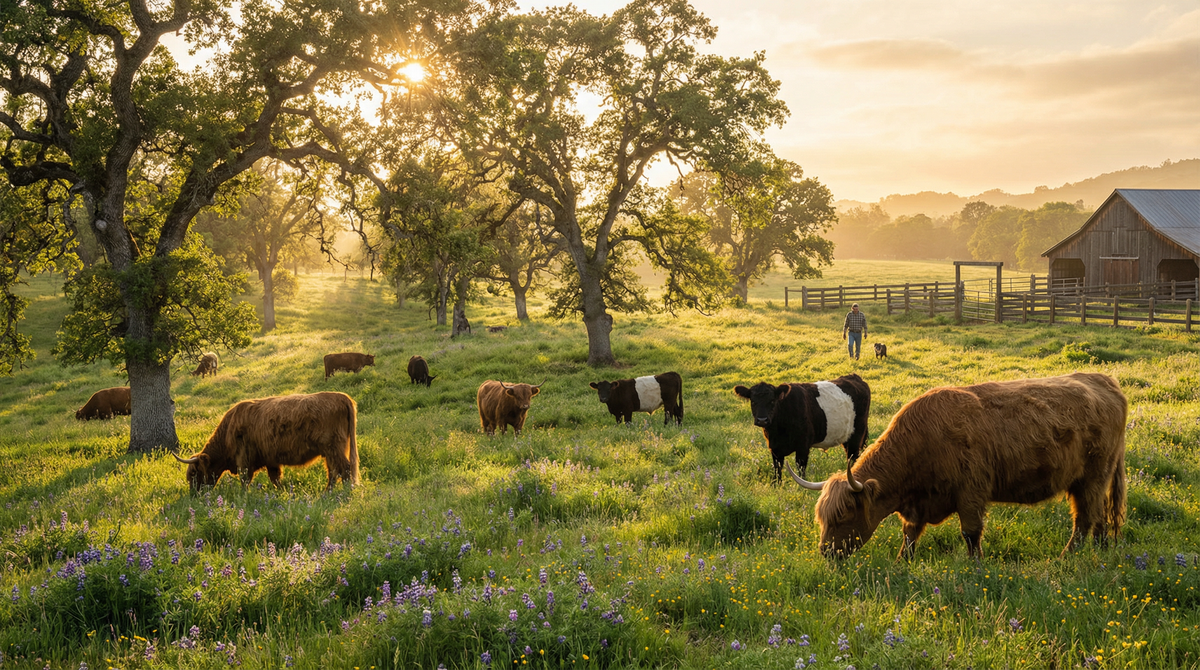
Overview & breed notes
Cattle (Bos taurus, with a sister species B. indicus for humped tropical zebu types) are large four-stomached ruminants in the family Bovidae. Wild aurochs were domesticated in two independent events roughly 10,500 years ago, in the Near East and the Indian subcontinent [1]. More than 1,000 breeds are recognized worldwide, grouped functionally as dairy, beef, dual-purpose, or draft.
For permaculture and small-acreage settings, smaller heritage and dual-purpose breeds usually outperform commercial Holstein or Angus. Cool-temperate favorites:
- Dexter — adult cow 600–750 lb (270–340 kg); milk + meat + oxen on under 10 acres.
- Highland — hardy, long-coated, browses readily, thrives in zones 3–6.
- Belted Galloway — efficient grass converter, calm, well suited to silvopasture.
- Devon and British White — dual-purpose, gentle, finish well on grass alone.
For warm-humid southeastern U.S. specifically, lean toward heat-adapted breeds and crosses:
- Florida Cracker and Pineywoods — heritage B. taurus landraces selected in the Southeast since the 1500s; tick- and heat-tolerant, small (700–1,000 lb), excellent on rough or wet ground [2].
- Brahman crosses (Brangus, Beefmaster, Senepol) — introduce B. indicus heat tolerance and parasite resistance to a more conventional carcass.
Adult cows weigh 700–1,500 lb (320–680 kg) depending on breed. Gestation averages 283 days, almost always producing a single calf. Productive lifespan is 8–15 years for commercial herds, up to 20 years for heritage breeds on low-stress regenerative operations.
Role in a permaculture system
Cattle are typically the largest livestock a temperate-climate permaculture site will hold, and their impact runs in both directions: well managed, they build pasture; poorly managed, they compact soil and degrade riparian zones. Functions worth designing for:
- Forage-to-protein conversion. Cattle turn cellulose-heavy material humans cannot eat (grass, legume hay, crop residues) into edible protein and fat.
- Nutrient cycling. An adult cow returns roughly 60–80 lb of fresh manure and urine per day, depositing nitrogen, phosphorus, potassium, and microbial inoculum [3].
- Disturbance and trampling. Hoof action breaks soil crust, presses seed into contact, and tramples standing forage into a litter layer that feeds soil biology.
- Brush and weed management. Cattle eat thistle, ragweed, multiflora rose, and many invasive woody saplings if introduced young in dense paddocks.
- Multiple yields. Milk, meat, leather, manure, draft work, and predator deterrence for poultry stack onto the same animal.
Typical zone placement is Mollison Zone 3 to Zone 4: daily attention feasible, pasture acreage available. Well adapted to USDA zones 3–9 with appropriate breed selection and shelter; zones 10+ favor B. indicus breeds or composites.
Shelter, fencing & space requirements
Shelter
Cattle are more cold-tolerant than heat-tolerant. In zones 3–6, an open-front loafing shed of 25–50 sq ft (2.3–4.6 m²) per head with a clean dry bedded pack is adequate. Dense windbreaks (50% porosity tree lines, four to six rows of mixed conifer and deciduous) reduce winter feed demand by 10–15%. In hot humid regions, shade is non-negotiable: 35–40 sq ft (3.3–3.7 m²) of dense shade per adult animal, ideally from oak, honey locust, or mulberry.
Fencing
- Perimeter: four to five strands barbed wire OR woven wire 48 in (122 cm) high OR five-wire high-tensile electric (alternating hot and ground).
- Internal subdivisions: single strand polywire on step-in posts at 32–36 in (81–91 cm), 4,000–6,000 volts; this is what makes cell rotation practical.
- Bulls: add a second strand and consider 60 in (152 cm) total height.
Space
Stocking depends on rainfall, soil, and management intensity. Benchmarks: 1 acre per cow-calf pair in humid zones 6–7 with rotational grazing, 5–20 acres per pair on dryland or set-stocked pasture, up to 40 acres per pair on arid range. USDA NRCS Animal Unit Months (AUMs) is the standard planning unit; one AUM is the forage required by a 1,000 lb (454 kg) cow + calf for one month, roughly 780 lb (354 kg) of dry matter [3].
Feeding, foraging & integration with plants
Daily dry matter intake is 2.5–3% of body weight, or 25–40 lb (11–18 kg) of forage for an adult cow. Cattle are unselective grazers compared with sheep or goats; they sweep the sward with their tongues and accept a wider range of forage species.
Cool-temperate pasture (zones 4–7)
- Cool-season grasses: orchard grass, timothy, fescue, brome.
- Legumes for protein and N-fixation: alfalfa, clover, sainfoin.
- Forbs that diversify the sward: chicory, plantain, dandelion.
Warm-humid pasture (zones 8–10)
The Southeast runs on a different forage base. Bahiagrass and bermuda grass dominate; perennial peanut (Arachis glabrata) is the warm-season legume of choice; pearl millet and sorghum-sudan are summer annual options. Overseed cool-season annuals (rye, triticale, oats, crimson clover) in fall for winter forage quality. Crabgrass is a legitimate forage in this context, not a weed.
Tree fodder and silvopasture
Black locust, mulberry, and willow tolerate browsing and contribute high-protein leaves; honey locust pods are 11–28% sugar and a useful late-season carbohydrate.
Plants to remove or fence off
- Lethal: water hemlock, poison hemlock, yew, oleander, and wilted cherry leaves (cyanogenic glycosides).
- High toxicity: larkspur, lupine (teratogenic in early pregnancy), milkweed.
- Moderate: nightshade, cocklebur (seedlings), pokeweed, sorghum regrowth after frost (prussic acid).
Health, climate tolerance & welfare
Thermal envelope: most temperate breeds are comfortable from −10°F (−23°C) with dry coat and windbreak up to about 75°F (24°C). Heat stress begins when the Temperature-Humidity Index (THI) exceeds 72 [4]. THI of 80 = emergency cooling (shade, water, sprinklers).
From the field (Lucas Summer, central Florida, USDA zone 9b): A neighbor running Angus on bahiagrass loses about 15–20% of expected weight gain through July and August every year — the cattle stand under live oaks all day and graze only in the early morning and after sunset. He has since added 12 Brahman-cross heifers and the difference in heat behavior is immediate: the Brangus animals continue grazing into the afternoon at temperatures that shut his Angus down. For a southeastern site of any scale, the breed conversation matters more than the rotational-grazing conversation. Cracker cattle (now under recovery through the Florida Cracker Cattle Association) are the historical answer and finish well on native pasture, but they are small, slow-growing, and a tough sell at conventional sale-barn weights — their market is direct-to-consumer grass-fed beef.
Core herd-health protocol
- Annual vaccination for clostridial diseases (8-way), IBR/BVD/PI3/BRSV, and leptospirosis. Brucellosis (Bang’s) vaccination of replacement heifers where state-required.
- Strategic deworming using fecal egg counts rather than calendar-based drenches.
- Body Condition Scoring (BCS, 1–9) monthly; target BCS 5–6 at calving.
- Hoof inspection twice a year, more on wet ground; foot rot (Fusobacterium necrophorum) is the dominant lameness in pastured herds.
Common diseases to plan around
- Bovine respiratory disease complex (BRD) — leading cause of death in feeders; minimize commingling stress.
- Pinkeye — surges in summer; fly control and shade help.
- Grass tetany — magnesium deficiency on lush spring growth; provide hi-mag mineral.
- Bloat — on legume-heavy pasture; introduce gradually and feed dry hay first thing in the morning.
- Anaplasmosis in the Southeast — tick-borne; especially important on heritage or imported breeds without established resistance.
Polyculture & rotational systems
The single change with the largest effect on cattle’s permaculture footprint is moving from continuous grazing to planned rotation. Three patterns are well documented:
Adaptive multi-paddock (AMP) grazing
Subdivide pasture into 20–100 paddocks, move the herd every 0.5–3 days, rest each paddock 30–90 days depending on growth rate. Stocking densities during the graze period are 50,000–500,000 lb of live weight per acre. Compared with continuous grazing, AMP has been associated with higher soil organic carbon, faster water infiltration, and increased plant species richness in multiple U.S. trials [5].
Silvopasture
Plant or thin trees to 25–40% canopy cover. In temperate North America, black locust, honey locust, oak, and mulberry. In the southeastern Coastal Plain, longleaf pine + native warm-season grass silvopasture is the regional pattern, often with hardwood mast trees retained at the edges. Protect young trees with tubes or electric exclusion for 5–8 years until bark hardens.
Leader-follower polycultures
Run chickens in mobile coops 3–5 days behind cattle on the same paddock. The chickens scratch through cow pats, eat fly larvae, and break the parasite cycle while spreading manure. The classic Salatin pattern uses cattle, then layers, then broilers in succession. Sheep and goats can co-graze with cattle on a 1:5 ratio without competing significantly for forage.
Frequently asked questions
What is the best breed for a small permaculture farm?
Under 10 acres in temperate climates, Dexter is the standard answer: small enough to handle solo, dual-purpose for milk and meat, gentle. For browse-heavy or rough ground, Highland. For grass-only beef in the Upper Midwest or Northeast, Devon, Red Poll, or Belted Galloway. In the Deep South, Florida Cracker or a Brahman cross will outperform any imported European breed on the same forage and management.
How much pasture do I need per cow?
Plan 1 acre per cow-calf pair in well-managed humid zones 6–7, 2–5 acres in zones 4–5 or under continuous grazing, 5–40 acres on dryland or arid range. Use AUM calculations adjusted for your local NRCS forage productivity tables for a defensible number.
Can I graze cattle in an orchard?
In mature orchards yes, with electric exclusion of trunks until bark exceeds 1/2 in (1.3 cm) thickness, typically year 6–10. Smaller breeds (Dexter, Cracker) cause less limb damage than full-sized cattle. Avoid grazing during fruit drop in stone fruit orchards; pits can lodge in the esophagus.
Are cattle bad for the climate?
Industrial feedlot beef has a high greenhouse footprint. Well-managed pastured cattle on AMP grazing can be near-neutral or net carbon-positive on a per-acre basis according to several long-term studies, though per-pound-of-beef numbers are still debated [5]. Local context matters more than category.
How does hurricane season change cattle management in Florida?
Time spring calving for February–March so cows are dry by August. Keep an extra two weeks of hay on hand from June through November. Identify your highest pasture for stand-up evacuation and stage a portable corral panel set with the trailer for fast loading.
References
- FAO. Domestication of Animals: Cattle. The Food and Agriculture Organization of the United Nations.
- Florida Cracker Cattle Association. Breed standard and registry.
- USDA NRCS. Prescribed Grazing (Conservation Practice Standard 528).
- Penn State Extension. Heat Stress in Dairy Cattle.
- Stanley, P.L. et al. (2018). Impacts of soil carbon sequestration on life cycle greenhouse gas emissions in Midwestern USA beef finishing systems. Agricultural Systems 162: 249-258.
- UF/IFAS Extension. Florida Beef Cattle Production Series.
- ASPCA Animal Poison Control Center. Toxic and Non-Toxic Plants.
Field notes by Lucas Summer, central Florida (USDA zone 9b). Observations about Brahman-cross vs Angus heat behavior are from a neighbor’s operation; numbers without citations come from regional discussion and field practice rather than published trials.
Foraging Behavior
Cattle are diurnal grazers, foraging during the daytime, often in social groups. Their foraging strategies adapt to changing plant availability and phenology throughout the seasons. They use visual cues to locate food and can be selective in their diet, preferring grasses and forbs.
Fencing Requirements
Strong and secure fencing is essential for containing cattle. Common options include barbed wire, woven wire, and high-tensile electric fences, which should be at least four feet high. The choice of fencing depends on the management system, such as rotational or continuous grazing, and the temperament of the animals.
Shelter Requirements
While cattle are adaptable, they require protection from extreme weather. This can range from simple windbreaks and shade structures to more substantial barns, especially for dairy breeds or during calving. Adequate shelter is crucial for animal welfare and productivity, helping to mitigate the effects of heat stress in summer and cold stress in winter.
Permaculture Notes
In permaculture systems, cattle are managed as a key component of a holistic and regenerative agricultural model. Their integration is centered on mimicking natural grazing patterns to enhance ecosystem health and productivity. Through practices like rotational grazing and silvopasture, cattle can be used to build soil fertility, increase biodiversity, and manage landscapes effectively. One of the primary roles of cattle in permaculture is nutrient cycling. As they graze, they deposit manure and urine, which fertilizes the soil and stimulates plant growth. Their hoof action also helps to aerate the soil and incorporate organic matter, improving soil structure and water infiltration. This process, often referred to as 'mob grazing' or 'holistic planned grazing,' involves moving a high density of cattle through small paddocks for short durations, followed by long rest periods. This mimics the behavior of wild herbivores and prevents overgrazing, allowing pastures to recover and thrive. Cattle are also integrated into silvopasture systems, where they graze among trees. This provides a number of benefits, including shade for the animals, which reduces heat stress, and additional forage from tree fodder. The trees, in turn, benefit from the weed control and fertilization provided by the cattle. This symbiotic relationship creates a more resilient and productive system, with multiple yields from the same land area. The integration of cattle into permaculture designs requires careful planning and management, but the rewards are significant, leading to a more sustainable and regenerative agricultural system.