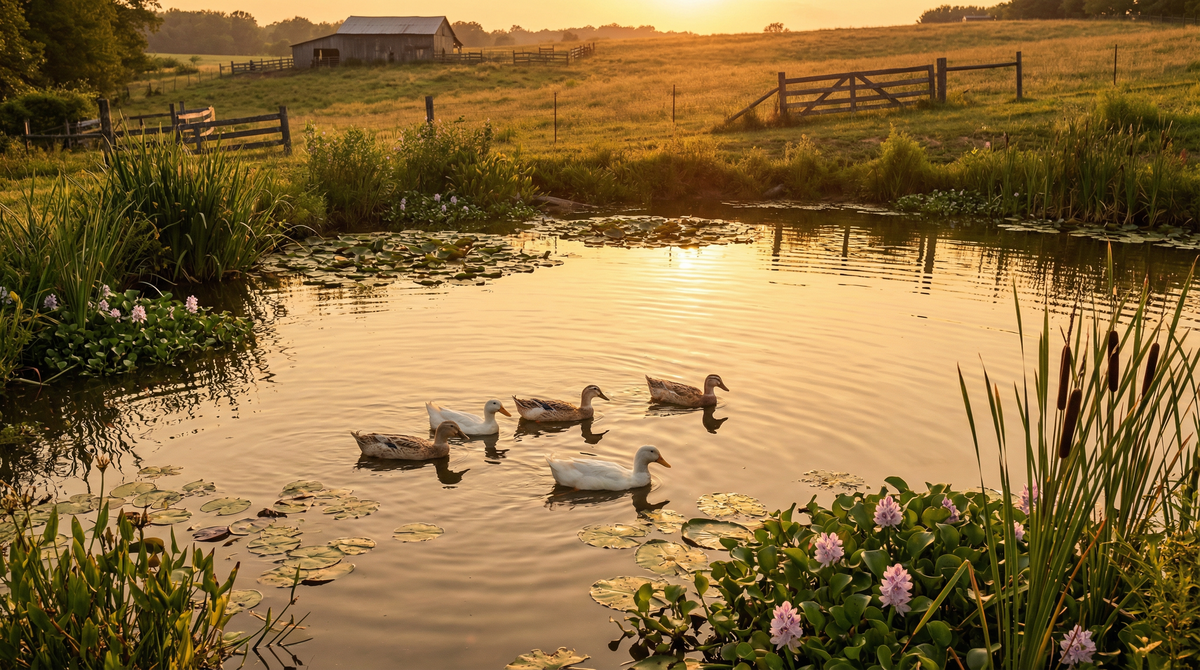
Overview & breed notes
The domestic duck (Anas platyrhynchos domesticus) is a subspecies of the wild mallard, domesticated independently in Southeast Asia and Europe. A separate domesticated species, the Muscovy (Cairina moschata), is sometimes lumped with ducks in everyday talk but is biologically distinct: a tropical perching waterfowl from Central and South America that hybridizes with mallards only to produce sterile mules. The two species are managed differently and are addressed where it matters below [1].
Breeds worth knowing, grouped by purpose:
- Layer breeds: Khaki Campbell (280–320 eggs/year), Welsh Harlequin (240–330), Indian Runner (200–250) — lean upright birds, exceptional foragers.
- Meat breeds: Pekin (mature 7–9 lb in 7–9 weeks), Rouen, Aylesbury.
- Dual-purpose: Cayuga, Saxony, Silver Appleyard, Buff Orpington duck.
- Muscovy — not technically a duck but managed similarly; 6–15 lb at maturity, lean meat, modest egg production, exceptional foraging. Quiet (hiss instead of quack), heat-tolerant, the de facto choice in many subtropical sites.
Adult ducks reach sexual maturity at 4–7 months; laying breeds are very productive in years 1–3 and continue at declining rates to 5–7 years. Lifespan with care is 8–12 years; Muscovies often longer.
Role in a permaculture system
Ducks are the permaculture animal of choice on wet ground, in slug-and-snail country, and anywhere chickens compact the soil too much. Functions:
- Slug, snail, and grub control. A small flock (4–6 birds) will clear a 1/4 acre vegetable garden of mollusk pressure within a season; the famous Khaki Campbell + hostas combination is built on this.
- Mosquito control. Muscovies and runners eat adult flies and mosquitoes opportunistically; standing water that hosts ducklings will not host mosquitoes.
- Less soil compaction than chickens. Webbed feet spread weight; they do not scratch.
- Fertigation. Pool water collected weekly is mild liquid fertilizer for fruit trees and ornamentals (typical 8–15 ppm N).
- Fruit drop sanitation. Ducks (especially Muscovies) clean up fallen fruit and break codling-moth and apple-maggot cycles without scratching out tree roots.
- Rice-paddy integration. The classic aigamo system in Japan uses ducks to weed and fertilize rice fields; the same principle works for taro, watercress, and other wet-bed crops.
Zone placement is Mollison Zone 1 to Zone 3 depending on flock size; ducks need daily water changes, so plan plumbing accordingly. Suited to USDA zones 3–10 with appropriate shelter and breed selection.
Coop, water & space requirements
Coop
- Floor space: 4–6 sq ft (0.4–0.6 m²) per bird, more for Pekin and Muscovy.
- No roosts needed — ducks sleep on the ground. Provide thick clean straw or wood-shavings bedding.
- Nest boxes: ground-level or low (a milk crate on its side works); ducks lay early morning.
- Ventilation: more is better; ducks generate substantial moisture. In subtropical climates, three-sided run-in sheds are sufficient most of the year.
- Door at least 12 in (30 cm) wide; Pekins and large breeds need 18 in.
Water
Ducks need water deep enough to dip their entire head and clear their nostrils. A small permanent pond (200–500 gal / 750–1,900 L) is ideal; a child's wading pool emptied and refilled every 2–4 days works for 6–10 birds. Muscovies are the exception — they tolerate dry living far better than mallard-derived breeds and can thrive with just a deep water trough for head-dipping.
Run / range
Plan 25 sq ft (2.3 m²) per bird in an enclosed run, more for free-range. Forage availability dramatically reduces feed cost: a 10-bird flock on 1/4 acre of mixed cover can self-supply 30–50% of summer calories.
Predators
Same threat list as chickens with two additions: large turtles and predatory fish for ducklings on open ponds, and in the Southeast, alligators on any pond over about 2 acres. Hardware cloth (1/2 in), buried apron, latches a raccoon cannot defeat, overhead cover where hawks hunt.
Feeding, foraging & integration with plants
Adult ducks eat roughly 0.3–0.5 lb (135–230 g) of dry feed per day. Use waterfowl-formulated feed, not chicken feed: ducks need more niacin (50–60 mg/kg) than chicken feed provides, and chicken feed deficiency causes lameness in growing ducklings. If only chicken feed is available, supplement with brewer's yeast at 1 Tbsp per cup of feed.
Feed base
- 16–18% protein layer ration formulated for waterfowl during production.
- 20–22% starter (not medicated with amprolium — ducks can overdose) for ducklings 0–3 weeks.
- Niacin supplement if using chicken feed.
- Grit, oyster shell, abundant water.
On-site forage and supplements
- Aquatic plants for the pond: duckweed (35–45% protein), watercress at the margins, arrowhead tubers, pickerelweed for cover.
- Slugs, snails, larvae — the headline reason to keep them.
- Garden greens: comfrey wilted overnight, dandelion, plantain, chickweed, clover, alfalfa.
- Calorie crops: cracked corn, sorghum, pearl millet, sunflower; subtropical add moringa, mulberry, fallen taro leaves.
- Black soldier fly larvae — ducks devour them.
Do not feed
Health, climate tolerance & welfare
Ducks are remarkably hardy when kept dry-at-night and given clean water during the day. Most breeds tolerate 0°F (−18°C) outdoors with a dry windbreak and unfrozen water; Muscovies are less cold-tolerant and need a draft-free roost below 25°F (−4°C). Heat tolerance is breed-dependent: Muscovies thrive to 100°F (38°C) with shade; Pekins and mallard-derived breeds stress above 85°F (29°C) without water access.
From the field (Lucas Summer, central Florida, USDA zone 9b): Muscovies are my default duck recommendation for the Gulf Coast and any other place with hot, humid summers and serious mosquito pressure. They tolerate the heat better than any mallard-derived breed I have run, they will eat anolis lizard eggs and palmetto bug nymphs as enthusiastically as slugs, and unlike Khaki Campbells they do not need a wet wallow that turns into a mosquito reservoir 48 hours later. The trade-off is escapes: Muscovies can and will fly short distances if not wing-clipped (a 6–10 minute job per bird annually), and feral Muscovy populations are legally complicated in Florida — FWC regulates capture and disposition. Keep your birds clearly identified, contained, and confirm legal status in your county before stocking.
Common issues
- Wet feather / oil-gland failure — ducks unable to preen properly become waterlogged and chilled. Usually a stress or housing-cleanliness symptom.
- Bumblefoot — less common than in chickens, but heavy meat breeds on hard surfaces develop it; provide soft yielding ground.
- Duck virus enteritis (duck plague) — a reportable disease in many jurisdictions; vaccinate where it is endemic.
- Niacin deficiency — bowed legs and inability to stand in ducklings; entirely preventable with proper feed.
- Highly pathogenic avian influenza is a reportable disease (USDA APHIS); waterfowl are a key reservoir and biosecurity is increasingly important [2].
Polyculture & rotational systems
Aigamo-style rice and wet-crop weeding
Ducks released into a flooded rice paddy or taro bed at the right growth stage eat weed seedlings, insect pests, and snails while their swimming aerates the water and stirs sediment. The technique reduces or eliminates herbicide use and adds nitrogen and protein output to the same acre. It does not work well in deep-water rice systems or after rice begins to head out (the ducks eat the grain).
Orchard understory and food forest
Ducks belong in established orchards once trees are 2–3 years old. Their lack of scratching protects shallow roots; their preference for fallen fruit and pest larvae sanitizes the orchard floor. In subtropical food forests, mulberry drop and moringa leaf litter become high-quality duck calories.
Aquaponics
Small mallard-derived breeds and Muscovies integrate well into pond aquaponics, where their droppings drive plant nutrition for floating duckweed, watercress, and emergent cattail while their swimming oxygenates the pond. Stocking rate is much lower than fish-only systems; plan 1 adult duck per 200–400 gal (750–1,500 L).
Pasture rotation behind larger livestock
Ducks follow cattle the same way chickens do, but with less ground disturbance. They favor fly larvae in moist pats and ignore dried ones; deploy them in the wet window 1–3 days after cattle leave.
Frequently asked questions
Do I need a pond?
No, but you need clean water deep enough for the bird to dip its entire head. A kiddie pool emptied every 2–4 days works for a small flock; Muscovies can manage on a deep trough alone. A small pond is more pleasant for the birds and lower-labor for you.
What's the best layer breed for a small homestead?
Khaki Campbell and Welsh Harlequin are the consistent winners on egg numbers (280–320/year). Indian Runner is less productive (200–250) but exceptional in the garden because of the upright body and active foraging. In subtropical climates, Muscovies are productive on much less feed but lay fewer eggs (80–180/year).
Are duck eggs better than chicken eggs?
Larger, richer in fat and protein, with a higher yolk-to-white ratio that bakes better than chicken eggs. Some egg-allergic people tolerate duck eggs; some do not. Many find them stronger-flavored; this fades when birds are pastured rather than fed kitchen scraps heavy in onion or garlic.
Can ducks live with chickens?
Yes with caveats. Drakes occasionally attempt to mate with hens, which can injure or kill the hen. Mixed flocks work best when there is no drake or when the flock is large enough to disperse drake attention; provide separate water for ducks because chickens drown ducklings or get themselves wet and chilled.
Muscovy or mallard-derived?
In zones 3–7 with abundant water, mallard-derived breeds (Khaki, Runner, Pekin) are the conventional answer. In zones 8–10, in places with serious mosquito pressure, or on dry-land sites with limited pond infrastructure, Muscovies win on overall fit by a wide margin — provided local rules permit them.
References
- FAO. Small-scale poultry production — ducks and geese. Food and Agriculture Organization of the United Nations.
- USDA APHIS. Avian Influenza — biosecurity and reporting.
- Penn State Extension. Ducks and Geese.
- UF/IFAS Extension. Duck Production in Florida.
- Merck Veterinary Manual. Ducks.
- The Livestock Conservancy. Heritage Duck Breed Profiles.
- Florida Fish and Wildlife Conservation Commission. Muscovy Duck Management.
Field notes by Lucas Summer, central Florida (USDA zone 9b). Recommendation of Muscovies for hot humid sites is based on running both Khakis and Muscovies on the same site across two years; Florida regulatory caveat is per current FWC guidance and should be confirmed at the county level before stocking.
Foraging Behavior
Ducks are active and enthusiastic foragers, constantly searching for food. They use their bills to dabble in shallow water and probe in mud for aquatic plants and invertebrates. On land, they eagerly consume a wide variety of pests, including slugs, snails, and insects, making them excellent for pest control in gardens and orchards.
Fencing Requirements
Ducks are less destructive to gardens than chickens, but fencing may still be necessary to protect young or delicate plants from being eaten or trampled. Low fencing (2-3 feet) is usually sufficient to contain most domestic breeds, as they are generally poor fliers. Portable electric netting is an effective option for rotational grazing systems.
Shelter Requirements
A simple, predator-proof shelter is required to keep ducks safe at night. The shelter should be well-ventilated and have at least 4 square feet of floor space per duck. Unlike chickens, ducks do not roost and will sleep on a thick layer of bedding on the floor.
Permaculture Notes
Domestic ducks are a valuable and versatile component of many permaculture systems, often favored over chickens for certain applications. Their natural inclination to forage for pests like slugs and snails makes them exceptional for integrated pest management in gardens, orchards, and food forests, without causing the same level of soil disruption as chickens. Their manure is a rich source of nitrogen and can be used to create a nutrient-dense liquid fertilizer by collecting the water from their pools, or it can be composted with their bedding. One of the most effective ways to integrate ducks is through the use of a 'duck tractor,' a mobile, bottomless pen that can be moved to different areas to target pest outbreaks or to fertilize specific garden beds. In orchards and food forests, ducks can be allowed to free-range, where they will help control pests, eat fallen fruit, and fertilize the soil. Their minimal scratching behavior means they are less likely to damage the root systems of established trees and shrubs. Ducks can also be integrated into aquaponics or pond systems, where their waste provides nutrients for aquatic plants and fish, contributing to a closed-loop, productive ecosystem. While ducks are relatively low-maintenance, providing for their specific needs is key to a successful integration. They are social animals and should always be kept in groups of at least two or three. Access to a body of water for swimming and bathing is essential for their health and well-being; a small pond or even a kiddie pool is sufficient. Although they are hardy, a secure, predator-proof shelter is necessary to protect them at night. By thoughtfully incorporating ducks into a permaculture design, one can leverage their natural behaviors to build a more resilient, productive, and self-sustaining system.