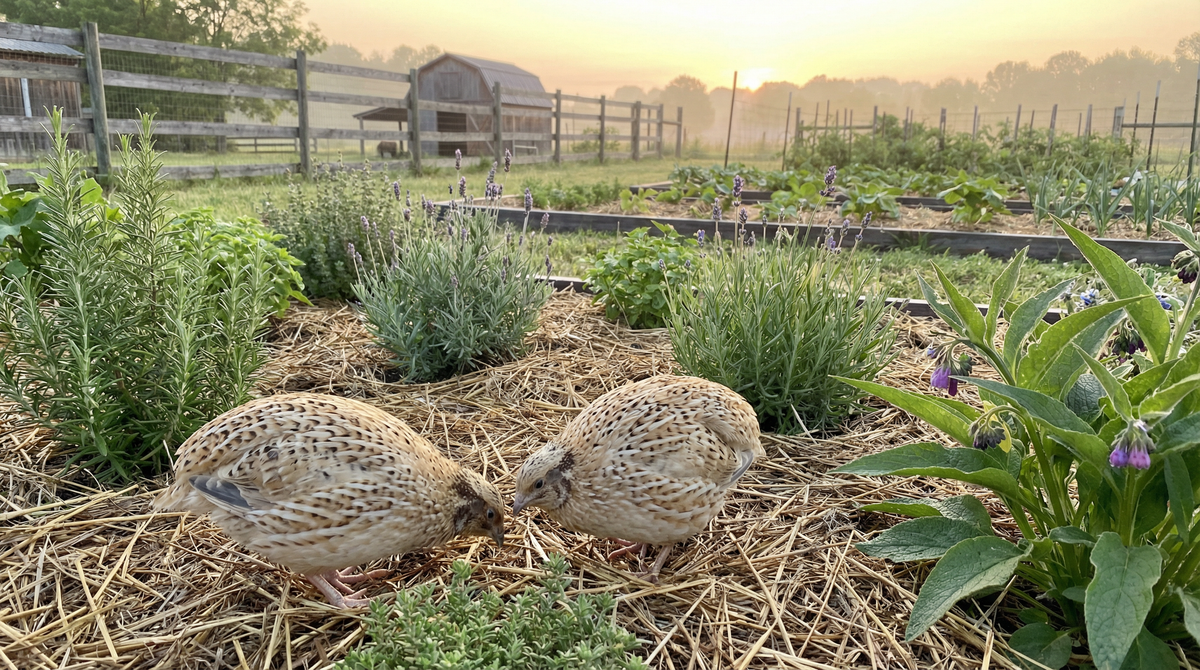
Overview & breed notes
Coturnix quail (Coturnix coturnix, also called Japanese quail) are the small, fast-growing poultry that punch well above their weight on a permaculture site. Domesticated in Japan in the 11th century for song and later for eggs, they are now the most farmed quail species worldwide [1]. Distinct from the native bobwhite (Colinus virginianus) of North America; Coturnix are an introduced species and are kept in cages rather than released.
Key biology:
- Adult weight 4–10 oz (115–285 g) depending on strain.
- Sexual maturity at 6–8 weeks — among the fastest of any commonly kept bird.
- Laying hens produce 250–300 small eggs per year (5–7 quail eggs = 1 chicken egg by volume).
- Meat birds dress out at 8–10 weeks with a 65–70% yield on live weight.
- Productive lifespan only 2–3 years; replace breeding stock annually.
Common strains:
- Pharaoh — wild-type plumage, standard production strain.
- Texas A&M (white) and Jumbo Brown — selected for meat size, 12–14 oz dressed.
- Italian, Tibetan, Tuxedo, English White — ornamental color variations; identical husbandry.
Role in a permaculture system
Coturnix quail occupy a niche no other poultry quite fills: serious protein production from urban-scale space, with no rooster crow to upset neighbors (males make a soft "ka-ka-koh" call, audible only at close range). Functions:
- Eggs in six weeks. A pen of 10 hens started today produces ~7 eggs/day starting mid-summer.
- Meat in eight weeks. 25–40 birds can be processed in one afternoon in a small backyard setup.
- Tight nitrogen cycling. Manure-and-bedding catchpans below cages give clean, weighable nitrogen for the compost system.
- Insect control under high tunnels. A small ground pen with overhead protection inside a hoophouse keeps pest populations down without chemical input.
- Urban legality. Many municipalities that prohibit chickens permit quail; check your code before buying birds.
Zone placement is Mollison Zone 1 to early Zone 2 — quail need daily checks but the footprint is small enough that they belong near the kitchen. Suited to all USDA zones with appropriate weatherproofing; in zones 8+ shade is non-negotiable.
Cage, pen & space requirements
Cages (typical small-scale production)
- Floor space 1 sq ft (0.09 m²) per bird minimum, 1.5–2 sq ft preferred.
- Cage height 9–14 in (23–36 cm) only — quail flush vertically when startled and break their necks on taller ceilings.
- 1/2 in (1.3 cm) hardware-cloth bottom over a manure tray; the small mesh holds standing birds without injury and lets droppings fall through.
- External nipple waterers or trough; food access along one wall.
Ground pens / tractors
Less productive than cages but more behaviorally rich. A 4×8 ft (1.2×2.4 m) tractor with a wire floor or solid floor with deep litter houses 15–20 quail. Provide hide structures (overturned flower pots, evergreen branches) to reduce stress.
Predators
Quail are bite-size to nearly every small predator. Specifications:
- Use 1/2 in hardware cloth on all sides, including the bottom of any ground pen. Standard chicken wire (1 in / 2.5 cm hex) is a snake highway and a raccoon paw guide.
- Latches a raccoon cannot defeat (carabiners on every door).
- In the southeastern U.S., black racer, oak snake, and rat snake will visit any pen they can enter for eggs and chicks; mouse-tight construction matters as much as raccoon-proofing.
Feeding, foraging & integration with plants
Quail need higher protein than chickens: 24–28% for starter and breeder, 18–22% for maintenance. A laying hen eats roughly 0.05–0.07 lb (22–32 g) per day. Game-bird crumbles labeled for "quail" or "turkey/game" are the off-the-shelf base.
On-site supplements
- Black soldier fly larvae — can replace up to 30% of pellet ration; quail love them.
- Mealworms — easy to raise in a small bin, particularly for breeder birds.
- Greens: comfrey wilted overnight, dandelion, plantain, chickweed, clover, alfalfa sprouts.
- Garden surplus chopped fine: squash, cucumber, lettuce, spinach, sweet potato trimmings, mulberry berries.
- Calorie supplements: cracked sunflower seed, sorghum, amaranth; in subtropical zones moringa leaf is exceptional.
- Grit: free-choice fine insoluble grit if greens or whole grains are fed.
- Oyster shell free-choice for laying hens.
Do not feed
Health, climate tolerance & welfare
Coturnix tolerate a wider thermal envelope than most domestic poultry, but they are small and dehydrate quickly. Comfort range is roughly 50–85°F (10–29°C); productivity holds to 95°F (35°C) with shade and unlimited water; mortality risk climbs above 100°F (38°C). Cold tolerance is surprisingly good — adults handle 20°F (−7°C) in dry windless quarters with extra calorie ration.
From the field (Lucas Summer, central Florida, USDA zone 9b): I run a 3-tier cage stack of about 24 hens under shade cloth on the north side of the workshop, where afternoon sun never hits and the prevailing southeast breeze passes through. That setup has held egg numbers at 18–22 per day right through July, with bird losses confined to one or two heat events a year on extreme heat-index days. The trick I wish I had known sooner: feed and water containers in stacked cages benefit enormously from a small ceiling fan running on a thermostat above 85°F — total cost about $35 and the difference in panting behavior is immediate. Snake pressure here is the second design constraint; the cage stack sits on a smooth poured concrete pad with hardware-cloth aprons because oak snakes will absolutely climb a wood-frame stand to reach eggs.
Common health issues
- Ulcerative enteritis (quail disease) caused by Clostridium colinum; manage with sanitation and low stocking density. Acute mortality response requires veterinary input.
- Coccidiosis — medicated game-bird starter prevents most cases in chicks under 6 weeks.
- Vent prolapse in young layers from oversized eggs — reduce light hours and protein for a week.
- Cannibalism on injured birds — remove the wounded immediately, reduce light intensity, increase animal-protein supplementation.
Polyculture & rotational systems
High-tunnel and greenhouse integration
A small pen of 10–15 quail at one end of a high tunnel feeds on aphids, whiteflies, leafhoppers, and stray insects that enter; their CO2 respiration mildly benefits the growing crop. Keep a wire divider so birds cannot reach edible plantings, and avoid spraying anything in the tunnel that is not labeled for use around poultry.
Compost-driven feeding loop
Place the BSF bin and compost system directly beside the quail cages. Larvae are harvested daily into a small dish; aged manure and bedding from the cage tray feed back into the compost. The whole loop fits in a 10×10 ft (3×3 m) corner of a backyard.
Cage stacking under shade
Three-tier 3 ft × 2 ft cage stacks hold 30–40 production hens in a single shaded square meter of floor space. This is the unit economics that lets quail compete with chickens for egg cost per dozen in tight urban or apartment-balcony settings.
What not to do
Do not release coturnix into a wild bobwhite habitat under any circumstance. Coturnix are non-native, do not establish well, and any escapes that do persist confuse population management of the native species. In Florida and most southeastern states, intentional release is prohibited under state wildlife code.
Frequently asked questions
How many quail do I need for my household?
Plan 4–5 hens per person if eggs are your main goal — quail eggs are small, so the per-bird count is roughly double a chicken estimate. A pen of 20 hens produces around 100 dozen eggs in year 1.
Do I need a permit?
State rules vary. In the U.S., coturnix are exempt from federal Migratory Bird Treaty Act protections, but many states (including Florida) require a small game-bird license to keep them and prohibit release. Check your state Wildlife / Fish and Game agency before buying.
Can I keep quail indoors?
Yes, with caveats. Cage stacks in a well-ventilated garage or shed work well; daily manure-tray cleanout is essential to control ammonia. A pen of 12 birds in a 5×5 ft (1.5×1.5 m) shed corner produces enough ammonia to harm bird respiratory health within 48 hours if uncleaned.
What about predators?
Use 1/2 in hardware cloth everywhere, not chicken wire. Snake-proof every joint. Close cages every night even if elevated; raccoons climb. In hawk country, no overhead cover means no flight pen.
Are coturnix legal where chickens are not?
Often yes. Many municipalities define poultry ordinances around "chickens" or "fowl" and exclude small game birds; quail are also quieter, making them more politically acceptable. Always read your local code rather than assume.
References
- Feedipedia. Japanese quail (Coturnix japonica). INRA, CIRAD, AFZ, FAO.
- UF/IFAS Extension. Coturnix Quail Production in Florida.
- Penn State Extension. Quail Production.
- Merck Veterinary Manual. Coturnix Quail.
- Florida Fish and Wildlife Conservation Commission. Captive Wildlife and Game Bird Licensing.
- ASPCA Animal Poison Control Center. Toxic and Non-Toxic Plants.
Field notes by Lucas Summer, central Florida (USDA zone 9b). Cage-stack configuration and snake-prevention details are from on-site practice; egg-production numbers are from one season of records on a 24-hen flock.
Foraging Behavior
Coturnix quail are ground-dwelling birds that forage for insects, seeds, and plant matter on the ground. They will scratch and peck at the soil, which can be beneficial for light tillage and pest control in a garden setting. When kept in a tractor system, they can be moved to different areas to forage and fertilize.
Fencing Requirements
Due to their small size and ability to fly, Coturnix quail require a secure, fully enclosed coop or tractor. Modified rabbit hutches with wire mesh are a popular option for housing. The enclosure should be predator-proof and have a low ceiling to prevent injury, as quail have a tendency to fly straight up when startled.
Shelter Requirements
Quail require a dry, draft-free shelter that protects them from the elements. The shelter should have a low ceiling (under 2 feet) to prevent them from injuring themselves if they fly up suddenly. Bedding such as pine shavings or straw should be provided to keep the shelter clean and dry.
Permaculture Notes
Coturnix quail are a valuable addition to a permaculture system due to their multiple functions and small footprint. They are an excellent source of nutrient-dense eggs and meat, with a much faster maturation rate than chickens. Quail can be integrated into a garden system using a 'quail tractor,' a movable pen that allows them to till the soil, eat weed seeds and pests, and fertilize the ground with their manure. This system helps to build soil fertility and reduce the need for external inputs. Their manure is high in nitrogen and should be composted before being applied directly to most garden plants. A simple composting system can be set up to process the manure and bedding, creating a rich soil amendment. Quail are also very efficient at converting feed into protein, and their diet can be supplemented with garden scraps and foraged greens like comfrey, further closing the loop on the homestead. One of the key advantages of quail in a permaculture design is their suitability for small spaces. They can be raised in a garage, on a balcony, or in a small backyard, making them an ideal choice for urban and suburban homesteaders. Their quiet nature also makes them less likely to disturb neighbors. By carefully observing and interacting with the quail, a permaculturist can find many ways to integrate them into a resilient and productive system.