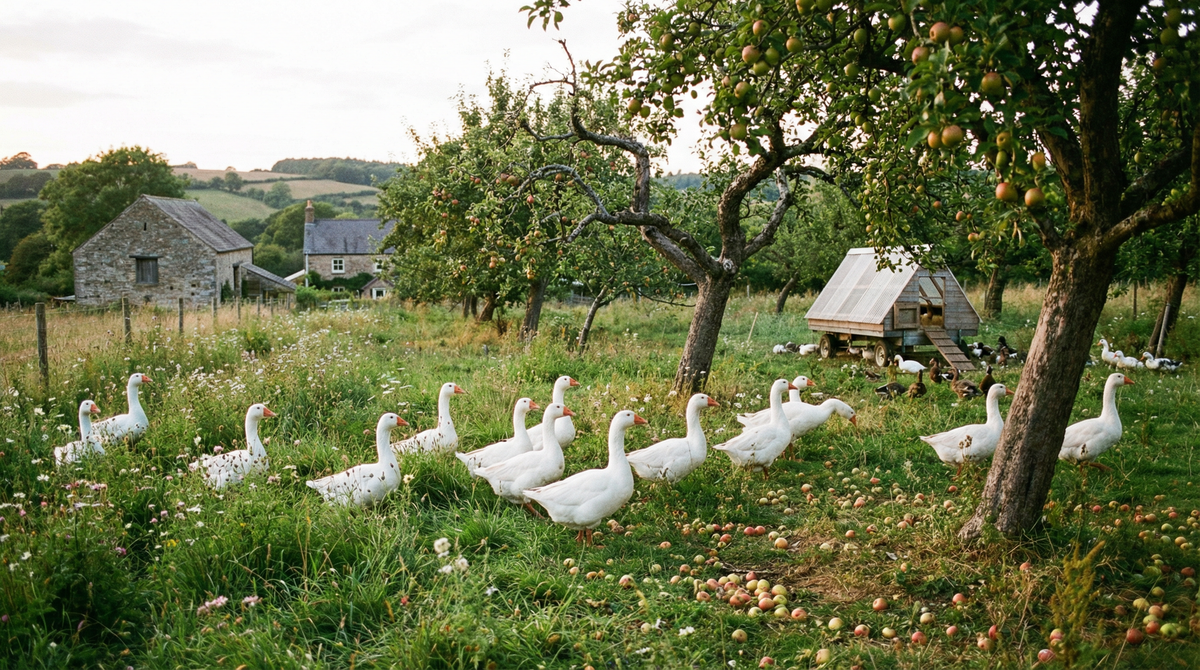
Overview & breed notes
The domestic goose (Anser anser domesticus) descends from the European greylag goose; the related Chinese goose derives from the swan goose (Anser cygnoides). Both have been domesticated for more than 4,000 years for meat, eggs, fat, down, and guard duties [1]. Modern breeds split into three weight classes:
- Light (8–14 lb): Chinese, Roman, Egyptian — agile, vocal, exceptional weeders.
- Medium (14–18 lb): Pilgrim, American Buff, Steinbacher — the working homestead class.
- Heavy (18–26 lb): Toulouse, Embden, African — market meat birds.
Pilgrim and Cotton Patch geese are sex-linked at hatch (gander is white, goose is gray), which is a quiet advantage for any small flock manager. Cotton Patch is a U.S. heritage breed historically used for weeding cotton and corn rows in the South; now critically endangered and worth seeking out from heritage breeders.
Adult geese reach sexual maturity at 9 months to 3 years (later than ducks and chickens). Eggs are seasonal: most breeds lay only in spring, producing 20–50 eggs per year. Meat birds reach market weight at 4–6 months. Working lifespan 8–15 years; geese can live 20+.
Role in a permaculture system
Geese are vegetation managers first, food producers second. Functions:
- Selective weeding. Geese prefer young grass and broadleaf weeds; mature broadleaf crops with tough stems (strawberry, cotton, established blueberry) are largely left alone. This is the basis for "weeder goose" market gardens.
- Orchard floor management. Mature orchards benefit from goose grazing once tree bark is thick enough to resist nibbling.
- Predator alarm. Loud, persistent, and quick to challenge intruders. Effective against foxes, free-roaming dogs, and many raptors; not a substitute for fencing.
- Meat, eggs, down. A spring goose at 16 weeks dresses out at 9–14 lb; down is harvested only from molted feathers, never plucked from live birds.
- Nitrogen distribution. Geese deposit roughly 0.5 lb (230 g) of manure per day at 4–5% N; distribute it across pasture during normal grazing rotation.
Zone placement: Mollison Zone 2 or Zone 3. Geese need water access and pasture, do not belong in the kitchen-garden core. Well suited to USDA zones 3 through 9 with shade and water; zones 10+ stress heavy breeds.
Shelter, water & space requirements
Shelter
Geese tolerate weather better than almost any other domestic bird. A three-sided run-in shed with deep dry bedding suffices in zones 3–9. Allow 6–10 sq ft (0.6–0.9 m²) per bird. Ventilation matters more than insulation; geese are surprisingly heat-sensitive due to body mass and feather density.
Water
Geese need water deep enough to immerse the head and neck for normal preening and bill cleaning. A 100–300 gal (380–1,140 L) pond or stock tank is ideal for a small flock; minimum is a 15–30 gal (60–115 L) tub refreshed daily. Unlike ducks, geese do not require constant swimming water, but they cannot thrive without periodic bathing access.
Pasture and space
Stocking rate: 6–10 adult geese per acre on improved pasture, less on rough or dry land. For weeding service in an orchard or vineyard, 2–4 birds per acre is the typical working ratio. A grazing flock will self-supply 60–90% of summer calories from forage; supplemental grain becomes important in late summer and winter.
Predators and fencing
Adults are large enough to deter most small predators on their own, but goslings under 8 weeks are vulnerable to everything from hawks to snapping turtles. Confine goslings until they reach 5 lb (2.3 kg) and have fully feathered wings. Coyote, bobcat, and free-roaming dogs can take adult geese; perimeter fencing is appropriate where these are present.
Feeding, foraging & integration with plants
Geese are the most grass-adapted of all domestic poultry, with a digestive tract better at processing fibrous forage than any chicken or duck. On good pasture, adult feed costs can run 70–90% lower than for chickens of similar weight.
Forage base
- Cool-season grasses (rye, fescue, brome) and short legumes (clover, alfalfa) make up the diet base where they grow.
- Warm-season grasses (bermuda grass, bahiagrass) work in subtropical zones but support lower goose stocking rates due to lower digestibility.
- Forbs and "weeds" geese readily eat: dandelion, plantain, chickweed, young pigweed, lambsquarters.
Calorie supplements
- Whole or cracked grain (corn, oats, wheat, sorghum, pearl millet, triticale) free-choice in the evening during heavy laying and pre-winter conditioning.
- Garden surplus: squash, sweet potato trimmings, sunflower heads, fallen mulberry in subtropical zones.
- Free-choice oyster shell for laying females; grit for any bird without consistent soil access.
Do not allow or feed
- Highly toxic ornamentals to avoid in goose pasture: rhododendron, yew, wisteria, honeysuckle berries, nightshade.
- Toxic kitchen items: avocado, rhubarb leaves, green/sprouting potato, raw dry beans, moldy bread, chocolate.
- Avoid raw onion and garlic (taint flavor and irritate the GI).
Health, climate tolerance & welfare
Cold tolerance is exceptional — healthy adults handle −30°F (−34°C) with windbreak and unfrozen water. Heat tolerance is the operational ceiling: heavy breeds (Toulouse, Embden, African) stress badly above 90°F (32°C); Chinese and Roman breeds remain functional to 95°F (35°C) with shade and bathing water.
From the field (Lucas Summer, central Florida, USDA zone 9b): The breed I keep coming back to for the Gulf South is the Chinese (or its smaller cousin, the African is too heavy). They handle our summers without supplemental cooling beyond shade and a 50-gallon stock tank, they will weed a strawberry patch or a young blueberry block without damaging the crop once the goslings learn the boundaries, and they alert hard at coyote and free-roaming-dog activity in a way my Muscovies do not. The single biggest health risk on this site is Clostridium botulinum — warm shallow water with rotting vegetation in late summer produces botulism toxin that kills waterfowl quickly. I drain and dry the goose tank weekly through July and August, and I do not let standing water sit in low spots after thunderstorm flooding. Two geese lost early on taught that lesson.
Common health issues
- Botulism (limberneck) — flaccid paralysis from C. botulinum toxin; prevent by keeping standing water clean and avoiding swampy rot zones.
- Bumblefoot — heavy breeds on hard ground; provide soft yielding pasture.
- Niacin deficiency in goslings on chicken starter; use waterfowl starter or supplement.
- Highly pathogenic avian influenza — reportable to USDA APHIS; biosecurity matters increasingly [2].
- Egg binding in first-year layers; ensure calcium and gentle warmth during onset.
Polyculture & rotational systems
Weeder geese in row crops and perennials
The historical and current production niche. Geese will weed grass and broadleaf seedlings out of:
- Strawberry beds — once plants are established and bearing.
- Cotton rows — the namesake of the Cotton Patch goose.
- Blueberry blocks once bushes are 3+ years old with hardened bark at the base.
- Established orchards, vineyards, and Christmas-tree plantations.
Stocking: 2–4 birds per acre during the growing season; supervise the first day to confirm the geese leave the crop alone. Move or rest them when forage is depleted (look for soil showing through the sward).
Silvopasture and rotational grazing
Run geese behind cattle or sheep on cool-season pasture; they pick up regrowth and seedling weeds the larger animals leave. They do not significantly compete with cattle for forage at typical stocking ratios.
Guard duty
A pair of geese loose with a chicken flock will challenge raccoons and small dogs and broadcast every intrusion at high volume. They are not predator-proof on their own; treat them as an alarm system, not a security system.
What not to do
Do not put geese in a young orchard (under year 3): they will girdle small trees by stripping bark and snap leaders by climbing on low branches. Do not run goslings with adult chickens; chickens will pick at them, often to the point of injury.
Frequently asked questions
Are geese noisy?
Yes. Domestic geese vocalize loudly when surprised, threatened, or excited — that is the feature, not a bug, for predator deterrence. Suburban or close-neighbor situations can be a problem; check noise ordinances before stocking.
Will geese attack my children or visitors?
Ganders defending a nest can and do bite and slap with the wings. Bite force is unpleasant but rarely injurious to adults; small children should not be unsupervised around a breeding flock in spring. Handle birds calmly and consistently from a young age to reduce general aggression.
How many eggs do geese lay?
Most breeds 20–50 per year, all in a single spring laying season. Chinese geese are the exception, producing 40–60 over a longer season. Geese are not a serious egg-production animal compared with chickens or ducks; the meat, weeding, and guard functions justify the flock.
Can I keep just one goose?
Strongly discouraged. Geese pair-bond and a solo goose will fixate on humans or another animal and exhibit stress behaviors. Keep at least two, ideally three to five for a working flock.
What's the best breed for the Deep South?
Chinese for active weeding and heat tolerance. Pilgrim if sex-linkage at hatch is useful. Cotton Patch if heritage conservation is part of your goal. Avoid the heaviest breeds (Embden, Toulouse) below zone 8a unless you can provide deep shade and active cooling.
References
- FAO. Small-scale poultry production — ducks and geese. Food and Agriculture Organization of the United Nations.
- USDA APHIS. Avian Influenza — biosecurity and reporting.
- Penn State Extension. Ducks and Geese.
- University of Georgia Extension. Geese for Weed Control in Crops.
- The Livestock Conservancy. Heritage Goose Breed Profiles (incl. Cotton Patch).
- Merck Veterinary Manual. Geese.
Field notes by Lucas Summer, central Florida (USDA zone 9b). Breed recommendation and botulism prevention practice are from on-site experience; the loss-by-botulism observation is from the second season on this site and informs the current water-management protocol.
Foraging Behavior
Geese are avid and selective foragers with a strong preference for grass. They will graze on grasses, broadleaf weeds, and clean up fallen fruit in orchards. Their long necks allow them to reach weeds in difficult-to-access areas.
Fencing Requirements
A lightweight, temporary fence is often sufficient to contain geese and rotate them through different pasture areas. The fencing should be secure enough to prevent them from accessing garden areas with vulnerable crops.
Shelter Requirements
Geese require a simple, secure shelter that protects them from the elements and predators, especially at night. The shelter should provide a dry space for sleeping and nesting.
Permaculture Notes
Domestic geese are a valuable addition to permaculture systems, offering a multitude of benefits with minimal inputs. Their primary role is as natural weeders and lawnmowers. Geese have a voracious appetite for grasses and many broadleaf weeds, making them ideal for managing vegetation in orchards, vineyards, and pastures. By employing geese for weed control, farmers can reduce or eliminate the need for herbicides and mechanical mowing, saving time, labor, and fuel. In addition to their weeding services, geese contribute to soil fertility through their nitrogen-rich manure. As they graze, they distribute their droppings across the pasture, providing a natural source of fertilizer. Their bedding, rich in manure, can also be composted and used to enrich garden soils. This closed-loop system of nutrient cycling is a core principle of permaculture, and geese are excellent partners in achieving it. Geese are also known for their protective nature, acting as a natural alarm system against predators. Their loud calls can deter smaller predators and alert farmers to potential threats. This makes them a valuable asset for protecting other poultry and livestock. Furthermore, geese are a source of nutritious eggs and meat, as well as down and feathers for insulation and crafts. Their long lifespan and self-sufficiency make them a cost-effective and sustainable choice for the small farm or homestead.