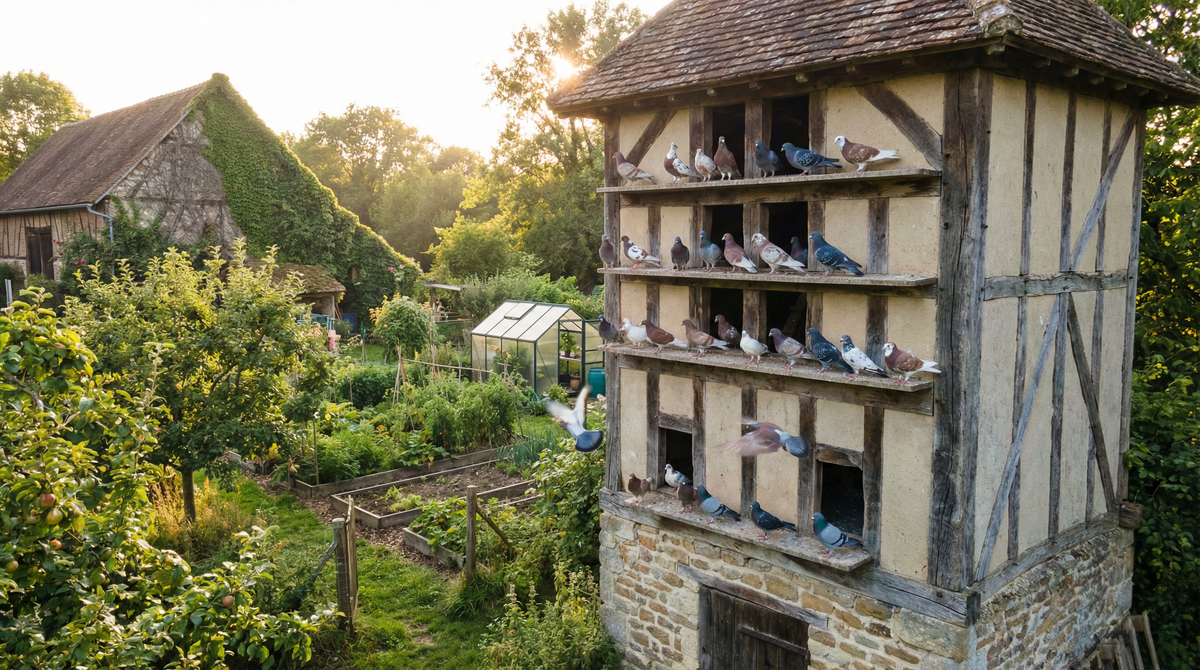
Overview & breed notes
The domestic pigeon (Columba livia domestica) is the same species as the wild rock dove, domesticated more than 5,000 years ago in Mesopotamia and Egypt and now found in feral populations on every continent except Antarctica [1]. The modern breed inventory exceeds 300, sorted historically into utility, fancy, and flying types.
Permaculture-relevant categories:
- Utility (squab meat) breeds: King, Carneau, Mondain, Texan Pioneer — bred for fast-growing chicks that reach 14–18 oz (400–510 g) at 28–30 days when they leave the nest as “squab.”
- Homing/racing breeds: Belgian Homer, Birmingham Roller — fly out, forage, and return to a fixed loft; the basis of the “import fertility” permaculture model.
- Heritage and ornamental: Fantail, Pouter, Modena — conservation-only; not productive for food or work.
Adults weigh 9–30 oz (250–850 g) depending on breed. A breeding pair raises 8–12 squab per year, with both parents producing crop milk for the first week. Working lifespan is 6–10 years; some birds productive for 15+.
Role in a permaculture system
Pigeons fill a niche the other domestic poultry cannot: they will fly out from a fixed loft, forage across a wide radius, and return home daily, importing nutrients and protein into the system from surrounding land. Functions:
- Squab meat. 28–30 day-old squab is a premium protein product; a 20-pair loft produces 160–240 squab per year.
- Concentrated high-P manure. Pigeon guano is roughly 4% N, 2–3% P, 1–2% K — one of the most phosphorus-dense organic fertilizers available, historically prized for vineyards and orchards [2].
- Imported fertility. Free-flying flocks gather grain and seed at distance and return it to the loft as droppings; this is the “dovecote effect” on a permaculture site.
- Pest control (minor). Pigeons opportunistically eat insects and small grubs while ground-foraging; the effect is marginal compared to chickens or ducks.
- Urban legality. Many cities that prohibit chickens permit hobby pigeons under hobbyist or "pet" classifications; verify before stocking.
Zone placement is Mollison Zone 0 or Zone 1: the loft typically sits on the house, garage, or barn roof. Suited to all USDA zones with adequate roof ventilation.
Loft & space requirements
Loft design
- Allow 1.5–3 sq ft (0.14–0.28 m²) per breeding pair, more for squab-production breeds.
- Nest boxes 12×12×12 in (30 cm cube) with a 5 in (13 cm) front sill; pairs hold their box for life.
- Two nest bowls per pair; the hen will lay the next clutch while she still feeds the first squab.
- Perches at multiple heights; pigeons strongly prefer high roosts.
Ventilation
Pigeon respiratory health depends on air movement. Lofts should have screened openings totaling at least 25% of floor area, with cross-ventilation through opposing walls. In hot climates, ridge vents plus low intake openings prevent the loft from cooking under a metal roof.
Trap doors and flight
A one-way trap (or bobwire) at the loft entry lets birds return after foraging but prevents re-exit, useful for predator and weather management. For homing pigeons, a small landing board angled 15–20 degrees outside the trap helps tired birds.
Predators
The honest list: Cooper's hawk, sharp-shinned hawk, red-shouldered hawk, peregrine falcon, owl (at night), house cat, raccoon (in unsecured lofts), rat (eggs and squab). Cooper's hawks are the single most consequential threat for free-flying flocks; expect 5–15% annual loss in regions with established Cooper's populations. Provide a secure return loft, a safe landing approach, and never let birds out within 30 minutes of dusk or dawn when raptor activity peaks.
Feeding, foraging & integration with plants
Adult pigeons eat 1.0–1.5 oz (28–43 g) of grain daily; a breeding pair feeding two squab consumes roughly 5 oz (140 g) per day at peak. Commercial pigeon feed mixes are blends of small grains, designed to be picked from a feeder rather than scratched.
Feed base
- Corn (cracked), wheat, milo (sorghum), peanut chips, safflower (safflower), small sunflower, pearl millet, buckwheat, barley.
- Pulses for protein: cowpea, lentil, vetch, small soybean or roasted peanut in breeder mixes.
- Cool-season cover seed they will glean if free-flown: rye, triticale, clover, alfalfa.
Free-choice supplements
- Grit (insoluble) and pigeon mineral mix in separate dishes.
- Crushed oyster shell or limestone for laying females.
- Clean water deep enough for the bird to immerse the head; pigeons drink by suction.
- Annual probiotic / vitamin pack at breeding-season onset; many keepers add apple cider vinegar (1 Tbsp/gal) one day per week as a mild gut-health practice (evidence is anecdotal, not clinical).
Do not feed
- Raw kidney beans (phytohaemagglutinin), avocado, chocolate, caffeine, salty foods, moldy grain (Aspergillus).
- Lawn-treated forage (herbicide, neonicotinoid coatings on seed treatments).
Health, climate tolerance & welfare
Pigeons handle a wide thermal envelope. Adults are comfortable from 20°F (−7°C) in a dry windless loft up to 100°F (38°C) with shade and water; humidity tolerance is excellent. The two operational risks are respiratory disease in poorly ventilated lofts and protozoan parasites contracted by wild-flock contact.
From the field (Lucas Summer, central Florida, USDA zone 9b): The pigeon loft on this site is a 6×8 ft (1.8×2.4 m) garden-shed conversion with the entire south wall replaced by 1/4 in hardware cloth and a tin roof shaded by live oak. Four breeding pairs of Texan Pioneers produced 36 squab the first year with zero feed cost beyond the 50-lb (23 kg) bag of pigeon mix per quarter; the birds free-fly an hour each morning and gather corn and millet from a neighbor's spilled deer feed within a mile. The losses I have taken are entirely to Cooper's hawks, which work this neighborhood persistently; I now release birds only between 9 AM and 4 PM and trap them in by sundown without exception. Trichomoniasis (canker) from contact with wild urban pigeons appeared in year two and required a 5-day metronidazole course under vet direction; I now keep new birds quarantined 30 days and never share feeders with wild flocks.
Common health issues
- Trichomoniasis (canker) — cheesy yellow lesions in the throat; treat under vet direction; quarantine new birds.
- Paramyxovirus (PMV-1, "pigeon paramyxo") — reportable in some jurisdictions; vaccinate where endemic.
- Coccidiosis — sanitation; rotate or scrape loft floor weekly.
- Worms (Capillaria, Ascaridia) — annual fecal screen.
- Highly pathogenic avian influenza — reportable to USDA APHIS.
Polyculture & rotational systems
Loft over the compost bay
The classic Mediterranean and Persian design positions the loft above the compost pile or vegetable beds, so droppings fall through a slatted floor onto bedding that becomes part of the compost system. Allow 6–12 in (15–30 cm) of clearance between the floor and the catchment to avoid moisture/ammonia accumulation in the loft.
Free-fly fertility import
For permaculture sites with 1+ acres of adjacent crop or pasture land, a small homing flock acts as a slow nutrient pump. Each free-flying bird returns roughly 0.25–0.5 oz (7–14 g) of guano per day, gathered as grain at distance. A 10-bird flock contributes 2–5 lb (1–2 kg) of high-P fertilizer per month to the loft for collection.
Squab production for direct market
Squab is a premium protein with consistent restaurant and ethnic-market demand at $5–$12 per dressed bird in most U.S. urban markets. A 20-pair loft producing 200 squab/year yields a real but modest income stream that complements other small-farm products.
What not to do
Do not free-fly in areas with hunting hawk populations during peak migration (March–April, September–October in the Eastern U.S.). Do not stock breeding pigeons within 30 days of arrival without a quarantine and fecal screen; canker and PMV move through introduced birds easily.
Frequently asked questions
Are pigeons legal in my city?
Often yes, especially under hobbyist or "pet" classifications, while chickens may be restricted. Check municipal code for "fowl," "pigeon," and "dovecote" before stocking. HOAs and historic districts add a separate layer.
Do free-flying pigeons come back?
Yes, when properly trained. Start squab in the loft until they are 4–6 weeks old and reliably eating; release in small groups at first, never on stormy days, never near sunset. Most loss is to hawks, not to disorientation.
How is squab different from chicken?
Squab is dark, rich, ducklike meat. It is harvested before fledging at 28–30 days while the breast muscle is still tender and unused, giving the characteristic texture and flavor. Commercial squab is a premium product, not a commodity protein.
Is pigeon guano safe to use in the garden?
Yes, but compost it for 60–120 days before contact with edible roots due to high concentration and pathogen risk. Hot composting (above 130°F / 55°C for 3+ days) substantially reduces pathogen load.
What's the best breed for a small homestead?
For meat production: King, Carneau, or Texan Pioneer — large squab, calm temperament. For free-fly fertility import: a small flock of Belgian Homers or rollers, started young in the loft.
References
- FAO. Small-scale poultry production — pigeons. Food and Agriculture Organization of the United Nations.
- Penn State Extension. Manure as a Source of Crop Nutrients and Soil Amendment.
- Merck Veterinary Manual. Pigeons and Doves.
- USDA APHIS. Avian Influenza — biosecurity and reporting.
- The Livestock Conservancy. Heritage Pigeon Breed Profiles.
- National Pigeon Association. Breed standards and husbandry.
Field notes by Lucas Summer, central Florida (USDA zone 9b). The Cooper's hawk and trichomoniasis observations are from years 1–2 on the current loft; release-window protocol and quarantine practice were adopted in response.
Foraging Behavior
Domestic pigeons are natural foragers, seeking out seeds, grains, and insects in the surrounding landscape. They will travel to gather resources and then return to their home loft. This behavior makes them unique in their ability to import nutrients into a permaculture system from the outside.
Fencing Requirements
Pigeons are typically housed in a loft or dovecote rather than being contained by traditional fencing. The structure must be predator-proof, with secure latches and openings no larger than half an inch to exclude rodents and snakes. A dedicated aviary can be attached to the loft to allow for safe, enclosed outdoor access.
Shelter Requirements
A well-ventilated, dry, and predator-proof loft or dovecote is essential for housing pigeons. The shelter should provide nesting boxes for each breeding pair and perches for roosting. The size of the loft should allow for adequate space for the flock to move around comfortably.
Permaculture Notes
Pigeons offer a unique advantage in permaculture systems due to their foraging habits. By building a dovecote or pigeon loft, a permaculturist can create a home base for a flock that will fly out to forage for food and bring back valuable nutrients in the form of manure. This high-nitrogen fertilizer can be collected from the loft and used to enrich compost piles or create liquid fertilizers, effectively importing fertility into the system from the surrounding area. Their diet of seeds and grains can also help with weed control by consuming spilled seeds. In a food forest or silvopasture system, pigeons can be integrated to forage for fallen seeds and insects, helping to control pests and clean up the understory. The squabs (young pigeons) can be harvested for meat, providing a sustainable and low-maintenance source of protein. The primary challenge with raising free-flying pigeons is predation from hawks and other raptors. Therefore, the design of the loft and the timing of letting the birds out to forage are important considerations. Providing a secure loft and a protected water source is essential for their well-being. For urban permaculture systems, pigeons can be a viable livestock option, as they require relatively little space and can be housed on rooftops or in small backyard lofts. Their ability to forage in the urban landscape can supplement their diet, reducing the need for purchased feed. However, it is important to be mindful of local regulations regarding the keeping of pigeons. Overall, the domestic pigeon is a versatile and productive animal that can be a valuable addition to a variety of permaculture designs.