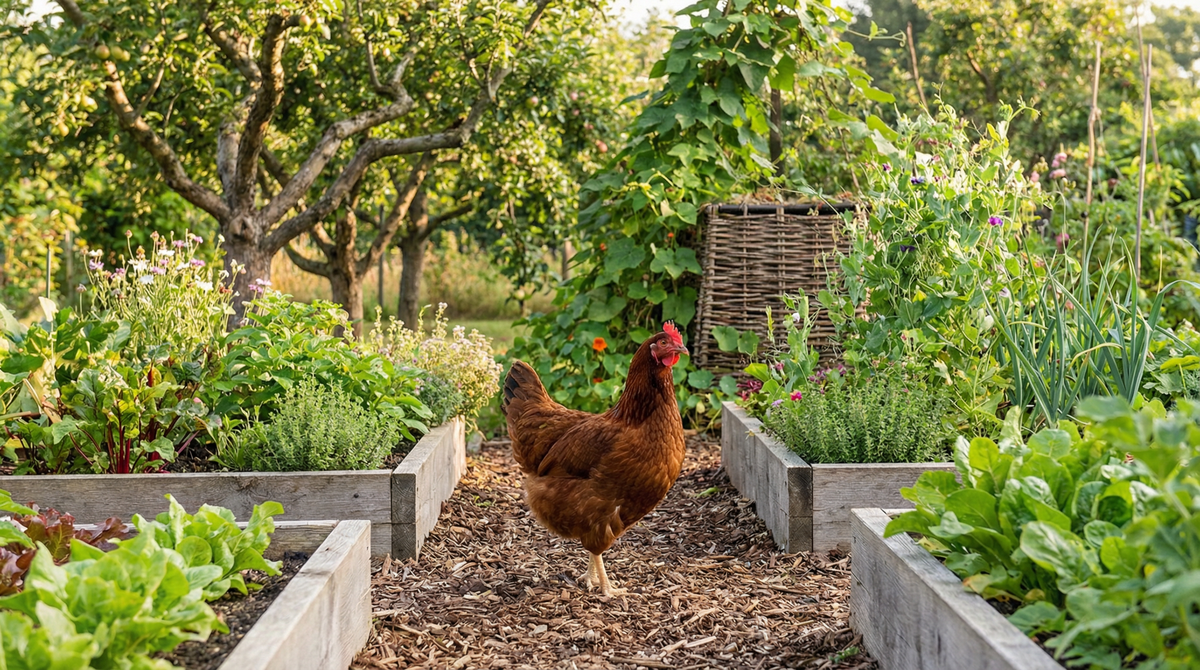
Overview & breed notes
The chicken (Gallus gallus domesticus) is a domesticated subspecies of the Southeast Asian red junglefowl, and by population the most numerous bird on the planet. They were domesticated at least 3,500 years ago and possibly far earlier; current consensus places initial domestication in northern Thailand or southern China for ritual and cockfighting, with food use following [1].
Adult standard hens weigh 4–8 lb (1.8–3.6 kg) depending on breed; bantams 1–2 lb (0.5–1 kg). Hens begin laying at 18–24 weeks, peak production years 1–3, and continue at declining rates to age 6–8; lifespan with care is 8–12 years. Annual egg yield ranges from 150 (heritage dual-purpose) to 320+ (production Leghorns) per hen.
Breeds worth knowing for permaculture, grouped by climate fit:
- Cool-temperate dual-purpose: Buff Orpington, Australorp, Plymouth Rock, Wyandotte. Heavy, calm, forage well.
- Cold-hardy: Chantecler, Brahma, Cochin. Small combs, feathered legs, tolerate −20°F with dry quarters.
- Warm/humid-adapted: Leghorn, Andalusian, Minorca, Penedesenca (Mediterranean breeds with large combs that radiate heat); Naked Neck Turken (no neck feathers, dramatic heat tolerance); Easter Egger and Sex-Links (production hybrids that handle Gulf-coast summers).
- Forage-aggressive: Welsummer, Cubalaya, Old English Game; less suited to confinement but exceptional in food-forest understory.
Role in a permaculture system
No other small animal stacks as many permaculture functions as the chicken. The standard list:
- Eggs and meat — the headline yields.
- Pest control — ticks, slugs, grasshoppers, squash bug nymphs, fire-ant brood, larval flies in cow pats.
- Tillage — a flock of 6 hens can clear and turn a 4×8 ft (1.2×2.4 m) bed in 5–7 days, leaving it loose and fertilized.
- Compost acceleration — chickens turn and inoculate a hot pile while harvesting protein from larvae.
- Manure — nitrogen-rich (3–5% N fresh), must be composted 60–120 days before contact with edible roots [2].
- Orchard sanitation — following fruit drop they break the codling moth and apple maggot life cycle by eating infested fallen fruit.
- Weed seed reduction — intensive scratching in beds before planting can drop the next-flush weed pressure substantially.
Zone placement is Mollison Zone 1 to Zone 3 depending on intensity. A small layer flock for the household sits in Zone 1; mobile broiler tractors and pasture flocks belong in Zone 2 or 3. They are well suited to all USDA zones with breed selection and appropriate housing.
Coop, run & space requirements
Coop
- Floor space: 3–4 sq ft (0.28–0.37 m²) per standard hen, 2 sq ft (0.19 m²) per bantam.
- Roost: 8–10 in (20–25 cm) of perch per hen, 2–4 ft (0.6–1.2 m) off the floor, with a 2×4 oriented flat-side-up so birds cover their toes in winter.
- Nest boxes: 1 box per 4 hens, 12×12×12 in (30 cm cube), darkened.
- Ventilation: more than you think. In warm climates, screened openings should equal at least 20% of the wall area on opposite walls for cross-flow. Insulation is unnecessary south of zone 6; ventilation is everything.
Run
If birds will spend time inside an enclosed run, plan 10 sq ft (0.93 m²) per standard hen at minimum, 25–50 sq ft (2.3–4.6 m²) ideally. Mobile chicken tractors house 4–10 birds on 32 sq ft (3 m²) with daily moves.
Predators and exclusion
The honest list in most North American climates: hawk, owl, raccoon, opossum, fox, coyote, free-roaming dog, weasel, mink, snake (for eggs and chicks), and in the Southeast bobcat. Specifications:
- Hardware cloth (1/2 in / 1.3 cm), not chicken wire, on all run walls, the bottom 18 in (46 cm) buried or apron-skirted outward.
- Overhead netting or wire over runs in any landscape with hawk pressure.
- Latches that a raccoon cannot defeat (carabiners, not slide bolts).
Feeding, foraging & integration with plants
An adult standard hen eats roughly 0.25–0.33 lb (115–150 g) of dry feed per day. On good pasture and forage, that can drop 25–40% but rarely to zero; a complete laying ration in the coop closes the gap.
The feed base
- 16–18% protein layer ration for hens in production; 20–24% starter for chicks 0–8 weeks.
- Calcium: free-choice crushed oyster shell in a separate dish; do not mix into the feed.
- Grit: free-choice insoluble granite if birds don’t have soil access.
- Water: 0.5–1 quart (0.5–1 L) per hen per day; double in heat.
On-site supplements
- Black soldier fly larvae — 40–44% protein, 30–35% fat; replace up to 30% of pellet ration.
- Vermicompost worms, garden surplus (squash, cucumber, sweet potato trimmings), comfrey leaves wilted overnight.
- Forage greens: dandelion, plantain, chickweed, clover, alfalfa.
- Calorie crops grown for the flock: amaranth, sorghum, sunflower heads, corn, pearl millet; in subtropical zones add cassava (cooked, never raw), moringa leaf, and mulberry drop.
Do not feed
Health, climate tolerance & welfare
Thermal tolerance is breed-dependent. Heavy cold-hardy breeds suffer above 85°F (29°C); Mediterranean and tropical breeds remain productive to 95°F (35°C) with shade, water, and ventilation. Heat-stress thresholds [3]:
- Panting begins about 85°F (29°C).
- Egg production drops sharply above 90°F (32°C) with humidity > 60%.
- Mortality risk rises rapidly above 100°F (38°C) without intervention.
From the field (Lucas Summer, central Florida, USDA zone 9b): I started with Buff Orpingtons because every backyard-chicken book says they’re the friendliest. They are; they also stand in a panting pile under the coop from June to September and drop laying to roughly two eggs per hen per week. Replacing them with a mix of Easter Eggers, Black Sex-Links, and one Naked Neck rooster cut summer feed bills (more foraging, less standing) and held egg numbers above 4 per hen per week through August. The other change that mattered more than breed: the coop and main run sit under three live oaks, which drop ambient temperature about 8–10°F versus the open yard and shut down hawk attacks I was losing 1–2 birds per month to before the canopy filled in. In zone 9 and warmer, find your live oaks first and put the coop there.
Health protocol
- Marek’s disease vaccination at hatch is standard for any flock acquired as chicks. Most hatcheries offer this for under $1/bird.
- Coccidiosis prevention via medicated starter (amprolium) for the first 8 weeks, or unmedicated with a careful litter program in pasture-raised systems.
- External parasite checks every 2–3 weeks: vent inspection, leg-scale check, dust bath maintenance.
- Bumblefoot (Staphylococcus aureus) inspection on heavy birds; lower roosts and provide soft litter.
- Mortality reporting for unusual losses; in the U.S., highly pathogenic avian influenza is a reportable disease to USDA APHIS.
Polyculture & rotational systems
Chicken tractor
A bottomless mobile coop 4×8 to 10×12 ft (1.2×2.4 to 3×3.6 m) moved daily across pasture or garden beds. Stocking density 1–2 sq ft per bird depending on residence time. Joel Salatin’s broiler model uses 75–90 birds in a 10×12 ft tractor moved every 24 hours for 8 weeks.
Pasture rotation behind cattle
Move egg-mobiles (housing 100–500 hens) into a paddock 3–5 days after cattle. The hens scratch through dried cow pats, eat fly larvae, and break parasite cycles while spreading manure.
Food-forest integration
Chickens belong in the established food forest, not the young one. Once trees are 4+ years old and bark has hardened, a small flock keeps the understory in check, eats fallen fruit, and limits pest reservoirs. In subtropical food forests, mulberry, moringa, and chinaberry are productive overstory species that chickens benefit from; in temperate food forests, oak mast and elderberry drop.
Garden bed prep
Use a small portable run to confine 4–6 hens on a finished bed for 5–10 days; they will scratch out old roots, eat slugs and grasshopper eggs, and lay down a complete fertilizer pass. Move them off, cover the bed for 2–3 weeks for manure to mellow, then plant.
Frequently asked questions
How many hens do I need for my household?
Plan 2 hens per person for adequate fresh eggs through peak laying (years 1–3), or 3 per person to cover the natural drop in years 4–6. A flock of 6 hens produces 24–30 dozen eggs in year 1 from quality production breeds.
Do I need a rooster?
Not for eggs — hens lay unfertilized eggs daily without one. You only need a rooster for fertile eggs (chick production) or for some flock cohesion benefits in larger pastured groups. Check your municipal code first; many cities prohibit roosters but allow hens.
What’s the best heat-tolerant breed?
For sustained productivity in zones 9–10: Mediterranean breeds (Leghorn, Andalusian, Penedesenca), Naked Neck Turken, and Easter Egger / Black Sex-Link hybrids. Avoid Buff Orpington, Brahma, Cochin, and Wyandotte as your primary layer in those zones — they’re wonderful birds in the wrong climate.
How do I keep predators out?
Hardware cloth, never chicken wire. Bury or apron-skirt the bottom 18 in. Cover runs with netting in hawk country. Latches a raccoon can’t open. Close the coop every night; most predator losses happen at dusk to dawn.
Do I need a heat lamp in winter?
Almost never. Healthy adult chickens of cold-hardy breeds handle −20°F with a dry, well-ventilated coop and a roost. Heat lamps cause coop fires every winter; if you genuinely need supplemental heat, use a flat panel radiant heater rated for poultry.
References
- Larson, G. & Fuller, D.Q. (2014). The evolution of animal domestication. PNAS / Annual Review of Ecology, Evolution, and Systematics.
- Penn State Extension. Poultry Manure Management.
- Poultry Extension. Heat Stress in Poultry.
- Merck Veterinary Manual. Poultry.
- USDA APHIS. Avian Influenza — reporting and biosecurity.
- The Livestock Conservancy. Heritage Chicken Breed Profiles.
- ASPCA Animal Poison Control Center. Toxic and Non-Toxic Plants.
Field notes by Lucas Summer, central Florida (USDA zone 9b). Breed-comparison numbers (Buff Orpington vs Easter Egger / Sex-Link / Naked Neck summer laying) are from on-site observation across two flocks; hawk-loss numbers from pre- and post-canopy years on the same site.
Foraging Behavior
Chickens are avid foragers that scratch and dig at the soil to unearth insects, seeds, and worms. They readily consume weeds and green vegetation, and will enthusiastically break down and sanitize manure piles while searching for insect larvae.
Fencing Requirements
Fencing is essential to protect chickens from predators and to manage their access to garden areas. Electric netting is effective for rotational grazing, while chicken tunnels (chunnels) can provide controlled access to garden beds for weeding and pest control.
Shelter Requirements
A secure, predator-proof coop is necessary to provide shelter from the elements and a safe place to roost at night. The coop should be well-ventilated to prevent respiratory issues and include nesting boxes for egg-laying. A general guideline is to provide at least 4 square feet of coop space per chicken.
Permaculture Notes
Chickens are a cornerstone species in many permaculture designs due to their versatility and numerous benefits. They are exceptional at pest control, consuming slugs, grasshoppers, and other insects that can damage crops. Their constant scratching and digging aerates the soil, acting as a natural form of tillage that prepares garden beds for planting. Chicken manure is a highly effective, nitrogen-rich fertilizer that can be composted to enrich the soil and boost plant growth. In a permaculture system, chickens can be integrated in various ways. A 'chicken tractor,' a mobile coop without a floor, allows for targeted tillage and fertilization of specific areas. In orchards and food forests, chickens can be used to sanitize the ground by eating fallen fruit and controlling pest populations. They can also be rotated through pastures after larger livestock to break up manure, control parasites, and further fertilize the land. One of the key principles of permaculture is to turn problems into solutions, and chickens excel at this. They can be used to turn a compost pile, accelerating the decomposition process while also finding food for themselves. Weeds and garden pests, which are typically seen as problems, become a valuable food source for chickens. By carefully planning their integration, chickens can significantly reduce the need for external inputs like pesticides and fertilizers, while simultaneously providing valuable products like eggs and meat, thus closing the loop on a more sustainable and resilient system.