
The most productive gardens are not the ones with the most work poured into them, but the ones that were planned with a little thought before a single seed went in. Learning how to plan a vegetable garden layout is the quiet secret behind a season of abundant harvests, less wasted effort, and far fewer of the common mistakes that trip up new growers. An hour spent sketching your garden on paper over winter, with a cup of tea and a stack of seed catalogs, pays you back many times over in summer. A good plan means you grow the right crops in the right amount, fit far more into your space, keep the harvest coming for months rather than in one glut, and set your soil up for years of health. This guide walks through the whole process, from reading your site to sketching the beds, spacing the crops, and planning for a continuous harvest.
Why Plan Your Garden?
It is tempting to simply buy some plants and put them in the ground, but a little planning transforms the results. Planning lets you match what you grow to what your family actually eats, and in sensible quantities, so you are not drowning in one crop while short of another. It lets you use every inch of space efficiently, fitting in far more food through good spacing and clever timing. It helps you avoid the classic errors of shading small plants with tall ones, running out of room, or harvesting everything in a single overwhelming week. And it lets you build in the crop rotation and soil care that keep a garden healthy year after year. Best of all, planning is a pleasure: the off-season, seed catalog in hand, is the perfect time to dream and design next year's garden. This planning step naturally follows on from the groundwork in my guide to starting a vegetable garden.
Start with Sun and Site
Every good garden plan begins not on paper but with your patch of ground, because the layout has to fit the site rather than the other way around. Spend some time observing where the sun falls, since most vegetables need at least six to eight hours of direct sun a day, and note which areas are shadier, as those are where you will put the few crops that tolerate less light, like leafy greens. Consider access to water and how close the garden is to the house, because the beds you walk past daily are the ones you will actually tend. Note the slope, the wettest and driest spots, and any frost pockets, and get to know your soil with a simple soil test. Only once you understand the site can you plan a layout that works with it.
Decide What, and How Much, to Grow
The heart of a good plan is a realistic list of what to grow, and the golden rule is to grow what you love to eat. Beyond that, think hard about quantity, which is where most beginners go wrong in both directions. A single tomato plant or two and one or two zucchini will bury a family in fruit, while you might want a long row or several successions of quick crops like lettuce, radishes, and carrots to keep a steady supply. Factor in how much space each crop needs and how long it occupies the ground, since a fast spinach clears in weeks while a tomato holds its spot all season. I wildly overplanted my first garden, sowing six zucchini and a whole packet of lettuce all at once, and spent August giving away marrows while my glut of lettuce bolted uneaten; planning realistic quantities the next year gave me far more of what I actually wanted to eat.
Choose Your Beds and Paths
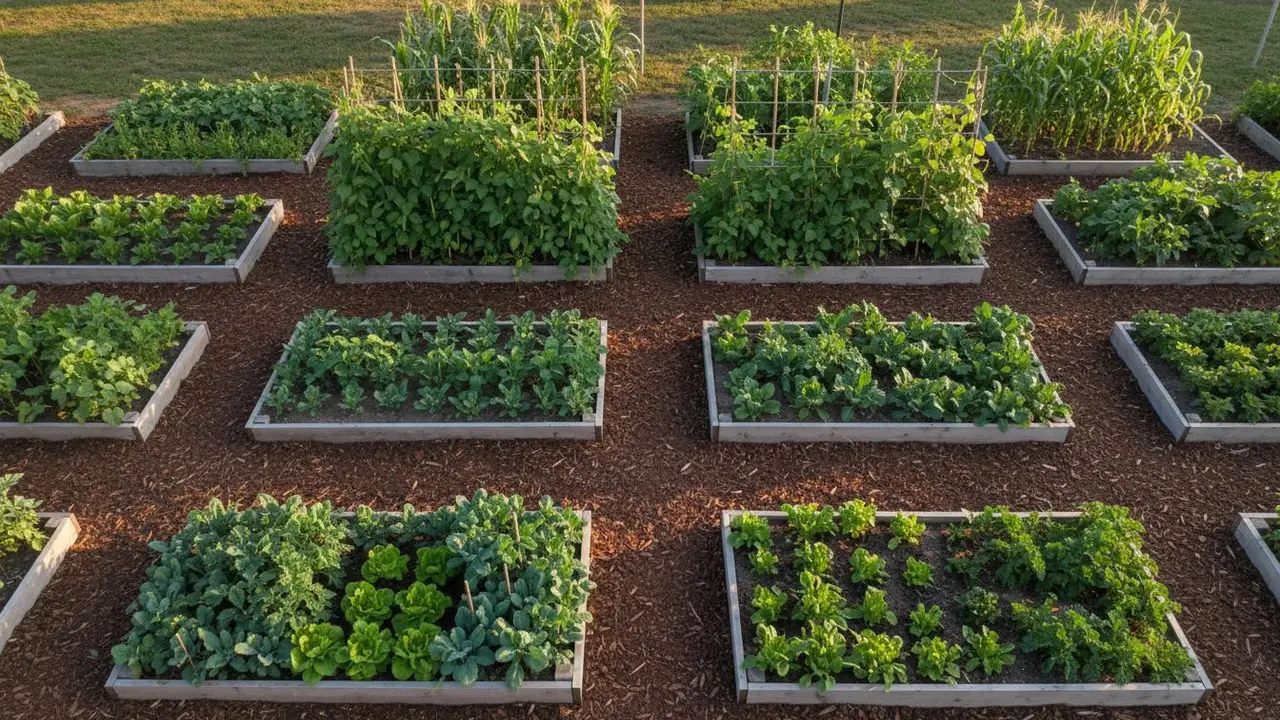
With your crop list in hand, decide on the structure of the garden. The most important principle is to grow in defined beds you never walk on, so the soil stays loose and uncompacted, with paths in between for access. Keep beds narrow enough to reach the middle from either side without stepping in, which usually means around three to four feet wide, and as long as suits your space. You might use raised beds, simple no-dig beds at ground level, or, where space is tight, a cluster of containers. Leave paths wide enough to kneel and to get a wheelbarrow through, roughly a foot or two, and mulch them to keep them clean. This bed-and-path framework is the skeleton your whole plan hangs on.
Sketch the Layout: Spacing and Positioning
Now comes the satisfying part: drawing your garden to scale on paper or graph paper, marking the beds and slotting in the crops. Two principles guide where each crop goes.
First, space plants properly, neither too close, which invites disease and stunts growth, nor too far, which wastes ground. Rather than sowing in widely spaced traditional rows, many gardeners now space plants equidistantly across the whole bed so that mature leaves just touch, which fits in far more, shades out weeds, and makes better use of a small space. The seed packet tells you the spacing each crop needs.
Second, and often overlooked, position crops by height so the tall ones do not shade the short. Place your tallest crops, corn, trellised tomatoes, and climbing beans, on the north side of the garden (or the south side in the southern hemisphere), with medium crops in the middle and low ones like carrots and lettuce to the sunny front, so every plant gets its share of light. Group crops with similar needs together, give sprawling plants like squash room to roam, and keep the fast, small crops where you can easily reach them for frequent picking. Seeing it all laid out on paper before you plant is what catches the clashes while they are still easy to fix. The first year I drew my garden to scale before planting, I caught that my sweet corn would have thrown the whole bed into shade, and simply moved it to the back; that one sketch saved my whole crop of peppers and lettuce.
Plan for Crop Rotation
A garden plan should look beyond a single season, because moving your crops around from year to year is one of the best ways to keep soil healthy and pests and diseases at bay. As you plan, group your crops by family, the cabbage family, the tomato and potato family, the onions, the legumes, the roots, and plan to move each group to a different bed next year, so no family returns to the same ground for several seasons. Sketching this year's plan with next year already in mind makes the rotation effortless, and it is far easier to work out on paper than to remember in the ground. My full guide to crop rotation lays out the groupings and the sequence in detail.
Plan for a Continuous Harvest
One of the greatest benefits of planning is a garden that feeds you steadily for months rather than in a few overwhelming weeks. The key tool is succession planting: rather than sowing all your lettuce or beans at once, plan to sow short batches every couple of weeks, so a fresh supply matures in turn. Build into your plan a sense of which crops are quick and which are slow, so you can follow an early crop with a later one in the same bed, and slip fast growers like radishes into the gaps between slow ones, harvesting them before the mains need the room. Planning the timing this way, anchored to your frost dates, turns a garden from a summer glut into a larder that produces from spring through fall. The first year I planned succession sowings into my layout instead of one big spring planting, I was still cutting fresh salad in October, long after my old single-sowing gardens would have been bare.
Weave In Companions and Vertical Space
A thoughtful plan also makes the most of two more tricks. Consider companion planting as you place your crops, grouping plants that help one another, such as basil among the tomatoes or flowers to draw in pollinators and confuse pests, and keeping apart those that clash. And do not forget to grow upward as well as outward: planning in trellises, arches, and supports for climbing beans, cucumbers, and squash, as covered in my guide to vertical gardening, multiplies the harvest you can fit into a small footprint and keeps sprawling crops off your beds. A garden planned in three dimensions grows far more than a flat one.
Keep a Garden Journal
The final piece of planning is the one that makes every future plan better: keep a simple garden journal or map. Each year, record what you planted and where, the varieties you chose, the dates you sowed and harvested, what thrived and what failed, and how much each crop yielded. This record turns memory, which is unreliable, into hard-won knowledge, showing you at a glance next winter what to grow more of, what to drop, where each family was so you can rotate it, and when to time your sowings. I kept no notes in my early years and made the same timing mistakes again and again; the season I finally started jotting down sowing and harvest dates in a notebook, my plans grew sharper every year, and the journal became the single most valuable tool in my garden.
Putting Your Plan Together
Pulling it all together, a simple plan might look like this. You settle on four beds. In the sunniest, on the north side, go the tall tomatoes and a trellis of climbing beans, underplanted with quick lettuce. The next bed holds the roots, carrots, beets, and radishes, sown in succession. A third bed carries the cabbage family under cover, and the fourth the onions and a block of bush beans. You note which family sits in each bed so you can rotate them next year, mark where you will slip in fast catch crops, sketch in a few flowers for the pollinators, and pencil your sowing dates down the margin. It need not be elaborate; even a rough sketch on the back of an envelope, thought through in advance, will grow you a better garden than the finest plot planted at random.
Plan Well, Harvest Well
A vegetable garden planned with care is a garden that gives back generously for the effort, feeding you longer, wasting less, and asking less of you than one thrown together on planting day. The essentials are simple: read your site and its sun, choose what and how much to grow, lay out beds you never tread on, position crops by height and space them well, and build in rotation, succession, and good companions, all captured in a sketch and refined each year in a journal. Do that and your garden will all but run itself. My honest advice is to spend a quiet evening this off-season with graph paper and a seed catalog, and sketch out next year's garden bed by bed before the busy season arrives. That single hour of planning will reward you right through the growing year. For more on growing your own food, our gardening library and gardening basics have a guide for every step, from a first vegetable garden to a whole patch of berries.
Sources
- Clemson Cooperative Extension — Planning a Garden
- University of Minnesota Extension — Planting the vegetable garden
- Utah State University Extension — Vegetable Garden Planning
- Michigan State University Extension — Planning your vegetable garden
- University of Illinois Extension — Planning a Vegetable Garden
About the Author
Lucas is a writer and researcher focused on sustainable agriculture and permaculture practices.